Tag Archives: Federal Goverment

Donald and the “Maestro”

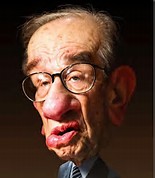
trump-ii            greenspan-ii

Former Federal Reserve Chairman Alan Greenspan, who was once laudably referred to as “Maestro” for his supposed astute stewardship of U.S. monetary policy, commented last week on the nation’s current political and economic climate:

We’re not in a stable equilibrium.  I hope

we can all find a way out because this too

great a country to be undermined, by how should

I say it, crazies.*

Well, if there is anyone who knows how to “undermine” an economy, it is the Maestro, since it was his “crazed” policies that brought about the 2008 financial crisis which ushered in the Great Recession that continues to this very day.

In a demonstration of how truly clueless Greenspan is about economic conditions, he cautioned that the U.S. is “headed toward stagflation – a combination of weak demand and elevated inflation.” Memo to the Maestro: stagflation is already here and has been for quite a while, especially when real economic gauges are used instead of the phony baloney numbers routinely lied about by the BLS and other corrupt state agencies.

The “crazies” that Greenspan refers to are, of course, the “deplorable” Trump supporters and The Donald himself, who the Maestro contends is responsible for “the worst economic and political environment that I’ve ever been remotely related to.” Oh, poor Alan has to suffer through an election where one of the candidates has not been approved by the ruling class.  Too bad.

Instead of carping about the current state of political affairs which, at least financially, he and his successor, Helicopter Ben Bernanke, largely contributed to, Greenspan should be grateful that he has had no reprisals for the financial crimes, chaos, and misery that he has afflicted upon the world.  Instead of significant jail time or worse, Greenspan is free to pontificate on current events, receiving hefty financial remuneration, and just as important for top members of the governing elite, ego-enhancing hosannas!

While Ben Bernanke has been a lifelong committed Keynesian and inflationist, Alan Greenspan, at least in his younger days as a member of Ayn Rand’s circle, was a free marketer who spoke positively about the efficacy and moral soundness of a gold standard.  That he abandoned these beliefs to go over to the Dark Side is further cause for retributive justice.

Greenspan’s betrayal was similar to those economists of the 1930s (Lionel Robbins most notable) who were followers of the teachings of Mises and Hayek, yet were swept away by the fanciful Keynesian deluge of the day and abandoned their economic senses and conscious for similar allurements which seduced the Maestro.  Had these economists as well as Greenspan stuck to their original principles, the world may not be in its current financial mess.

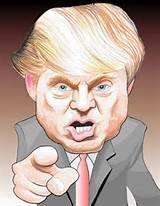
While Greenspan was lamenting the state of political affairs, the head “crazy,” Donald Trump, commented on the Maestro’s former place of employment.  Unlike the Maestro, the financial media, and just about every other politician, Trump had some perceptive things to say about the nation’s central bank, showing again that the billionaire businessman’s political acumen is quite good:

The Fed is being totally controlled politically because

Obama wants to go out with no stock market disruptions.**

The Republican Presidential hopeful could have easily added that the Fed’s policy is being deliberately carried out to ensure his Democratic opponent’s victory this fall.  A booming stock market is perceived by most as an indication of a vibrant economy.

Trump does not buy the supposed “independence” of the Fed from political influence and the conduct of monetary policy solely for the well being of the economy:

If it was a choice between the right decision and a political

decision… The Fed would choose the political decision.

Throughout the campaign, Trump’s instincts on political and economic matters have been quite good and hopefully if he does become chief executive those instincts will translate into positive change.

A Clinton Presidency would assuredly mean a continuation of the ruinous policies of Greenspan and his successors.  The election of Donald Trump could not only mean a new direction in monetary policy, but the public demotion of the likes of Alan Greenspan who will hopefully fade into the sunset never to be heard or seen from again.

*Rich Miller, “Greenspan Worries That ‘Crazies’ Will Undermine the U.S. System.”  Bloomberg.  14 September 2016.  http://www.bloomberg.com/news/articles/2016-09-14/greenspan-worries-that-crazies-will-undermine-the-u-s-system

**Tyler Durden, “Trump Slams ‘Totally Politically Controlled’ Fed, Sees No Rate Hike Until Obama Has Left.”  Zero Hedge. 15 September 2016.  http://www.zerohedge.com/news/2016-09-15/trumps-slams-totally-politically-controlled-fed-sees-no-rate-hike-until-obama-has-le

Antonius Aquinas@AntoniusAquinas
https://antoniusaquinas.com/


The Donald Versus Killary: War or Peace?

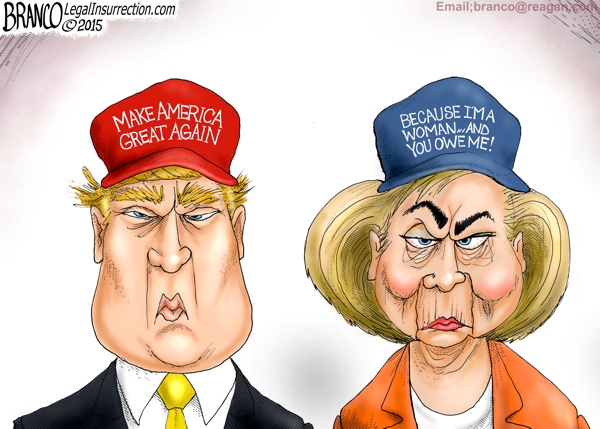
trump-vs-clinton

Although history does not exactly repeat itself, it does provide parallels and sometimes quite ominous ones.  Such is the case with the current U.S. Presidential election and the one which occurred one hundred years earlier.

The dominating question which hung over the 1916 campaign was whether the country would remain neutral in regard to the horrific slaughter which was taking place on the European battlefields in probably the greatest act of mass insanity ever recorded, World War I.

President Wilson had maintained that the U.S. would continue a policy of strict neutrality.  By all indications, the nation wanted no part of the war, with the President’s own party at his nomination delivering an emphatic “No” to any foreign intervention.

Although Wilson maintained a neutral policy through the election and briefly afterwards, his advisors and Cabinet had been lobbying for war and continued to do so even more vehemently after the President’s re-election was secured.  Nearly all of them, including Wilson himself, had deep financial, family, and political ties to J.P. Morgan.  Wilson received considerable Morgan financial backing for his two presidential runs.

The Morgan operatives within the Administration were pushing for war because the House of Morgan had “invested” heavily in the “Allied” cause and a defeat or a negotiated settlement with any favorable concessions to Germany would be a catastrophe for Morgan financial interests.

Germany understood the cozy Morgan relationship with the Wilson Administration and the Allied powers as Morgan representatives, especially the sinister Colonel House, had repeatedly rebuffed peace proposals from the Central Powers.  The Allies and their opponents understood that Wilson’s re-election would mean U.S. entry into the conflict.

Tragically, for the U.S. and for the course of war-ridden 20th century history, Wilson capitulated and brought the U.S. into the battle despite the campaign promise of neutrality and no real German threat.  The House of Morgan’s financial bacon was saved at the cost of a devastated Western world.

One hundred years later, the U.S. and the world stand at another critical juncture and face a similar choice: the election of a known war criminal who has not only shown no remorse for her murderous policies, but promises, if elected, to continue them; or the election of a candidate who has spoken of negotiating with America’s supposed principle enemy, a possible pull back in the nation’s unsustainable global empire, and the enactment of a legitimate use of federal authority – protection of the country’s borders.

It is difficult to believe that Donald Trump is not sincere in seeking accommodation and friendly relations with Russia.  It would be far easier for the billionaire businessman and would most likely secure his election if he followed the bellicose policy of the Democrat and Republican Presidents of the recent past who have continued to antagonize and threaten Russia.  The most hopeful sign for peace coming from the U.S. in quite a while has been Trump’s talk of de-escalation of tensions and a pledge to place American interests first in foreign policy, instead of mouthing the global domination designs of the crazed neocons.

Some of the things he has said about Vladimir Putin and Russia have been, to say the least, quite encouraging:

I think I would get along with Vladimir Putin.

I just think so.*

It is always a great honor to be so nicely

complimented by a man [Putin] so highly respected

within his own country and beyond.**

I have always felt that Russia and the United States

should be able to work well with each other towards

defeating terrorism and restoring world peace, not

to mention trade and all of the other benefits derived from

mutual respect.***

Although not a non-interventionist, a President Trump is unlikely to provoke Russia or China into a civilization-ending conflagration and has displayed the instincts of a true peace maker.

There is, however, little hope for a reduction of global tensions if his sociopathic opponent becomes Commander-in-Chief.  Killary has repeatedly demonstrated that she is a willing tool of the neocons and the global financial forces that will profit mightily from continued U.S.- instigated conflicts.  If she makes it past the finish line, either legitimately or more likely through fraud, she will surely do their bidding.

For once, politicians and pundits who routinely call every election “the most crucial of a generation” are right.  This year’s Presidential election is the most significant one since at least the fall of the Soviet Union and Eastern Bloc.  If the U.S. electorate wants to avoid the disaster not only to its own land and the world that followed in the wake of the 1916 election, there can be only one choice in November of 2016.

* , “Trump Says he Would ‘Get Along Very Well’ With Putin.”  NBCNews.com 30 July 2015.

**Maxwell Tani, “Vladimir Putin’s Praise is ‘A Great Honor.'”  Business Insider.  17 December 2015.

***Ibid.

Antonius Aquinas@AntoniusAquinas

https://antoniusaquinas.com/


John Maynard Keynes’ “General Theory” Eighty Years Later

Keynes Gen Theory

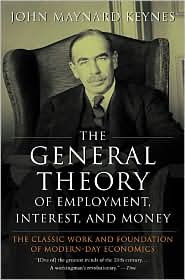
To the economic and political detriment of the Western world and those economies beyond which have adopted its precepts, 2016 marks the eightieth anniversary of the publication of one of, if not, the most influential economics books ever penned, John Maynard Keynes’ The General Theory of Employment, Interest and Money.  Sadly, even to this day, despite its thorough refutation by lights such as Henry Hazlitt and other eminent scholars, The General Theory, which spawned “Keynesianism” and its later variants, remains supreme in academics, financial markets, and public policy.

Despite its outlandish theoretical flaws and nonsensical economic jargon and the catastrophic empirical evidence of its failure to prevent financial downturns or “stimulate” sustainable growth, Keynesianism remains the ruling paradigm of economic thought.

Why?

A number of trenchant reasons have been given for the General Theory’s continued dominance, however, one stands above all else: Keynesian economics provides the intellectual justification for economists, statisticians, technocrats, bureaucrats, and policy wonks in their exalted positions as “fine tuners” of economies the world over.  Since markets are to Keynes and his disciples inherently unstable from erratic investment spending and aggregate demand, it is up to these theoreticians steeped in the knowledge of their master’s teachings to ameliorate any economic fluctuations.

The General Theory came on the scene at a propitious time during the height (or more accurately the depth) of  the Great Depression, which in 1936, despite Roosevelt’s New Deal and other Western nation states’ initiatives, had not improved conditions.  Keynesianism was actually a “middle way” between all out Soviet-style central planning and that of laissez-faire capitalism.  Primarily through fiscal policy, the economy would be kept on an even keel under the astute management of Keynesian-trained economists.  Naturally, this appealed to academics and intellectuals the world over who correctly envisioned positions of power and influence in expanded state apparatuses.

As history has shown, Keynesianism was to become more than a remedy for the Depression, but would be applicable after the crisis dissipated.  The General Theory was based, in part, on the (false) notion that the capitalist system is inherently unstable and is, therefore, in need of state intervention.  Keynes  deliberately ignored the scholarship at the time, which demonstrated that the instability was not a “market failure,” but a monetary disorder caused by artificial credit expansion generated by the central banks, especially the Federal Reserve.

The enthusiasm for The General Theory came at first from younger economists while it was (rightly) dismissed by many of their elders as incomprehensible.  Yet, its lack of clarity was appealing to the novices, since they would become the Creed’s interpreters.

Not all, however, were entirely overwhelmed by their mentor’s magnum opus as Paul Samuelson candidly admitted:

[The General Theory] is a badly written book:

poorly organized. . . . It abounds in mares’ nests

of confusions. . . .  I think I am giving away no

secrets when I solemnly aver – upon the basis of

vivid personal recollection – that no one else in

Cambridge, Massachusetts, really knew what it

was all about for some twelve to eighteen months

after publication.*

Despite such an assessment, Keynesianism was never seriously challenged by its adherents, it opened too many lucrative policy making doors to be refuted.

That Keynesianism continues to reign supreme, despite its theoretical and empirical bankruptcy, speaks volumes of the state of Western intellectual and academic life.  Instead of the pursuit of truth and the refutation of error, Western intelligentsia is primarily concerned with securing privilege and power for itself.  At one time such status was gained by honest inquiry into social questions and issues, now it is obtained in the justification of the expansion of state power.  Very few turn down such enticements!

Societies are the product of ideas.  Since the release of The General Theory, the Western world has been under the destructive sway of Keynesianism, which has resulted in stagnation, financial turmoil, and eventual collapse.  Until Keynes and his nutty theories have been refuted, the economic malaise will continue.

Quoted in Murray N. Rothbard, “Keynes, the Man.” In Mark Skousen, ed., Dissent on Keynes: A Critical Appraisal of Keynesian Economics.  New York: Praeger Publishers, 1992, p.184

Antonius Aquinas@AntoniusAquinas

https://antoniusaquinas.com/

“A Date Which Will Live in Infamy:” President Nixon’s Decision to Abandon the Gold Standard

Nixon-Gold

Franklin Delano Roosevelt called the Japanese “surprise” attack on the U.S. occupied territory of Hawaii and its naval base Pearl Harbor, “A Date Which Will Live in Infamy.”  Similar words should be used for President Nixon’s draconian decision 45 years ago this month that removed America from the last vestiges of the gold standard.

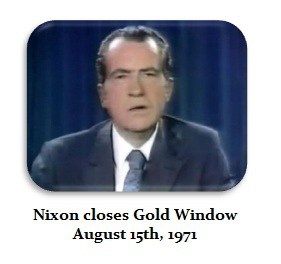
On August 15, 1971 in a televised address to the nation outlining a new economic policy entitled, “The Challenge of Peace,” Nixon instructed the Treasury Department “to take the action necessary to defend the dollar against the speculators.”*

Nixon continued:

I have directed Secretary Connally to suspend temporarily the convertibility of the dollar into gold or other reserve assets, except in amounts and conditions determined to be in the interests of monetary stability and in the best interests of the United States.**

Of course, any objective student of history knows that this was a lie and that it was not “speculators” which were causing monetary instability, but the U.S.’s own crazed inflationary policy which attempted to fund its imperialistic endeavor in Vietnam while expanding the welfare state at home.  This resulted in the Treasury losing an alarmingly amount of gold reserves to other central banks who rightly sought real value in exchange for depreciated American greenbacks.

In essence, Nixon’s decision ended gold redemption and placed the U.S. and the rest of the world on a purely fiat paper standard for the first time in recorded time.  By doing so, the U.S., in effect, became a deadbeat nation which no longer honored its obligations and was set on the road to its current banana republic status.

Instead of impeachment proceedings and his ultimate resignation for the juvenile break in at the headquarters of the nation’s other ruling crime syndicate, Nixon should have been imprisoned for this deliberate and destructive act which has led, in large measure, to the nation’s crushing and insurmountable debt burden, reoccurring booms and busts, and now economic stagnation.

Nixon’s disastrous decision had precedent.  FDR had his own day of monetary infamy in 1933 when, by Executive Order 6102, he outlawed the private ownership of the precious metal while eliminating  gold redemption by banks for dollars.  Ostensibly, the order was instituted as an emergency measure to combat the Depression, but in reality, it was done to allow the Federal Reserve greater “flexibility” in inflating the money supply.

While Roosevelt and Nixon’s decisions would backfire economically, their actions highlighted the totalitarian direction that the federal government and its executive branch were heading throughout the 20th century.  Moreover, the lack of opposition or protest to blatant executive dictatorial decrees by either the legislative or judicial wings of the federal government demonstrates again the flawed and frankly naive argument put forth by Constitutionalists of every ideological persuasion on how the celebrated “separation of powers” theory checks tyranny.

Nixon’s final abandonment of the gold standard had far greater ramifications than simply bad economics.  Without the discipline of hard money, central banks could, and did, create massive quantities of paper money and credit, which enriched the politically connected financial elites and the governments which they were aligned.  Such power was used, in time, to control, spy on, and regulate the subject populations to a degree never seen before.  The power of the state has swelled mostly through bank credit expansion without worry of gold redemption.

Despite what is taught in social science courses, a true gold standard is a greater protector of individuals’ economic well being and, ultimately, their political liberty than any legislation or “rights” document ever penned.  Hard money limits state power!

While it is painful to quote from an ardent opponent of sound money, the international bankster Baron Rothschild said it best when he described the relationship of money and power: “Permit me to issue and control the money of a nation, and I care not who makes its laws.”

Richard Nixon’s elimination of the last remnant of the gold standard over four decades ago combined with FDR’s earlier decree has fulfilled to the detriment of the American and world economies Baron Rothschild’s adage to a tee.  The return of prosperity and individual liberty will only come about when these two heinous acts are eradicated.

*Richard M. Nixon.  “Address to the Nation Outlining a New Economic Policy: ‘The Challenge of Peace.’”  The American Presidency Project.  15 August 1971. http://www.presidency.ucsb.edu/ws/?pid=3115

**Ibid.

Antonius Aquinas@AntoniusAquinas

https://antoniusaquinas.com/


Don’t Expect a Return to a Gold Standard Any Time Soon

goldstandard

Despite trillions of paper currency units poured into the world economies since the start of the financial crisis, there has been no recovery, in fact, all legitimate indicators have shown worsening conditions except, of course, for the pocketbooks of the politically -connected financial elites.  Yet, despite the utter failure of the current money and banking paradigm to resolve the situation, the chance of a return to a commodity based monetary order is highly unlikely especially when one looks at the anti-gold bias found in typical college economics textbooks.

Macroeconomics: Principles, Problems and Policies by McConnell, Brue and Flynn is a leading introductory level college text which has been through, to date, some 20 editions.  Until the financial crisis of 2008, the subject of a commodity- backed money was not discussed, however, after the crisis and the popularity of gold standard enthusiasts like former Congressman and Presidential candidate Ron Paul, the authors of Macroeconomics obviously felt the need to address the resurgence in the interest of metallic money.

McConnell and company’s critique of the gold standard is full of fallacious reasoning that monetary cranks have employed for generations, all of which have been easily refuted by eminent economists.  Yet, the lies and distortions about commodity money continues in academia.

The authors admit that:

To many people, the fact that the government does

not back the currency with anything tangible seems

implausible and insecure.

This logical sentiment and realization of the fraudulent nature of unbacked currency by those outside the economics profession is brushed aside by the esteemed trio:

But the decision not to back the currency with anything tangible was made for a very good reason.

Yes, and we know what that reason was: so that the state and central banksters could have a ready and unlimited access to the creation of money to solidify and expand their power.  The gold standard was always an impediment to this cherished dream of the political elites – the establishment of an irredeemable, paper monetary order.

The authors, not surprisingly, see things differently:

If the government backed the currency with something

tangible like gold, then the supply of money would

vary with how much gold was available.  By not backing

the currency, the government avoids this constraint and

indeed receives a key freedom – the ability to provide

as much or as little money as needed to maintain the

value of money and to best suit the economic needs of

the country.

By all means, the state and central banksters should be given as much “freedom” as possible for we all know that governments would never abuse such license and would always act in the best interests of their citizens.  Certainly, the authors are not aware of any cases in history where such “freedom” was ever abused.

    Nearly all today’s economists agree that managing the

money supply is more sensible than linking it to gold or

to some other commodity whose supply might change

arbitrary and capriciously. . . .  if we used gold to back the

money supply so that gold was redeemable for money . . .

then a large increase in the nation’s gold stock as the

result of a new gold discovery might increase the money

supply too rapidly and thereby trigger rapid inflation.  Or

a long-lasting decline in gold production might reduce the

money supply to the point where recession and

unemployment resulted.

Volumes have been written debunking such stupidity.  The point, however, is that millions of minds have been exposed to such thinking and while most will not become economists (thank goodness!), what is taught in college and university classrooms about the gold standard is negative, to say the least.  Moreover, those who continue in a career in finance or economics will unlikely ever be presented with an accurate assessment of the gold standard.

A return to a sound and just monetary order will only take place after the ideological groundwork has been first laid, just as fiat money and central banking came about after years of proselytizing by inflationists.  It is also not enough to show the economic efficacy and moral soundness of commodity money, the ideas of crackpots like McConnell, Brue and Flynn need to be exposed for what they are.

Under the current academic environment, as generations have been misinformed, deceived, and lied to, it is unlikely that a return to a gold standard will take place.  Until the intellectual battle is won, paper money and the central banksters that manage it will continue their reign of financial terror.

Antonius Aquinas@AntoniusAquinas

https://antoniusaquinas.com/


The Gold Standard: Friend of the Middle Class

In-Gold-We-Trust

It has been theoretically demonstrated and seen in general practice that a monetary system of 100% metallic money devoid of central banking checks monetary inflation, prevents a general rise in the price level, and eliminates the dreaded business cycle while making all sorts of monetary mischief nearly impossible.  A gold standard is not only economically superior to any paper money scheme, but is morally just, which is why it is hated by the politically well-connected, academics, politicians, and the rest of the Establishment.

Often not discussed, however, even by its proponents is the beneficial effect that “hard money” has for the middle class.

It is not a coincidence that since the U.S. left the last vestiges of the gold standard in 1971with President Nixon’s nefarious decision to no longer redeem international central bank payments in gold, real wages for Americans have stagnated.  Nixon’s decision to put the nation on an irredeemable paper money standard set it on a course of economic ruination, which is why he should have been hounded from office not for his role in the bungled, petty cover up at the Watergate.

Stagnating wage rates have been confirmed by a number of studies, take, for instance one from the Pew Research Center which states that “today’s average hourly wage has just about the same purchasing power as it did in 1979. . . . [I]n real terms the average wage peaked more than 40 years ago: The $4.03-an-hour rate recorded in January 1973 has the same purchasing power as $22.41 would today.”*

While the absence of the gold standard has impoverished laborers, it has benefitted (not surprisingly) the very wealthy – hence, the reason why it was abandoned, as the Pew Study reports: “What gains have been made, have gone to the upper income brackets.  Since 2000, usual weekly wages have fallen 3.7% (in real terms) among workers in the lowest tenth of the earnings distribution, and 3% among the lowest quarter.  But among people near the top of the distribution, real wages have risen 9.7%.”**

Of course, this was part of Nixon’s plan: redistribution of wealth from the middle class and low income groups via money printing to the political class.  Such a scheme, however, could have only happened if the gold standard was eliminated.

Since the start of the abominable Obama Administration in 2009, the adjusted monetary base of the U.S. rose from $1.772 trillion to $3.966 trillion as of March 16, 2016.***  Of course, even these unfathomable figures as well as all other information supplied by the dominant media and government cannot be trusted.  It, therefore, can be safely assumed that the real money supply is more than officially reported.

Money, like every other good, is subjected to the immutable law of supply and demand.  Every increase in the money supply reduces the purchasing power of the monetary units which are already in circulation.  Naturally, since wages are paid in dollars, increases in the supply of them will decrease their purchasing power.  Thus, while nominal wages have gone up as the Pew Study shows, real wages (what wages can purchase) have stagnated.

The decline in real wages over the decades from profligate money printing has resulted in lower standard of living for wage earners and those living on fixed incomes. The rise in two income families is, in part, a consequence of a paper money economy and the fact that the financial survival of families now requires two incomes.  Two-income families have also profound cultural implications which are now manifesting themselves.

There has been much talk throughout the current presidential campaign about the financial decline of the middle class.  Candidates on the Left naturally talk of subsidies and more redistribution of wealth while those on the Right have called for tax cuts. While tax reduction of any kind is always welcomed and leads to economic growth, a sound monetary policy is just as important for a revitalization of the middle class.  Moreover, a return to honest money does not require any expansion of government spending or debt.

If policy makers truly want to improve the condition of the middle class, which consists primarily of wage earners, a return to a monetary order of “hard money” is an economic and moral necessity.

*Drew Desilver.  “For Most Workers, Real Wages Have Barely Budged for Decades.”  Pew Research Center.  9 October 2014.

**Ibid.

***Jerome R. Corsi, “Obama’s Latest Fraud: ‘Economic Recovery’ Disproven in Just 9 Charts.”  WND Money.  3 March 2016.

Antonius Aquinas@AntoniusAquinas

https://antoniusaquinas.com/

Presidential Dictatorship

Sic Semper tyrannis II

Executive orders, undeclared wars, drone hits, assassination of citizens and non-citizens alike, the overthrow of foreign regimes, domestic spying, the abetting of known criminal activities through pardons, economic planning, opening borders, monetary manipulations are just some of the nefarious activities that routinely emanate from the most dangerous political office that the world has ever painfully come to know – the United States Presidency!

The U.S. presidents can and have created a veritable “hell on earth” for their opponents, perceived enemies, and the innocent not only in the country in which they reign, but over the lives and fortunes of peoples and places where they have absolutely no authority to interfere.  While other chiefs of state have theoretically had such power, U.S. presidents have been able to inflict their destruction and chaos because, paradoxically, the nation’s free-market system, for a long time, created immense wealth which could be tapped into.

The tyrannical nature of the presidency was recognized long ago by those politically perspicacious men who opposed both the office and the draconian document which created it.  Few groups in history have been so vindicated for their foreboding as those who vainly argued against the ratification of the United States Constitution than the Antifederalists.

“An Old Whig”* aptly sums up the damage that would come about if the Constitution was ratified and the office of president would come into being:

. . . the office of President of the United States appears to me

to be clothed with such powers as are dangerous.  To be the

fountain of all honors in the United States, commander in chief

of the army, navy and militia, with the power of making treaties

and of granting pardons, and to be vested with an authority to

put a negative upon all laws, unless two thirds of both houses

shall persist in enacting it, . . . .**

An Old Whig saw that the president would become a “king” but without the natural and binding checks that even the most absolutist of monarchs were restrained by:

[The president] is in reality to be a KING as much a King

as the King of Great Britain, and a King too of the worst

kind; – an elective King. . . . The election of a King

whether it be in America or Poland, will be a scene of

horror and confusion; and I am perfectly serious when

I declare that, as a friend to my country, I shall despair

of any happiness in the United States until this office

is either reduced to a lower pitch of power or made

perpetual and hereditary.***

One of the Federalists’ counterarguments to the Antifederalists’ concern over the presidential office was the widely held assumption that George Washington would become the new Republic’s first chief executive and the general knowledge of his impeccable character would assuage those worried of potential executive overreach.  Such a lame response neglected to look into the future when the office’s huge potentiality for despotism would be sought after and won by those who had less upstanding personal traits than the father of the country.

The growing decentralized political movements throughout the world with, for instance, the hopefully upcoming British exit from the European Union, can only be enhanced if the office of the president and, for that matter, all other nation state’s chief executives are exposed as tyrannical institutions which are anathema to individual liberty and collective self-determination.  Presidents, premiers, chancellors, prime ministers, and their like along with central banking are the two nefarious pillars of power of the modern nation state whose continued existence guarantees perpetual war and economic regression.

In this seemingly interminable presidential election cycle, populist, libertarians, conservatives, and all sorts of anti-Establishment types are delusional if they believe the totalitarian direction in which the country is now headed will be reversed through elections or choosing the “right” candidate.  “Making American Great Again” will only come about when the chief executive office and the statist document that created it have been repudiated.

Prior to the presidency’s abolition, its ideological justification must be first debunked.  There is no finer place to start for this most necessary task to take place than in the dissemination of the perceptive and enduring words of the much neglected Antifederalists.


*Probably penned by a group of Philadelphia Antifederalists – George Bryan, John Smilie, James Hutchinson and maybe others.  See, John P. Kaminski & Richard Leffler, eds., Federalists and Antifederalists: The Debate Over the Ratification of the Constitution.  Madison, Wisconsin: Madison House Publishers, 1989, p. 18.

**Ibid., p. 86.

***Ibid.

Antonius Aquinas@AntoniusAquinas

https://antoniusaquinas.com/

Long Live the Flags of Dixie!

Confederat Flag

On May 19, the House of Reprehensibles passed a proposal that would essentially ban the display of Confederate flags from national cemeteries.  The amendment was added to a Veteran Affairs spending bill.

Not surprisingly, House Speaker Paul Ryan allowed the measure to be voted upon in hopes of not disrupting the appropriations process.  Yes, by all means Paul, the redistribution of taxpayers’ confiscated wealth should take precedent over a draconian attempt to eradicate a heroic symbol of the country’s past.  Hopefully, Ryan will be ousted this November as both Speaker and Congressman for not only his consistent sell out to Obummer and the Democrats on the budget, but his lack of understanding and appreciation of what is arguably the most important period of American history.

In a certain sense, the Confederate flag should not be displayed in national cemeteries or for that matter flown alongside those of the Union.  The two are representations of dramatically opposed political ideologies.  Liberals and political opportunists of all sorts have deliberately smeared the South’s attempt at secession as being entirely over the issue of slavery.  The “Civil War” (which that struggle has become known by) is now seen through Politically Correct hindsight.

A civil war, in the truest sense, is a conflict between factions attempting to gain control of a government typically for their own aggrandizement.  The bloody conflict between the North and South was not that, nor was it solely over slavery although the institution played a role in it.

The Confederacy wanted no part of the Washington establishment at the time, which it believed had become too tyrannical, and attempted to secede from it.  The remaining states of the North, under the “leadership” of Abraham Lincoln, prevented this at the cost of more than 600,000 lives, the vast destruction of property, and the impoverishment of a people who simply sought to rule themselves.

The South’s action was nearly identical to what the colonies, North and South, did some 80 years previously in breaking away from the British Empire and becoming free and independent states under the benign rule of the Articles of Confederation.

As America’s Founding Fathers saw their liberties violated by King and Parliament, Southerners witnessed similar tyrannies and wisely anticipated more federal oppression with the election of Lincoln.

This interpretation has been ably supported by scholarship, though the view is rarely acknowledged in academia or in the mainstream media.  In an essay from an insightful collection titled Secession, State and Liberty, Donald Livingston persuasively describes the ideological content of the Declaration of Independence, the revolution it inspired, and its influence on the South’s leadership.

He writes: “Overall, the Declaration is an argument designed to justify the secession of the new self-proclaimed American states from the British state. . .  [It] is a document justifying the territorial dismemberment of a modern state in the name of the moral right of a people to self-government.”*

The South, imbued with such logic and the example of the Revolutionary generation’s break with Great Britain, attempted to separate from the Union on similar grounds and, in Livingston’s view, had a much stronger claim than the Founding Fathers had for independence:

[T]he colonies were not and never had been recognized as sovereign states, either by others or even by themselves.  At the time of the Civil War, however, the southern states had been and still were sovereign states, and so they could mount not only a moral argument but a legal one as well.  And it was the legal argument they primarily insisted upon.  Each state used the same legal form to secede from the Union that it has used to enter, namely, ratification in a convention of people.**

Although slavery was a part of the South’s final break with the North, the Confederacy could never have been built on such a narrow foundation.  Those who seek to paint Southern secession as a movement solely designed to protect their “peculiar institution” have either misunderstood the genesis of that struggle or do so for political gain.

While Southern secession is mercilessly condemned by the Establishment, scholars like Professor Livingston see it and the War for Southern Independence in a much different and far nobler light: “With the orderly, legal secession of the southern states, the American genius for self-government reached its highest moral expression.”***

The Northern and Southern flags which fly in national cemeteries across the land are indeed representative of different traditions, but not what the Politically Correct crowd would have everyone to believe.

The defenders of Dixie and the flags that commemorate their courageous actions have long since been morally justified.  The Union flag, on the other hand, has been one of aggression and domination, at first, brutally directed at its fellow countrymen who simply sought self-determination, and afterwards against millions of peoples from Vietnam to Iraq.

Hopefully, in the not too distant future as economic conditions worsen and American hegemony can no longer be maintained, the Union flag and the empire in which it represents will receive greater vitriol than the Confederate flag has gotten for its innumerable mass murders, destruction, crimes, and chaos which it has wantonly brought to every corner of the planet.

*David Gordon, ed., Secession, State & Liberty. Donald W. Livingston, “The Secession Tradition in America.” New Brunswick (U.S.A.), Transaction Publishers, 1997, p. 7

** Ibid., 18.

*** Ibid., 19.

Antonius Aquinas@AntoniusAquinas

https://antoniusaquinas.com/

Rock ‘N’ Roll Has Got to GO!

R n R

Has Got to GO!

Those who believe that the Western world can solely be turned around by the enactment of sound economic policies are sadly mistaken.  Until the Left is not only defeated, but annihilate in the culture war, the decline of the West both economically and socially will continue as recently witnessed by the “controversy” over the use of public bathrooms by perverts.

To accomplish such a necessary task, those on the Right must identify the means and mechanism by which liberalism has so adroitly used to accomplish the cultural transformation.

No finer example of the Left’s use of a medium for its depraved ends can be seen in that of rock “music.”  It is safe to say that rock ‘n’ roll has done more to undermine public morality than all of the judicial activism and welfare legislation enacted throughout the past half century or so.  And, without a conducive social atmosphere created by such music, it is doubtful that the sexual revolution and its perverse byproducts such as militant homosexuality and feminism would have ever flourished.

While initially rock was relatively innocuous, it, nevertheless, was subversive to traditional morality.  Most rock songs are couched in cleverly worded lyrics which promote promiscuity, vices such as drug use, and frequently mocks Christianity, all of which has led to the corruption and eventual ruination of countless lives.

Yet, despite these well established sociological “facts” of rock ‘n’ roll’s corrupting influence, those among the Right have long ago accepted this insidious form of music.  In fact, many actually promote it.  Rock is used as lead-in and background music to conservative television and radio programs while publications carry reviews of rock albums and concerts with writers often boasting about attending such events with their wives and children in tow.

After the recent passing of the degenerate and truly odd character who went by the name of “Prince,” a number of conservative outlets praised his “music” while one popular radio and television personality attempted to make the case that Prince was an opponent of the New World Order!

At one time, the culture war was an integral part of the political discourse, however, the debate over the issues of that war have been abandoned.  The acceptance of rock music by the Right is another demonstration of how it has succumbed to nearly all of liberalism’s premises.

The Left has understood (and still does) that through mediums such as television, motion pictures, and music, they could accomplish their agenda despite setbacks in the political arena.  While unsuccessful for a time in politics, they were, nevertheless, winning the important cultural battles and it was through rock music that society was gradually transformed.

There is, thus, no need for those who seek a return to traditional society to celebrate and embrace rock music, instead it should be treated with scorn.  But, it must first be recognized for the evil that it is.

While rock music must be understood for what it represents and debunked for its part in the triumph of the counterculture, an alternative should also be offered.  Happily, one can be readily found in the sublime and societal enhancing music of such masters as Brahms, Beethoven, Bach, Mozart and Tchaikovsky.

Better still, St. Augustine reportedly remarked, “Qui cantat, bis orat” (“A person who sings prays twice”).  When Western man’s Creator is once again prayed to through the music of such greats as Palestrina, Victoria, and Byrd throughout all the lands will the cultural war be won and society revitalized while rock music will be a distant and regrettable memory of a troubled time.


Antonius Aquinas@AntoniusAquinas

https://antoniusaquinas.com/

A Morally Sound Tax Reform Proposal

US Taxpayer

The Oppressed U.S. Taxpayer

This year, Americans’ day of tribute to their federal overlords falls on April 18.  As calculated by the Tax Foundation, the average American will work from January 1 to April 24 (Tax Freedom Day) to pay his share of taxes to all levels of government with some $3.3 trillion to be forked over to the federal government and $1.6 trillion to state and local jurisdictions.*

While any talk of tax cuts are verboten on the Democratic side of the presidential campaign, the remaining Republican contenders have offered their views on the matter suggesting a flat tax, reduction in corporate tax rates, and a call for the consolidation of the current tax bracket from seven to four.*  Most of these and their variations have been trumpeted before and even if enacted would not permanently undo the crushing tax burden or prevent rates from escalating to even more confiscatory heights.

If real and lasting tax relief is ever going to come, a more fundamental alteration of tax policy needs to be taken, which has not been suggested by any of the presidential contenders, but had once been an integral part of the nation’s political thought.

One of America’s most neglected political theorists of the 19th century was South Carolina statesman John C. Calhoun, who wrote the important treatise, A Disquisition on Government.  Calhoun perceptively saw that politically, society is divided between two distinct groups: taxpayers and taxconsumers.  Obviously, taxpayers are the ones who “pay” taxes while taxconsumers, such as government employees, welfare recipients, state contractors, and all others that receive income from the public trough, “consume” or live off taxation.

Naturally, when it comes to the issue of taxation, taxconsumers will be in favor, or, at least, want to maintain the status quo and, more than likely, would support notions of tax increases.  Taxpayers, on the other hand, would oppose increases or enlargement of the tax base, since they are the ones “footing the bill.”

Of course, politicians of all stripes and colors try to blur this distinction that Calhoun so brilliantly made, especially on tax day by declaring how “they paid their taxes.”  This, however, is sophistry.

In reality, politicians are just returning some of the loot that they coercively took from their fellow citizens.  Federal government employees in essence do not pay federal taxes!  Nor do individual state employees pay state taxes.  This is merely an accounting gimmick to bamboozle the public. And, this is one of the reasons that, for the longest time (and wisely so), citizens of the District of Columbia could not vote in federal elections since most of them were government employees and would, in their self interest, oppose tax cuts or public spending reductions.

When government was limited and the welfare state effected only a small group, voting and levels of taxation did not have a significant correlation.  However, with the number of people working for the government in the millions and those dependent on state largesse in the tens of millions, who votes, and in what numbers is extremely important.

It has been recently estimated that of the total U.S. adult population of some 260 million, only one third (some 79 million) can be said not to be dependent on state support for their existence while 70% of the adult population or 57% of the total population is dependent on some form of state aid.  And, unfortunately, all indicators point to more and more headed for the dependency category, primarily due to the destructive economic policies of the Obama Administration.

All of those who seek to lower the oppressive levels of taxation not only in America but throughout the Western world are foolish if they allow those who parasitically live off others to have a voice in choosing candidates or initiatives in regard to taxation.  Democracy does not trump human nature.  State dependents will vote for those they perceive will continue their subsidies.

Instead of lobbying for the redress of phony grievances against Politically Correct victims and groups, social justice warriors should direct their energies to the long suffering U.S. taxpayers and demand that those who live off them should have no say in either how much taxpayers are to pay or how their confiscated wealth is to be dispersed.

*”No Emancipation This Year.”  The Washington Times.  Friday, April 15, 2016, B2.

**Ibid.

Antonius Aquinas@AntoniusAquinas