Tag Archives: History

A Morally Sound Tax Reform Proposal

US Taxpayer

The Oppressed U.S. Taxpayer

This year, Americans’ day of tribute to their federal overlords falls on April 18.  As calculated by the Tax Foundation, the average American will work from January 1 to April 24 (Tax Freedom Day) to pay his share of taxes to all levels of government with some $3.3 trillion to be forked over to the federal government and $1.6 trillion to state and local jurisdictions.*

While any talk of tax cuts are verboten on the Democratic side of the presidential campaign, the remaining Republican contenders have offered their views on the matter suggesting a flat tax, reduction in corporate tax rates, and a call for the consolidation of the current tax bracket from seven to four.*  Most of these and their variations have been trumpeted before and even if enacted would not permanently undo the crushing tax burden or prevent rates from escalating to even more confiscatory heights.

If real and lasting tax relief is ever going to come, a more fundamental alteration of tax policy needs to be taken, which has not been suggested by any of the presidential contenders, but had once been an integral part of the nation’s political thought.

One of America’s most neglected political theorists of the 19th century was South Carolina statesman John C. Calhoun, who wrote the important treatise, A Disquisition on Government.  Calhoun perceptively saw that politically, society is divided between two distinct groups: taxpayers and taxconsumers.  Obviously, taxpayers are the ones who “pay” taxes while taxconsumers, such as government employees, welfare recipients, state contractors, and all others that receive income from the public trough, “consume” or live off taxation.

Naturally, when it comes to the issue of taxation, taxconsumers will be in favor, or, at least, want to maintain the status quo and, more than likely, would support notions of tax increases.  Taxpayers, on the other hand, would oppose increases or enlargement of the tax base, since they are the ones “footing the bill.”

Of course, politicians of all stripes and colors try to blur this distinction that Calhoun so brilliantly made, especially on tax day by declaring how “they paid their taxes.”  This, however, is sophistry.

In reality, politicians are just returning some of the loot that they coercively took from their fellow citizens.  Federal government employees in essence do not pay federal taxes!  Nor do individual state employees pay state taxes.  This is merely an accounting gimmick to bamboozle the public. And, this is one of the reasons that, for the longest time (and wisely so), citizens of the District of Columbia could not vote in federal elections since most of them were government employees and would, in their self interest, oppose tax cuts or public spending reductions.

When government was limited and the welfare state effected only a small group, voting and levels of taxation did not have a significant correlation.  However, with the number of people working for the government in the millions and those dependent on state largesse in the tens of millions, who votes, and in what numbers is extremely important.

It has been recently estimated that of the total U.S. adult population of some 260 million, only one third (some 79 million) can be said not to be dependent on state support for their existence while 70% of the adult population or 57% of the total population is dependent on some form of state aid.  And, unfortunately, all indicators point to more and more headed for the dependency category, primarily due to the destructive economic policies of the Obama Administration.

All of those who seek to lower the oppressive levels of taxation not only in America but throughout the Western world are foolish if they allow those who parasitically live off others to have a voice in choosing candidates or initiatives in regard to taxation.  Democracy does not trump human nature.  State dependents will vote for those they perceive will continue their subsidies.

Instead of lobbying for the redress of phony grievances against Politically Correct victims and groups, social justice warriors should direct their energies to the long suffering U.S. taxpayers and demand that those who live off them should have no say in either how much taxpayers are to pay or how their confiscated wealth is to be dispersed.

*”No Emancipation This Year.”  The Washington Times.  Friday, April 15, 2016, B2.

**Ibid.

Antonius Aquinas@AntoniusAquinas

“Pope” Francis and the Disintegration of Europe

Pope's Wall

A Massive Wall Surrounds Francis-Bergoglio’s Vatican City-State

Despite being rebuked and humiliated by the Republican presidential front runner over his inflammatory statements about U.S. illegal immigration policies, Newpope Francis of the Vatican II sect has continued to opine about the migration crisis.

In an address to a Newcatholic French group, Bergoglio admitted the obvious: “We can speak today of [an] Arab invasion.  It is a social fact.”  Yet, despite the horrific consequences of this fact, mostly orchestrated by New World Order groups and organizations of which his church is a part, Newpope amazingly contends that this will eventually be a positive thing for Europeans: “How many invasions has Europe experienced in the course of its history! But it’s always been able to overcome them and move forward, finding itself complimented and improved by the cultural exchange they brought about.”*

Europe “complimented and improved”?!   Right.  Tell that to the thousands of women who have been raped, assaulted, and terrorized by mostly Muslim fanatics, or look at the widespread destruction of private property that these trespassers have wrought, and worse, the cultural transformation that this deliberately created crisis has produced.

Bergoglio furthered these idiotic statements with some multicultural speak: “the only continent [Europe] that can bring some unity to the world.”  And that Europe must fulfill its “universal role” and “rediscover its cultural roots.”**

If Bergoglio really wants Europeans to “rediscover” their “cultural roots,” they will find that ever since the emergence of Mohammedanism, its fanatical adherents have repeatedly attempted to overrun and conquer the Continent and subject its peoples to the crazed religious and political dictates of its possessed “prophet.”

At one time, Europe fulfilled its “universal role” by engaging in a series of military actions (the Holy Crusades) which were mostly inspired by true popes (which Bergoglio and his Vatican II predecessors are certainly not) to expunge the infidel from the sacred places where the Founder of Christianity lived, preached, was crucified, and gloriously rose from the dead.  These authentic successors of St. Peter, in particular Urban II and Innocent III, understood the threat that Mohammedanism posed to their flocks both spiritually and culturally.

The failure of Christendom to ultimately defeat Islam and drive it out of the former lands of the Roman Empire was not the fault of the popes, but that of the secular powers who increasingly sought their own aggrandizement. If the European principalities had heeded the popes’ calls and driven the Muslims back to their tribal homeland, history would have had a happier outcome.

Bergoglio, if he cared to look, would find that Europe’s “universal role” included the justification of “holy war,” in the use of violence against Islam, not only during the Crusades, but in the re-conquest of Spain, and in the defense of its homeland from numerous Muslim assaults. Moreover, the idea of Muslims living side-by-side with Europeans or being able to create their own autonomous communities would have rightly been considered societal genocide.

No authentic pope would be engaged in “dialogue,” common prayer meetings, or other ecumenical interchanges with Muslims as Bergoglio and his Vatican II predecessors have repeatedly and blasphemously done over the years.  Any pre-Vatican II pope, theologian, bishop, priest, or, for that matter, astute layman would properly consider such actions abominable and would recommend as punishment a rendezvous with some of the scum that abounds at the bottom of the Tiber for its transgressors!

Bergoglio and most of the Newchurch hierarchy’s support for free migration and open borders and their condemnation of those who have opposed such lunacy clearly demonstrates that the Vatican II sect is part and parcel of the New World Order which seeks the eradication of sovereignty and the extinction or at least subjugation of European peoples to the global elites.

Not only is this cretin wantonly overturning two thousand years of traditional Christian teaching on morality, but he is openly encouraging the destruction of those societies which that morality ultimately helped to build.

Despite the skillfully and deceitfully crafted persona as “Mr. Humble” and his white pontifical attire, “Pope” Francis and the sect that he heads are a clear and present danger to what remains of Western civilization and must be opposed and removed from power.

*Tom Wyke, “The Pope says ‘It is a Social fact’ that Europe is seeing an ‘Arab Invasion’ and it’s a Good Thing.”  Daily Mail.com.  4 March 2016

**Ibid.

Antonius Aquinas@AntoniusAquinas


Queen Isabella and the Invasion of Europe

Surrender of Granada

The Muslim Surrender of Granada to Fernando and Isabella, 1492

If the Western world ever becomes serious on how to deal with the current, mostly Muslim, invasion of its once sacred soil, all it needs to do is to look to its glorious past.  In particular, it should examine the heroic actions of one of its greatest figures, Isabella of Castile. This is why the historian William Thomas Walsh entitled his magisterial biography of the queen, Isabella of Spain: The Last Crusader.

While the Reconquista was not directed at securing access to the Holy Land and Jerusalem as earlier Crusades had attempted, the ridding of the Spanish peninsula of Muslim power was a definite part of what Jonathan Riley-Smith calls the “paraphernalia of crusading:”

. . . with the union of Aragon and Castile in the

persons of Ferdinand and Isabella in 1479 and

the resurgence of crusading ideas that had followed

the loss of Constantinople the Spanish court, with

Isabella taking the lead, began to seethe with fervour,

nationalistic as well as religious.  The paraphernalia

of crusading – papal letters and crusading privileges –

were in evidence.  [Jonathan Riley-Smith,

The Crusades: A History, p. 312

Isabella and Fernando used their money and resources not for “national greatness,” or their own self aggrandizement as the later “absolutist” monarchs would do, but instead employed their treasures to triumphantly defeat one of Christianity’s mortal foes.

Huge sums of money were spent and large armies

raised and the war was pursued with a remarkable

singlemindedness at the expense of almost

all the country’s other interests.  [Ibid]

If Christian principalities and powers had a portion of Isabella’s ardor for the Faith, the infidel would have long since been vanquished or at least pushed out of the former lands of the Roman Empire which they had brutally overrun.  Unfortunately, the Western world went in an increasingly secular direction after the passing of the great queen, eventually adopting totalitarian social democracy as its governing system while pushing Christianity out from nearly every sector of public life.

Norman Housley in Contesting the Crusades adds, “. . .  the Granada war of 1482-92 had shown not just that the crusading mechanism could still work, thereby confirming the lesson of the Hussite crusades, but that it could generate military success.” (p. 138) He points out that the Reconquista was a part of crusading tradition and not some separate political aggrandizement scheme of Isabella and Fernando: “A significant feature of recent research on the Granada war, however, has been the demonstration that the campaigns were advanced with the help of a cluster of ideas and emotions that had strong links with past crusading.” (p. 139)

Before the final elimination of Muslim power in Spain, Isabella was engaged in crusading activity.  Her forays against the Muslims were undertaken outside of Spain proper and done despite the kind of internal political difficulties which kept other sovereigns from taking up the Cross.

In 1479, the Grand Turk Mohammed II besieged Rhodes which Venice had abandoned, in part, to preserve its own trading privileges in the Levant.  While the Hospitallers of St. John of Jerusalem had held off the Muslims, it did not end the threat as the Turks set their sights on the coast of Italy which, of course, sent shock waves not only throughout the country, but Europe at large.

In August of 1480, the Turks attacked and took the city of Otranto in the Kingdom of Naples.  The atrocities committed were particularly heinous as Walsh details:

Of the 22,000 inhabitants, the barbarians bound 12,000

with ropes and put them to death, thus helpless, with

terrible tortures.  They slew all the priests in the city.

They sawed in two the aged Archbishop of Otranto,

whom they found praying before the altar.  On a hill

outside the city, now known as Martyrs’ Hill, they

butchered many captives who refused to become

Mohammedans, and threw their corpses to the dogs.

[Walsh, Isabella of Spain, p. 192]

The account of these actions became widely dispersed and certainly known to Isabella.

As happened far too often in earlier crusades the political leadership, this time in Italy, was too busy with their own petty squabbles to recognize the Muslim threat despite pleas from the pope: “If the faithful, especially the Italians wish to preserve their lands, their houses, their wives, their children, their liberties, and their lives; if they wish to maintain that Faith into which we have been baptized, and through which we are regenerated, let them at last trust in our word, let them take up their arms and fight.” [Quoted in Walsh, Isabella of Spain, p. 192]

Not only for the rest of Europe, but the Moors’ capture of Otranto was a threat to Spain, especially since Granada, with two important sea ports on the Mediterranean, could easily be used as military bases.  Isabella, however, keenly understood what the establishment of a Muslim foothold on Italian soil would mean for the security of Christendom.  In response, she sent the entire Castilian fleet to assist in the recapture of Otranto.  The queen went beyond just providing arms for defensive purposes, but took the offensive despite delaying much needed domestic reform as Walsh describes:

. . . it was characteristic of Isabella to stop at nothing short of

her utmost.  At a moment when she had need of her new

revenues to complete her program of reform and to prepare

for war with Granada . . . she generously threw all her energies

and material resources into the major struggle for the safety

of Christendom.  She formed the audacious design of raising

a fleet powerful enough not only to defend Italy and Spain,

but if necessary to defeat the Turks on the high seas and

smash their whole offensive.   [Ibid., p. 193]

The idea of compromise or coexistence with the Muslims, a policy which had been taken by crusaders both in the East and in Spain’s case with El Cid was anathema to Fernando and Isabella.  [S.J. Allen & Emilie Amt, eds.,The Crusades: A Reader, pp188-191]  After the sultan of Egypt, al-Ashnat Saifud-Din Qa’it Bay, had won a significant victory over the Ottoman Turks, he demanded that Fernando and Isabella stop their war on Granada.  He threatened, among other measures, to take reprisals on Christian pilgrims and suggested destroying the Holy Sepulcher.  [Warren H. Carroll, Isabel of Spain: The Catholic Queen, p. 190]

Fernando was not to be intimidated.  He quickly retorted with a sharp and detailed history of the Reconquista which showed that it was his and his predecessors’ right to regain their homeland from the Muslim invaders.  Moreover, if Catholics were killed to stop the war in Granada, Fernando would kill Granada Moors in retribution. [Ibid.] To this warning, no response was ever recorded from the sultan!

Isabella’s personal sanctity and love for her people has never been denied.  Prior to the attack on the Muslim held fortress of Loja, Isabella organized a massive army the makeup of which consisted of soldiers from across the Continent eager to join the crusade, inspired, no doubt, by the queen’s indomitable will as the late Warren Carroll shows:

The whole army knew that Isabella . . . was praying night

and day for their success; knowing her holiness, they were

immensely confident in the power of her prayers.  Never

had her prestige among them stood so high; her constant

care for the wounded, her fine and firm hand upon their

supply line, keeping them equipped with all they needed

wherever they might go, were now known and honored by

every soldier.  [Ibid., p. 172]

Even her love for her husband would not dissuade the queen from accomplishing what she believed was a holy mission.  In 1484, Fernando had sought to reclaim rights that his family had in Roussillon, France.  Yet, the financial situation at the time only allowed for one war to be fought so a decision had to be made: a conflict over a dynastic dispute or the continuation of the struggle to expel the Muslims.

Isabella never wavered.  Unlike other sovereigns who became embroiled in internal politics instead of fulfilling their crusading vows, Isabella pressed on, even more determined.  In one of the few instances where her disagreements with her husband became public, the queen wrote:

    This is so just and so holy an enterprise that among all

those of Christian princes there was none more honorable

or more worthy, none more likely to gain the aid of God and

the love of the people. . . .   Two years ago the war with the

Moors began, in which great efforts were made and great

preparations undertaken on land and sea, at immense cost.

In view of all this, it appears unwise to lose all by beginning

another war with the French.  [Quoted in Carroll, Isabel of Spain,

pp, 158-9.]

The Reconquista was not only a part of Spain’s struggle, but became one of Christendom’s, which can easily be seen with the participation of knights and fighting men from across the Continent.  The most important of these were the Lombards whom Isabella recognized as crucial for the achievement of the ultimate goal as Carroll points out:

. . .  the Lombards became the key to the war against Granada;

they were the decisive and irresistible weapon, once brought

to the scene of action.  It was not easy to transport these

monsters over the primitive roads of southern Spain, but

it was done under Isabella’s constant prodding.  [Ibid., p. 159]

While the conquest of Granada at the beginning of 1492 ended seven hundred years of Muslim rule on the Iberian peninsula, the victory would have never been achieved without the sacrifices of Queen Isabella.  Before an attack on Granada could be made, the fortress of Baza had to be captured, however, Fernando’s earlier defense of Sicily and his foray into France left him critically short of funds.  He considered postponing the assault until the needed money and supplies could be procured and sought Isabella’s advice.

Her response was typical, “[Baza] has to be continued and it will continue.”  [quoted in Carroll, Isabel of Spain, p. 192]  Another retreat would be fatal to the spirit of the people and ultimate success.  William Thomas Walsh explains the heroic efforts the queen made to secure the funds, soldiery, and supplies for Baza’s capture:

Money was the first need.  She pawned her gold and plate,

priceless heirlooms from her ancestors; and she sent all

her jewels by speedy messengers to  Valencia and

Barcelona . . . her pearl necklace, her balas rubies, even

the jeweled crown of Saint Fernando.  [Walsh, Isabella of

                                Spain, p. 312]

The amount sold was astronomical totaling some 60,000 gold florins.  [Carroll, Isabel of Spain, p. 192]  “The pawning of Isabella’s jewels,” Walsh contends,” was the turning point in the Crusade, and the fall of Baza marked the beginning of its third and final phase.”  [Walsh, Isabella of Spain, p. 314]

The capitulation of Granada and the restoration of Christianity throughout Spain was celebrated throughout Europe and recognized at the time for its supreme significance.  Probably no one summed up the accomplishment of Fernando and Isabella than King Henry VII who proclaimed:

These many years the Christians have not gained new ground

or territory upon the infidels, nor enlarged and set farther the

bounds of the Christian world.  But this is now done by the

prowess and devotion of Fernando and Isabella, sovereigns

of Spain, who to their immortal honor have recovered the

great and rich kingdom of Granada, and the populous and

mighty  city of the same name from the Moors . . . for which

this assembly and all Christians are to render laud and thanks

to God, and to celebrate this noble act of the King of Spain, who

in this is not only victorious but apostolical, in the gaining of

new provinces to the Christian faith.  [Quoted in Walsh, Isabella

of Spain, pp. 333-34]

While it took some 700 years to rid Spain of the Muslim yoke, at least Isabella and her predecessors had only to contend with the infidel.  Today, however, those who oppose the invaders have a two-fold problem: not only must they battle a hostile, alien group which may freely roam within their midst, but they must counter the Continent’s political elites who are allowing and, often times, encouraging the catastrophe to take place.

If victory is to be achieved, those who seek to preserve Europe’s cultural and demographic heritage must adopt Isabella’s uncompromising policies and replicate her own tremendous sacrifices.  Many have done so already and will certainly be honored by history for their gallant stand, but many more must join if the contest is to be ultimately won.


Selected Bibliography

Allen, S.J. and Amt, Emilie, eds., The Crusades: A Reader.  2nd ed., Toronto:

University of Toronto Press, 2014.

Carroll, Warren H.  Isabel of Spain: The Catholic Queen.  Front Royal, VA.:

Christendom Press, 1991

Housley, Norman.  Contesting the Crusades.  Malden, MA.: Blackwell

Publishing, 2006.

Smith, Jonathan Riley.  The Crusades: A History.  3rd ed., London:

Bloomsbury Academic, 1987; 2014.

Walsh, William Thomas.  Isabella of Spain: The Last Crusader.  New York:

Robert M. McBride and Company, 1930; Rockford, Illinois: Tan Books and

Publishers, Inc., 1987.


Antonius Aquinas@AntoniusAquinas


Holy Week and the Decline of the West

hp_holy_week_07

At one time, Holy Week – Palm Sunday through Easter Sunday – was recognized and commemorated by the Western world as a solemn period where earthly matters were put aside and focus was directed to history’s most seminal event.

Most businesses were closed or had reduced hours especially during the Sacred Triduum of Maundy Thursday, Good Friday and Holy Saturday.  Entertainment and leisurely activities were curtailed while schools and universities’ “spring breaks” coincided with Holy Week as mankind contemplated, as best as it could, the momentous events which took place in a small backwater outpost of the mighty, and at the time, unknowing, Roman Empire.

Tragically, for the human race those days are a thing of the discredited past.  Sports are played, most work throughout the week, financial affairs are routinely conducted, while Easter Sunday is not seen as a celebration of the Resurrection, but of egg hunts.  In politics, it can be safely assumed that there will be no let up in the seemingly interminable U.S. presidential campaign during this week which, of all places, is in the most need of spiritual reflection.

The triumph of secular humanism is almost complete.

Such disregard and ingratitude for what took place two millennium ago does not bode well for mankind’s future, especially in those lands and among those peoples which once revered these sacred days.  The ominous eternal consequences of such indifference was warned about by the Divine Savior as recounted in St. Matthew’s Gospel: “Whosoever therefore shall confess me before men, I will also confess him before my Father, who is in heaven.”

While most do not realize it, the grave economic, political, and social problems which the West faces are ultimately the result of the indifference toward God with the neglect of Holy Week as a prime example.  None of the current abominations such as abortion and “gay” marriage could have ever been possible had human societies been dedicated toward Christ.

Such disregard will not go unpunished.  Could the continuing economic malaise and possible financial collapse, the burgeoning police states and the mostly Muslim invasion of what was once Christendom be heavenly retribution for man’s lackadaisical attitude toward his God?

It is amazing that none among the current crop of presidential contenders have recognized this obvious fact.  Their ignorance, and the blindness of those that are currently in power, will mean that none of the issues being debated and discussed will be solved.  The problems that the West faces today cannot be resolved as a matter of the right policy, but are at their core spiritual.  Redress of these issues will not come about through the ballot box or reform.

The forces that seek the West’s destruction must be fought on the spiritual plane.  They have long understood this, which is why they have tried to and largely succeeded in removing religion from society, allowing it only on Sundays – and if trends continue even this will no longer be tolerated.  Those who seek to preserve the fruits of Western civilization must realize that it is a religious contest.

The disastrous consequences of mankind ruling itself is on display for those who have ears to hear and eyes to see.  The cultural depravity that abounds in contemporary life is stunning and has gone on so long and has been conducted with such intensity that most are now desensitized to it.  Creating jobs, halting mass immigration, appointing “conservative” judges will do little to overthrow the cultural Marxism that permeates society.

Until the Divine Entity for which Holy Week is centered on is once again placed at the summit of Western life, the chances of resolving its various crisis are nil.


Antonius Aquinas@AntoniusAquinas


St. Thomas Aquinas – A Commemoration

220px-Saint_thomas_d_aquin

March 7th is the traditional feast day of one of the most important thinkers of Western Civilization, the Angelic Doctor, St. Thomas Aquinas (c.1225-1275).  Despite being referred to early in life as a “Dumb Ox,” St. Thomas would, nevertheless, profoundly shape the development of Western theology and philosophy.

St. Thomas was instrumental for the reintroduction of Aristotle into Western thought and synthesized Greco-Roman natural law constructs with Christian Revelation to produce the mighty system which became known as “Thomism.”  The eminent saint’s importance in this regard cannot be understated as the late Murray Rothbard so aptly describes: “For in reviving and building on Aristotle, St. Thomas introduced and established in the Christian world a philosophy of natural law, a philosophy, in which human reason is able to master the basic truths of the universe.  In the hands of Aquinas as in Aristotle, philosophy, with reason as its instrument of knowledge, became once again the queen of the sciences.”*

A prolific and multidimensional writer, St. Thomas’ best-known work was the Summa Theologiae which has been called by one commentator “the fullest exposition of theological teaching ever given to the world.”**  He was also an accomplished poet whose hymns such as Lauda Sion and the Adoro Te Devote are some of the most sublime in all of Christian tradition.  Legend has it that Pope Urban IV commissioned the Angelic Doctor and St. Bonaventure to compose hymns for the Feast of Corpus Christi. St. Bonaventure, after hearing St. Thomas’ compositions, was so overwhelmed with their splendor that he promptly burned his own.

Sainthood, however, requires more than a brilliant mind and facile pen, and by all accounts St. Thomas led a holy and virtuous life and despite his intellectual prowess remained the humblest of men.  Near the conclusion of his life, he received a private revelation which changed him to such a degree that he could no longer engage in scholarly endeavors.  He reportedly said, “The end of my labors is come.  All that I have written appears to me as so much straw, after the things that have been revealed to me.  I hope in the mercy of God that the end of my life may soon follow the end of my labors.***

A characteristic of nearly all seminal thinkers is that history would have been considerably different if they had not lived.  This is undeniable in the case of St. Thomas.  One of his 20th-century biographers, G.K. Chesterton, summarized the saint’s role in Western intellectual development in this manner: “. . . St. Thomas was one of the great liberators of the human intellect. . . .  [He] was a very great man who reconciled religion with reason, who expanded it toward experimental science, who insisted that the senses were the windows of the soul and that reason had a divine right to feed upon fact, and that it was the business of the faith to digest the strong meat of the toughest and most practical of pagan philosophies.”****

Saint, confessor, theologian, philosopher, mystic, poet, the Angelic Doctor’s works were the summit of the often and wrongly maligned Medieval Era and until St. Thomas is returned to his exalted status, Western Civilization will continue its tragic decline.


*Murray N. Rothbard, Economic Thought Before Adam Smith: An Austrian Perspective on the History of Economic Thought, Volume 1 (Brookfield, VT.: Edward Elgar Publishing Company, 1995), p. 57.

**Herbart J. Thurston and Donald Attwater, eds., Butler’s Lives of the Saints, rev. edition (Allen, Texas: Christian Classics, 1996), vol. 1, p. 512.

***Dominican Saints of the Rosary Series, St. Thomas Aquinas: Universal Doctor of the Church (Rockford, Ill.: TAN Books and Publishers, inc., 1995), p. 30.

****G.K. Chesterton, St. Thomas Aquinas (New York: image books Doubleday, 1956), pp. 32-33.

Antonius Aquinas@AntoniusAquinas


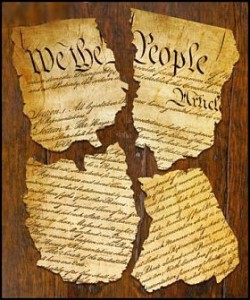
Another Constitutional Convention: An Idea Whose Time Has Not Come

const conven

In the midst of the seemingly indeterminable presidential electoral campaign, some of the candidates have been asked about the possibility of convening a constitutional convention in the hope of addressing the nation’s most pressing issues, most ominously the gargantuan federal deficit now in excess of $18 trillion.

Governor John Kasich supports such a notion with the explicit purpose of passing a balanced budget amendment.

Mark Meckler, president of Citizens for Self Governance, a leading group pushing the idea, believes that “If it starts to become a serious presidential issue, we could get it done in 2016.”*

Not all presidential contenders are on board with the idea. Senator Marco Rubio has expressed trepidation over the possibility of a convention for amending the current document fearful that it would lead to a total rewrite:

Just make sure that we know how it is going to turn out
because if you open up the Constitution, you are also
opening it up to people that want to re-examine the First
Amendment, people that want to re-examine the Second
Amendment, people that want to re-examine some other
fundamental protect[ions] that are built into the Constitution.”**

Unlike most issues on which he pontificates, Senator Rubio is this time right in his analysis, but most likely for the wrong reasons.

The original Constitutional convention was called to “revise” the supposedly defective Articles of Confederation, but by the time the deliberations (more like arm twisting, threats, and bribes) were over, the Articles had been replaced by a brand spanking new document. The Constitution granted the central government far more power than it had before while the individual states had, in effect, lost their cherished sovereignty and had become mere appendages within the new “federal” union.

Under the current ideological climate, the convocation of another constitutional convention would not return the nation to its halcyon days as a confederation of independent states, but would more than likely increase the central government’s power at the expense of what is left of state and individual rights. The idea of amending the current document is naïve at best, but more importantly a gigantic waste of time.

Groups like Citizens for Self Government do not grasp the essential problem of American political, social and economic life. It is the Constitution itself that is the cause of the myriad of problems which besiege the land. The adoption of the Constitution despite what its sycophantic champions of today and yesteryear have erroneously argued, created a highly centralized national state which is virtually limitless in its power.

The Articles of Confederation, on the other hand, were just that – a system where the national government was dependent for its existence on the individual states’ benevolence. American constitutional history can be seen as the systematic destruction of state, regional, local and, eventually, individual sovereignty from the aggrandizement of federal power, all achieved under Constitutional rule.

The Constitution negates one of the great safeguards of individual liberty – “voting with one’s feet.” Under a confederation of states, tyranny can be avoided, to an extent, by simply relocating to another political jurisdiction. If a state becomes too confiscatory in its taxing policies, its subjects can move to a less tax burdensome district. Thus, the more political jurisdictions there are the better.

Under the Constitution, there is no escape from its dictates unless one expatriates. The ability of populations to move and the greater number of political units provides a far superior check on tyranny than the supposed “checks and balances” and “separation of powers” so celebrated in American federalism.

Amendments, conventions, “strict interpretation” of the Constitution, and all other reforms of the federal system will do nothing to limit or eventually slay the American Leviathan. Decentralization is the key which means secession and a dismantling of the Union.

Secession should not be limited to the Union, but allow for the breakup of the existing states along political, economic and cultural lines. States as geographically, culturally, and economically diverse as California should be broken down into numerous smaller entities. The overriding principle in regard to liberty and prosperity is the greater number of political configurations the better.

Until the Constitution is seen for what it truly is, the rapacious federal state will continue to gorge itself on the ever dwindling productive efforts of its citizenry. Once this is recognized and efforts are taken to disembowel the beast, will the lives, liberties, and property of Americans and a great many around the globe be secured.

*David Sherfinski, “GOP Hopefuls’ Support Boosts Constitutional Convention Idea.” The Washington Times. 24 December 2015.
**Ibid.

Antonius Aquinas@AntoniusAquinas
The Constitution’s Big Lie

Rossiter II

One of the greatest hoaxes ever perpetrated upon Americans at the time of its telling and which is still trumpeted to this very day is the notion that the U.S. Constitution contains within its framework mechanisms which limit its power. The “separation of powers,” where power is distributed among the three branches – legislative, executive, judicial – is supposedly the primary check on the federal government’s aggrandizement.

This sacred held tenet of American political history has once again been disproved.

Last Friday (October 23), the Attorney General’s office announced that it was “closing our investigation and will not seek any criminal charges” against former Internal Revenue Service’s director of Exempt Organizations, Lois Lerner, or, for that matter, anyone else from the agency over whether they improperly targeted Tea Party members, populists, or any other groups, which voiced anti-government sentiments or views.

The Department of Justice statement read:

The probe found ‘substantial evidence of mismanagement,
poor judgment and institutional inertia leading to the
belief by many tax-exempt applicants that the IRS targeted
them based on their political viewpoints. But poor
management is not a crime.’ (My emphasis)

Incredibly, it added:

We found no evidence that any IRS official acted based on
political, discriminatory, corrupt, or other inappropriate
motives that would support a criminal prosecution.*

That the DOJ will take no action against one of its rogue departments demonstrates the utter lawlessness and totalitarian nature of the federal government. The DOJ’s refusal to punish documented wrongdoing by the nation’s tax collection agency shows the blatant hypocrisy of Obummer, who promised that his presidency would be one of “transparency.”

It can be safely assumed that Congress will not follow up on the matter, as Darrell Issa (R-Ca.), who chaired a committee to investigate the bureau’s wrong doings, admitted that its crimes may never be known.** The DOJ and Issa’s responses are quite predictable once the nature of the federal government and, for that matter, all governments are understood.

Basic political theory has shown that any state is extremely reluctant to police itself or reform unless threatened with destruction, take over, or dismemberment (secession). The Constitution has given to the federal government monopoly power where its taxing and judicial authority are supreme. It will not relinquish such a hold nor will it seek to minimize such power until it is faced with one of these threats.

While it was called a federated system at the time of its enactment and ever since by its apologists, the reality of the matter is quite different. As the Constitution explicitly states in Art. VI, Sect. 2, the central government is “the supreme law of the land.” The individual states are inferior and mere appendages to the national government – ultimate control rests in Washington.

In fact, it was the Constitution’s opponents, the much derided Antifederalists, who were the true champions of a decentralized system of government while their more celebrated opponents such as Madison, Hamilton and Jay wanted an omnipotent national state.

Thus, in the American context, the only method for those oppressed by the federal government is to either threaten or actually go through with secession. Attempts to alter its dictatorial rule through the ballot box or public protests are futile. While there will naturally be outrage at letting the IRS off the hook, focus and anger must be redirected away from participation within the current political system to that of fundamental change.

Congress’ refusal to prosecute an executive bureau that has deliberately used (and is still using) state power to oppress and harass opponents of the Obama regime demonstrates the bankruptcy of the idea that separation of power limits tyranny. Federal power and the corresponding tyranny and corruption which it has bred has never been countered by the checks and balances and separation of powers of the supposed “federal republic” created a little over two centuries ago.

Until the “big lie” of the Constitution is realized, agencies like the IRS will continue to target and tyrannize anti-government organizations, groups, and individuals. The Constitution provides no real mechanism for the redress of grievances from the subjects which it rules. Only when the breakup of the federal Union has taken place, will American liberties and freedoms be secured.

*Tyler Durden, “DOJ Closes Lois Lerner Investigation Without Charges.” Zero Hedge http://www.zerohedge.com/news/2015-10-23/doj-closes-lois-lerner-investigation-without-charges
October 23, 2015.
**Melanie Batley, “Issa on IRS Scandal: May Never Get the Truth.” Newsmax http://www.newsmax.com/US/issa-scandal-irs-investigation/2014/07/09/id/581638/ July 9, 2014.

Antonius Aquinas@AntoniusAquinas

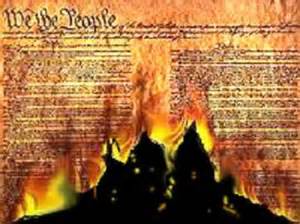
Down with the Constitution!

constitution burning


It has been quite an eventful and productive couple of weeks for the forces of statism in the former “land of the free, and home of the brave.”

The federal government’s highest court has enshrined “perversity” into law, guaranteeing untold amounts of future litigation while infringing on the right of freedom of association and, just as important, “disassociation” for those who rightly consider sodomy an abomination which wantonly mocks the Author of the natural law.

Prior to its cultural wrecking decision on “gay marriage,” the Court ensured that socialized medicine would become a permanent feature of American life upholding a key provision of Obamacare.

While the Supreme Court was issuing its heinous decisions, the two other federal branches of government were also actively augmenting the American Leviathan. After considerable arm twisting, threats, payoffs, and a large dose of GOP support, President Obummer was able to secure passage of the TPA fast-track legislation one of, if not, the greatest piece of “crony capitalism” ever conceived. Of course, in the current statist era, the exact details of this monstrous law has, as of yet, been made public, however, what has been made known is quite chilling.

While these liberty-defying acts were being committed, a prior provision of the American police state was renewed by Big Brother Barack and his Congressional Commissars. The National Defense Authorization Act (NDAA) which outlines the budget and expenditures of the U.S. Defense Offense Department has since 2012 contained the provision (section 1021) “which allows the Federal government, through military force, to arrest anyone, including American citizens, without a warrant, and hold them indefinitely without charges or due process – habeas corpus.”

Naturally, there was considerable outrage among freedom groups and those within the alternative media over the latest expansion of federal power. The responses, however, were typical with calls for “taking back the country from the globalists,” “restoring the Constitution,” “electing liberty-loving candidates to office.” The latter cry was spoken about the most with the Presidential election around the corner with some commentators speculating on which candidate could best “turn things around.”

Such talk and the tactics promoted to combat totalitarian America have been trumpeted so many times that they have long ago lost their appeal. They are not only worn out, but they would not work even if successfully implemented, simply because they are not directed at the source of the problem.

The recent judicial decisions, the many wars, the debasement of the currency, spying, the fomentation of racial violence, and the ruination of the economy are the result of a single institution – the United States federal government – which was surreptitious created with the “ratification” of the Constitution in 1789 against, as most historians agree, the will of the American majority for which it would tyrannically rule over ever since.

“The Miracle at Philadelphia” was a “miracle” only in the sense that the event has been viewed as some sort of liberty defining watershed where individual rights would be safeguarded and state power held in check by the Constitution. Few historical fantasies have been believed for so long!

Instead of a federated system where power is decentralized between national and local governments, the Constitution created a highly centralized state through the document’s often vague terminology “for the general welfare,” and its explicit grants of power, “federal statute is the supreme law of the land.”* The highly lauded system of “checks and balances” between the three branches of government have rarely, if ever, stemmed the growth of state power.

Yet, despite the suzerainty of the federal state, “patriots” and all those opposed to the regime still believe the system can be “reformed.” Even when the national government is controlled by those supposedly sympathetic to liberty, government power continues to expand while any previous welfare or draconian measure enacted are never curtailed, much less abolished.

Attempts at reform or working within the “political process” is a gigantic waste of time. Instead, such efforts should be directed at secession the goal of which is the dismemberment of the Federal Union into sovereign, independent entities, the greater in number the better.

Until the Constitution is recognized for what it is, the chances of ending the American police state, economic recovery, and the cessation of the myriad of global conflicts, wars, and hostilities in which the U.S. is actively fomenting, are next to nil.

The dissolution of the U.S. “federated” Republic is not only necessary for the well being of Americans, but for the peoples of the globe, millions of which have been murdered, intimidated, plundered, and spied upon by the Leviathan residing on the shores of the Potomac. Likewise, as the Constitution has served as a model in the development of nation states throughout the last three centuries, so its demise will provide an example for the rest of the world to hopefully emulate.

* Kenneth W. Royce, Hologram of Liberty: The Constitution’s Shocking Alliance with Big Government.  Javelin Press, 2nd ed., 2012, pp. 105-106.

Antonius Aquinas@AntoniusAquinas

Political De-Centralization: the Model for Western Rejuvenation

Europe 1300

As the modern secular nation state becomes increasingly totalitarian, European history provides the model for the political reconstruction of the Western world. The above historical map of Europe circa 1300 should be the ideal for those opposed to the corrupt and now bankrupt nation state and the system of international political and financial governing bodies and organizations that seek the elimination of all regional and local sovereignty.

The map shows that Europe at the time and for many years afterwards was comprised of numerous political configurations – principalities, duchies, confederations, city states. Instead of a few centralized nation states that currently dominate the landscape, Europe was, for the most part of its history, politically decentralized which explains not only the Continent’s tremendous economic growth, but also its unparalleled cultural achievements.

Monarchical style governance was the most popular form of rule during the period and, despite the negative modern bias against kings and queens, there was far greater personal freedom than there has been in the “democratic age.” More importantly, warfare, when it was conducted, was far less destructive in loss of life and that of wealth and property than the horrific contests which have since taken place. Moreover, the monarchical age was one of metallic money which proved to be difficult to manipulate by the political classes.

Political and economic theory has long since shown that decentralization results in greater individual liberty and economic growth. A multitude of independent states and sovereignties is a far better check on tyranny than the supposed “checks and balances” of modern constitutional democracies. Even the much celebrated “separation of powers” concept adopted by most constitutional republics has not prevented the rise of the “total state.”

Numerous states provide the opportunity for the oppressed to “vote with their feet” expatriating from draconian regimes. The threat of population drain and thus a reduction in the tax base is a far superior check on state power.

A number of small states makes it unlikely that a fiat paper money system, in which the world currently suffers under, would emerge. It would be extremely difficult for a dominant monetary authority to coerce and get a multitude of states to agree to accept a single currency outside of their control. Even the Euro almost failed to come into existence, and had Europe been more decentralized the “Euro experiment” would have never been attempted.

Unfortunately, under the current ideological mindset, the breakup of the nation state into smaller units does not seem likely. Social change typical occurs after there has been an ideological shift and the present dominant political paradigm is that of statism. However, an economic collapse or the continuing fall in living standards could lead to the breakaway of regions from their nation-state overlords.

Those opposed to the current world order need to redirect their efforts away from “reform,” electoral politics, or lobbying for favorable court decisions and instead focus on the development of organizations, the forming of alliances and relationships whose end result is the creation of new autonomous entities outside the hegemony of the nation state.

As farfetched as the idea of a decentralized world might seem to be, there has been some recent examples of it. The collapse of the Soviet Union and the separation of the Baltic states shows that no matter how impregnable a regime may appear, political disintegration can happen. The severe economic crisis that led to the fall of Soviet Communism could take place in the United States or in any number of European regimes.

While the nation state is in perilous financial position, it will not relinquish its power voluntarily. The politically-connected financiers will do whatever it takes to keep the system afloat and will use any upcoming economic crisis to accelerate their drive for a New World Order. If a politically decentralized world is to come about, the groundwork for it must be now laid.

Lord Acton’s famous words about political centralization should be the mantra for those who seek a more peaceful and prosperous world devoid of the tyrannical nation state: “power tends to corrupt and absolute power corrupts absolutely.”

Antonius Aquinas@AntoniusAquinas

Secession and the Antifederalists

R.H. Lee

Richard Henry Lee, leading Antifederalist

One of the most exciting political developments in recent years has been the secessionist movement which has flourished among a number of American states and across the globe in places such as Venice and Scotland. The common thread in nearly all these movements has been opposition to the modern nation state which secessionists believe has become totalitarian and now hopelessly bankrupt.
Many secessionist groups draw their inspiration from American history in particular the country’s founding document, the Declaration of Independence, and the southern states’ valiant attempt to secede from the Union in the 1860s. While secessionists have pointed to America’s past for much of their inspiration, one group which they seem to have ignored, has been the Antifederalists.

The “Antifederalists” was the term given to those opposed to the ratification of the U.S. Constitution. They were not an insignificant segment of the population and consisted of such luminaries as Sam Adams, Patrick Henry, George Mason, and Richard Henry Lee, who wrote under the pseudonym of the “Federal Farmer.” Still under-appreciated to this day, Lee’s political thought equaled, if not surpassed, those of the more celebrated Founding Fathers.

The Antifederalists correctly predicted that the Constitution would usurp the sovereignty of the individual states and become a highly centralized national state. Moreover, they saw that it granted too much power to the executive branch.

A number of historians believe that at the time most Americans opposed ratification and had it not been for some shrewd and, quite frankly, underhanded tactics by their opponents, the Federalists, the Constitution would not have been ratified. Patrick Henry certainly thought so when he wrote: “Let me say, sir, that a great majority of the people even in the adopting states have been shockingly misled.”*

More than two centuries later their fears have turned into grim reality. History, however, is written by the victors and the Antifederalists and their perspicacious views have been largely forgotten.

For secessionists, the Antifederalist literature should be a prime reference point to be repeatedly invoked to justify their cause. For secessionists to succeed, the battle of ideas must be first won, and the writings of the Antifederalists provide ample ammunition for those who seek to break away from the corrupt and tyrannical nation states which dominate the globe.

The future of human liberty and economic well being depends on the success of the secessionist movements. The political parties of the world be they “liberal” or “conservative” have no interest in scaling back the size and scope of the state. Any chance of real reform through the current political system is hopeless since it is rigged to enrich the power and pocketbooks of the political elites.

Thus, all efforts – whether on a practical or an “intellectual” basis, which strengthen the secessionist cause – need to be encouraged and supported by those concerned about the future of freedom. Participation in politics or the electoral process is futile and counterproductive as the Antifederalists long ago recognized: “But, remember, when the people once part with power, they can seldom or never resume it again by force. Many instances can be produced in which the people have voluntarily increased the powers of their rulers; but few, if any in which rulers have willingly abridged their authority.”**

The globe’s ruling regimes will simply not allow their power to be undermined. Most likely, if secession becomes a reality, it will come only by the use of force and loss of life. The powers-that-be will not relinquish their control peacefully.

However, as daunting as state power appears to be, it can be negated by a coterie of committed and dedicated individuals. The advantage that secessionists possess is that they do not seek conquest, but simply wish to be left alone, free from tyrannical rule. Such a position is appealing and, if properly articulated, will garner public sympathy and support.

For those across the globe who are contemplating the weighty and possibly dangerous action of secession, the words of one of the Antifederalists’ mentors should be remembered:

Whenever any . . . Government becomes destructive
of these ends, it is the Right of the People to alter or
to abolish it; and to institute new Government, laying
its foundation on such principles and organizing its
powers in such form, as to them shall seem most likely
to effect their Safety and Happiness.
[From the Declaration of Independence]


*Paul Douglas Boyer. The Original Counter-Argument: The Founders’ Case Against the Ratification of the Constitution Adapted for the 21st Century. Copyright Paul Douglas Boyer, 2013, p. 250
**Kenneth W. Royce. Hologram of Liberty: The Constitution’s Shocking Alliance with Big Government. Javelin Press, 2012, p. 63
Antonius Aquinas@AntoniusAquinas