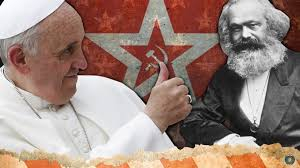
As if there needs to be further evidence that the current occupant of St. Peter’s Chair in Rome is a Marxist, the announcement of an upcoming conference at Assisi entitled the “Economy of Francesco” should convince any skeptic otherwise.
In his invitation letter to “young economists and entrepreneurs worldwide,” Bergoglio sets the agenda for the Leftist confab quite clearly which is virulently anti-market, a call for massive redistribution of wealth, and a reordering of the current economic systems of the world with a healthy dose of climate change nonesense:
. . . a different kind of economy: one that brings life not death, one that is inclusive and not exclusive, humane and not dehumanizing, one that cares for the environment and does not despoil it.*
While Bergoglio’s Marxist credentials have been firmly established, his blashemous actions and words has a growing number outside of “sedevacantist circles” calling him a heretic. The legitimacy of “Pope Francis,” however, is more fundamental than him being a manifest heretic, but his standing as a legitimate pope is invalid since his ordination as a priest and his consecration as a bishop came under the new rites of Holy Orders instituted in the wake of the Second Vatican anti-Council (1962-1965).
The mastermind behind Bergoglio’s summit is professor Luigino Bruni and from his comments he sounds more radical than the Argentine Apostate, if that is possible. Professor Bruni wants to use taxation as a weapon to “redistribute income and wealth from the rich to the poor.”*
Bruni, a professor of political economy at the Italian University, LUMSA, and the author of a number of books, basis his advocacy for redistribution of wealth on the Scriptures:
[T]he Bible has many words to offer our economic life and ideas [with] the transformation of wealth into well-being.**
It appears that the good professor’s Bible is missing the Seventh Commandment of the Decalogue which solemnly states: THOU SHALL NOT STEAL! In no legitimate commentary ever written on this Commandment is there an exception made for the confiscation of wealth from the well-to-do to be given to the poor. Probably just an oversight on the Professor’s part.
Because they are blinded by socialistic ideology, Bruni, Bergoglio, and the likes of Bernie Sanders cannot see that the growing wealth inequality which they complain about is not the result of “capitalism,” but is the outcome of the monetary policy of the world’s central banks. This, along with tax policies which hamper innovation and shield the entrenched financial class from competition, is why financial elites are able to maintain and increase their power.
Central bank policy of suppressing interest rates and of money printing allow banks and financial institutions to receive “free money” which they can invest and speculate with at zero cost. The boom (actually a bubble) in asset prices on Wall Street is a demonstration of how wealth disparity takes place.
If Bergoglio really meant to reform the present system, he would call for the abolition of central banking and a return to “hard money.” Under such an order, banks and financial institutions become wealthy on their ability to make prudent investment decisions subjected to profit and loss. A free market in banking is the antithesis of the current system of credit expansion and money printing.
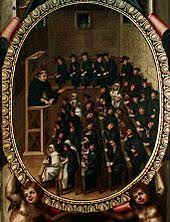
Not only have Bergoglio and his cohorts abandoned the Faith, but they have also overturned the Church’s long-held condemnation of socialism and have ignored many of its own outstanding thinkers on financial matters. From the Scholastics to the School of Salamanca through the Jesuits and the great Cardinal Cajetan, who finally taught the proper doctrine on interest rates, the Church has produced scores of eminent economic thinkers in its long history.
School of Salamanca
Ever since socialism reared its ugly head as a social system of thought, the Church has warned of its dangers even its more milder forms as Pope Pius XII wrote, “No Catholic could subscribe even to moderate socialism.” Since Vatican II and especially under Bergoglio’s regime, however, Leftist ideas of all sorts have been warmly embraced.
At the heart of socialism, be it Marxism or its equally pernicious variants, lies envy which became a part of the human condition with the fall of man. While once condemned, envy has been turned into a virtue by the likes of Bergoglio.
While such ideas may sound appealing to human sensibilities, they will not pass the Divine Judge who knows the thoughts and souls of all His creatures even those of supposed popes.
The efficacy of a metallic monetary system is beyond dispute at least among real economists which eliminates just about 95% of whom are now engaged in the “profession.” Money, which gold is, allows for specialization, the division of labor, and provides the means for mankind to escape from barter and, thus, a primitive existence. Like free trade, money naturally integrates mankind both among and between peoples.
A system of central banking with an unbacked paper currency is the antithesis of a gold standard. Manipulation of currencies by central banks, mostly through debasement, hinders trade, creates distortions, and ultimately leads to the dreaded business cycle. Murray Rothbard aptly describes the baneful results of state intervention in the monetary system:
. . . government meddling with money has
not only brought untold tyranny into the world;
it has also brought chaos and not order. It has
fragmented the peaceful, productive world
market and shattered it into a thousand pieces,
with trade and investment hobbled and hampered
by myriad restrictions, controls, artificial rates,
currency breakdowns, etc. It has helped bring
about wars by transforming a world of peaceful
intercourse into a jungle of warring currency blocs.*
While the economic efficiency of a gold standard is important, the ethical case for it is more compelling and was the reason why gold, as money, lasted as a medium of exchange for so long. Gold/money has to be created through honest-to-goodness production and exchange. The often dangerous mining of gold takes labor, capital goods, and land. Turning raw gold into coinage is another process which requires a high level of specialization and production techniques. Both are honest and morally sound activities which make for the betterment of life all around.
The ethical standing of central banking and its issuance of unbacked currency as money through the printing press, stroke of a computer key, or via the expansion of credit cannot stand similar scrutiny. By any appraisal, central banking is immoral. Through the creation of money, banks stealthy transfer wealth to those who control the money supply and those closely associated with it.
The ability of central banks to create unlimited amounts of money and credit has been the greatest redistribution scheme ever conceived. The process ultimately leads to class conflict as the wealth disparity between the politically well-connected and those outside that nexus invariably widen.
Under a gold standard, none of this would take place.
Because of their lack and often distain for economic doctrines, in particular, monetary theory, “economic nationalists” (really “economic ignoramuses”) have wrongly focused on trade as a factor in the continued decline of the middle and working classes. China’s supposed unfair trade practices was a staple of President Trump’s campaign rhetoric and has continued through much of his first term.
The focus on trade has deflected attention from the real cause of worsening economic conditions for American workers and the enrichment of Wall Street. Despite the blatant transfer of wealth via the Fed’s policies of suppressed interest rates and money printing since the 2008 Recession, economic nationalists continue to applaud President Trump’s tariff policies while the President continues to browbeat the Fed to do more of the same even calling for negative interest rates and more Quantitative Easing.
The Left rightly speaks out of the vast and growing inequality of wealth distribution, but like those who espouse economic nationalism, they fail to understand the reason for why the societal imbalance has occurred. One remedy they propose – a “wealth tax” – will not address the problem. Moreover, their “soak-the-rich” schemes would snare in their plunder (not that Leftists particularly care) many of the wealthy outside of the banking and financial sector of their legitimate, just gains.
The case for honest money must be made on ethical grounds. The current system must be exposed and shown for the scam that it is: a massive redistribution scheme enriching the political elites and their closely aligned business and financial allies. While it is undeniable that a gold standard would lead to enormous prosperity, its reinstatement would remedy one of the great injustices that plague the world – central banking!
*Murray N. Rothbard, What Has Government Done To Our Money? BN Publishing, 2012: 84.
With the recent ominous inversion of the 2-10 year yield curve and its near infallible predictive recessionary power, the consequences for the economy are plain to see, however, what has not been spoken of by pundits will be the effect of a recession on US foreign policy. If a recession comes about prior to November 2020, or if economic indicators such as GDP plummet even further, the chances of a Trump re-election is extremely problematic even if the Democrats nominate a socialist nut case such as Bernie Sanders or Pocahontas.
Elizabeth Warren has been the most vocal about coming economic troubles:
Warning lights are flashing. Whether it is
this year or next year, odds of another
economic downturn are high – and growing. . . .
When I look at the economy today, I see
a lot to worry about again. I see a
manufacturing sector in recession. I see
a precarious economy built on debt – both
household debt and corporate debt and that
is vulnerable to shocks. And I see a number
of serious shocks on the horizon that could
cause our economy’s shaky foundation to crumble.*
A “doom and gloomer” Demo?
If the economy cannot be reversed, despite the likelihood of rate cuts in September and a possible resumption of “QE” by the end of the year, President Trump will probably look for some “victory” or success to divert public attention away from deteriorating economic conditions. The most likely targets will be renewal of hostilities toward Iran and/or an escalation of pressure on Venezuelan President Nicolas Maduro to resign.
Of course, the US has been conducting economic warfare on Iran ever since Trump stupidly pulled out of the nuclear agreement and began applying even more crippling sanctions on Iran. In June, armed hostilities were about to take place over the Iranians downing of a US drone over its air space. Reportedly, at the last minute, Trump called off retaliation, enraging, no doubt, the bloodthirsty neocons itching for an excuse to unleash more death and destruction.
Another factor, which has been little spoken of, but may contribute to foreign intervention is that Trump has alienated a number of his political base especially the spokesmen among the Alt Right. While he still commands high poll numbers among Republicans and still attracts impressive rallies of “deplorables,” a number of his prominent backers, who were so crucial for his success in 2016, are, to say the least, disappointed over his inability to stem the tide of illegal immigration. Moreover, these voices feel rightly betrayed since he has done nothing to halt the Internet tech giants from de-platforming many of their social media activity.
Another group which may be quickly added to disillusioned Trump supporters are gun owners and free-speech advocates if the President goes along with the proposed draconian “red flag” legislation. If these totalitarian measures are enacted, 2nd Amendment defenders will probably not vote for Trump’s opponent in 2020, but instead, may stay home in protest.
In electoral politics, voter enthusiasm can sometimes offset money and media control which was certainly the case for Trump both in the Republican primaries and the general election. To win again, he will need to mobilize similar sentiment.
The politically savvy neocons, which the President has insanely surrounded himself with, are certainly aware of this dynamic which will give them considerable leverage to push forward their agenda. A desperate Trump will surely be more malleable if a second term is in jeopardy. Just look at the recent capitulation when there is, as of yet, no recession, yet, he called off the additional Chinese tariffs after the Dow plunged 800 points.
Even if a recession does not rear its ugly head, an armed conflict with Iran is a distinct possibility. The more hard line neocons understand that they would be out of power under a Democratic president who may revert to compromise and negotiations to re-engineer a nuclear deal with Iran. The push for war will intensify if Trump’s poll numbers drop as the election gets nearer due to a moribund economy.
Of course, the US is infamous for provocations and with the huge military build up in the Persian Gulf, any of the many trip wires may spring, leading to a local war which might turn into a general conflagration.
While it is not a certainty that a recession will lead to regime change in Washington, Trump has mistakenly tied his political fortunes to the well being of the economy especially the stock market. He had the chance and the public support at the beginning of his term to level with the country and explain the monumental financial and economic problems which exist and that he had pointed out during the campaign. Unfortunately, for both his and the nation’s future, he chose business as usual putting his own political goals (re-election) over the good of the country.
The cost of that choice is now coming to bear which may end in another war that will certainly seal the President’s fate and likely that of America.
*Sanjana Karanth, “Elizabeth Warren Predicts Another Economic Downturn.” Politics. 22 July 2019.
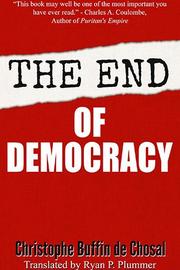
Review: Christophe Buffin de Chosal, The End of Democracy, Translated by Ryan P. Plummer. Printed in the U.S.A.: Tumblar House, 2017.
Introduction
One cannot speak too highly of Christophe Buffin de Chosal’s The End of Democracy. In a fast paced, readable, yet scholarly fashion, Professor Buffin de Chosal* demolishes the ideological justification in which modern democracy rests while he describes the disastrous effects that democratic rule has had on Western societies. He explodes the myth of Democracy as a protector of individual liberty, a prerequisite for economic progress, and a promoter of the higher arts. Once Democracy is seen in this light, a far more accurate interpretation of modern history can be undertaken. The book is a very suitable companion to Hans-Hermann Hoppe’s iconoclastic take down of democracy in Democracy: The God That Failed, released at the beginning of this century. Buffin de Chosal has spoken of a follow up which will be eagerly awaited for.
Democratic Governance
The idea of rule by the people is a scam, one perpetuated by those who, in actuality, are in control of the government. Through the “democratic process” of voting and elections, a small, determined minority can impose its will despite majority opposition:
We often hear it said that ‘in a democracy,
it is the people who rule. . . .’ Rule by the
people is a myth which loses all substance
once confronted with the real practice in
democracy. [13]
Quoting from a Russian philosopher, Buffin de Chosal continues his criticism:
The best definition [of democracy] was
given by the Russian philosopher Vasily Rozanov.
‘Democracy is the system by which an
organized minority governs an unorganized
majority.’ This ‘unorganized majority’ is the
people, aggregated and individualistic,
incapable of reaction because disjointed. [28]
He expands upon Rozanov’s theme:
. . . [C]ontrary to what [democracy’s] principles
proclaim: one can say that the majority
almost never wins. Democracy is not the
system of the majority, but that of the most
powerful minority, and it has this power
not simply due to its numbers, but also and
above all due to its organization. [31]
Power does not reside in “the people” and certainly not in the individual. In democracy, the only way to express one’s preference or protect one’s rights is through the ballot box every so often. “Each voter,” writes Buffin de Chosal, “in a democracy, is the depositary of a tiny particle of sovereignty, in itself unusable. His sole power consists in dropping a ballot into a box, whereby he is immediately dispossessed of his particle of sovereignty at the profit of those who are going to represent him.” [Ibid.]
Popular democracy has always been condemned and feared by most thinkers since the beginning of human societies. It was not until intellectuals saw democracy as a way they could attain power that they began to advocate it as a system of social order. Prior to the democratic age, most of the learned understood that democracy would result in mob rule and the displacement of natural authority with demagogues. In short, the worst would rise to the top as the author describes the characteristics of a contemporary politician:
The ideal politician, on the other hand, is
pliable, convincing, and a liar by instinct. He is
not attached to any platform and has no
ideological objective. The single thing to which
he is truly committed is power. He wants its
prestige and advantages, and seeks above all
to be personally enriched by it. Any politician
who presents this aspect is recognized as fit for
power in a democracy. . . . It is therefore not
surprising that democratically elected assemblies
are almost exclusively comprised of
these kinds of men and women. Elected
heads of state almost always fit this profile,
and international institutions, such as the
European Union, consider it the only
acceptable profile. . . . [35]
Democracy and the State
Since the advent of modern democracy, the principle benefactor of its rule has been the State and the politically-connected financial elites who are in actuality the true rulers of societies. Instead of putting an end to the supposedly despotic rule of the Ancien Régime, which Democracy’s proponents claim to have existed throughout the monarchial and aristocratic age, governance by the people, has instead witnessed an increase in state power and control of individual lives to an unprecedented level in human history. Few, if any, pope, emperor, king, prince, or duke have ever possessed such suzerainty.
In contrast to what has been taught in classrooms, on university campuses, and espoused throughout the media, individual rights and freedoms were far better guarded in the age prior to Democracy’s ascendancy. Pre-revolutionary Europe had social structures which insulated individuals from State power far more effectively than under modern democracy:
The concept of an organic society was abolished at
the time of the French Revolution. The corps and
orders were suppressed, the privileges were abolished,
and everything which allowed the people to protect
themselves from the power of the state was banished
in the name of liberty. [24]
And in return for giving up the order that protected them from state depredations, the people received “sovereignty:”
They were given the false promise that they
would no longer need to defend themselves
from the state since they themselves were the
state. But if a people organized into corps and
orders are incapable of exercising sovereignty,
how much more so a people comprising a formless
mass of individuals! [Ibid.]
Historically, all of the democratic movements which supposedly stemmed from the people were, in fact, a falsehood, perpetuated largely by revolutionaries who sought to replace the established order with themselves. While legislatures, congresses, and democratic bodies of all sorts have been interpreted as the fruition of the masses’ desire for representation, the reality was quite different:
Democracy is not, in its origin, a system of
the people. In England with the advent of the
parliamentary system just as in France during the
Revolution, it was not the people who were seen
at work. Even the Russian Revolution was not a
phenomenon of the people. To regard the people
or what the communist elegantly call the ‘masses’
as the agent of change or political upheaval is purely
a theoretical view, a historical myth, of which
one sees no trace in reality. The ‘people’ were
the pretext, the dupes, and almost always the
victims of the revolutions, not the engines. [13]
Not only was propagation of the myth of popular support for democratic ideals propounded for the survival of the new social order, but putting these tenets into practice was accomplished, in large part, by the role of the “intellectual” an often neglected feature of standard historical analysis and the reason behind much social transformation:
The ‘nation’ met the desires of the philosophers
who wanted to transfer power from the monarch
to an enlightened, philosophical, and philanthropic
class who, moreover, ought to be financially
comfortable. The educated bourgeoisie of the
time were the protagonists of this idea, and a
portion of the nobility formed their audience. [13-14]
The intellectuals promoted Democracy because it would open up for them considerable opportunities for position and income in the nation state. It must be remembered that it was the intellectuals who justified the idea of Absolutism. Later, the intellectuals turned on the monarchies and sided with the emerging republican classes rightly believing that democratic governance would give them greater opportunities for power in the emerging nation states.
Democracy and Modern History
While most historians see the advancement of democracy and the development of legislative bodies over the course of the last centuries as an advancement in the human condition and one that has emanated from the people’s desire for greater political representation, Buffin de Chosal presents a far different and more accurate interpretation. “Democracy,” he asserts, “is not, in its origin a system of the people.” [13] All of the social movements which eventually led to the destruction of Christendom did not come from the people seeking a greater “voice” in their governance.
“The ‘people,’” he argues, “were the pretext, the dupes, and almost always the victims of the revolutions, not the engines.” [Ibid.] Liberty, Equality and Fraternity was not a popular cry, but one coined and used by the “enlightened” classes to mobilize and justify their overthrow of the French monarchy and with it the destruction of the Church.
The French Revolution was built on the
idea of the ‘nation,’ which claimed to bring
together the intellectual, social, and financial
elite of the country. It was on this foundation
that democracy was established and that it
functioned during almost all of the nineteenth
century. [Ibid.]
A similar historical narrative can be seen in England.
The rise and eventual triumph of representative democracy in England was not one that percolated from the masses itching for more freedom. “The appearance of the parliamentary system in England,” Buffin de Chosal contends, “was tied to the great movement of Church property confiscation begun under Henry VIII and continuing until the coming of the Stuarts.” [14]
After Henry gorged himself on the Church’s wealth, he sought to bribe as much of the nobility as possible with his ill-gotten gains to insure his power. An envious Parliament, however, wanted its cut of the loot which led to the great internecine struggle between Crown and Parliament which eventually ended in the suzerainty of the latter with the Glorious Revolution of 1688. The real power from then on rested with an oligarchical legislative branch:
The families who had thus helped themselves
to the Church’s goods, morally justified by
Protestant ethics, formed the gentry, the class
of landowners who sat in Parliament. Parliament
was not then, as one might believe today, an organ
of poplar representation. It was an instrument
in the hands of the gentry to defend its own class
interests. [16-17]
That Parliament and the monarchy would become the two dominant ruling structures was the result of the breakdown of the feudal structure which was taking place not only in England, but across Europe. European monarchs continued to gain more and more power at the expense of the feudal landed elite. The gentry’s power and wealth was also on the wane with the rise of commercial centers which most of the time aligned themselves first with the kings and then later with Parliament. The eventual triumph of Parliament, however, did not mean greater democracy for the people:
The financial incentives for England’s adoption
of the Protestant Reformation are therefore
intimately connected with the bolstering of
Parliamentary power. The Parliament in England
was used to put the monarchy in check and to
replace it with an oligarchic class of wealthy
Protestants to whom the kings were required to
submit. This is why the overthrow of James II
in 1688 was a true revolution. It was not a
popular revolution or the overthrowing of a
tyranny, but it was the rebellion of a class
implementing the transfer of sovereign power
for its own profit. [17]
The Market Economy
The author takes a refreshing look at the market economy that sets straight the inaccurate and often times hostile analysis of it that frequently comes from conservative circles. He distinguishes and rightly points out that “pure capitalism” or the “unhampered market” is an “excellent thing” [123]. The free market is intimately tied with private property which is a prerequisite for a just society:
[Capitalism] proceeds from respect for private property.
As capitalism is the reinvestment or saved money for the
purpose of making new profits, it presupposes respect for
property rights and free enterprise. It has existed in Europe
since the Middle Ages and has contributed significantly to
the development of Western society. [Ibid.]
He insightfully notes that “bad capitalism” often gets lumped in with its “good form” while the latter gets the blame for the baneful excesses of the former. “Monopoly capitalism,” “corporatism,” “the mixed economy,” and “crony capitalism” are not the result of the market process, but stem from “intervention” brought about by the State in favor of its business favorites through participatory democracy. In a truly free market, entrenched wealth is rarely maintained but is constantly subjected to challenges by competitors:
But what one ought to designate as bad
capitalism is the concentration of wealth and
power this wealth procures. This danger does
not stem from capitalism itself but rather from
parliamentary democracy, for it is democracy
that enables money powers to dominate the
political realm. [Ibid.]
The “monied interest” did not exist under “traditional monarchy,” but was a product of Democracy and the protection and extension of the “bad capitalistic” paradigm that came into being and was expanded by the rise of popular representative bodies. Assemblies, legislatures, and congresses, which emerged, became aligned with the banking and financial interests to bring about the downfall of the monarchies.
The concentration of political power could only be attained after the control of money and credit were centralized in the form of central banking and the gold standard was eliminated. Central banks have been an instrumental part of the democratic age, funding the nation state’s initiatives and enriching the politically- tied financial elites at the expense of everyone else.
Wealth concentration is not a by-product of the free market. Rarely are firms able to maintain their dominance for long periods of time. Many turn to the State to get protection and monopoly grants to ensure their position in the economy:
. . . capitalism only becomes harmful when
it grants political power to the money powers.
This was only made possible thanks to the advent
of parliamentary democracy, which was an
invention of liberalism. It is therefore the
foundational principles of political liberalism
(equality before the law, suppression of privileges,
centralization of political power, censitary suffrage,
and the accountability of ministers to the legislative
houses) which have enabled the rise of a wealthy class
and its power over society. [124]
Such sound economic analysis abounds throughout his tome.
Future Prospects
The author rightly sees that because of its nature and the type of personalities that it attracts, modern democracy cannot reform itself, but will eventually collapse from financial stress, war, and/or civil strife:
Parliamentary democracy rarely produces true
statesmen, as its party system more often
promotes ambitious and self-interested persons,
demagogues, and even communication experts.
These are generally superficial and egocentric
individuals with a very limited understanding
of society and man. These politicians do not
have the makings of statesmen. They are
adventurers who use the state to satiate their
hunger for power and money or to benefit
their party. [147]
Efforts to reform it, however, should not be totally dismissed since they could lead to more fundamental change and ultimately the creation of a new political paradigm for Western governance. Populism and the various movements around the globe which fall into that category should be encouraged. Populism, because of is lack of definite ideological underpinnings, has meant different things at different times to different people. Most populists, however, do not want to get rid of democratic forms of government, but want the system to be more “responsive” of its constituents instead of favoring entrenched political elites. Populism is a symptom of the growing failure of modern democracy’s inability to “deliver the goods” that it promises to a now growing dependency class.
As a means of getting rid of totalitarian democracy, populist movements and themes should always be encouraged:
In Europe, the only political forces today
which could, in the more extreme of circumstances
assume this rescue role are found on the side of
populism. Conservative in its values, sometimes
classically liberal when it is a matter of opposing
the stifling interventionism of the state, and yet ready
to defend social gains . . . populism is the only
political current which comes to the defense of
those interests of the population denied or ignored
by the parties in power. [148]
He adds:
Populist parties, from the simple fact that they
can bring together voters from both the left
and the right, have a chance of coming to power
in the near enough future. The deterioration of
security conditions in Europe due to mass
immigration plays in their favor. [148-49]
While he does not explicitly discuss it, a more concrete and ideological coherent idea and one of historical precedent, is that of secession. For all those who oppose the democratic order, secession is the most justifiable, logical, and practical strategy for the dissolution of the nation state. Secession movements, therefore, whether they do not outwardly condemn parliamentary democracy and only seek to establish a “better run” system, should always be supported.
Conclusion
The most likely scenario if there is to be a change in Western democratic life will be from a world-wide economic crisis and collapse of the financial system which will render the nation states unable to meet their financial obligations to their citizens. All economies are hopelessly indebted from their welfare state excesses and can never hope to meet their promises which now runs in the trillions. What will emerge in the aftermath of a collapse is hard to predict, but some form of authoritarianism is likely which will be centered on a one-world state with a single, irredeemable currency.
While the financial demise of Western-styled democracy will be evident for all to see, its ideological underpinnings which have justified its existence needs to be extirpated. Any hope of it being reconstituted to better serve “the people” needs to be shot down. There is no better place to start the de-mystification of Democracy than with Christophe Buffin de Chosal’s magnificent, The End of Democracy.
*Professor Christophe Buffin de Chosal teaches economic history at the United Business Institutes.
The idea of a constitution and/or written legislation to secure individual rights so beloved by conservatives and among many libertarians has proven to be a myth. The US Constitution and all those that have been written and ratified in its wake throughout the world have done little to protect individual liberties or keep a check on State largesse. Instead, in the American case, the Constitution created a powerful central government which eliminated much of the sovereignty and independence that the individual states possessed under the Articles of Confederation.
While the US Constitution contains a “Bill of Rights,” the interpreter of those rights and protections thereof is the very entity which has enumerated them. It is only natural that decisions on whether, or if such rights have been violated will be in favor of the state. Moreover, nearly every amendment which has come in the wake of the Bill of Rights, has augmented federal power at the expense of the individual states and that of property owners.
History has shown the steady erosion of individual rights and the creation of “new rights” and entitlements (education, health care, employment, etc.) which have occurred under constitutional rule. Instead of limitation on government power, constitutions have given cover for the vast expansion of taxation, regulation, debt, and money creation.
While taxation has always been a facet of constitutional governments, it has been the advent of central banking and with it the elimination of the gold standard which has provided the means for the state to become such an omnipresent force in everyday life. Irredeemable fiat paper money issued by central banks has also led to the entrenchment of political parties which has allowed these elites to create and subsidize dependency groups which, in turn, repeatedly vote to keep the political class in office.
Without the ability to create money and credit, the many bureaucracies, regulations, and laws could neither be created or enforced. This would mean that the vast and powerful security and surveillance agencies could not exist or would be far less intrusive than they currently are. With commodity money, debt creation would have to be repaid in gold, not monetized as it is currently done through the issuance of paper currency.
Just as important, it would have been next to impossible for the two world wars to have been fought and carried to their unimaginable destructive ends. None of the populations involved would have put up with the level of taxation necessary to wage such costly undertakings. Few of the wars which followed (most of which have been instigated by the US) could have taken place without central banking. Nor could the level of “defense” spending – currently at a whopping $717 billion for fiscal year 2018 – be financed if the US was on a commodity standard.*
Under a gold standard, governments would have to rely on taxation alone. Since citizens directly feel the effects of taxation, there is a “natural level” that it can be raised. Punitive tax rates usually lead to a backlash and potential social insurrection which strike fear in the hearts of political elites.
Recent projections by the Congressional Budget Office again demonstrate that constitutional government provides little restraint on spending.
If present trends continue, the federal government will spend more on its interest serving its debt than it spends on the military, Medicare, or children’s programs. It is also expected that next year’s interest on the debt will be some $390 billion, up an astonishing 50 percent from 2017.** And, for the entire fiscal year of 2018, the gross national debt surged by $1.271 trillion, to a mind-boggling $21.52 trillion.***
At one time, economists used to speak of the pernicious effects that “crowding out” had on an economy. Since the onset of the “bubble era,” talk about deficits has almost dropped out of financial discussions. Yet, the reality remains the same: public spending and borrowing divert scarce resources away from private capital markets to unproductive wasteful government projects and endeavors.
For those who seek a reduction in State power, defense of individual rights, and economic prosperity, the re-establishment of a monetary order based on the precious metals is the most efficacious path to take. Such a social system would not require elaborate legislation or fancy proclamations of man’s inalienable rights, but simply a return to honest money – gold!
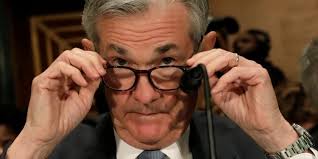
Fed Chair Jerome Powell apparently doesn’t see the pernicious effects of inflation
At one time, the Federal Reserve’s sole mandate was to maintain stable prices and to “fight inflation.” To the Fed, the financial press, and most everyone else “inflation” means rising prices instead of its original and true definition as an increase in the money supply. Rising prices are a consequence – a very painful consequence – of money printing.
Naturally, the Fed and all other central bankers prefer the definition of inflation as a rise in prices which insidiously hides the fact that they, being the issuers of currency, are the real culprit for increased prices.
Be that as it may, the common understanding of inflation as rising prices has always been seen as pernicious and destructive to an economy and living standards. In the perverted world of modern economics, however, the idea of inflation as an intrinsic evil has been turned on its head and monetary authorities the world over now have “inflation targets” which they hope to attain.
America’s central bank is right in line with this lunacy, as it has been reported that at the Fed’s “May minutes” it wants “a temporary period of inflation modestly above 2 percent [which] would be consistent with the Committee’s symmetric inflation objective.”* Translated into understandable verbiage, the Fed wants everyone to pay at least 2% higher prices for the goods they buy.
Yes, by some crazed thinking US monetary officials believe that consumers paying higher prices is somehow good for economic activity and standards of living! Of course, anyone with a modicum of sense can see that this is absurd and that those who espouse such policy should be laughed at and summarily locked up in an asylum! Yet, this is now standard policy, not just with the Fed, but with the ECU and other central banks.
The baneful consequence of this economic quackery is being felt by American workers as admitted by the Labor Department. Instead of spurring expansion, inflation is eating into and depressing wages:
For workers in ‘production and
nonsupervisory” positions, the value
of the average paycheck has actually
declined in the past year. For those
workers, average ‘real wages’ – a
measure of pay that takes inflation
into account fell – from $22.62 in
May 2017 to $22.59 in May of 2018.*
While the decline in nominal wages is not significant, the manner in which the government now calculates inflation has been skewed to understate its impact. Under the previous calculation, the current US inflation rate is probably closer to 5%.
Wage stagnation is not new. Average real wages peaked more than 40 years ago and have fallen in real terms ever since. Not surprisingly, the drop in wages in real terms began soon after the US went off the last vestiges of the gold standard in 1971.
As sound theory has long ago demonstrated, the idea of economic growth through money printing is absurd. Increases in living standards and real wages can only come about through savings, investment, and capital accumulation. Workers who have superior tools and equipment are obviously more productive than those that do not. Yet, capital goods have to be produced and production takes place over time. Savings allow for the production process.
The level of wages are also closely linked to savings. The greater savings an economy has enables entrepreneurs to bid for workers and increase wage rates. This is how wages rise – competition for labor among businessmen pushes up wage rates. The more savings entrepreneurs have, the higher they can bid for employees.
How and why wage rates rise and how employment is created had been understood by economists of yesteryear. Today, however, the profession is dominated by “inflationists” and monetary cranks who believe that nearly every economic problem can be solved by the printing press. Anyone who holds such ideas cannot be taken seriously.
While the Federal Reserve may think an inflation target will create prosperity, the reality for real wages is quite the opposite. The laws of economic science have not been repealed. An inflation target will lead to the impoverishment of not just workers, but lower living standards for all.
*Jeff Stein and Andrew van Dam, “For the Biggest Group of American Workers, Wages Aren’t Just Flat. They’re Falling.” The Washington Post. 16 June 2018 A10.
A couple of recent articles have once more made the case, at least implicitly, for political decentralization as the only viable path which will begin to solve the seemingly insurmountable political, economic, and social crises which the Western world now faces.
In the last few months, over 3,000 millionaires have fled the hopelessly corrupt and bankrupt state of Illinois. When asked, 47% of Illinoisans would like to leave the state which, over the last decade, has seen over a half million of its residents flee. Naturally, this exodus has exacerbated the Land of Lincoln’s financial straits to catastrophic levels.*
A report published by the American Legislative Exchange Council predicted that the tax flight which is occurring in Illinois will similarly take place in the coming years in high-tax blue states such as California and New York. The 2017 Trump tax reform will accelerate this process since under the new legislation the amount of state income tax that can be deducted on federal tax returns has been capped at $10,000 per family. The authors of the report wrote: “. . . high [income] earners in places with hefty income taxes – not just California and New York, but also Minnesota and New Jersey – will bear more of the true cost of their state government.”**
The not too subtle consequences of the new tax code will mean an even greater exodus of taxpayers out of blue states which will shrink state revenues even further and create job losses across the board.
While those who want to escape the crushing burden of individual state taxation and regulation, if they have the means and desire to do so, can move to more favorable climes, no such option exists (except the drastic step of expatriation) to escape federal tyranny. Yet, the same benefits which occur from a multiple of individual states and jurisdictions would be present if the various nation states which dominate the globe were broken up into smaller political units.
While the authors of the cited articles see the advantage that multiple states have where one can “vote with his feet,” the same logic can be applied to central governments across the planet who are, on the whole, more tyrannical than local jurisdictions. More political bodies would not only provide sanctuary for the oppressed, but it would tend to keep a check on tyranny among existing states.
Political decentralization is a far greater deterrent to government largesse than constitutions, elections, or finding the “right person” to “fix things.” The events of the last few weeks in the realm of US foreign policy once again demonstrate that trusting candidates to fulfill campaign promises is naive, to say the least.
To get to this goal, all and every secession movement, even of a Leftist bent, should be supported, whether they are nations that want to “exit” from larger political units, such as Great Britain from the EU, or within nation states themselves such as California in the US. All should be encouraged.
Of course, the case for decentralization has to be made on ideological grounds. The Left, most likely, will not be a natural ally for secession, nor are conservatives, most of whom are under the spell of “nationalism” and “restoring the Republic.” Yet, the Right offers the best opportunity to build a secession movement and needs to be convinced that the preservation of the nation state will only lead to the complete triumph of liberalism.
Secession would also necessitate the breakup of the nation-state’s monopoly of money and banking. Numerous political divisions would be more likely to adopt a single monetary unit – gold – which would guarantee financial stability rather than the debt ridden paper-money system now in place.
Next to the outbreak of World War III, immigration is the greatest threat to what remains of Western Civilization. Smaller political units would be far better to control their borders than reliance on a central authority which can be easily manipulated from outside agents.
The solution to the myriad of social and economic problems that confront Western societies will not come about from a “reform” of the nation state, but through its dissolution. Only through a world made up of hundreds, if not thousands, of Lichtensteins, Hong Kongs, Monacos, confederacies, free cities, etc., will these crises be hoped to be resolved.
**Robert Frank. “800,000 People Are About to Flee New York and California Because of Taxes, Say Economists.” CNBC.com. 26 April 2018. https://www.cnbc.com/2018/04/26/800000-people-are-about-to-flee-new-york-california-because-of-taxes.html?__source=sharebar|twitter&par=sharebar
The Bomber-in-Chief announces air attacks on Syria
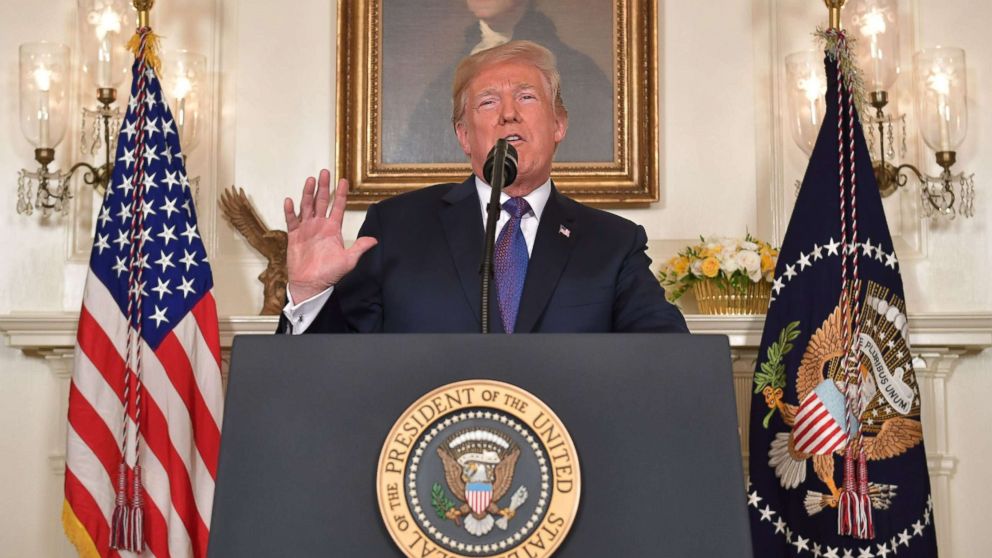
Despite the vehement pleas and letter-writing campaigns by a significant portion of his political base including notable media personalities such as Tucker Carlson against military action in Syria, President Trump committed what looks like political suicide by ordering air strikes on Friday evening. The bombing, thankfully, appeared to have been thwarted by Syrian air defenses, nor, as of this date, has the insane American, British and French action led to a wider conflagration.
As of yet, no doubt due to Divine Intervention, WWIII has not erupted and although the ramifications of the attack will reverberate for weeks to come, what is clear is that President Trump is now firmly in the clutches of the neocons, Israel, and the American Deep State, all of who are the direct beneficiaries of the wanton attack on the Assad regime.
A good portion of Trump’s base is rightfully enraged by the action, which will dash any hope of it coming to his aid if future impeachment proceedings are commenced over the Mueller investigation. Many of Trump’s supporters have been seething ever since he signed off on the $1.3 trillion omnibus spending package in March and his continued failure to start construction on a border wall.
Talk about shooting one’s self in the foot!
Whether President Trump survives until 2020 or is replaced in the interim by neocon Mike Pence, American foreign policy will, in all likelihood, continue its bellicose ways. Ever since WWI, which the current Bomber-in-Chief mentioned in his address announcing the air strikes, America has been an interventionist, destructive, and murderous empire.
The reason for this is that the nation’s ideology had changed where it had once trumpeted the ideas of non-intervention and peace (except, of course, for the people of the South during their heroic attempt at independence) to those that glorified empire and war, largely based on the British model which, ironically, was the system that America seceded from in 1776. By the time of WWI (actually the disgraceful Spanish-American War), the ideals of non-intervention, peace, free trade, and hard money had been gradually replaced by those of empire, central banking, war, and debt.
Until there is a change in ideology, it is unlikely that the US will refrain from its interventionist foreign policy. And, typically, social change comes after men’s minds have been convinced of a different paradigm which, of course, does not happen overnight.
Like the British Empire before it, the only way the US will stop its murderous ways will be from economic collapse or a severe financial panic which threatens or ends the US dollar’s status as the world reserve currency.
Candidate Trump may have been the last hope of an American Firster who had the wherewithal to attain the Presidency. Although not an ideologue, Trump spoke of getting along with Russia, disengaging from the Middle East, and backing out of, or making NATO members pay for their own “defense.” These qualities faded once elected and the ominous talk about scuttling the Iranian arms deal and spending more on the military were pushed ahead.
After WWII, Britain had simply exhausted itself with its insane participation in the world wars and could no longer maintain its empire. Britain’s ideology did not change, but reality stepped in: it simply did not have the capacity (wealth) to fund a world-wide empire. It had squandered its resources and men on the battlefields of Europe.
Winston Churchill destroyer of the British Empire
The US is headed in the same direction, which is what both Russia and China are counting on. Its crushing debt burden, costly wars, and out-of-control spending are sapping its productive capacity, which the military industrial complex taps to sustain itself.
The US’ enemies have based their strategies on this. In reference to the US’ involvement in the Afghanistan quagmire, Osama bin Laden reportedly said:
We, alongside the mujahideen, bled Russia for 10
years, until it went bankrupt and was forced to
withdraw in defeat . . . So we are continuing this
policy in bleeding America to the point of bankruptcy.*
Osama Bin Laden
The question that remains is when will a collapse occur or at least another crisis like in 2008 take place? The warning signs abound. The most pressing is the exploding US deficit which has soared in March to $209 billion. In 2007, the entire deficit for the year was less than $200 billion!
The collapse of the US economy is unavoidable, however, it is not “if” but “when.” For world peace, it had better be sooner than later.
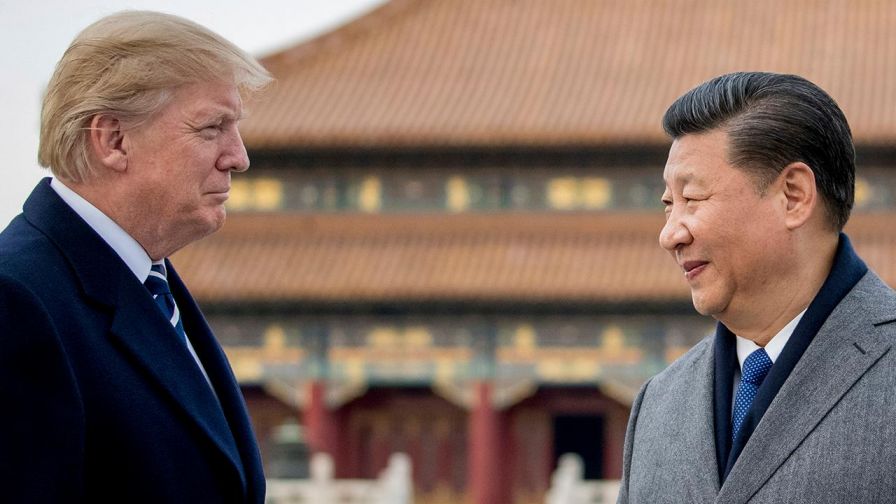
Instead of a demonstration of its overwhelming military might intended to intimidate tiny North Korea and pressure China to lean on its defiant communist neighbor, President Trump and the West should try to learn a few things from China.
The President’s trip to the Far East came on the heels of the completion of China’s 19th National Congress where the current president, Xi Jinping, has cunningly positioned himself as China’s unchallenged leader. In an address at the opening of the Congress, Xi cautioned that the country faced “challenges” that are “extremely grim” yet, despite these, the nation’s future is “extremely bright.”*
While Western politicos and pundits bemoan the lack of political pluralism that exists within China and President Trump complained about bad trade “deals,” they miss an important factor as to why China has transformed itself from a socialist basket case some three decades ago into an economic powerhouse which now boasts over a third of the world’s billionaires!
China’s economic ascendancy can be attributed not only to the implementation of market reforms in the 1990s, but also its lack of “political competition.” As a one-party state, resources, time, energy, and capital are not allowed to be channeled into wasteful political processes, but instead are used and “invested” in wealth-creation activities – construction, factories, plants, equipment, research, technology – all of which leads to more and cheaper consumer goods.
The US and the West spend too much on elections, campaigns, polling, political consultation, etc., which diverts scarce resources away from the private wealth sectors of society. For example, in her last failed presidential campaign run, the Wicked Witch of Chappaqua alone spent over a half of billion dollars.
Under Western democratic pluralism, public debt and state spending have increased to unsustainable levels. In the US alone – history’s greatest debtor nation – the national debt is in excess of $20 trillion, while its total debt officially is $68 billion with a federal deficit (GAAP) running yearly at $5 ½ trillion.
Such staggering numbers are the result, in part, from political parties seeking public office and once elected exploiting their position to enrich themselves, their constituents, and create dependent classes among the ever shrinking productive segments of society.
China’s foreign policy – an extension of politics – has also been conducive for wealth creation. Instead of wasteful spending on military hardware, the maintenance of a far-flung global empire, and involvement in incessant wars, China has a rather meek military compared to its national income and has conducted a pretty much non-interventionist foreign policy – witness its diplomacy with North Korea.
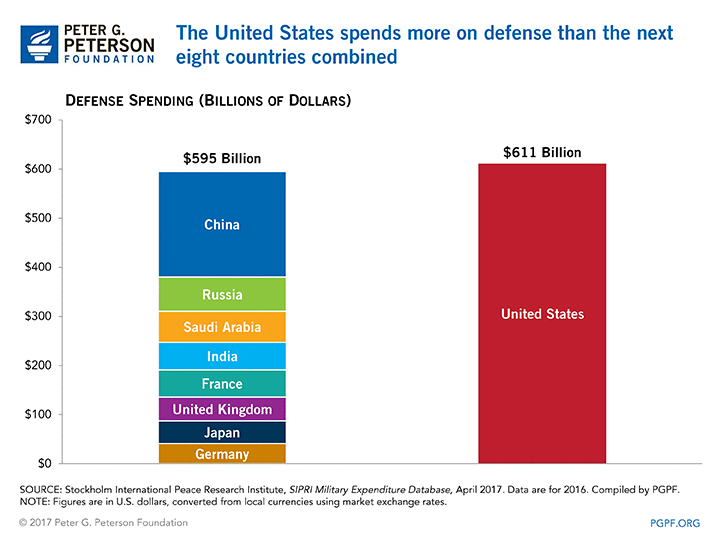
The US is almost the polar opposite. It spends more on “defense” than the next eight countries combined.** Instead of the production of useful consumer goods, billions are siphoned off into the military/security industrial complex. Not only does this impoverish Americans at home, but it leads to never ending involvement in wars, conflicts, and disputes, most of which are created or exacerbated by US spy organizations.
After meeting with Chinese leadership, President Trump tweeted:
I don’t blame China, I blame the incompetence
of past Admins for allowing China to take advantage
of the U.S. on trade leading up to a point where the
U.S. is losing $100’s of billions. How can you blame
China for taking advantage of people that had no clue?
I would’ve done the same!
Making better trade deals will not revitalize the moribund US economy. Instead, there should be less politicization of society and adoption of market reforms as China has done. The most important plank of such a policy would be the encouragement of real savings – not the creation of bank credit – through the normalization of interest rates. This would begin the arduous process of capital accumulation, the basis upon which any economy can be built.
Another sign of the divergence between the two is China’s continued push to make the yuan the world’s reserve currency with apparently some sort of gold backing to it. Contrarily, the Trump Administration has continued the same disastrous policies of its predecessors and has chosen a Janet Yellen clone to head the Federal Reserve with a continuation, no doubt, of the suppression of interest rates. On the other hand, China continues to import massive quantities of gold and encourages its citizens to own the yellow metal while the West is in the midst of a crypto currency mania, another fraudulent monetary scheme.
China’s economic miracle, while certainly impressive, would not look as astounding if Western economies had not been in a state of stagnation and decline over the past half century. It was not political liberalization that led to China’s phenomenal growth, but economic freedom which used to be a staple of Western life. The lesson that should be taken from President Trump’s trip is less politics domestically and more free markets.
*Chris Buckley, “Xi Jinping Opens China’s Party Congress, His Hold Tighter Than Ever.” The New York Times, 17 October 2017. https://www.nytimes.com/2017/10/17/world/asia/xi-jinping-communist-party-china.html
It is altogether fitting that crypto currencies, in particular Bitcoin, have witnessed a meteoric rise in this illusionary age. Not only has their monetary value gone to dizzying heights, but they are now being touted as the destroyer of the current, crumbling monetary order and the next paradigm upon which a new money and banking system will emerge.
In an era where sacrifice, hard work, loyalty, ingenuity, tradition, and independent thought are considered anathemas, while affirmative action, sloth, effeminacy, office seeking, and something-for-nothing schemes are endemic in every walk of life, it is not surprising that non-tangible, computer-generated currencies would become a “natural” feature of such a world.
While it has always been a haven for charlatans, traitors, cheats, thieves, liars, and serial adulterers, contemporary political life has become even more of a sham. The most glaring example of politics’ utter corruption can be seen in the recent departed chief executive officer of the US. Unless one abandons all critical thinking, Obummer was unqualified to be president because of the obvious fact that he was not born on American soil. Not only did this disqualify him, but his educational and professional backgrounds have not been verified. Neither his collegiate records nor his supposed teaching career at the University of Chicago Law School have ever been exposed to public scrutiny. From the few utterances he has made about his supposed specialty – constitutional law – it appears that he has only a rudimentary knowledge of the subject.
Cultural life has descended to the basest of levels and has abandoned nearly all of Western Civilization’s glorious achievements. Consider music. The dominant form of what passes as music today is not the works of the great maestros of the past – Bach, Mozart, Beethoven – but instead, noise in the form of rock, hip hop, rap, grunge, or whatever the latest degenerate trend is in vogue.
Modern democracy is also a fallacy. Being sold to the masses as a system where the people rule and personal liberties are guaranteed, democratic governance is anything but, and has instead been craftily used by the elites to amass state power to an unprecedented extent not witnessed in human history. The much maligned monarchial age even during its “absolutist phase” could not come close to the scope and intrusiveness that democratic governments possess today.
Religion, too, is not immune from its share of hypocrisy. Not only is the supposed head of the Catholic Church a manifest heretic who almost daily blasphemies the Divine Majesty, but he is not qualified to occupy the august chair in which he sits. Jorge Bergoglio was neither ordained as a priest nor consecrated as a bishop in the traditional, Apostolic rite of Holy Orders. He is, therefore, an imposter not a priest, nor the bishop of Rome, and scandalously not a true pope.
Now enter crypto currencies. Not only will they never become money – a general medium of exchange – as gold and silver once were and will become once again, but cryptos lack the necessary requirements to be money. Yet, their “development” is systematic of the times. Cryptos are another variant of fiat currencies which digitally can be created by a stroke of a computer key or in cryptos’ case, a code.
Gold and silver – real money – must be mined from the ground, minted and “marketed” before they can be used to facilitate exchange. This is an arduous, capital-intensive process which takes resources, labor, and time to accomplish. Something as important as money should require an elaborate procedure not be created out of thin air as are all fiat currencies as well as cryptos.
Money must originate as a tangible, sought-after commodity – the great Misesian insight that crypto enthusiasts do not know or do not understand – then, over time, be recognized as having a “second feature” as a good sought after for “exchange value.” Once a good is demanded for its use primarily to facilitate exchange, it then becomes a “money.”
In a fundamental sense, crypto currency cultists are rebelling against the natural order of things. The precious metals were created in their quantity and quality by Divine Wisdom for a purpose – to act as money. While governments have habitually corrupted the monetary order through coin clipping, fractional-reserve banking, and other nefarious schemes, it does not undo this primordial fact. It is for the intellectually honest opponents of monetary chicanery to point this out and decry all governments and banksters’ attempts to eradicate gold and silver as money, not attempt to create another unnatural and false monetary order that mirrors the current fiat system.
Money, like all other institutions of society, will reflect its belief system. Decaying cultures will most likely have debased monetary units. A turnabout in the status of money will only happen when Western Civilization returns to what money is – gold and silver – and abstains from trying to create illusions of it through computer software schemes.




 vs.
vs. 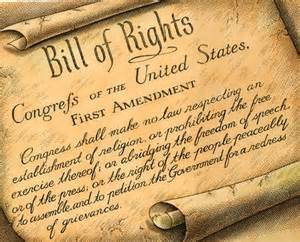
 Fed Chair Jerome Powell apparently doesn’t see the pernicious effects of inflation


 Antonius Aquinas