Category Archives: Taxation

Big Spending Continues Under Trump

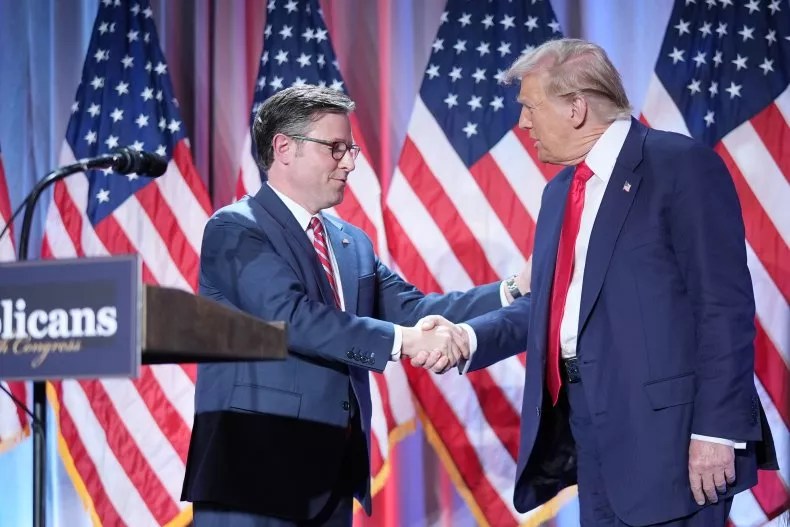
While DOGE (the Department of Government Efficiency) has made almost daily headlines pointing out fraud and waste in government, the real battle over federal spending is beginning to take place.  From what has been proposed, it looks like it will be business as usual in Washington.

Last week, the full House of Representatives passed the House Budget Committee’s plan (budget resolution) which specifies cuts in both taxes and spending over the next decade.  The key phrase here is “over the next decade.”

In a Feb. 13, 2025 Tax Foundation article titled “House Budget Resolution Aims to Balance Tax Cut and Spending Reduction Goals,” William McBride, explains that:

The resolution caps the deficit increase resulting from

                   tax cuts at $4.5 trillion over the next decade and requires

                   a minimum of $1.2 trillion in spending cuts.  Additionally,

                   it sets as a goal to reduce mandatory spending by $2 trillion

                   over the next decade, and, if not accomplished, the cap on

                   tax cuts would be reduced commensurately. *

The resolution calls for certain committees to implement the cuts:

  • Energy and Commerce Committee ($880 billion)
  • Education and Workforce Committee ($330 billion)
  • Agriculture Committee ($230 billion)

Programs that more than likely face budget reductions include: Medicaid, student loan relief, and the Supplemental Nutrition Program. 

Despite Defense Secretary Pete Hegseth’s call for an 8% yearly cut in defense spending over the next five years, the current House resolution would increase defense spending by $100 billion. There is an additional increase of $230 billion for border control and “deportation plans to be executed” according to Brett Samuels of the political website The Hill, in an article he penned titled “Trump Backs House GOP Reconciliation Bill Over Senate Version.”  ** 

Like Trump and most of his administration, Hegseth has sent conflicting signals on defense spending.  While in Germany, the defense secretary said: “I think the US needs to spend more than the Biden administration was willing to, who historically under-invested in the capabilities of our military.”

Hegseth bombastically added that he wants “the biggest most badass military on the planet,” as quoted by Dave DeCamp of news and commentary website Antiwar.com in a Feb 2025 analysis. *** So much for an America first foreign policy. 

The House’s estimate for spending and tax cuts are based on a real rate of growth of 2.6%.  This optimistic forecast, of course, does not account for any downturn in the economy, war, or continued uptick in price inflation.  Any of these, or some exogeneous shock to the economy would lower gross domestic product and tax revenues and jeopardize any long-term projected tax or spending cuts.

In the end, the budget resolution will increase spending, which Trump vowed to curb, as Rep. Thomas Massie (KY), who courageously voted against, succinctly summarized:

If the Republican plan passes under the rosiest

                                                assumptions, which aren’t even true, we’re gonna

                                                add $328 billion to the deficit this year, we’re gonna

                                                add $295 billion to the deficit the year after that, and

                                                $242 billion to the deficit after that. . . . ****
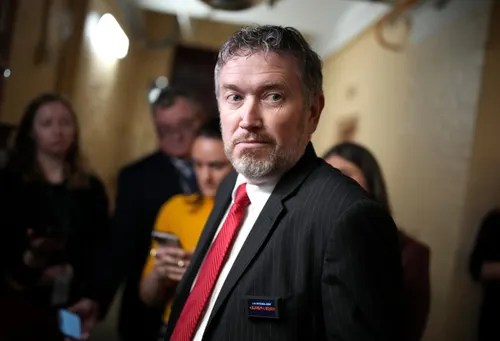
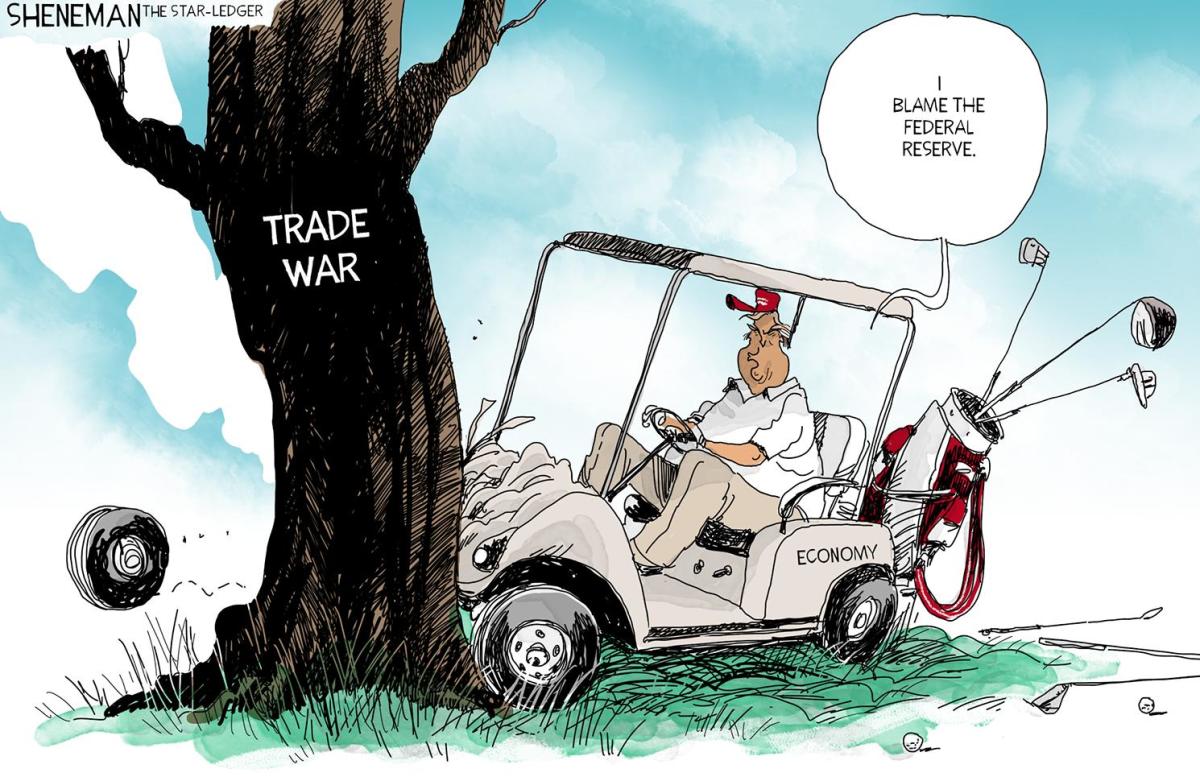
Trump, who enthusiastically supports the budget resolution, fails to realize that without deep and significant spending cuts, the cost of living will continue to escalate.  The president blamed the Biden Administration’s policies for the run-up in prices, when, in fact, it was Trump who began the present inflation cycle with the passage of the CARES Act in 2020, expanding the budget an unimaginable $2.2 trillion.

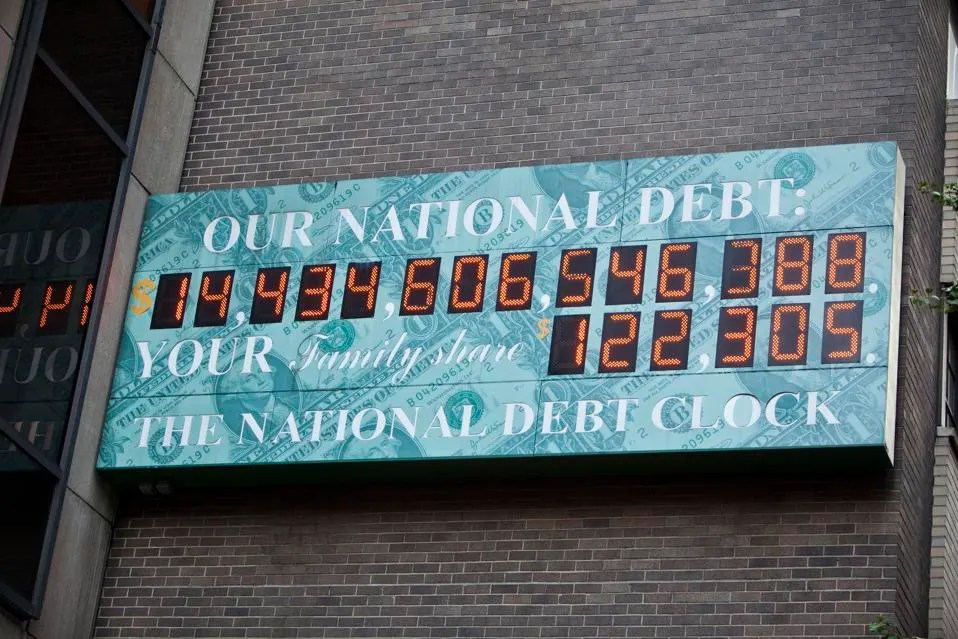
Without spending cuts, the burgeoning federal deficit ($2 trillion) and the interest on the national debt ($1 trillion) will need to be continually financed through borrowing.  The borrowing by the federal government is “paid for” through money printing (the real definition of inflation) by the Federal Reserve which buys U.S. debt with money “created out of thin air” which in essence is debt monetization.  The new money puts pressure on prices as it filters through the economy increasing the cost of living. 

While cuts in spending and reducing the amount of dollars in circulation will lower the cost of living, it will not come without severe economic pain.  The fall in prices will pop the bubble that stocks and other financial assets have been in which will result in widespread unemployment and business failures.  This is necessary to cleanse the malinvestment caused by the money printing and credit expansion and is necessary if America is to be put on a sound financial footing.

Of course, no politician wants to be blamed for such misery and even though Trump will not be up for re-election, he still does not want to be holding the bag when the economy implodes.  Yet, if such a scenario happens, the president should bear much of the blame for his policies ignited the present problem.

If President Trump truly wants to make America great again, cutting government spending must be undertaken no matter how painful. 

It appears, however, that he will join the long list of chief executives who have spent the nation into a horrific debt spiral which will inevitably end in economic ruin.

*William McBride, “House Budget Resolution Aims to Balance Tax Cut and Spending Reduction Goals,” Tax Foundation, 13 February 2025.  https://taxfoundation.org/blog/house-budget-resolution-tax-cuts-spending/

**Brett Samuels, “Trump backs House GOP reconciliation bill over Senate version,” The Hill, 19 February 2025.   https://thehill.com/homenews/administration/5152871-trump-endorses-house-gop-strategy/

***Dave DeCamp, “Pentagon Says Hegseth’s Order Will Redirect Spending, Not Make Actual Cuts,” Antiwar.com, 20 February 2025.

****Tyler Durden, “House Republicans Advance Trump Agenda as Final Vote Looms Tonight.” Zero Hedge, 25 February 2025,  https://www.zerohedge.com/political/house-republicans-advance-trump-agenda-final-vote-looms-tonight

Antonius Aquinas@AntoniusAquinas

Trump’s Grandiose Political Centralization Scheme Not America-First in Spirit

Colorful houses of the coastal town of Ilulissat in western Greenland.

Although Donald Trump is now in office, his statements since the election indicated he has forgotten his pledge to follow an “America first” foreign policy. This is what he promised during the recent presidential contest and what he pledged in the 2016 campaign, but failed to deliver during his first term.  While domestic issues are what a president is mostly concerned with, the most important decisions surround foreign affairs, since they often involve war.

Since his lopsided victory over the hapless Kamala Harris, Trump has made few references about reigning in the murderous U.S. Empire, but instead has talked about buying or invading Greenland, seizing the Panama Canal, and making Canada an American state.  After the resignation of Prime Minister Justin Trudeau, Trump said that “many people in Canada love being the 51st state,” according to The New York Times, Jan. 7.*

If Joe Biden or Kamala Harris said such things, the MAGA crowd would be up in arms and accuse them of moving the country in the direction of the New World Order.

Whether Trump follows through with such fanciful plans, it shows that he does not understand what lies at the heart of the social and economic problems that America and the Western world face.  Trump’s ideas would create greater political centralization, as an American-Canadian or American-Canadian-Mexican-Greenland union would create a gigantic North American state.

For anyone concerned with individual liberty, prosperity, and the No. 1 social issue that confronts the U.S. – illegal immigration – a North American superstate would be a nightmare. Gone would be the vital ability of “dissenters” to “vote with their feet” and move to less burdensome political jurisdictions.

In the United States, one can see this taking place on a daily basis as Americans move from high-tax and high regulatory states to those less onerous.  Of course, citizens cannot escape the federal government’s dictates unless one decides to expatriate. Students of the nation’s history know the often-overlooked Anti-federalists made this argument in their opposition to the Constitution which has, over time, proven to be quite prescient.

The idea that more political entities lead to greater freedom has been proven by history.  The best example of this is pre-modern Europe which was made up of a host of kingdoms, duchies, and free states with no dominant central government that could tax without impunity.  It is well accepted by historians that Europe’s rise in its standard of living was the result of its political decentralization that resulted in low levels of taxation.

A multitude of nation states allows for “competition,” where if one government becomes too tyrannical, people have an opportunity to flee to another land.  In recent U.S. history, a number of draft-aged men fled to Canada instead of being sent off to Vietnam to fight in what they considered an immoral war.  A colossal North American state would have ended such an option.

Although not explicitly discussed by Trump, a North American Union would more than likely mean the creation of a new monetary unit as was done with the euro when the European Union was formed.  Despite the warnings of some economists, price inflation in Europe escalated for countries like Germany once they relinquished their monetary autonomy. 

Currently, national currencies “float” against one another in terms of exchange rates. If one central bank inflates its currency too much, its money will lose purchasing power to less inflationary nations.  While not nearly as good as a gold standard, there is a sort of a “check and balance” on central bank monetary debasement with floating exchange rates.

A single North American monetary unit would not face the kind of limit that now exists, where the Canadian dollar, Mexican peso and U.S. dollar vie against each other.  A North American currency would be another ominous step to a one-world currency – a dream of New World Order proponents. 

While Trump’s disappointing talk about political centralization looks like a betrayal of the principles of America first principles, there may be a glimmer of hope.  In a recent Truth Social post, Trump reposted a video of Prof. Jeffery Sachs, a longtime critic of American foreign policy, criticizing Israeli Prime Minister Benjamin Netanyahu’s genocidal actions in Gaza and throughout the Middle East calling him a “deep, dark SOB.”

Since the video has been posted, Netanyahu has canceled his plans to attend Trump’s inauguration, the implication being the Israeli leader was offended by the comment.

Only time will tell if Trump will abandon his promised America-first policies or pursue a drive to a New World Order.

*David E. Sanger and Michael D. Shear, “Trump Floats Using Force to Take Greenland and the Panama Canal,”  The New York Times, 7 January 2025. 

Antonius Aquinas@antoniusaquinas

https://antoniusaquinas.com

Taxes vs. Tariffs: Which is Fairer?

In the final days of his presidential run, Donald Trump floated the idea of eliminating the income tax and replacing it with tariffs as the means to fund federal spending.  He cited the era of U.S. history when the country had no income tax:

When we were a smart country, in the 1890s . .

this is when the country was relatively the

richest it ever was.  It had all tariffs.  It didn’t

have an income tax.*

While Trump was correct about the prosperity at the time, it is wrong to suggest that tariffs were the reason.  While there was no income tax, there was little if any burdensome regulation or government subsidy, and, most importantly, the nation was on a gold standard, which kept increasing the purchasing power of wages, all of which raised living standards to unprecedented heights.

On the surface, the idea of replacing the income tax with tariffs seems equitable. This is why many conservatives, populists, and libertarians have supported the idea. 

Under the present political order, the United States is a constitutional republic that is based on the social contract theory.  Government is established, in part, to protect the persons and property from external threats and internal unrest.  All citizens, in theory at least, are protected by the state.  It follows, therefore, that they are obliged to contribute to their defense.

Tariffs, on the other hand, are borne directly by two groups: consumers who buy imported goods, and businesses who sell imported goods and are impacted by a loss of income. 

Consumers pay the tax levied on foreign goods.  Therefore, those consumers who buy more expensive goods, such as a Mercedes Benz, pay a higher percentage of tax than those who buy trinkets such as Christmas tree ornaments and plastic cutlery from China.

Businesses, too, suffer from tariffs.  While it is often said that the tax is “passed on to consumers,” companies will see a reduction in income, since tariffs raise the price of goods.  Higher prices will cause a fall in demand, resulting in loss revenue.  Moreover, businesses who deal in foreign products have to bear the bureaucratic cost of complying with the government’s ever-changing trade policies while serving as tax collector for the state. 

While the income tax under social contract theory is more “equitable” than tariffs, one of its most egregious features cannot be justified.  Under current law, American citizens that are living abroad or have relocated permanently are still subjected to the income tax.  However, expats are no longer being defended by the U.S. government.  Renouncing citizenship (which is quite costly) is the only way to avoid being taxed.

Why should Americans, who are no longer being defended by their government, still be required to pay for it?  This would be a clear violation of the “social contract” that citizens have supposedly agreed to. 

There are other dangers that have come with government financing through tariffs, or, as some have called for, a national sales tax. Originally, when the income tax was proposed, it was to replace tariffs.  Tariffs, like all sales taxes, burden the poor and middle class disproportionately.  The income tax, which at first only affected the affluent, was accepted by the public since tariffs were to be eliminated.  Unfortunately, the tariffs remained after the two world wars and the income tax was levied on almost everyone. 

A similar situation could occur with the expansion of tariffs or the implementation of a national sales tax.  Governments rarely relinquish their taxing power.  

What is being ignored in the talk about tariffs and the income tax are the exploding government deficits.  Fiddling with what source of revenue the government collects is not addressing an impending financial crisis that could bring down the entire U.S. economy.

Of course, runaway debts and deficits are inherent in democratic republics as politicians are not personally responsible for the debt, unlike a monarch or king.  This is another flaw in the social contract theory. 

Before policy makers change the nation’s tax system, they should carefully consider the ramifications and seek to find the most equitable solution that will not burden only part of the citizenry. Cutting runaway federal spending is a first step.       

*https://www.cnn.com/2024/10/26/politics/trump-income-taxes-tariffs/index.html

“Don’t Buy Government Bonds”

As another farcical “debt-ceiling raising” saga unfolds, conducted by the two indistinguishable political parties hell-bent on driving America into economic ruin, it would be instructive to look at how some earlier conservative/libertarian thinkers viewed public debt.  Unlike the present generation – with the notable exception of Ron Paul – these intellectuals asked fundamental questions about such matters as debt, taxation, central banking, and foreign policy.

One of the leading lights of what was known as the “Old Right” of the 1950’s, which opposed the Cold-War globalism of the likes of William Buckley and domestically sought to overturn the New Deal, was Frank Chodorov (1887-1966).  In his books and essays, Chodorov challenged the pillars which social democracy rested and sought to return America to small government, free trade, and “isolationism.” 

In one of his provocative essays, Chodorov pervasively argued that those who purchase public debt are complicit in the enhancement of state power.  Unlike many present-day economists who only see the baneful economic effects of profligate government borrowing, he makes a moral case against debt financing.*

He points out that public borrowing burdens future generations for the benefit of the present.  Despite reasons often given for the necessity of borrowing – war, natural disaster, infrastructure, etc., – Chodorov contends that the practice of shifting the cost to later generations, whatever the reason, is unjust:

This is exactly what you do when you
cooperate with the State’s borrowing
program. You are loading on your children
and your children’s children an obligation to
pay for something they had no voice in, and
for which they may not care at all. Your
‘investment for posterity’ may earn you
nothing but the curses of posterity.

Chodorov understood, as most commentators do not today, that a gold-backed currency restrained State largesse: “When money was redeemable in gold, the inherent profligacy of government was somewhat retrained; for, if the citizen lost faith in his money, or his bond, he could demand gold in exchange, and since the government did not have enough gold on hand to meet the demand, it had to curtail its spending proclivity accordingly.”

It was Franklin Delano Roosevelt’s despicable and criminal act of taking the U.S. off the gold standard domestically that led to the expansion of the public debt as Chodorov describes: “. . . Mr. Roosevelt removed this shackle and thus opened the flood gates.  The only limit to the inclination of every politician to spend money, in order to acquire power, is the refusal of the public to lend its money to the government. . . . the government can then resort to printing of money, to make money out of nothing. . . .” 

Not realized at the time, but the ability of the American government to expand its revenue base fit nicely into FDR’s later nefarious foreign policy objectives. 

Chodorov’s viewpoint on public debt can also easily be applied to FDR’s decision to eradicate the gold standard through which the U.S. currency could be redeemed for precious metals.  FDR’s act, however, was a “violation of contract” with American citizens since the U.S. government defaulted on its obligations.

In Orwellian fashion, the verbiage used with most government operations is often misused to legitimize State functions.  “Investment” is one such term that has been corrupted in relations to spending and debt.

In promoting their spending schemes, politicians will often use the term investment, “investment in education,” “investment in infrastructure,” etc.  This is deliberate, since it tries to equate government spending with a vital component of the market process.

In a market economy, investment means the lending of savings, which is used to expand and/or start an enterprise.  In return, the lender receives a stock or a bond.  If the business is successful, the lender’s investment will receive a return – dividends from a stock or interest from a bond.  Business investment is, therefore, a necessary aspect of capitalism which results in economic growth and increased living standards.

As Chodorov incisively points out, however, government investment is the antithesis of what takes place in the marketplace:  

The State, however, does not put your money into production.  The State spends it – that is all the State is capable of doing – and your savings disappear.  The interest you get comes out of the tax fund, to which you contribute your share, and your share is increased by the cost of servicing your bond.

Chodorov’s solution to deficit financing was not to buy government bonds.  While this would certainly be a step in the right direction, a more radical approach is needed since the problem has now become so immense. 

Simply put: there should be a prohibition on government borrowing of any kind.  State revenues should only come through tax receipts and fees paid by those in the present.  This would completely eliminate the “moral hazard” of debt financing and drastically reduce the size and scope of government over society.

For those who seek to put an end to the current debt-ceiling charade and rectify the immoral practice of burdening future generations by the irresponsibility of the present, the works of Frank Chodorov are essential.

* “Don’t Buy Government Bonds,” The Mises Institute, 13 January 2011. https://cdn.mises.org/Out%20of%20Step_4.pdf

Antonius Aquinas@AntoniusAquinas
https://antoniusaquinas.com

The Convention of States Project: A Bad Idea

Similar to Patrick Buchanan’s campaigns, Newt Gingrich’s “Contract with America,” the Tea Party, and to some extent Donald Trump’s presidency, the Convention of States Project* will not solve the crises that America faces.  It will, undoubtedly, like most of the previous reform and populist movements be sabotaged by the ruling class if it ever gets close to accomplishing its goals.

The Project’s rhetoric is “old-style” conservative/populist-speak which seeks to “[propose] amendments that impose fiscal restraint on the federal government, limit the power and jurisdiction of the federal government, and limit the terms of office for its officials and for members of Congress.”** Some of the proposed amendments include:

  • Congressional term limits
  • Requiring a two-thirds vote of the House and Senate to increase the public debt
  • Restoring the Commerce Clause to its original intent and scope
  • Repeal of the 16th Amendment, which gave us the income tax
  • Giving states, by a three-fifths vote, the power to negate any federal law, regulation or executive order giving Congress an easy means of overriding regulation

So far, 19 state legislatures have called for a constitutional convention, 34 states are needed for a convention to be called and, for an amendment to be passed, it must be approved by three quarters of state legislatures. 

The state legislatures who have signed on have realized that the federal government has become omnipotent and the individual states are now merely appendages to Washington.  “The states,” said South Carolina state representative Bill Taylor, “have sort of lost their voice, and all we can do now is beg from the cheap seats and say, ‘Hey, don’t do that.’”***

After the totalitarian and draconian efforts of the U.S. government and those around the world the past two years in response to the “pandemic,” Mr. Taylor’s sentiment is, to say the least, an understatement!

The fundamental problem with efforts such as the Convention of States Project is that they do not understand the nature of the crises that both America and most of the world face.  For America, its current malaise can be traced shortly after its independence with the adoption of the Constitution itself. 

While it has long been touted as a great document of freedom and liberty, it is anything but.  The “founding fathers” knowingly created a powerful central government and decreased the sovereignty of the individual state governments which had existed under the Articles of Confederation. 

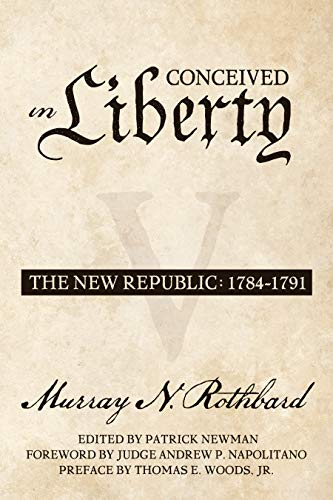
In the words of Murry Rothbard, the Constitution was a coup that, for the most part, was the antithesis of the spirit and drive of the American Revolution which was a movement against political centralization and empire:

It was a bloodless coup d’etat against an unresisting

Confederation Congress. . . . .  The Federalists, by use

of propaganda, chicanery, fraud, malapportionment of

delegates, blackmail threats of secession and even

coercive laws, had managed to sustain enough delegates

to defy the wishes of the majority of the American people

and create a new Constitution.****

Worse than the power grab was the establishment of an omnipotent state as Rothbard incisively continues:

The drive [for ratification] was managed by a

corps of brilliant members and representatives

of the financial and landed oligarchy.  These

wealthy merchants and large landowners were

joined by the urban artisans of the large cities in

their drive to create a strong overriding central

government – a supreme government with its

own absolute power to tax, regulate commerce,

and raise armies.*****

410jXD-zO+L


The celebrated “separation of powers,” and “checks and balances” within the federal system and even the Bill of Rights, so often lauded by conservative and populist commentators, have proven from the very start to be ineffectual in stopping the expansion of state power. 

The Constitution itself declares that it is the ultimate authority as Article VI states:

This Constitution and the laws of the United States which

shall be made in pursuance thereof, and all treaties made,

or which shall be made, under the authority of the United States,

shall be the supreme law of the land. . . . [Italics mine.]

The massive and now unresolvable social, economic and political troubles both in the U.S. and around the world stems from a concentration of political power that is inherent in the nature of constitutional government.  This power is augmented and sustained by a system of central banking which provides the nation state with seemingly unlimited financial power to implement its various social engineering schemes, conduct continuous warfare, and has the ability to crush any opposition to its hegemony. 

The solution, which is all too obvious, but not attainable in the current ideological atmosphere dominated by statist thinking, is political decentralization.

The smaller political alignments under decentralization would probably coalesce around peoples with similar economic, social and religious affiliations and status and those with similar ethnic and racial backgrounds.  Such a system would be truly diverse and undoubtedly lower social tensions which derive from the central state’s forced integration polices. 

Once political decentralization became a reality, the natural and mutually beneficial relationships and interactions between peoples would emerge.  The immense advantage of free trade – the widening of the division of labor and specialization – would be the norm between societies since smaller countries could not afford to restrict trade since doing so would lead to autarky and the resultant fall in standards of living to primitive levels. 

Likewise, a universal monetary standard, most likely based on gold and silver, would arise among differing communities since a multitude of currencies would lead to monetary chaos and render economic calculation an impossibility.  Since no central state could impose its currency, the only honest and sound money – gold/silver – would be quickly adopted by all.

The mass invasion of the U.S. taking place under the negligence and encouragement of the Biden Administration could also be thwarted through political decentralization.  Areas where the lives and property of people are threatened by invaders have more of an incentive to effectively deal with unwanted groups than bureaucrats living often times thousands of miles away. 

Each jurisdiction would make its own policies on who or how many it wanted in its territory.  Moreover, each community could expel undesirables without interference from those who are not property owners or members of such communities.

While those behind the Convention of States Project and the state legislatures which have called for a constitutional convention may be well meaning, they will ultimately fail.  Such efforts are a wrongheaded approach to address the myriad of problems that plague the U.S. and, for that matter, the entire world.

Instead of attempts to amend the Constitution or though the electoral process by finding the “right candidate,” the very viable and historically proven alternative of de-centralization through secession is the only pathway to ultimate success.  Until the break-up of the nation state is accomplished, America and the world’s future will be considerably bleak.

*https://conventionofstates.com/

**https://starkrealities.substack.com/p/activists-more-than-halfway-to-forcing

***Ibid

**** Murray N. Rothbard, Conceived in Liberty. Vol. 5, The New Republic, 1784-1791, ed., Patrick Newman.  Auburn, AL.: Mises Institute, 2019, p. 306.

*****Ibid.

Antonius Aquinas@AntoniusAquinas

https://antoniusaquinas.com


On the 75th Anniversary of V-E Day and the Coronavirus Scamdemic

VE Day Coronavirus

The iconic Champs-Élysées and its Arc de Triomphe stand eerily empty before V-E Day ceremonies Friday in Paris.

This month (May 8th) marks the 75th anniversary of “V-E Day” when German forces unconditionally surrendered to the “Allies.”  Numerous articles, essays, and monographs have appeared commemorating the anniversary and while all are mostly laudatory, some have acknowledged that the outcome had its “drawbacks.”

By any objective rendering, for Western Civilization WWII was an unmitigated catastrophe whose reverberations continue to this day.  Forty-three million troops were senselessly killed between American, British and Continental forces while 38 million civilians perished.  Europe’s current demographic nightmare had its unfruitful seeds cut down with the depopulation of the Continent’s finest for the maniacal aims of the world’s power elites.  Not only the loss of life, but the destruction of property and the cultures upon which they were built have been incalculable.  Although the US emerged in the post-war world as the dominant economic and political power (as its mainland remained unscathed from wartime destruction), its participation in the conflict was a titanic geopolitical blunder.

The defeat of Germany and Japan, which would have not come about without US military might, left vast power vacuums in Eastern Europe and the Far East that Soviet Russia and Red China ruthlessly filled.  Half of Europe would fall behind the Iron Curtain, subjected to fierce political repression and debilitating socialistic economic planning.  In Asia, Communist regimes sprang up with the assistance of China and the Soviet Union which America attempted to counter in Korea and Vietnam at a staggering cost to its domestic economy and social tranquility.

Even after the fall of Soviet Communism, the US’s supposed lethal enemy, America maintained its empire as its “defense” spending continued to escalate beyond all reasonable levels which has led, in part, to the decline of domestic living standards of nearly all except, of course, for the politically well-connected. Not only has military adventurism bankrupted the country, but there is now “blowback” from the countless enemies either real, imagined, or contrived – created by US overseas meddling.  Moreover, the nation’s military-industrial and security complex has turned on its own citizens with spying, surveillance, and data gathering that would be the envy of Stalin’s Cheka. Yet, it was US participation in WWII which cemented the nation on its ruinous course as global policeman.  This was predicted and feared by “isolationists” at the time which is why they so courageously fought to keep the country neutral.

While the peoples of the world suffered from the Apocalyptic-like destruction of the war, certain groups did gain.  The benefactors were obvious – Stalin and the Soviet state which was given free reign in Eastern Europe; the US military and security industrial complex which had a world empire to police; Chinese Communists, with Imperial Japan decimated, it left little opposition for them to gain control in China and beyond.  For almost everyone else, even the so called “victors,” WWII was a Pyrrhic victory at best.

For the remainder of 20th century American history, US entry into the Second World War proved to be the catalyst which led to the immense cultural, economic, and political changes, which many conservatives, libertarians, and traditional-minded people at the time and afterwards opposed.  Yet, it was US participation in the war which meant that all of those changes would become permanent.  Harry Elmer Barnes, who was a keen social theorist and wrote extensively in sociology, clearly understood the effects of US entry into the war:

Drastic changes in the domestic realm can also be attributed to the impact of our

entry into the second World War.  The old rural society that had dominated

humanity for millennia was already disintegrating rapidly as the result of

urbanization and technological advances, but the latter failed to supply adequate

new institutions and agencies to control and direct an urban civilization.  This

situation faced the American public before 1941 but the momentous transformation

was given intensified rapidity and scope as a result of the extensive dislocations

produced by years of warfare and recovery.*

Harry Elmer Barnes Harry Elmer Barnes

While every sector of American life was unalterably changed, the most ominous took place in the political order.  Although the federal government had begun to expand during the Progressive Era, its scope and involvement in society drastically accelerated during and after the war.  Barnes, holding many libertarian beliefs, observed the totalitarian features of the post-war nation:

The complex and cumulative aftermath of [WWII] has played the dominant role in

producing the menacing military pattern and political impasse of our time, and the

military-industrial-political Establishment that controls this country and has sought

to determine world policy.**

The rise of America to world power status diverted attention and scarce resources away from the domestic front, which further exacerbated social and economic changes.  The societal strife would become more and more acute as the nation’s overseas commitments mushroomed, as Barnes incisively explains:

The social problems of an urban age were enlarged and intensified, crime increased

and took on new forms that became ever more difficult to combat, juvenile

disorganization became rampant, racial problems increased beyond precedent, and

the difficulties of dealing with this unprecedented and complicated mass of domestic

issues were both parried and intensified by giving primary but evasive

consideration to foreign affairs in our national policy and operations.***

While domestic problems received less attention as the American empire expanded, foreign lands which held different patterns of social order or had non “democratic” forms of government, were targeted for “regime change,” even if they had taken no hostile action toward the US:

. . .  the results of [WWII] already indicate that this produced drastic and possibly

ominous changes in the pattern of American relations to the rest of the world.  We

voluntarily and arbitrarily assumed unprecedented burdens in feeding and

financing a world badly disrupted by war. . . .  The United States sought to police the

world and extend the rule of law on a planetary basis, which actually meant

imposing the ideology of our eastern seaboard Establishment throughout the world,

by force, if necessary. . . .****

Had the US remained neutral as the isolationists and American First supporters had pleaded, the world today would be markedly different – undoubtedly freer, more prosperous, and likely more peaceful.  Since every society is governed, in part, by its understanding of the past, the post-WWII world is built on a lie.  The lie, of course, was that the attack on Pearl Harbor was unprovoked and that the Roosevelt Administration had negotiated in good faith with the Japanese in the months and years leading up to it.

While not recognized at the time and even today the outcome of WWII ushered in the totalitarian nation state which would become a permanent and intimate fixture in the lives of its citizens.  There was no appeal to its dictates and as the decades rolled on it accrued unthinkable power over the society and economy.  It attempted to solve every social and economic problem or inequality (most of which it created) and in each action enhanced its power and control dramatically.

The corona scamdemic may be the state’s greatest power grab yet.  Besides the infringement of civil liberties, the shut down has been adroitly used to cover for the titanic economic collapse which began in the weeks prior to the draconian response measures.  Actually, the financial breakdown began last September with the Fed’s “repo” operations.

All of this has been quietly and deliberately forgotten by the financial press and under the cover of fighting the virus, the Fed and the rest of the world’s central banks have expanded their power and control of financial markets to unprecedented levels, making a mockery that the economy is in any sense “capitalistic.”

The adage that “history is written by the victors” has never been more apparent than in regard to V-E Day, however, the coronavirus scam has shown once again that the consequences of the day and the war which it commemorates are now being ominously fulfilled.

*Harry Elmer Barnes, “Pearl Harbor After a Quarter of a Century.”  In Left and Right: A Journal of Libertarian Thought.  Vol. IV, 1968, p. 11.

**Ibid., pp. 9-10.

***Ibid., p. 11.

****Ibid., pp. 10-11.

Antonius Aquinas@AntoniusAquinas

https://antoniusaquinas.com

Memo to The Donald: Cut Tariffs NOT Rates

trump tariff

So far, President Trump’s economic response to a potential coronavirus outbreak and a further stock market sell off has been expected – calls for more interest rate cuts and an additional round of monetary stimulus.  For the stock market, economy, and the virus itself, neither measure will have their desired effect and, in fact, may exacerbate things.

Further rate cuts and more money printing will not alleviate the situation since it has been the Federal Reserve’s recent “repo operations” which has pushed the market to its unsustainable highs.  For President Trump’s re-election hopes, the current “correction” better be short lived since he has repeatedly boasted about the stock market and has tied its success with the supposed health of the economy.  He will pay a political price if the market continues to tank and brings the economy down with it.

While President Trump and economic nationalists have bashed China for its trade practices, they are now going to see first hand how dependent the US and the West are on Chinese exports, as supply chains are disrupted over the coronavirus.

A Bloomberg article describes China’s weakest factory activity ever recorded:

The manufacturing purchasing managers’ index plunged to 35.7 in

February form 50 the previous month, according to data received by the

National bureau Statistics on Saturday, much lower than the median

estimate of economists.  Both were well below 50, which denotes

contraction.*

The expected reduction of Chinese goods will mean higher US domestic prices, however, the increase in prices can be offset somewhat not by rate cuts, but by tariff reductions, or, better still, elimination of duties on imports.  Increasing the money supply or cutting interest rates, which is what Trump, the market, and 95% of economists favor, will only mean higher prices for dwindling imports as greater amounts of money will chase fewer goods.

In the President’s comments on the coronavirus and the stock market plunge, he has repeatedly cited other nations’ (Japan, Germany) – lower interest rates as a policy that the Fed should pursue.  Apparently, the President is not aware that recent data out of Japan has shown that the economy shrank at an annualized rate of 6.3% for the fourth quarter of 2019 while the German economy only grew at 0.6% last year.**  Low rates have not helped either economy or anywhere else where they have been foolishly tried.

What President Trump, world policy makers, and central bankers do not understand, whether deliberately or from willful ignorance, is that the artificial suppression of interest rates and money printing does not lead to economic growth. Instead, prosperity can only come about by the arduous process of saving (abstention from consumption), which provides the means for capital formation, which leads to production.  Employment, wage growth, and income are also ultimately tied to savings.  For the creation of wealth, there is no way around this elementary economic principle – one that few profession economists comprehend.

For saving and investment to have their most efficacious impact and for individuals to engage in such sacrificial behavior, a sound monetary order must be in place.  Unfortunately, ever since the US went off the gold standard internationally in 1971, its monetary system has grown increasingly unstable.

If the Trump Administration would eliminate, or at least reduce significantly, tariffs, it would more than likely induce China to do the same.  The benefits of lower import prices for the millions of out of work Chinese due to the coronavirus shut downs would be a tremendous help and would also boost America’s export industries.  Such action would show to those who elected him that Donald Trump was not a typical politician, but one who thought outside the box.

While it did not cause the Great Depression, the Smoot-Hawley Tariff of 1930 contributed to its severity.  If the recent sell-off is indeed the beginning of the long anticipated bust, following a supposed decade long expansion, then policy makers should do all in their power to alleviate the coming suffering.  The reduction of tariffs not only on Chinese goods, but those the world over would be a step in the right direction.

Let us hope that someone will convince Donald Trump that tariff reduction and not rate cuts will help Americans better deal with the troublesome and potentially economic and socially devastating coronavirus.

*China Posts Weakest Factory Activity on Record,” Bloomberg News, 29 February 2020.  https://www.bloomberg.com/news/articles/2020-02-29/china-feb-manufacturing-pmi-at-35-7-est-45-0

**Megumi Fujikawa, “Japan’s Economy Shrinks Faster Than Expected.”  Market Watch.  16 February 2020.  https://www.marketwatch.com/story/japans-economy-shrinks-faster-than-expected-2020-02-16;  “German Economy Stagnates as Eurozone Growth Hits Seven-Year-Low,”  The Guardian,  14 February 2020, https://www.theguardian.com/business/live/2020/feb/14/german-economy-stagnates-growth-eurozone-gdp-business-live

Antonius Aquinas@AntoniusAquinas

https://antoniusaquinas.com

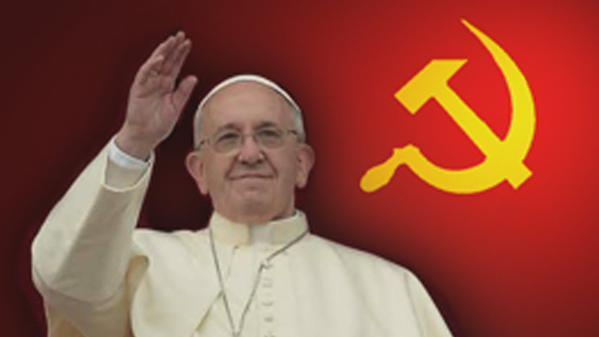
Pope Francis the Taxman

Bergoglio Marxist


On the heels of calling for a Marxist economic conference this coming March (“Economy of Francesco”), Jorge Bergoglio (a.k.a. “Pope Francis”) has once again opined on financial matters.  The purported head of the Catholic Church has now designated “tax cuts” as sinful behavior on a par, apparently, with stealing, lying, and adultery:

Today’s structures of sin include repeated tax cuts for the richest people,

often justified in the name of investment and development.*

Bergoglio did not mention what category of sin advocacy for tax cuts falls under – venial or mortal.  Maybe the details of how such a policy ranks in offending Divine Justice will be hammered out at the upcoming Economy of Francesco Commie confab!

In Bergoglio’s collectivist mind, those who try and keep their wealth from the ravenous demands of the State are somehow denying the poor their just due:

Every year hundreds of billions of dollars, which should be paid in taxes to

fund health care and education accumulate in tax haven accounts, thus

impeding the possibility of the dignified and sustained development of all

social agents.

What Bergoglio and his fellow socialists do not understand is that tax cuts lead to economic growth, whether they are for higher or lower income groups.  The less wealth that the State confiscates, the more is available to be used for saving and investment – two keys to economic growth.  The rich do not horde their money but expand and create businesses which leads to more and better paying jobs for lower income groups who supposedly Bergoglio wants to help.

The poor will only be uplifted by greater production where more goods and services are available at lower prices.  Redistribution of income via taxation does not create new wealth, but simply transfers existing wealth from the productive class.  Moreover, taxation has the deleterious effect of making individuals produce less since their efforts are siphoned off at the point of a gun.  More taxation means less production and, thus, less and more expensive goods for the poor.

Of course, this is basic economic theory that any sane person can understand unless one has matriculated to a Western university or college or pays attention to economic ignoramuses like Jorge Bergoglio!

Bergoglio’s constant attention to the plight of the poor along with other social issues (“climate change,” the environment, immigration) does not align with the vision that the Entity, which created the office that Bergoglio currently holds, had in mind.  On at least two occasions, He counseled His followers to focus their attention on spreading the “good news” instead of earthly concerns:

For the poor you have always with you:  but me you have not always.  [Mt. 26:11]


Let the dead bury their dead, but go thou, and preach the kingdom of

God.  [Lk. 9: 60]

While the Church has always sought to protect and help the poor, widows, orphans, and the downtrodden, its primary mission is to preach the Gospel.  Since the time of the Second Vatican Anti-Council, 1962-65, and especially during the “reign” of Pope Francis, evangelization has been condemned and, like tax cuts, is now considered sinful activity.

Bergoglio’s criticism of tax reduction is, no doubt, aimed at the Trump Administration’s plan for an additional round of tax cuts.  Tax reduction, however, without cuts in government spending will further explode budget deficits which are now even beyond sustainable.

Without corresponding spending reduction, tax cuts will mean that the Federal Reserve will have to make up for the short fall with further money printing.  One cannot have Big Government and tax cuts simultaneously.  The inevitable monetary crisis will, unfortunately, be blamed on tax cuts and will play into the hands of Bergoglio and his fellow travelers.

That Bergoglio spends most of his time as a social justice warrior instead of the supposed “vicar of Christ” on earth shows the state of the modern Church.  Worse, when he does speak on matters of faith, his words and actions are riddled with heresy.

For all those concerned, it is best that “Pope Francis” should be ignored not only for the falsehoods he spreads about Christianity, but also as a social theorist.  His pronouncements on the latter will only lead to further impoverishment of the poor and the rest of society while inciting class conflict between those who seek to keep their wealth and those who want to confiscate more of it.


*https://www.teaparty.org/tax-the-rich-pope-francis-calls-for-global-wealth-redistribution-427517/

Antonius Aquinas@AntoniusAquinas

https://antoniusaquinas.com


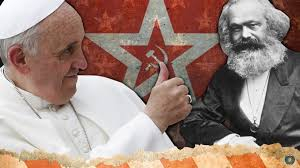
Pope Francis Calls Marxist Economic Summit

index

Pope Francis and his mentor

As if there needs to be further evidence that the current occupant of St. Peter’s Chair in Rome is a Marxist, the announcement of an upcoming conference at Assisi entitled the “Economy of Francesco” should convince any skeptic otherwise.

In his invitation letter to “young economists and entrepreneurs worldwide,” Bergoglio sets the agenda for the Leftist confab quite clearly which is virulently anti-market, a call for massive redistribution of wealth, and a reordering of the current economic systems of the world with a healthy dose of climate change nonesense:

. . . a different kind of economy: one that brings life not death, one that is inclusive and not exclusive, humane and not dehumanizing, one that cares for the environment and does not despoil it.*

While Bergoglio’s Marxist credentials have been firmly established, his blashemous  actions and words has a growing number outside of “sedevacantist circles” calling him a heretic.  The legitimacy of “Pope Francis,” however, is more fundamental than him being a manifest heretic, but his standing as a legitimate pope is invalid since his ordination as a priest and his consecration as a bishop came under the new rites of Holy Orders instituted in the wake of the Second Vatican anti-Council (1962-1965).

The mastermind behind Bergoglio’s summit is professor Luigino Bruni and from his comments he sounds more radical than the Argentine Apostate, if that is possible.  Professor Bruni wants to use taxation as a weapon to “redistribute income and wealth from the rich to the poor.”*

Bruni, a professor of political economy at the Italian University, LUMSA, and the author of a number of books, basis his advocacy for redistribution of wealth on the Scriptures:

[T]he Bible has many words to offer our economic life and ideas [with] the transformation of wealth into well-being.**

It appears that the good professor’s Bible is missing the Seventh Commandment of the Decalogue which solemnly states: THOU SHALL NOT STEAL!  In no legitimate commentary ever written on this Commandment is there an exception made for the confiscation of wealth from the well-to-do to be given to the poor.  Probably just an oversight on the Professor’s part.

Because they are blinded by socialistic ideology, Bruni, Bergoglio, and the likes of Bernie Sanders cannot see that the growing wealth inequality which they complain about is not the result of “capitalism,” but is the outcome of the monetary policy of the world’s central banks.  This, along with tax policies which hamper innovation and shield the entrenched financial class from competition, is why financial elites are able to maintain and increase their power.

Central bank policy of suppressing interest rates and of money printing allow banks and financial institutions to receive “free money” which they can invest and speculate with at zero cost.  The boom (actually a bubble) in asset prices on Wall Street is a demonstration of how wealth disparity takes place.

If Bergoglio really meant to reform the present system, he would call for the abolition of central banking and a return to “hard money.”  Under such an order, banks and financial institutions become wealthy on their ability to make prudent investment decisions subjected to profit and loss.  A free market in banking is the antithesis of the current system of credit expansion and money printing.

Not only have Bergoglio and his cohorts abandoned the Faith, but they have also overturned the Church’s long-held condemnation of socialism and have ignored many of its own outstanding thinkers on financial matters.  From the Scholastics to the School of Salamanca through the Jesuits and the great Cardinal Cajetan, who finally taught the proper doctrine on interest rates, the Church has produced scores of eminent economic thinkers in its long history.

index 1

School of Salamanca

Ever since socialism reared its ugly head as a social system of thought, the Church has warned of its dangers even its more milder forms as Pope Pius XII wrote, “No Catholic could subscribe even to moderate socialism.”  Since Vatican II and especially under Bergoglio’s regime, however, Leftist ideas of all sorts have been warmly embraced.

At the heart of socialism, be it Marxism or its equally pernicious variants, lies envy which became a part of the human condition with the fall of man.  While once condemned, envy has been turned into a virtue by the likes of Bergoglio.

While such ideas may sound appealing to human sensibilities, they will not pass the Divine Judge who knows the thoughts and souls of all His creatures even those of supposed popes.

*Vatican website: http://www.vatican.va/content/francesco/en/letters/2019/documents/papa-francesco_20190501_giovani-imprenditori.html

**Jules Gomes, “Pope Francis Convenes ‘Anti-Capitalism’ Summit,”  Church Militant.com, 15 January 2020.

Antonius Aquinas@antoniusaquinas

https://antoniusaquinas.comhttps://antoniusaquinas.com


The Constitution Myth

One reason for the failure of the modern conservative and libertarian movements to scale back, in even a miniscule way, the now gargantuan US welfare/warfare state has been the misinterpretation of the US Constitution.  Many conservatives have a slavish devotion to the document, placing it on a par with the Ten Commandments and New Testament.

A typical misunderstanding of the Constitution’s history and content appeared in this recent op-ed:


The Constitution was intended to limit 1) the power


of government over the citizenry 2) the power of each branch of


government and 3) the power of political/financial elites over the


government and the citizenry, as the Founders recognized the intrinsic risks


of an all-powerful state, an all-powerful state dominated by one branch of


government and the risks of a financial elite corrupting the state to serve


the interests above those of the citizenry.*

The author, like so many “Constitution enthusiasts” has also been hostile to the Medieval era, denigrating its institutions and social constructs – feudalism, aristocracy, crusading – when, in fact, the Middle Ages, in many respects, were far freer with less government than the present epoch. **

When the founding fathers decided to meet in Philadelphia in 1787, they did so at first to “amend” the Articles of Confederation which had guided the young country through some perilous times.  While the Articles had some defects (some libertarians even contend that they were too statist***), the delegates, at first, did not want it scrapped, however, it was the “leading lights” of the convention which connived to completely do away with it.

By superior political maneuvering, the pro-Constitution forces were able to ramrod their plan through despite being in the minority.  Not only were the majority of the delegates initially against scrapping the Articles, but most Americans were opposed to the creation of a new central government. 

Despite this, the Constitution was ruthlessly pushed through and, as its opponents feared, America would be saddled with a highly centralized national government, the loss of considerable state sovereignty, and the eventual erosion of individual liberties even with the inclusion of a Bill of Rights.

A brief examination of the document reveals that its implicit and explicit language grants wide latitude for the expansion of state power.  In its Preamble, the ambiguous clause to “promote the general welfare” can and has led to all sorts of destructive social engineering schemes.  More ominously, for anyone that is under the illusion that America is governed by a “federal” system, they should reread Article VI which in part says

This Constitution, and the Laws of the United his Constitution, and the Laws of the United States which shall be made in Pursuance thereof; and all Treaties made, or which shall be made, under the Authority of the United States, shall be the supreme Law of the Land. [emphasis added]

An all-powerful central state went against much of Western history after the fall of the Roman Empire and the idea was always feared by philosophers.  Basic political theory and practical experience showed that a multitude of sovereign states were preferable not only for the protection of personal liberty, but for economic growth.  Numerous states and jurisdictions were a far greater check on government than the much celebrated “separation of powers” concept of constitutional government.

Under the Articles of Confederation, each individual state was autonomous while the national government had to rely on the states for most of its support.  Unfortunately, it will never be known what would have happened if the country remained as a confederacy of states, it is likely however, that there would have been less bloodshed, greater economic growth, and more personal freedom under a decentralized regime.

It is curious, therefore, why so many on the Right continue to revere the Constitution as some great bulwark against state power.  Much of it probably stems from ignorance or personal bias against the political conditions which existed prior to the late 18th century. 

Much of European history was under the sway of monarchial and aristocratic rule and the integral presence of the Catholic Church in society with a diffusion of power among kings, princes, dukes and Churchmen.  While far from perfect, the social order which existed under Christendom may not have been as materially or technologically advanced as contemporary times, but in regard to morality, justice, and individual freedom, there is no comparison.  The Christian age saw nothing of the social depravity, war making with its mass murder, the trampling of individual rights, and the existence of totalitarian government as witnessed in the supposedly “enlightened” modern age.

Decentralized Europe of 1300

Until it is realized that the Constitution is an impediment to rolling back the American Leviathan, there will be little progress in the fight for individual liberty and economic progress.


*Charles Hugh Smith, “Let’s Face It: The U.S. Constitution Has Failed.”  Zero Hedge.  20 February 2019. 

**One example, Charles Hugh Smith, “America’s ‘Neo-Feudal’ System is ‘Both False & Precarious.”  Zero Hedge 19 December 2018.

***David Gordon, ed., Strictly Confidential: The Private Volker Fund Memos of Murray N. Rothbard, Auburn, AL.: The Ludwig von Mises Institute, 2015, pp. 96-98.

Antonius Aquinas@antoniusaquinas

https://antoniusaquinas.com

[emphasis added]