Category Archives: Federal Government

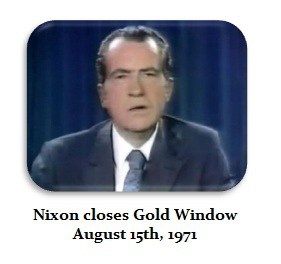
“A Date Which Will Live in Infamy:” President Nixon’s Decision to Abandon the Gold Standard

Nixon-Gold

Franklin Delano Roosevelt called the Japanese “surprise” attack on the U.S. occupied territory of Hawaii and its naval base Pearl Harbor, “A Date Which Will Live in Infamy.”  Similar words should be used for President Nixon’s draconian decision 45 years ago this month that removed America from the last vestiges of the gold standard.

On August 15, 1971 in a televised address to the nation outlining a new economic policy entitled, “The Challenge of Peace,” Nixon instructed the Treasury Department “to take the action necessary to defend the dollar against the speculators.”*

Nixon continued:

I have directed Secretary Connally to suspend temporarily the convertibility of the dollar into gold or other reserve assets, except in amounts and conditions determined to be in the interests of monetary stability and in the best interests of the United States.**

Of course, any objective student of history knows that this was a lie and that it was not “speculators” which were causing monetary instability, but the U.S.’s own crazed inflationary policy which attempted to fund its imperialistic endeavor in Vietnam while expanding the welfare state at home.  This resulted in the Treasury losing an alarmingly amount of gold reserves to other central banks who rightly sought real value in exchange for depreciated American greenbacks.

In essence, Nixon’s decision ended gold redemption and placed the U.S. and the rest of the world on a purely fiat paper standard for the first time in recorded time.  By doing so, the U.S., in effect, became a deadbeat nation which no longer honored its obligations and was set on the road to its current banana republic status.

Instead of impeachment proceedings and his ultimate resignation for the juvenile break in at the headquarters of the nation’s other ruling crime syndicate, Nixon should have been imprisoned for this deliberate and destructive act which has led, in large measure, to the nation’s crushing and insurmountable debt burden, reoccurring booms and busts, and now economic stagnation.

Nixon’s disastrous decision had precedent.  FDR had his own day of monetary infamy in 1933 when, by Executive Order 6102, he outlawed the private ownership of the precious metal while eliminating  gold redemption by banks for dollars.  Ostensibly, the order was instituted as an emergency measure to combat the Depression, but in reality, it was done to allow the Federal Reserve greater “flexibility” in inflating the money supply.

While Roosevelt and Nixon’s decisions would backfire economically, their actions highlighted the totalitarian direction that the federal government and its executive branch were heading throughout the 20th century.  Moreover, the lack of opposition or protest to blatant executive dictatorial decrees by either the legislative or judicial wings of the federal government demonstrates again the flawed and frankly naive argument put forth by Constitutionalists of every ideological persuasion on how the celebrated “separation of powers” theory checks tyranny.

Nixon’s final abandonment of the gold standard had far greater ramifications than simply bad economics.  Without the discipline of hard money, central banks could, and did, create massive quantities of paper money and credit, which enriched the politically connected financial elites and the governments which they were aligned.  Such power was used, in time, to control, spy on, and regulate the subject populations to a degree never seen before.  The power of the state has swelled mostly through bank credit expansion without worry of gold redemption.

Despite what is taught in social science courses, a true gold standard is a greater protector of individuals’ economic well being and, ultimately, their political liberty than any legislation or “rights” document ever penned.  Hard money limits state power!

While it is painful to quote from an ardent opponent of sound money, the international bankster Baron Rothschild said it best when he described the relationship of money and power: “Permit me to issue and control the money of a nation, and I care not who makes its laws.”

Richard Nixon’s elimination of the last remnant of the gold standard over four decades ago combined with FDR’s earlier decree has fulfilled to the detriment of the American and world economies Baron Rothschild’s adage to a tee.  The return of prosperity and individual liberty will only come about when these two heinous acts are eradicated.

*Richard M. Nixon.  “Address to the Nation Outlining a New Economic Policy: ‘The Challenge of Peace.’”  The American Presidency Project.  15 August 1971. http://www.presidency.ucsb.edu/ws/?pid=3115

**Ibid.

Antonius Aquinas@AntoniusAquinas

https://antoniusaquinas.com/


Don’t Expect a Return to a Gold Standard Any Time Soon

goldstandard

Despite trillions of paper currency units poured into the world economies since the start of the financial crisis, there has been no recovery, in fact, all legitimate indicators have shown worsening conditions except, of course, for the pocketbooks of the politically -connected financial elites.  Yet, despite the utter failure of the current money and banking paradigm to resolve the situation, the chance of a return to a commodity based monetary order is highly unlikely especially when one looks at the anti-gold bias found in typical college economics textbooks.

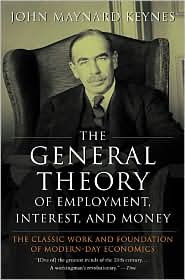
Macroeconomics: Principles, Problems and Policies by McConnell, Brue and Flynn is a leading introductory level college text which has been through, to date, some 20 editions.  Until the financial crisis of 2008, the subject of a commodity- backed money was not discussed, however, after the crisis and the popularity of gold standard enthusiasts like former Congressman and Presidential candidate Ron Paul, the authors of Macroeconomics obviously felt the need to address the resurgence in the interest of metallic money.

McConnell and company’s critique of the gold standard is full of fallacious reasoning that monetary cranks have employed for generations, all of which have been easily refuted by eminent economists.  Yet, the lies and distortions about commodity money continues in academia.

The authors admit that:

To many people, the fact that the government does

not back the currency with anything tangible seems

implausible and insecure.

This logical sentiment and realization of the fraudulent nature of unbacked currency by those outside the economics profession is brushed aside by the esteemed trio:

But the decision not to back the currency with anything tangible was made for a very good reason.

Yes, and we know what that reason was: so that the state and central banksters could have a ready and unlimited access to the creation of money to solidify and expand their power.  The gold standard was always an impediment to this cherished dream of the political elites – the establishment of an irredeemable, paper monetary order.

The authors, not surprisingly, see things differently:

If the government backed the currency with something

tangible like gold, then the supply of money would

vary with how much gold was available.  By not backing

the currency, the government avoids this constraint and

indeed receives a key freedom – the ability to provide

as much or as little money as needed to maintain the

value of money and to best suit the economic needs of

the country.

By all means, the state and central banksters should be given as much “freedom” as possible for we all know that governments would never abuse such license and would always act in the best interests of their citizens.  Certainly, the authors are not aware of any cases in history where such “freedom” was ever abused.

    Nearly all today’s economists agree that managing the

money supply is more sensible than linking it to gold or

to some other commodity whose supply might change

arbitrary and capriciously. . . .  if we used gold to back the

money supply so that gold was redeemable for money . . .

then a large increase in the nation’s gold stock as the

result of a new gold discovery might increase the money

supply too rapidly and thereby trigger rapid inflation.  Or

a long-lasting decline in gold production might reduce the

money supply to the point where recession and

unemployment resulted.

Volumes have been written debunking such stupidity.  The point, however, is that millions of minds have been exposed to such thinking and while most will not become economists (thank goodness!), what is taught in college and university classrooms about the gold standard is negative, to say the least.  Moreover, those who continue in a career in finance or economics will unlikely ever be presented with an accurate assessment of the gold standard.

A return to a sound and just monetary order will only take place after the ideological groundwork has been first laid, just as fiat money and central banking came about after years of proselytizing by inflationists.  It is also not enough to show the economic efficacy and moral soundness of commodity money, the ideas of crackpots like McConnell, Brue and Flynn need to be exposed for what they are.

Under the current academic environment, as generations have been misinformed, deceived, and lied to, it is unlikely that a return to a gold standard will take place.  Until the intellectual battle is won, paper money and the central banksters that manage it will continue their reign of financial terror.

Antonius Aquinas@AntoniusAquinas

https://antoniusaquinas.com/


Presidential Dictatorship

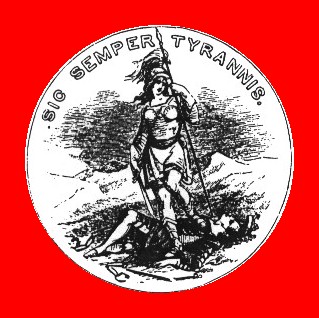
Sic Semper tyrannis II

Executive orders, undeclared wars, drone hits, assassination of citizens and non-citizens alike, the overthrow of foreign regimes, domestic spying, the abetting of known criminal activities through pardons, economic planning, opening borders, monetary manipulations are just some of the nefarious activities that routinely emanate from the most dangerous political office that the world has ever painfully come to know – the United States Presidency!

The U.S. presidents can and have created a veritable “hell on earth” for their opponents, perceived enemies, and the innocent not only in the country in which they reign, but over the lives and fortunes of peoples and places where they have absolutely no authority to interfere.  While other chiefs of state have theoretically had such power, U.S. presidents have been able to inflict their destruction and chaos because, paradoxically, the nation’s free-market system, for a long time, created immense wealth which could be tapped into.

The tyrannical nature of the presidency was recognized long ago by those politically perspicacious men who opposed both the office and the draconian document which created it.  Few groups in history have been so vindicated for their foreboding as those who vainly argued against the ratification of the United States Constitution than the Antifederalists.

“An Old Whig”* aptly sums up the damage that would come about if the Constitution was ratified and the office of president would come into being:

. . . the office of President of the United States appears to me

to be clothed with such powers as are dangerous.  To be the

fountain of all honors in the United States, commander in chief

of the army, navy and militia, with the power of making treaties

and of granting pardons, and to be vested with an authority to

put a negative upon all laws, unless two thirds of both houses

shall persist in enacting it, . . . .**

An Old Whig saw that the president would become a “king” but without the natural and binding checks that even the most absolutist of monarchs were restrained by:

[The president] is in reality to be a KING as much a King

as the King of Great Britain, and a King too of the worst

kind; – an elective King. . . . The election of a King

whether it be in America or Poland, will be a scene of

horror and confusion; and I am perfectly serious when

I declare that, as a friend to my country, I shall despair

of any happiness in the United States until this office

is either reduced to a lower pitch of power or made

perpetual and hereditary.***

One of the Federalists’ counterarguments to the Antifederalists’ concern over the presidential office was the widely held assumption that George Washington would become the new Republic’s first chief executive and the general knowledge of his impeccable character would assuage those worried of potential executive overreach.  Such a lame response neglected to look into the future when the office’s huge potentiality for despotism would be sought after and won by those who had less upstanding personal traits than the father of the country.

The growing decentralized political movements throughout the world with, for instance, the hopefully upcoming British exit from the European Union, can only be enhanced if the office of the president and, for that matter, all other nation state’s chief executives are exposed as tyrannical institutions which are anathema to individual liberty and collective self-determination.  Presidents, premiers, chancellors, prime ministers, and their like along with central banking are the two nefarious pillars of power of the modern nation state whose continued existence guarantees perpetual war and economic regression.

In this seemingly interminable presidential election cycle, populist, libertarians, conservatives, and all sorts of anti-Establishment types are delusional if they believe the totalitarian direction in which the country is now headed will be reversed through elections or choosing the “right” candidate.  “Making American Great Again” will only come about when the chief executive office and the statist document that created it have been repudiated.

Prior to the presidency’s abolition, its ideological justification must be first debunked.  There is no finer place to start for this most necessary task to take place than in the dissemination of the perceptive and enduring words of the much neglected Antifederalists.


*Probably penned by a group of Philadelphia Antifederalists – George Bryan, John Smilie, James Hutchinson and maybe others.  See, John P. Kaminski & Richard Leffler, eds., Federalists and Antifederalists: The Debate Over the Ratification of the Constitution.  Madison, Wisconsin: Madison House Publishers, 1989, p. 18.

**Ibid., p. 86.

***Ibid.

Antonius Aquinas@AntoniusAquinas

https://antoniusaquinas.com/

Long Live the Flags of Dixie!

Confederat Flag

On May 19, the House of Reprehensibles passed a proposal that would essentially ban the display of Confederate flags from national cemeteries.  The amendment was added to a Veteran Affairs spending bill.

Not surprisingly, House Speaker Paul Ryan allowed the measure to be voted upon in hopes of not disrupting the appropriations process.  Yes, by all means Paul, the redistribution of taxpayers’ confiscated wealth should take precedent over a draconian attempt to eradicate a heroic symbol of the country’s past.  Hopefully, Ryan will be ousted this November as both Speaker and Congressman for not only his consistent sell out to Obummer and the Democrats on the budget, but his lack of understanding and appreciation of what is arguably the most important period of American history.

In a certain sense, the Confederate flag should not be displayed in national cemeteries or for that matter flown alongside those of the Union.  The two are representations of dramatically opposed political ideologies.  Liberals and political opportunists of all sorts have deliberately smeared the South’s attempt at secession as being entirely over the issue of slavery.  The “Civil War” (which that struggle has become known by) is now seen through Politically Correct hindsight.

A civil war, in the truest sense, is a conflict between factions attempting to gain control of a government typically for their own aggrandizement.  The bloody conflict between the North and South was not that, nor was it solely over slavery although the institution played a role in it.

The Confederacy wanted no part of the Washington establishment at the time, which it believed had become too tyrannical, and attempted to secede from it.  The remaining states of the North, under the “leadership” of Abraham Lincoln, prevented this at the cost of more than 600,000 lives, the vast destruction of property, and the impoverishment of a people who simply sought to rule themselves.

The South’s action was nearly identical to what the colonies, North and South, did some 80 years previously in breaking away from the British Empire and becoming free and independent states under the benign rule of the Articles of Confederation.

As America’s Founding Fathers saw their liberties violated by King and Parliament, Southerners witnessed similar tyrannies and wisely anticipated more federal oppression with the election of Lincoln.

This interpretation has been ably supported by scholarship, though the view is rarely acknowledged in academia or in the mainstream media.  In an essay from an insightful collection titled Secession, State and Liberty, Donald Livingston persuasively describes the ideological content of the Declaration of Independence, the revolution it inspired, and its influence on the South’s leadership.

He writes: “Overall, the Declaration is an argument designed to justify the secession of the new self-proclaimed American states from the British state. . .  [It] is a document justifying the territorial dismemberment of a modern state in the name of the moral right of a people to self-government.”*

The South, imbued with such logic and the example of the Revolutionary generation’s break with Great Britain, attempted to separate from the Union on similar grounds and, in Livingston’s view, had a much stronger claim than the Founding Fathers had for independence:

[T]he colonies were not and never had been recognized as sovereign states, either by others or even by themselves.  At the time of the Civil War, however, the southern states had been and still were sovereign states, and so they could mount not only a moral argument but a legal one as well.  And it was the legal argument they primarily insisted upon.  Each state used the same legal form to secede from the Union that it has used to enter, namely, ratification in a convention of people.**

Although slavery was a part of the South’s final break with the North, the Confederacy could never have been built on such a narrow foundation.  Those who seek to paint Southern secession as a movement solely designed to protect their “peculiar institution” have either misunderstood the genesis of that struggle or do so for political gain.

While Southern secession is mercilessly condemned by the Establishment, scholars like Professor Livingston see it and the War for Southern Independence in a much different and far nobler light: “With the orderly, legal secession of the southern states, the American genius for self-government reached its highest moral expression.”***

The Northern and Southern flags which fly in national cemeteries across the land are indeed representative of different traditions, but not what the Politically Correct crowd would have everyone to believe.

The defenders of Dixie and the flags that commemorate their courageous actions have long since been morally justified.  The Union flag, on the other hand, has been one of aggression and domination, at first, brutally directed at its fellow countrymen who simply sought self-determination, and afterwards against millions of peoples from Vietnam to Iraq.

Hopefully, in the not too distant future as economic conditions worsen and American hegemony can no longer be maintained, the Union flag and the empire in which it represents will receive greater vitriol than the Confederate flag has gotten for its innumerable mass murders, destruction, crimes, and chaos which it has wantonly brought to every corner of the planet.

*David Gordon, ed., Secession, State & Liberty. Donald W. Livingston, “The Secession Tradition in America.” New Brunswick (U.S.A.), Transaction Publishers, 1997, p. 7

** Ibid., 18.

*** Ibid., 19.

Antonius Aquinas@AntoniusAquinas

https://antoniusaquinas.com/