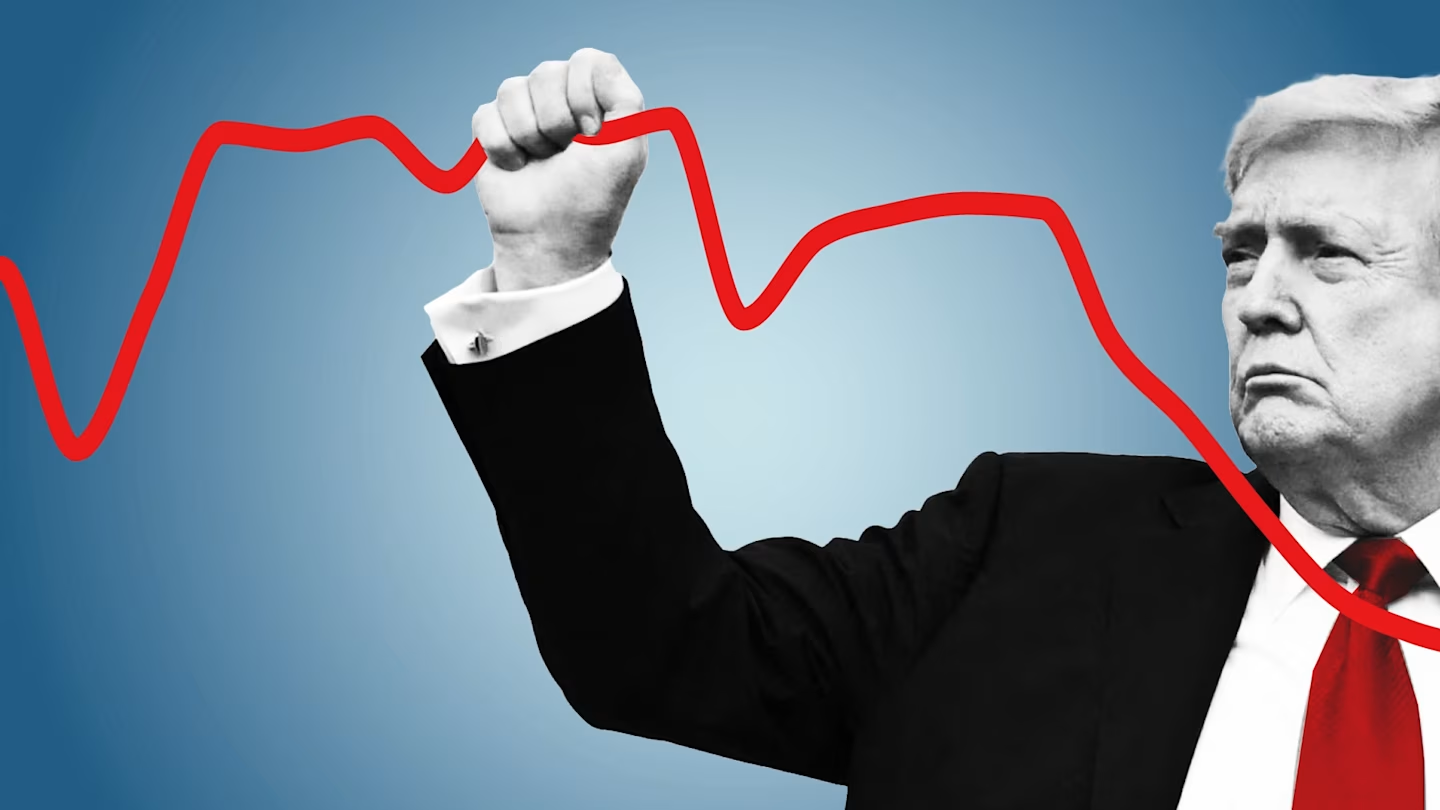
Donald Trump’s Economy Falters
As President Donald Trump seeks to extricate himself from the unprovoked and strategically inane war that he and his cohort Israeli Prime Minister Benjamin Netanyahu have waged on Iran, economic conditions in America continue to decline.
In a year and a half of Trump 2.0, things have gotten worse – factory closures, the return of price inflation, exploding deficits, spikes in interest rates, farm closures, etc.
The effect of the Iran war has had a devastating impact on U.S. agriculture which has caused the Trump administration to consider an aid package for hard-pressed farmers.
According to Tyler Durden at website Zero Hedge, fully 70% of recently surveyed farmers said that they have not been able to plant enough crops due to the higher prices for Persian Gulf energy products, most importantly fertilizer and diesel fuel. Diesel is used in tractors, combines, irrigation, and crop transport. *
The reduction in planting will mean less supply and higher food prices, which will disproportionately affect middle-and lower-income Americans.
Farmers are also facing higher costs for equipment and machinery, much of which is due to tariffs. Senator Raphael Warnock (D-Ga), at an Agriculture Committee hearing, echoed the dissatisfaction of his constituents over higher input prices:
Georgia farmers are telling me that they continue to struggle
with high costs, costs exacerbated by President Trump’s war
in Iran and his tariffs – which is a tax on all of us on virtually
everything. **
It is not very often that a politician expresses a correct view of basic economic theory, but, in this case, Warnock is right – tariffs are a tax paid by consumers. Foreign producers do not pay the tax, as Trump and the vast majority of his erroneously believe.
What is ironic, and painfully so for American taxpayers, is that while Trump continues to tout the tax cuts contained in the 2025 “Big Beautiful Bill,” he does not understand that he has hiked taxes on Americans through his tariffs.
Another key industry that has been in the economic doldrums is manufacturing, which traditionally provided well-paying jobs and created tangible goods. The sector has suffered from the prolonged closure of the Strait of Hormuz and Trump’s tariffs, but it has been stagnant for years despite both Trump and Joe Biden promising to revitalize it during their campaign rallies.
In his first term, Trump rescinded, through executive order, a number of regulations on business, which Biden summarily reimposed. One can be assured that if a Democrat captures the White House in 2028, a Gavin Newsom or Alexandria Ocasio-Cortez will repeat what Biden did.
What is needed is congressional action that permanently closes agencies and departments and removes laws that stifle business. Regulations are generally imposed to protect the politically well-connected firms from competition.
Burdensome regulations are not the only challenge that American industries face. A well-trained work force is also a necessary requirement. Unfortunately, American educational standards have fallen dramatically over recent decades. And, in the critical fields of engineering and science, the nation is far behind rivals such as China.
While agriculture and manufacturing, key components of any industrial society, are in trouble, the most dangerous threat to Americans’ livelihood is the state of the government’s monetary and fiscal condition. There will be no turnaround unless the debt crisis is addressed.
Last month, the federal budget deficit exploded 32% from May of 2025 as the government borrowed $292 billion up from $215 billion it borrowed a year ago. Uncle Sam is paying $1.6 trillion a year on interest on the debt alone, 30% of what it collects in taxes. The entire federal budget in 1997 was $1.6 trillion. Now, yearly interest payments on the debt equal all of the spending that took place at the time.
At the current pace, by the end of Trump’s second term, interest payments will easily exceed $2 trillion annually, under the assumption that rates stay at current levels.
Since spending and interest payments are more than what is taken in via taxes, the government has had to borrow, which has forced the Federal Reserve to finance it through money printing – “monetizing the debt.” This leads to a host of baneful consequences, not the least of which is an increase in consumer and producer prices. Eventually, American living standards will fall, as well.
The logical thing to do is to reduce spending so that the Federal Reserve does not have to monetize the debt, but since cutting spending is politically unpalatable, there is no way out of the crisis. Government spending and money printing are the culprits.
There is no doubt that the war and the closure of the Strait of Hormuz to those unfriendly to the Iranian government has caused tremendous harm, however, in some sense, the war, up until this point, has given Trump cover for the deteriorating economic data.
While many still believe that the solution to the nation’s economic woes can be found in different policies or through the ballot box, they fail to understand that Washington itself is the problem. Until this is realized, economic life in the United States will continue to worsen.
*Tyler Durden, “70% of US Farmers Say That They Won’t Be Able to Buy All the Fertilizer They Need in 2026,” Zero Hedge, 20 April 2026, https://www.zerohedge.com/geopolitical/70-us-farmers-say-they-wont-be-able-buy-all-fertilizer-they-need-2026
**Tyler Durden, “Trump Mulls Farmer Aid as Fertilizer and Fuel Costs Bite,” Zero Hedge, 13 June 2026, https://www.zerohedge.com/food/trump-mulls-farmer-aid-fertilizer-and-fuel-costs-bite
Antonius Aquinas@antoniusaquinas


