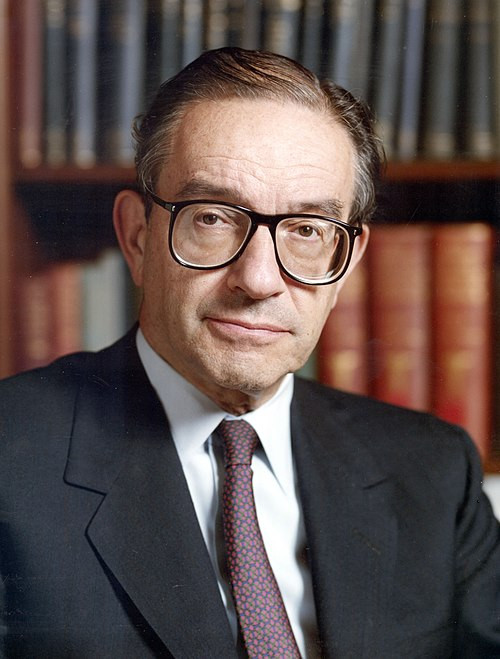
Alan Greenspan, the second-longest serving Federal Reserve Chairman in history, passed away on June 22, 2026 at the age of 100.
Greenspan was given the moniker of “Maestro” for his management of U.S. monetary policy, which saw periods of economic expansion, booming stock values, rising home prices, and low unemployment. While he was still lauded for his conduct of the nation’s monetary affairs at the end of his tenure as Federal Reserve chairman (1987-2006), his reputation was severely tarnished after the Great Financial Crisis (GFC). Although out of office, many critics believe that it was his policies that led to the collapse in 2008.
In addition, it was Greenspan and his successors who have facilitated the reckless government borrowing that has produced the gargantuan U.S. national debt and yearly budget deficits now in the trillions.
Greenspan received much of the blame for the GFC, the worst economic downturn since the Great Depression of the 1930s, which many analysts believe was the result of the deregulation of the financial sector undertaken by the Federal Reserve and Congress during his term. The Financial Crisis Inquiry Commission (FCIC), established in the wake of the GFC to investigate what went wrong, stated:
More than 30 years of deregulation and reliance on self-
regulation by financial institutions, championed by former
Federal Reserve Chairman Alan Greenspan and others,
supported by successive administrations and Congresses,
and actively pushed by the powerful financial industry at
every turn, had stripped away key safeguards, which could
have helped avoid catastrophe. *
Nearly all government commissions, inquires, and task forces are created to obfuscate and redirect public attention away from the real culprit. Invariably, it is the federal government itself and, in this case, the Federal Reserve. Commissions are never created to address the causes of crises.
Contrary to what the FCIC contends was the cause of the 2008 collapse, it was not “deregulation” or the elimination of “safeguards” that precipitated the crisis. Instead, like most of the nation’s previous panics, busts, and recessions, it was the central bank’s monetary policy. In the case of the GFC, it was the artificial lowering of interest rates throughout Greenspan’s term which created a boom, in particular “subprime mortgages,” that was the catalyst.
What the FCIC should have advised was a return to the gold standard, the abolition of central banking and, with it, the end of the pernicious practice of fractional-reserve banking that allows banks to create money out of thin air. Without a central bank and a monetary order based on gold, artificial booms and their destructive busts, like the one that occurred in 2008, could not happen.
While it was understandable that a state-appointed commission would never recommend a return to a monetary system that would severely limit government power, Alan Greenspan, on the other hand, was certainly familiar with the gold standard. In the 1960s, he penned an influential article, “Gold and Economic Freedom” advocating the importance of gold-backed money for individual freedom and prosperity:
In the absence of the gold standard, there is no way to
protect savings from confiscation through inflation. There
is no safe store of value. . . . The financial policy of the welfare
state requires that there be no way for the owners of wealth
to protect themselves. . . . Deficit spending is simply a scheme for the confiscation of wealth.
Gold stands in the way of this insidious process. It stands as
the protector of property rights. **
As part of the “intellectual caste” or those who shape public opinion, Greenspan’s defection from his principles serves as an example of how Big Government came to America.
A century before Greenspan came on the scene, most economists and the public were adamantly opposed to a central bank. Yet, by the time that Greenspan wrote his famous essay on gold, central banking had become revered and considered a necessary component of any well-running economy.
What changed?
It was the intellectuals, not just economists but most of those in the opinion- molding sectors of society, who sold out and justified government largesse. In return, they found cushy positions in the expanded state apparatus.
The real tragedy of Allan Greespan was not that his policies led to the GFC and contributed to a monstrous level of government debt, but that he sold out his principles which, at one time, he apparently firmly held, for the power, privilege and monetary renumeration of becoming Federal Reserve chairman. Greenspan, of course, was not the only man in the annals of history to succumb to the allurements of this material world.
Prior to this epoch, more individuals of Greenspan’s status resisted the enticements of the powers that be, which is why those ages were ethically superior to the present.
Until there is a prevalence among many more elites to stand up for what is right, there is little hope for prosperity or a just social order.
*Tyler Durden, “Alan Greenspan, Longtime Fed Chair and ‘Maestro’ of Markets Dies at 100,” Zero Hedge, 22 June 2026. Alan Greenspan, Longtime Fed Chair And “Maestro” Of Markets, Dies At 100 | ZeroHedge
Alan Greenspan, “Gold and Economic Freedom,” reprinted in Ayn Rand’s Capitalism: The Unknown Ideal, 1967. Alan Greenspan, Gold and Economic Freedom (1966)
Antonius Aquinas@antoniusaquinas


One thought on “The Tragedy of Alan Greenspan”