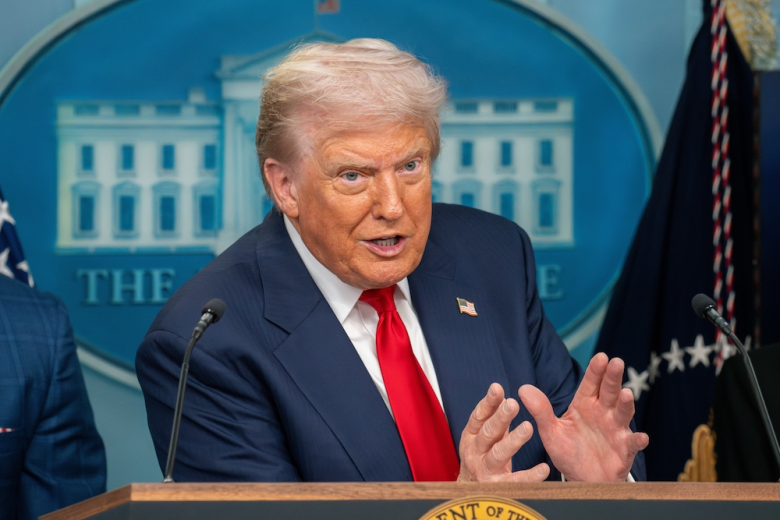
“I don’t think about Americans’ financial situation”
Similar to Hillary Clinton’s lack of empathy for the plight of unemployed West Virginia coal miners during her unsuccessful 2016 presidential run which contributed, no doubt, to her surprising defeat, President Donald Trump appears to be just as out of touch with the economic conditions of the vast majority of Americans as Hilary was.
Days before his trip to meet with Chinese President Xi Jinping, a reporter asked Mr. Trump: “To what extent are Americans’ financial situations motivating you to make a deal [with Iran]?”
Incredibly the president retorted “Not even a little bit. . . I don’t think about Americans’ financial situation.”
On an earlier occasion, when asked about the impact of higher gasoline prices, Trump said: “If gas prices continue to rise, then let them rise. I’m not bothered.” He added: “They are not very high,” and have “come down very much.” This, of course, is not true.
One can only imagine how many times Trump’s dismissive quips about financially squeezed Americans will be played in Democratic Party campaign advertisements this autumn, prior to the mid-term elections.
While economic conditions in the United States and throughout the world continue to deteriorate, most pundits believe that the worst is yet to come. In a frightening article about the comments made by the CEO of Shell Oil over the dire straits of the world’s oil supply, Hillary Remy, in an article in The Street titled “Shell CEO Sends Blunt Message on oil and the Economy,” writes:
Even if a peace deal [with Iran] were struck today, Persian
Gulf supply would not return to normal overnight. It could
take up to seven months to restart most shut-in wells, as
they require gas or water injections to repressurize.*
Despite the United States being a net exporter of oil and natural gas, and contrary to what the Trump Administration is saying, the nation will face energy shortages in the near future. One analyst gives the current state of America’s oil inventories:
- Total petroleum inventories – declining
- Crude oil inventories – declining
- Gasoline inventories – already at 5-year lows
- Diesel and jet fuel inventories – already below 5-year lows**
More ominous than the shortfall in Persian Gulf energy is America’s precarious monetary condition that has the potential to spiral into a sovereign debt crisis. Bond yields across the world have begun to spike, with Japan’s 20-year government bond yield surging to its highest level since 1997, while the yield on the U.S. 10-year Treasury note, the benchmark for pricing the nation’s interest rates, has recently surpassed the critical mark of 4.5%.
Japan is the largest foreign holder of American debt and will have to liquate its holding of treasuries to stabilize its own currency, which will put further pressure on U.S. yields.
The last time U.S. bond yields surged to this level was after Trump’s infamous “liberation day” tariff spree in April 2025. After the bond market in the president’s words, got “a little yippy,” he postponed a number of the levies on foreign goods which relieved pressure on yields.
The cost-of-living indices have begun to surge, with consumer prices up 3.8% in April from 3.3% in March. Meanwhile, the important, but often overlooked producer price index (PPI) spiked 1.4% in April, which will be felt through higher consumer prices in the coming months.
Contrary to what the financial press, policymakers, and many among the alternative media believe is the cause of the higher cost of living – rising bond yields, and the moribund U.S. economy – the real culprit is the gargantuan national debt, not the shortfall of Persian Gulf energy. The national debt will soon surpass $40 trillion, and the interest payments to sustain it are now in excess of $1 trillion annually.
To maintain this level of spending, the Federal Reserve has had to expand the money supply (inflation) which has led to higher consumer and producer prices, and an increase in bond yields. Higher prices lower the living standards of Americans, as a greater percentage of incomes are spent on essentials while discretionary purchases are curtailed. When discretionary spending shrinks, those sectors of the economy – such as producers of luxury items and the hospitality industry – suffer.
The evidence that Americans are being squeezed by the high cost of living can be seen in the rise of credit card, auto, and home mortgage delinquencies, as well as pressure on the repayment of student loans. Not surprisingly, the personal savings rate for the first three months of the year has steadily declined.
The massive public debt hinders the economy in other unseen ways. If borrowing by the government was instead available to the private sector, a legitimate economic boom could take place where large sums of capital could be used for the creation of businesses and employment. This is one of the reasons that many cannot find good-paying jobs: The much-needed capital is being siphoned off for wasteful government spending and debt financing.
Unfortunately, there is no quick fix to the nation’s economic woes. The first step to recovery would be a dramatic reduction in spending. In tandem with budget cuts, the Federal Reserve should halt all money printing operations and allow the market to set interest rates, which would be considerably higher than what they are now. Higher rates would induce savings and put a damper on consumer and producer prices.
Such a course would be extremely painful with significant unemployment and the collapse of asset prices. If such policies were taken, although harsh in the short run, the economy would be set on a path to legitimate recovery. The alternative will be far worse, with a sovereign debt crisis the likely outcome.
Of course, no politician who wants to stay in power or get elected will advocate such measures. Americans are thus left with a decidedly bleak economic future with little hope of a turnaround.
*Hillary Remy, “Shell CEO Sends Blunt Message on Oil and the Economy,” The Street, 9 May 2026. https://www.thestreet.com/economy/shell-ceo-sends-blunt-message-on-oil-and-the-economy
** ChrisMartenson@chrismartenson May 14, 2025
Antonius Aquinas@antoniusaquinas


