Tag Archives: Gold Standard

Central Banks Hoard Gold, Shed U.S. Treasuries

A lot has been made by gold-money bugs about the roles that central banks have played in the run-up in the gold price that accounts for a 38% increase in the yellow metal’s price this year alone.  Some of these analysts attribute the shedding of central bank holdings of U.S. treasuries and other agencies’ bonds to purchase gold, which has accelerated gold’s recent meteoric rise. 

It is not just those in the gold community that hold this belief, but some in the mainstream financial press cite reports and data that purportedly show that central banks now own more gold than U.S. bonds.  If true, such a shift would be a fundamental change in the world’s financial markets and could mean the end of the post-Bretton Woods monetary order, where the dollar acted as the reserve currency, replaced, ironically, by gold which the dollar replaced in 1971.

A recent Financial Times (FT) article, written by Toby Nangle and titled “Do Central Banks Really Have More Gold Than U.S. Treasury Bonds?,” attempts to shed light on these claims.* It should be a reminder, as the article admits, that it is difficult to get accurate figures from data provided by central banks and international agencies. 

Since the global financial crisis of 2007-2009, central banks’ holdings of gold have steadily risen.  The International Monetary Fund (IMF), which keeps data on central banks’ financial sheets, estimates that banks are holding between 22% to 28% of their assets in gold, which comes to $3.86 trillion of gold as of the end of June. 

The FT article contends that this percentage of reserves is “mostly about recent price action rather than a fundamental and dramatic shift out of treasuries and into the yellow metal.”

While central banks still hold the bulk of their reserves in U.S. treasuries, the gap is narrowing as the price of gold continues to reach new highs which FT admits, but downplays: “the underlying reality isn’t quite as dramatic as it might seem….”

What should be taken from the article, not only by investors, but just about everyone else, is that a mainstream financial organ like FT is noticing not only the rise in gold, but the potential of the greenback losing its reserve status – an event that would have immense and catastrophic consequences for all Americans.  Such talk, up to this point, was only heard from hard-money advocates.

The rising price of gold is signaling that greater price inflation is on the horizon with continuing deterioration of the dollar’s purchasing power along with more job losses, which is the dreaded specter of “stagflation.”

Another of America’s financial elite has sounded the alarm that something ominous is on the horizon.  Morgan Stanley has revised its traditional 60/40 portfolio split, the 40% typically allocated to bonds, to a 60/20/20 portfolio with 20% allocated to gold.  To readjust its portfolio to increase its gold holdings, Morgan Stanley will have to reduce its share of U.S. treasuries, which will put more downward pressure on bond prices and increase yields.

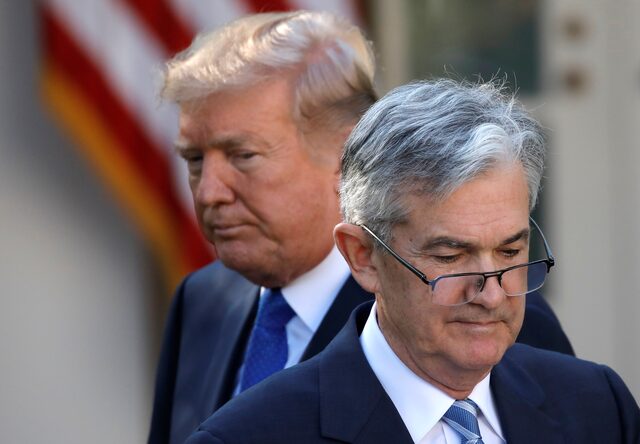
With growing concern over the safety of U.S. treasuries, the continuing rise in prices, and the all-time high in gold and asset prices, the Federal Reserve, at its September meeting, decided to cut the federal funds rate by 25 basis points while indicating that there will be more cuts coming.  The much-anticipated rate cut, of course, was in reaction to the unprecedented pressure brought to bear by President Donald Trump on Fed Chairman, Jerome Powell.

Like his reckless tariff policy, which has driven some allies into the arms of America’s supposed adversaries – see India and its rapprochement with China – Trump’s Fed bashing will have the opposite of its intended effect. 

Trump believes that rate cuts will make the economy “take-off” and he hopes that lower borrowing costs will make service of the gargantuan U.S. debt more manageable. 

As usual, the president talks out of both sides of his mouth.  He has spent most of his second term boasting that the economy is the best it has ever been.  Why then is there a need for interest rate cuts if the economy is booming? 

Trump also promised massive spending cuts via the Department of Government Efficiency but, instead, he passed the “Big Beautiful Bill,” which added more spending, requiring more borrowing.

America is not alone in cutting rates as central banks across the world (whose economies are also debt ridden) are reducing rates which will only encourage more borrowing.  This, of course, will lead to more price inflation as central banks will have to print more money to finance the profligate spending of their governments. 

Eventually there will be a return to gold in the monetary order, not just as a reserve asset, but one used in exchange as fiat currencies collapse. 

If economic trends continue, that day may not be far off.   

*https://www.ft.com/content/0dbc435d-7d7e-43d7-b730-b8ced4b1cba2

Antonius Aquinas@antoniusaquinas
https://antoniusaquinas.com

The Trump – Powell Spat: A Distraction from the Debt Crisis

Since his return to office in January, President Donald Trump has called on Federal Reserve Chairman Jay Powell to cut interest rates which Powell and the Fed’s Board of Governors have refused to do.  In typical child-like behavior when he doesn’t get his way, Trump has hurled insults at Powell calling him a “stupid person,” “too late Powell,” and a “numbskull.” 

Trump’s juvenile attacks, although misplaced, have been quite humorous and a welcome change in tone to the respect, reverence, and almost deification that previous Presidents, Congressmen, and the financial press heap on Federal Reserve Chairmen.

Unfortunately, as with all his policies, Trump’s megalomania is on display.  After the Fed’s June meeting when it once again decided to leave rates unchanged and indicated that there might be only one rate cut in 2025, Trump again slammed Powell and suggested that “Maybe I should go to the Fed.  Am I allowed to appoint myself to the Fed.?” *

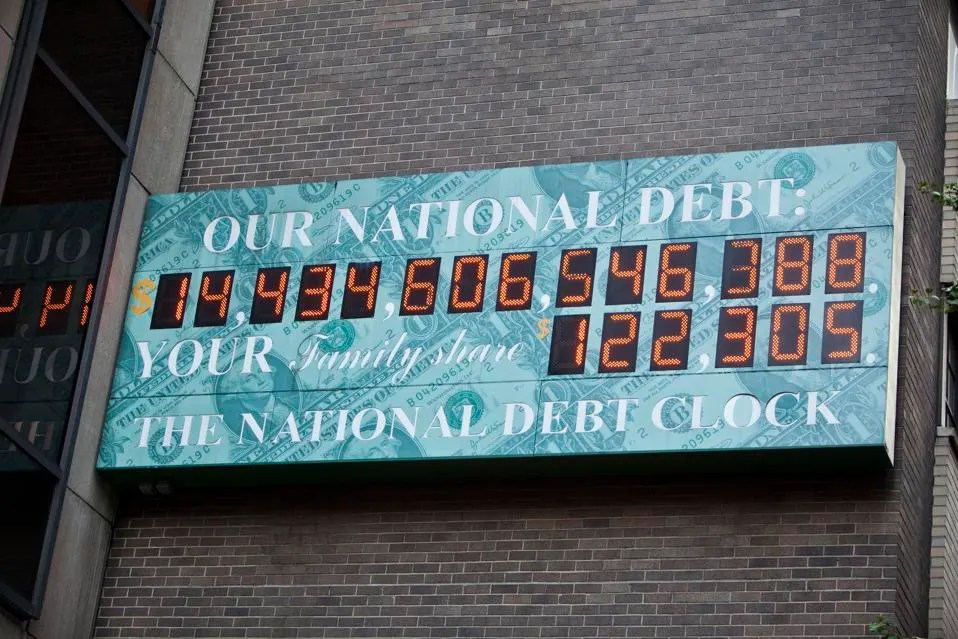
While Trump’s ridiculing the head of one of the sacred cows of America’s ruling establishment is welcomed, his crazed notion of putting himself, and presumably future presidents, in charge of monetary policy does not offer any viable alternative to the debt crisis that is staring the nation in the face with the U.S. in the hole in excess of now some $37 trillion. 

Although Trump’s blasting of Powell has provided some comic relief from the dire economic conditions which confront the U.S., in reality both the president and the Fed Chair are wrong over interest rate policy although, in this case, Powell is less wrong.  Like most of Trump’s kooky ideas – taking over Greenland, making Canada the 51st state – not only is the slashing of interest rates counterproductive, but the idea of giving the executive branch of government control of monetary policy would turn the nation into a complete dictatorship.

Powell, too, has been mistaken in his policy of holding rates steady. Interest rates, in fact, are too low and need to be higher.  At current levels, rates are too “accommodative” as price inflation remains above the Fed’s 2% target.  Of course, in reality prices are rising at a much briskier pace than official government estimates. 

Hiking rates would encourage savings and discourage consumption both of which would put downward pressure on consumer prices.  If Trump wants to achieve his goal of a reindustrialized America, there needs to be an increase in savings. Production of goods takes place over time and without savings to fund the construction of factories, the purchase of machines and equipment, and the payment of wages, there can be no economic growth.

Trump wrongly believes that lower rates will spur economic growth.  Sustained prosperity can only take place through savings and investment not money creation via credit expansion which the president is a fan of.    

More fundamentally, both Trump and Powell are wrong: interest rates should not be set by governments or monetary authorities, but be determined by market forces – the aggregate decision making of individuals on how much to save or how much to consume their income.  Concomitant with non-state involvement with the setting of interest rates, a return to a metallic monetary standard would prevent price inflation which would make saving more attractive.

Another reason why Trump wants lower rates is that servicing the mammoth U.S. debt would be somewhat more palatable. His “big, beautiful bill,” working its way through the Senate, will need to be financed.  Lower rates would reduce the government’s borrowing costs.  This irresponsible argument was also made by former Federal Reserve Chair and later Treasury Secretary Janet Yellen.   

Since Donald Trump has no ideological core that shapes his world vision, his outlook and policies are more often than not based on what affects him personally or who strokes his ego or lines his pockets.  The proper monetary policy for the nation is not to cut interest rates, but to raise them and reduce the national debt through spending cuts.  While there would certainly be short-term pain from such a policy, eventually matters would turn around and economic activity would be placed on a sound footing.

Ultimately, if sound money is ever to return to America and the Western world, its control must be taken away from central banks and the influence of mercurial politicians.  The creation of money, its distribution, authenticity, and safe keeping should be left up to a decentralized non-governmental arrangement. 

*Tyler Durden, “Trump Slams ‘Stupid’ Powell: ‘I Think He Hates Me.  I Call Him Every Name in the Book to Try and Get Him to Cut,’” Zero Hedge, 18 June 2025. https://www.zerohedge.com/markets/trump-slams-stupid-powell-i-think-he-hates-me-i-call-him-every-name-book-try-and-get-him

Antonius Aquinas@AntoniusAquinas

“Don’t Buy Government Bonds”

As another farcical “debt-ceiling raising” saga unfolds, conducted by the two indistinguishable political parties hell-bent on driving America into economic ruin, it would be instructive to look at how some earlier conservative/libertarian thinkers viewed public debt.  Unlike the present generation – with the notable exception of Ron Paul – these intellectuals asked fundamental questions about such matters as debt, taxation, central banking, and foreign policy.

One of the leading lights of what was known as the “Old Right” of the 1950’s, which opposed the Cold-War globalism of the likes of William Buckley and domestically sought to overturn the New Deal, was Frank Chodorov (1887-1966).  In his books and essays, Chodorov challenged the pillars which social democracy rested and sought to return America to small government, free trade, and “isolationism.” 

In one of his provocative essays, Chodorov pervasively argued that those who purchase public debt are complicit in the enhancement of state power.  Unlike many present-day economists who only see the baneful economic effects of profligate government borrowing, he makes a moral case against debt financing.*

He points out that public borrowing burdens future generations for the benefit of the present.  Despite reasons often given for the necessity of borrowing – war, natural disaster, infrastructure, etc., – Chodorov contends that the practice of shifting the cost to later generations, whatever the reason, is unjust:

This is exactly what you do when you
cooperate with the State’s borrowing
program. You are loading on your children
and your children’s children an obligation to
pay for something they had no voice in, and
for which they may not care at all. Your
‘investment for posterity’ may earn you
nothing but the curses of posterity.

Chodorov understood, as most commentators do not today, that a gold-backed currency restrained State largesse: “When money was redeemable in gold, the inherent profligacy of government was somewhat retrained; for, if the citizen lost faith in his money, or his bond, he could demand gold in exchange, and since the government did not have enough gold on hand to meet the demand, it had to curtail its spending proclivity accordingly.”

It was Franklin Delano Roosevelt’s despicable and criminal act of taking the U.S. off the gold standard domestically that led to the expansion of the public debt as Chodorov describes: “. . . Mr. Roosevelt removed this shackle and thus opened the flood gates.  The only limit to the inclination of every politician to spend money, in order to acquire power, is the refusal of the public to lend its money to the government. . . . the government can then resort to printing of money, to make money out of nothing. . . .” 

Not realized at the time, but the ability of the American government to expand its revenue base fit nicely into FDR’s later nefarious foreign policy objectives. 

Chodorov’s viewpoint on public debt can also easily be applied to FDR’s decision to eradicate the gold standard through which the U.S. currency could be redeemed for precious metals.  FDR’s act, however, was a “violation of contract” with American citizens since the U.S. government defaulted on its obligations.

In Orwellian fashion, the verbiage used with most government operations is often misused to legitimize State functions.  “Investment” is one such term that has been corrupted in relations to spending and debt.

In promoting their spending schemes, politicians will often use the term investment, “investment in education,” “investment in infrastructure,” etc.  This is deliberate, since it tries to equate government spending with a vital component of the market process.

In a market economy, investment means the lending of savings, which is used to expand and/or start an enterprise.  In return, the lender receives a stock or a bond.  If the business is successful, the lender’s investment will receive a return – dividends from a stock or interest from a bond.  Business investment is, therefore, a necessary aspect of capitalism which results in economic growth and increased living standards.

As Chodorov incisively points out, however, government investment is the antithesis of what takes place in the marketplace:  

The State, however, does not put your money into production.  The State spends it – that is all the State is capable of doing – and your savings disappear.  The interest you get comes out of the tax fund, to which you contribute your share, and your share is increased by the cost of servicing your bond.

Chodorov’s solution to deficit financing was not to buy government bonds.  While this would certainly be a step in the right direction, a more radical approach is needed since the problem has now become so immense. 

Simply put: there should be a prohibition on government borrowing of any kind.  State revenues should only come through tax receipts and fees paid by those in the present.  This would completely eliminate the “moral hazard” of debt financing and drastically reduce the size and scope of government over society.

For those who seek to put an end to the current debt-ceiling charade and rectify the immoral practice of burdening future generations by the irresponsibility of the present, the works of Frank Chodorov are essential.

* “Don’t Buy Government Bonds,” The Mises Institute, 13 January 2011. https://cdn.mises.org/Out%20of%20Step_4.pdf

Antonius Aquinas@AntoniusAquinas

https://antoniusaquinas.com

The Convention of States Project: A Bad Idea

Similar to Patrick Buchanan’s campaigns, Newt Gingrich’s “Contract with America,” the Tea Party, and to some extent Donald Trump’s presidency, the Convention of States Project* will not solve the crises that America faces.  It will, undoubtedly, like most of the previous reform and populist movements be sabotaged by the ruling class if it ever gets close to accomplishing its goals.

The Project’s rhetoric is “old-style” conservative/populist-speak which seeks to “[propose] amendments that impose fiscal restraint on the federal government, limit the power and jurisdiction of the federal government, and limit the terms of office for its officials and for members of Congress.”** Some of the proposed amendments include:

  • Congressional term limits
  • Requiring a two-thirds vote of the House and Senate to increase the public debt
  • Restoring the Commerce Clause to its original intent and scope
  • Repeal of the 16th Amendment, which gave us the income tax
  • Giving states, by a three-fifths vote, the power to negate any federal law, regulation or executive order giving Congress an easy means of overriding regulation

So far, 19 state legislatures have called for a constitutional convention, 34 states are needed for a convention to be called and, for an amendment to be passed, it must be approved by three quarters of state legislatures. 

The state legislatures who have signed on have realized that the federal government has become omnipotent and the individual states are now merely appendages to Washington.  “The states,” said South Carolina state representative Bill Taylor, “have sort of lost their voice, and all we can do now is beg from the cheap seats and say, ‘Hey, don’t do that.’”***

After the totalitarian and draconian efforts of the U.S. government and those around the world the past two years in response to the “pandemic,” Mr. Taylor’s sentiment is, to say the least, an understatement!

The fundamental problem with efforts such as the Convention of States Project is that they do not understand the nature of the crises that both America and most of the world face.  For America, its current malaise can be traced shortly after its independence with the adoption of the Constitution itself. 

While it has long been touted as a great document of freedom and liberty, it is anything but.  The “founding fathers” knowingly created a powerful central government and decreased the sovereignty of the individual state governments which had existed under the Articles of Confederation. 

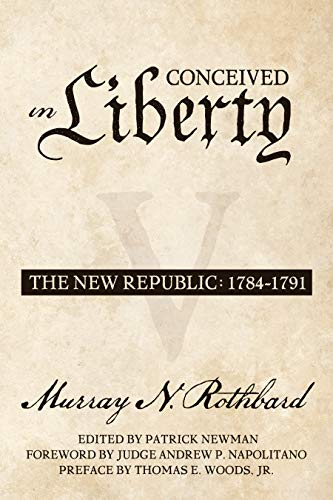
In the words of Murry Rothbard, the Constitution was a coup that, for the most part, was the antithesis of the spirit and drive of the American Revolution which was a movement against political centralization and empire:

It was a bloodless coup d’etat against an unresisting

Confederation Congress. . . . .  The Federalists, by use

of propaganda, chicanery, fraud, malapportionment of

delegates, blackmail threats of secession and even

coercive laws, had managed to sustain enough delegates

to defy the wishes of the majority of the American people

and create a new Constitution.****

Worse than the power grab was the establishment of an omnipotent state as Rothbard incisively continues:

The drive [for ratification] was managed by a

corps of brilliant members and representatives

of the financial and landed oligarchy.  These

wealthy merchants and large landowners were

joined by the urban artisans of the large cities in

their drive to create a strong overriding central

government – a supreme government with its

own absolute power to tax, regulate commerce,

and raise armies.*****

410jXD-zO+L


The celebrated “separation of powers,” and “checks and balances” within the federal system and even the Bill of Rights, so often lauded by conservative and populist commentators, have proven from the very start to be ineffectual in stopping the expansion of state power. 

The Constitution itself declares that it is the ultimate authority as Article VI states:

This Constitution and the laws of the United States which

shall be made in pursuance thereof, and all treaties made,

or which shall be made, under the authority of the United States,

shall be the supreme law of the land. . . . [Italics mine.]

The massive and now unresolvable social, economic and political troubles both in the U.S. and around the world stems from a concentration of political power that is inherent in the nature of constitutional government.  This power is augmented and sustained by a system of central banking which provides the nation state with seemingly unlimited financial power to implement its various social engineering schemes, conduct continuous warfare, and has the ability to crush any opposition to its hegemony. 

The solution, which is all too obvious, but not attainable in the current ideological atmosphere dominated by statist thinking, is political decentralization.

The smaller political alignments under decentralization would probably coalesce around peoples with similar economic, social and religious affiliations and status and those with similar ethnic and racial backgrounds.  Such a system would be truly diverse and undoubtedly lower social tensions which derive from the central state’s forced integration polices. 

Once political decentralization became a reality, the natural and mutually beneficial relationships and interactions between peoples would emerge.  The immense advantage of free trade – the widening of the division of labor and specialization – would be the norm between societies since smaller countries could not afford to restrict trade since doing so would lead to autarky and the resultant fall in standards of living to primitive levels. 

Likewise, a universal monetary standard, most likely based on gold and silver, would arise among differing communities since a multitude of currencies would lead to monetary chaos and render economic calculation an impossibility.  Since no central state could impose its currency, the only honest and sound money – gold/silver – would be quickly adopted by all.

The mass invasion of the U.S. taking place under the negligence and encouragement of the Biden Administration could also be thwarted through political decentralization.  Areas where the lives and property of people are threatened by invaders have more of an incentive to effectively deal with unwanted groups than bureaucrats living often times thousands of miles away. 

Each jurisdiction would make its own policies on who or how many it wanted in its territory.  Moreover, each community could expel undesirables without interference from those who are not property owners or members of such communities.

While those behind the Convention of States Project and the state legislatures which have called for a constitutional convention may be well meaning, they will ultimately fail.  Such efforts are a wrongheaded approach to address the myriad of problems that plague the U.S. and, for that matter, the entire world.

Instead of attempts to amend the Constitution or though the electoral process by finding the “right candidate,” the very viable and historically proven alternative of de-centralization through secession is the only pathway to ultimate success.  Until the break-up of the nation state is accomplished, America and the world’s future will be considerably bleak.

*https://conventionofstates.com/

**https://starkrealities.substack.com/p/activists-more-than-halfway-to-forcing

***Ibid

**** Murray N. Rothbard, Conceived in Liberty. Vol. 5, The New Republic, 1784-1791, ed., Patrick Newman.  Auburn, AL.: Mises Institute, 2019, p. 306.

*****Ibid.

Antonius Aquinas@AntoniusAquinas

https://antoniusaquinas.com


Trump’s Inflation

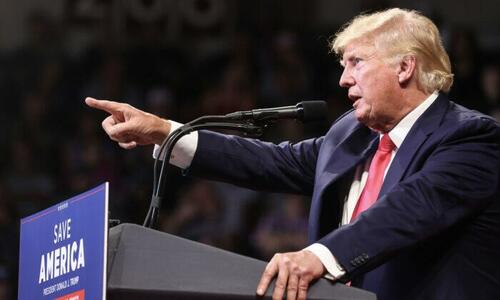
Former President Donald Trump attends a rally in support of Arizona GOP candidates, Prescott, Ariz., on July 22, 2022. (Mario Tama/Getty Images)

Once again, former president Donald Trump criticized the Biden Administration for the record consumer price increases that Americans are now paying.  His remarks followed up on his July 4th speech in Wyoming where he lamented about the state of the nation: “I know it’s not looking good for our Country right now, with a major War raging out of control in Europe, the Highest Inflation in memory, the worst 6 month Stock Market in History, the highest energy prices ever.”* 

In his most recent campaign rally for GOP hopeful Kari Lake, Trump lambasted President Biden for creating the “worst inflation in 47 years”** and for his “war on American energy” which Trump believes has contributed to the record hike in fuel prices.

The former president boasted that had he been re-elected “none of these terrible events would have happened.”  He reassured his audience “not to worry” and that “we will make America great again.” 

As with all of his post-presidential rallies, Trump’s criticism of the Biden regime comes with touting his own accomplishments as chief executive.  Most of these claims are so outrageous they damage or totally negate his critique of Biden’s policies and make Trump sound like a fool.

Take, for instance, his rally in Arizona for Kari Lake, where he had the audacity to say that under his watch the country “had the greatest economy in the history of the world with no inflation.” [!]  Such nonsense needs no comment.

Like his boasts about the economy, the former president deftly left out his Administration’s role in the drastic rise in prices which Americans are currently suffering from. 

First, however, the meaning of “inflation” should be explained.

Inflation, properly defined, as it was understood until the present era, meant an expansion of the money supply.  “Deflation,” its opposite is a decrease in the money supply.  The rise or fall in prices – usually a rise in producer and consumer prices – is a consequence of the expansion or contraction of the money supply.  Once understood, the rampant rise in prices in America and throughout the world has been the result of the increase in the money supply not only by the Federal Reserve, but all central banks.

Another important tenet of monetary theory long since forgotten has been the notion of a “lagging indicator.”  Between the expansion of the money supply – inflation – and the resultant increase in prices, there is often a lag which could take months or years to appear. 

The increase in consumer and producer prices is due to the dramatic explosion of money and credit which took place during the Trump Administration not only in response to the scamdemic, but in the years leading up to it.  In fact, the plandemic was a convenient excuse to inject massive liquidity into a system that began to hemorrhage in September, 2019.  In the early months of 2020, the markets began to implode before the unnecessary lockdowns as the air began to come out of the financial bubble.  This has been ignored by the financial press and Trump himself.

Prior to the covid hysteria, Trump had repeatedly lobbied for “cheap” money, calling for a renewal of quantitative easing, reduction in interest rates, and he even spoke about “negative” rates.  The former president threatened to fire Jerome Powell, whom he had picked to head the Federal Reserve, for not reducing interest rates far enough.  Trump complained that President Obama benefited from the Fed’s accommodative monetary policy and wanted similar treatment so as to keep the financial bubble going.

Trump’s fiscal policy was also highly inflationary as he ran record deficits long before covid.  His tax cuts and failure to cut government spending led to greater government borrowing which the Fed was forced to monetize.  Trump was on pace, well before the 2020 lockdowns, to spend more money in four years than Obama spent in his two terms.  By 2019, the deficit had grown to $1 trillion dollars, up $205 billion, 26 percent from 2018.***  Again, all before covid had begun.   

It was the Trump Administration’s wrongheaded response to the corona virus which is largely responsible for the rising prices of today.  If the lockdowns were necessary (which a growing number of officials now admit they were not), the proper policy would have been to reduce the money supply (and government spending in general) since the lockdowns reduced production meaning less goods and employment.  The massive increase in the Fed’s balance sheet from $4 trillion to some $9 trillion meant more money “chasing fewer goods” causing the prices of the available goods to increase – some dramatically.

What was needed was a reduction in consumer spending since there was less goods being produced with the lockdowns.  Less demand would have offset the reduction in supply and would have kept prices from spiraling.

Instead, Trump – as did his successor – following the doctrines of Lord Keynes, attempted to maintain aggregate demand at pre-covid levels and sent out stimulus checks even to those still employed.  While the money given out to American workers pales in comparison to the massive transfer of wealth to politically-favorite corporations, big business, and the expansion of the government itself, the propping up of aggregate demand led to supply chain shortages.   

Trump is not alone in his ignorance of economics.  His handlers, economic advisors, and the vast majority of his loyal supporters do not understand what took place under his administration.  The current financial mess can be laid at his – and the Federal Reserve’s – feet.  To be fair, his predecessor, Barrack Obama, is also liable.    

The “inflation,” and now recession, which the country is suffering through cannot be fully attributed to the Biden Administration although it too has added to the crisis with more profligate spending. 

The remedy for the current mess is not the re-election of a very flawed former president who does not understand the problem at hand and throughout his term was constantly outfoxed by the Swap which he was elected to drain.  The solution is a return to sound money, the abolition of central banking, and the allowance for the necessary cleansing of the financial bubble. Until a presidential contender speaks in these terms, America’s financial woes will continue.

*https://www.zerohedge.com/political/heres-what-trump-says-inflation-would-be-if-he-were-still-president

**https://www.zerohedge.com/political/trump-blasts-biden-over-soaring-prices-says-true-inflation-rate-much-much-higher-91

***https://www.washingtonpost.com/business/2019/10/25/us-deficit-hit-billion-marking-nearly-percent-increase-during-trump-era/

Antonius Aquinas@AntoniusAquinas

https://antoniusaquinas.com

The Ethics of a Gold Standard

goldstandard

The efficacy of a metallic monetary system is beyond dispute at least among real economists which eliminates just about 95% of whom are now engaged in the “profession.”  Money, which gold is, allows for specialization, the division of labor, and provides the means for mankind to escape from barter and, thus, a primitive existence.  Like free trade, money naturally integrates mankind both among and between peoples.

A system of central banking with an unbacked paper currency is the antithesis of a gold standard.  Manipulation of currencies by central banks, mostly through debasement, hinders trade, creates distortions, and ultimately leads to the dreaded business cycle.  Murray Rothbard aptly describes the baneful results of state intervention in the monetary system:

. . . government meddling with money has

not only brought untold tyranny into the world;

it has also brought chaos and not order.  It has

fragmented the peaceful, productive world

market and shattered it into a thousand pieces,

with trade and investment hobbled and hampered

by myriad restrictions, controls, artificial rates,

currency breakdowns, etc.  It has helped bring

about wars by transforming a world of peaceful

intercourse into a jungle of warring currency blocs.*

Rothbard Money

While the economic efficiency of a gold standard is important, the ethical case for it is more compelling and was the reason why gold, as money, lasted as a medium of exchange for so long.  Gold/money has to be created through honest-to-goodness production and exchange.  The often dangerous mining of gold takes labor, capital goods, and land.  Turning raw gold into coinage is another process which requires a high level of specialization and production techniques.  Both are honest and morally sound activities which make for the betterment of life all around.

The ethical standing of central banking and its issuance of unbacked currency as money through the printing press, stroke of a computer key, or via the expansion of credit cannot stand similar scrutiny.  By any appraisal, central banking is immoral.  Through the creation of money, banks stealthy transfer wealth to those who control the money supply and those closely associated with it.

The ability of central banks to create unlimited amounts of money and credit has been the greatest redistribution scheme ever conceived.  The process ultimately leads to class conflict as the wealth disparity between the politically well-connected and those outside that nexus invariably widen.

Under a gold standard, none of this would take place.

Because of their lack and often distain for economic doctrines, in particular, monetary theory, “economic nationalists” (really “economic ignoramuses”) have wrongly focused on trade as a factor in the continued decline of the middle and working classes.  China’s supposed unfair trade practices was a staple of President Trump’s campaign rhetoric and has continued through much of his first term.

The focus on trade has deflected attention from the real cause of worsening economic conditions for American workers and the enrichment of Wall Street.  Despite the blatant transfer of wealth via the Fed’s policies of suppressed interest rates and money printing since the 2008 Recession, economic nationalists continue to applaud President Trump’s tariff policies while the President continues to browbeat the Fed to do more of the same even calling for negative interest rates and more Quantitative Easing.

The Left rightly speaks out of the vast and growing inequality of wealth distribution, but like those who espouse economic nationalism, they fail to understand the reason for why the societal imbalance has occurred.  One remedy they propose – a “wealth tax” – will not address the problem.  Moreover, their “soak-the-rich” schemes would snare in their plunder (not that Leftists particularly care) many of the wealthy outside of the banking and financial sector of their legitimate, just gains.

The case for honest money must be made on ethical grounds.  The current system must be exposed and shown for the scam that it is: a massive redistribution scheme enriching the political elites and their closely aligned business and financial allies. While it is undeniable that a gold standard would lead to enormous prosperity, its reinstatement would remedy one of the great injustices that plague the world – central banking!

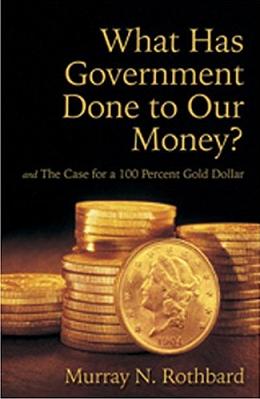
*Murray N. Rothbard, What Has Government Done To Our Money?  BN Publishing, 2012: 84.

Antonius Aquinas@antoniusaquinas

https://antoniusaquinas.comhttps://antoniusaquinas.com

The Gold Standard: Protector of Individual Liberty and Economic Prosperity

goldstandard vs.    the-bill-of-rights


The idea of a constitution and/or written legislation to secure individual rights so beloved by conservatives and among many libertarians has proven to be a myth. The US Constitution and all those that have been written and ratified in its wake throughout the world have done little to protect individual liberties or keep a check on State largesse.  Instead, in the American case, the Constitution created a powerful central government which eliminated much of the sovereignty and independence that the individual states possessed under the Articles of Confederation.

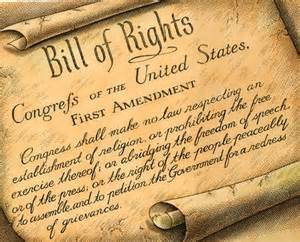
While the US Constitution contains a “Bill of Rights,” the interpreter of those rights and protections thereof is the very entity which has enumerated them.  It is only natural that decisions on whether, or if such rights have been violated will be in favor of the state.  Moreover, nearly every amendment which has come in the wake of the Bill of Rights, has augmented federal power at the expense of the individual states and that of property owners.

History has shown the steady erosion of individual rights and the creation of “new rights” and entitlements (education, health care, employment, etc.) which have occurred under constitutional rule.  Instead of limitation on government power, constitutions have given cover for the vast expansion of taxation, regulation, debt, and money creation.

While taxation has always been a facet of constitutional governments, it has been the advent of central banking and with it the elimination of the gold standard which has provided the means for the state to become such an omnipresent force in everyday life.  Irredeemable fiat paper money issued by central banks has also led to the entrenchment of political parties which has allowed these elites to create and subsidize dependency groups which, in turn, repeatedly vote to keep the political class in office.

Without the ability to create money and credit, the many bureaucracies, regulations, and laws could neither be created or enforced.  This would mean that the vast and powerful security and surveillance agencies could not exist or would be far less intrusive than they currently are.  With commodity money, debt creation would have to be repaid in gold, not monetized as it is currently done through the issuance of paper currency.

Just as important, it would have been next to impossible for the two world wars to have been fought and carried to their unimaginable destructive ends.  None of the populations involved would have put up with the level of taxation necessary to wage such costly undertakings.  Few of the wars which followed (most of which have been instigated by the US) could have taken place without central banking.  Nor could the level of “defense” spending – currently at a whopping $717 billion for fiscal year 2018 – be financed if the US was on a commodity standard.*

Under a gold standard, governments would have to rely on taxation alone.  Since citizens directly feel the effects of taxation, there is a “natural level” that it can be raised.  Punitive tax rates usually lead to a backlash and potential social insurrection which strike fear in the hearts of political elites.

Recent projections by the Congressional Budget Office again demonstrate that constitutional government provides little restraint on spending.

If present trends continue, the federal government will spend more on its interest serving its debt than it spends on the military, Medicare, or children’s programs.  It is also expected that next year’s interest on the debt will be some $390 billion, up an astonishing 50 percent from 2017.** And, for the entire fiscal year of 2018, the gross national debt surged by $1.271 trillion, to a mind-boggling $21.52 trillion.***

At one time, economists used to speak of the pernicious effects that “crowding out” had on an economy.  Since the onset of the “bubble era,” talk about deficits has almost dropped out of financial discussions.  Yet, the reality remains the same: public spending and borrowing divert scarce resources away from private capital markets to unproductive wasteful government projects and endeavors.

For those who seek a reduction in State power, defense of individual rights, and economic prosperity, the re-establishment of a monetary order based on the precious metals is the most efficacious path to take.  Such a social system would not require elaborate legislation or fancy proclamations of man’s inalienable rights, but simply a return to honest money – gold!

*Amanda Macias, “Trump Gives $717 Billion Defense Bill a Green Light. Here’s What the Pentagon is Poised to Get.”  CNBC.com 14 August 2018. https://www.cnbc.com/2018/08/13/trump-signs-717-billion-defense-bill.html

**Nelson D. Schwartz, “As Debt Rises, the Government Will Soon Spend More on Interest Than on the Military.”  The New York Times. 25 September 2018 https://www.nytimes.com/2018/09/25/business/economy/us-government-debt-interest.html

***Tyler Durden, “US Gross National Debt Soars $1.27 Trillion in Fiscal 2018, Hits $21.5 Trillion.” Zero Hedge.  2 October 2018.   https://www.zerohedge.com/news/2018-10-02/us-gross-national-debt-soars-127-trillion-fiscal-2018-hits-215-trillion

Antonius Aquinas@AntoniusAquinas

https://antoniusaquinas.com

Is Political Decentralization the Only Hope for Western Civilization?

US Secssion Map II

A couple of recent articles have once more made the case, at least implicitly, for political decentralization as the only viable path which will begin to solve the seemingly insurmountable political, economic, and social crises which the Western world now faces.

In the last few months, over 3,000 millionaires have fled the hopelessly corrupt and bankrupt state of Illinois.  When asked, 47% of Illinoisans would like to leave the state which, over the last decade, has seen over a half million of its residents flee.  Naturally, this exodus has exacerbated the Land of Lincoln’s financial straits to catastrophic levels.*

A report published by the American Legislative Exchange Council predicted that the tax flight which is occurring in Illinois will similarly take place in the coming years in high-tax blue states such as California and New York.  The 2017 Trump tax reform will accelerate this process since under the new legislation the amount of state income tax that can be deducted on federal tax returns has been capped at $10,000 per family.  The authors of the report wrote: “. . .  high [income] earners in places with hefty income taxes – not just California and New York, but also Minnesota and New Jersey – will bear more of the true cost of their state government.”**

The not too subtle consequences of the new tax code will mean an even greater exodus of taxpayers out of blue states which will shrink state revenues even further and create job losses across the board.

While those who want to escape the crushing burden of individual state taxation and regulation, if they have the means and desire to do so, can move to more favorable climes, no such option exists (except the drastic step of expatriation) to escape federal tyranny.  Yet, the same benefits which occur from a multiple of individual states and jurisdictions would be present if the various nation states which dominate the globe were broken up into smaller political units.

While the authors of the cited articles see the advantage that multiple states have where one can “vote with his feet,” the same logic can be applied to central governments across the planet who are, on the whole, more tyrannical than local jurisdictions.  More political bodies would not only provide sanctuary for the oppressed, but it would tend to keep a check on tyranny among existing states.

Political decentralization is a far greater deterrent to government largesse than constitutions, elections, or finding the “right person” to “fix things.”  The events of the last few weeks in the realm of US foreign policy once again demonstrate that trusting candidates to fulfill campaign promises is naive, to say the least.

To get to this goal, all and every secession movement, even of a Leftist bent, should be supported, whether they are nations that want to “exit” from larger political units, such as Great Britain from the EU, or within nation states themselves such as California in the US.  All should be encouraged.

Of course, the case for decentralization has to be made on ideological grounds.  The Left, most likely, will not be a natural ally for secession, nor are conservatives, most of whom are under the spell of “nationalism” and “restoring the Republic.”  Yet, the Right offers the best opportunity to build a secession movement and needs to be convinced that the preservation of the nation state will only lead to the complete triumph of liberalism.

Secession would also necessitate the breakup of the nation-state’s monopoly of money and banking.  Numerous political divisions would be more likely to adopt a single monetary unit – gold – which would guarantee financial stability rather than the debt ridden paper-money system now in place.

Next to the outbreak of World War III, immigration is the greatest threat to what remains of Western Civilization.  Smaller political units would be far better to control their borders than reliance on a central authority which can be easily manipulated from outside agents.

The solution to the myriad of social and economic problems that confront Western societies will not come about from a “reform” of the nation state, but through its dissolution.  Only through a world made up of hundreds, if not thousands, of Lichtensteins, Hong Kongs, Monacos, confederacies, free cities, etc., will these crises be hoped to be resolved.

*Tyler Durden, “This $5 Trillion Time Bomb Will Devastate Americans.” Zero Hedge.  9 August 2017.  https://www.zerohedge.com/news/2017-08-09/5-trillion-time-bomb-will-devastate-americans

**Robert Frank.  “800,000 People Are About to Flee New York and California Because of Taxes, Say Economists.”  CNBC.com. 26 April 2018.    https://www.cnbc.com/2018/04/26/800000-people-are-about-to-flee-new-york-california-because-of-taxes.html?__source=sharebar|twitter&par=sharebar

Antonius Aquinas@AntoniusAquinas

https://antoniusaquinas.com

“Strong Dollar,” “Weak Dollar,” What About a Gold-Backed Dollar?

gold backed dollar

The recent hullabaloo among President Trump’s top monetary officials about the Administration’s “dollar policy” is just the start of what will likely be the first of many contradictory pronoucements and reversals which will take place in the coming months/years as the world’s reserve currency continues to be compromised.  So far, the Greenback has had its worst start since 1987, the year of a major stock market reset.

The brief firestorm was set off by Treasury Secretary Steven Mnuchin who said in response to the dollar’s recent slide, “Obviously, a weaker dollar is good for us, it’s good because it has to do with trade and opportunities.”*  Mnuchin backtracked a bit as international financial leaders criticized the apparent shift in policy while Administration officials sought to clarify the Secretary’s remarks.  President Trump weighted in on the matter saying, “Ultimately, I want to see a strong dollar” and added that Mnuchin’s comments were “taken out of context.”

While President Trump sought to allay jittery currency markets that monetary policy had not changed, candidate Trump supported the Federal Reserve’s suppression of interest rates and did not want to see a rising dollar:

I must be honest, I’m a low interest rate

person.  If we raise rates and if the

dollar starts getting too strong, we’re going

to have some very major problems.**

Of course, the entire uproar about a strong dollar versus weak dollar is a sham. When the dollar (and for that matter all other national currencies) cannot be redeemed for either gold or silver, it is inherently “weak” and ultimately worthless.  That this obvious fact is not recognized by the Trump Administration, international monetary authorities, and the financial press demonstrates just how unstable the dollar and world currencies actually are.

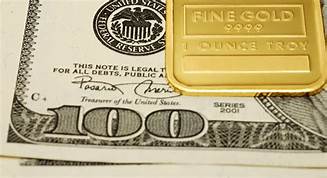
If President Trump truly wants to see a strong dollar that will become a linchpin in “making America great again,” he should enact policies that will return the dollar to its original function – a warehouse receipt that can be redeemed for precious metals.  Just as important, an authentic strong dollar policy would mean that no dollar can be created that did not have “an equal amount” of gold/silver in bank vaults – in essence a 100% gold dollar.  These two acts would guarantee a strong dollar and insure that the dollar would remain the world’s reserve currency.    Moreover, a fully redeemable dollar would likely lead to other nations adopting similar measures.

A gold-backed dollar would also head off China’s not too subtle attempt at replacement of the Greenback with the Yuan as the world’s reserve currency.  Its “Belt & Road Initiative,” its massive accumulation of gold, and other actions are all aimed at making the Yuan the dominant world currency which, if successful, will have catastrophic financial repercussions for the US and Western Europe.

Gold-backed money will not only have positive international effects, but domestic benefits as well.  Crippling price inflation that has been intentionally under reported by government statistics will be a thing of the past.  Prices in a gold-backed currency will actually fall, raising living standards for everyone.

Without the ability of the Federal Reserve to create money out of thin air, the massive federal budget deficits would have to be dealt with.  And, without the Fed’s purchasing of US debt, the government would be forced to make cuts in spending.  Spending cuts would have to be deep and across the board.

Happily, under such a scenario, reduction in spending would mean a pull back in the American Empire.  The US would simply not have the resources to maintain bases abroad or involve itself in the countless conflicts and wars it is now engaged in.  It is more likely that when the American Empire comes to an end, it will not be because of a military defeat, but because it can no longer be sustained financially.

Sadly, under current ideological conditions, a return to gold money is not on the financial horizon.  It will most likely take a collapse of the irredeemable paper monetary system before commodity-backed money is re-established as a general medium of exchange.

It is clear from the recent exchange among Trump Administration financial officers that the same dollar policy will continue, which will lead to an inevitable dollar crisis and certain political disaster for the President.

* “Trump Wades Into the Currency Uproar, Favours ‘Strong Dollar,’ Government & Economy.”  Brit Asian News  26 January 2018.  http://britasiannews.com/en/2018/01/25/trump-wades-into-currency-uproar-favours-strong-dollar-government-economy/

**Inflation Alert: Trump Also favors Low Interest Rates, Weak Dollar.”  Weekly Market Wrap. 6 May 2016.  https://www.moneymetals.com/podcasts/2016/05/06/trump-supports-weak-dollar-000864

Antonius Aquinas@AntoniusAquinas

https://antoniusaquinas.com


What President Trump and the West Can Learn from China

Trump Trip China

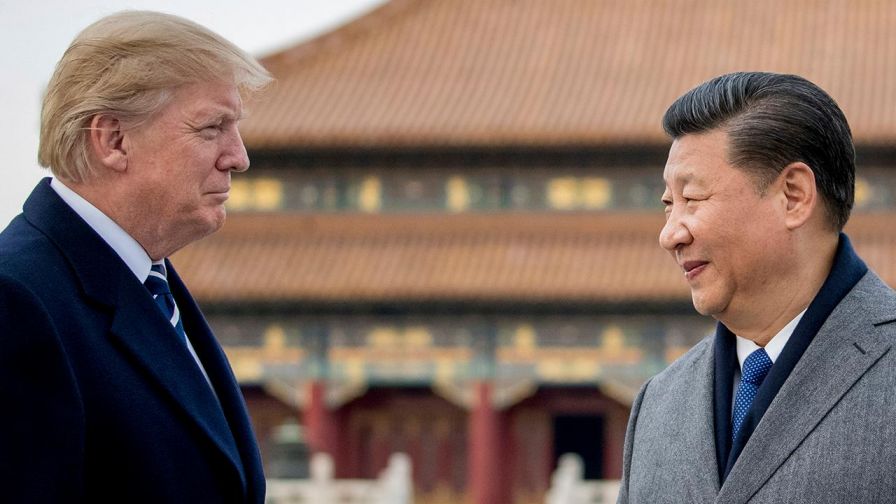
Instead of a demonstration of its overwhelming military might intended to intimidate tiny North Korea and pressure China to lean on its defiant communist neighbor, President Trump and the West should try to learn a few things from China.

The President’s trip to the Far East came on the heels of the completion of China’s 19th National Congress where the current president, Xi Jinping, has cunningly positioned himself as China’s unchallenged leader.  In an address at the opening of the Congress, Xi cautioned that the country faced “challenges” that are “extremely grim” yet, despite these, the nation’s future is “extremely bright.”*

While Western politicos and pundits bemoan the lack of political pluralism that exists within China and President Trump complained about bad trade “deals,” they miss an important factor as to why China has transformed itself from a socialist basket case some three decades ago into an economic powerhouse which now boasts over a third of the world’s billionaires!

China’s economic ascendancy can be attributed not only to the implementation of market reforms in the 1990s, but also its lack of “political competition.”  As a one-party state, resources, time, energy, and capital are not allowed to be channeled into wasteful political processes, but instead are used and “invested” in wealth-creation activities – construction, factories, plants, equipment, research, technology – all of which leads to more and cheaper consumer goods.

The US and the West spend too much on elections, campaigns, polling, political consultation, etc., which diverts scarce resources away from the private wealth sectors of society.  For example, in her last failed presidential campaign run, the Wicked Witch of Chappaqua alone spent over a half of billion dollars.

Under Western democratic pluralism, public debt and state spending have increased to unsustainable levels.  In the US alone – history’s greatest debtor nation – the national debt is in excess of $20 trillion, while its total debt officially is $68 billion with a federal deficit (GAAP) running yearly at $5 ½ trillion.

Such staggering numbers are the result, in part, from political parties seeking public office and once elected exploiting their position to enrich themselves, their constituents, and create dependent classes among the ever shrinking productive segments of society.

China’s foreign policy – an extension of politics – has also been conducive for wealth creation.  Instead of wasteful spending on military hardware, the maintenance of a far-flung global empire, and involvement in incessant wars, China has a rather meek military compared to its national income and has conducted a pretty much non-interventionist foreign policy – witness its diplomacy with North Korea.

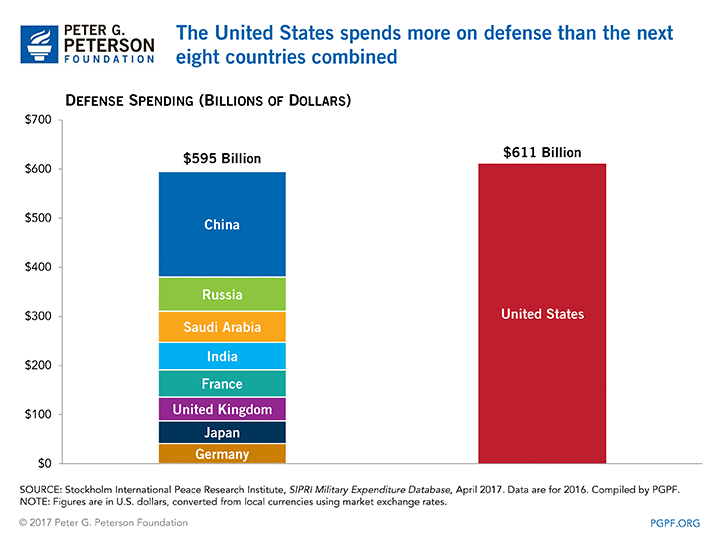
The US is almost the polar opposite.  It spends more on “defense” than the next eight countries combined.** Instead of the production of useful consumer goods, billions are siphoned off into the military/security industrial complex.  Not only does this impoverish Americans at home, but it leads to never ending involvement in wars, conflicts, and disputes, most of which are created or exacerbated by US spy organizations.

Def spending

After meeting with Chinese leadership, President Trump tweeted:

I don’t blame China, I blame the incompetence

of past Admins for allowing China to take advantage

of the U.S. on trade leading up to a point where the

U.S. is losing $100’s of billions.  How can you blame

China for taking advantage of people that had no clue?

I would’ve done the same!

Making better trade deals will not revitalize the moribund US economy.  Instead, there should be less politicization of society and adoption of market reforms as China has done.  The most important plank of such a policy would be the encouragement of real savings – not the creation of bank credit – through the normalization of interest rates.  This would begin the arduous process of capital accumulation, the basis upon which any economy can be built.

Another sign of the divergence between the two is China’s continued push to make the yuan the world’s reserve currency with apparently some sort of gold backing to it.  Contrarily, the Trump Administration has continued the same disastrous policies of its predecessors and has chosen a Janet Yellen clone to head the Federal Reserve with a continuation, no doubt, of the suppression of interest rates.  On the other hand, China continues to import massive quantities of gold and encourages its citizens to own the yellow metal while the West is in the midst of a crypto currency mania, another fraudulent monetary scheme.

China’s economic miracle, while certainly impressive, would not look as astounding if Western economies had not been in a state of stagnation and decline over the past half century.  It was not political liberalization that led to China’s phenomenal growth, but economic freedom which used to be a staple of Western life.  The lesson that should be taken from President Trump’s trip is less politics domestically and more free markets.

*Chris Buckley, “Xi Jinping Opens China’s Party Congress, His Hold Tighter Than Ever.”  The New York Times, 17 October 2017.   https://www.nytimes.com/2017/10/17/world/asia/xi-jinping-communist-party-china.html

**Peter G. Peterson Foundation.  “US Defense Spending Compared to Other Countries.”  1 June 2017.  https://www.pgpf.org/chart-archive/0053_defense-comparison

Antonius Aquinas@AntoniusAquinas

https://antoniusaquinas.com