Tag Archives: Economy

Jailing Banksters Will Not Resolve the Economic Crisis

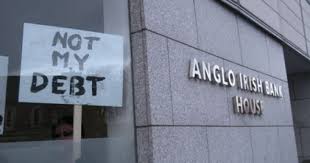
Anglo Irish Bank

Last week, an Irish court sentenced three prominent banksters for their roles in the 2008 financial crisis.  Judge Martin Nolan, who pronounced judgment, said that the bansksters had committed “a very serious crime.”  He continued, “The public is entitled to rely on the probity of blue chip firms. If we can’t rely on the probity of these banks we lose all hope or trust in institutions.”*

A number have criticized the judge’s sentence for its mildness in light of the catastrophic damage that the banks have done to the economy.  Irish taxpayers have bailed out the banks five times since 2011, while it has been estimated that it will take up to 15 years, if ever, to recover.

While Irish banksters and the political class who have enabled them are certainly deserving jail time and much worse, whether they or other banksters who have committed similar crimes are punished will not prevent a reoccurrence of further economic crisis, undo the harm done to the Irish economy, nor will it pull Ireland or the rest of the Western world out of its economic malaise.

The seminal cause of the economic crisis of 2008 and almost every one preceding it has been the fraudulent expansion of the money supply by the banking system through the practice of fractional reserve banking.  Until this economy wrecking and social destructive scheme, along with the central banks that oversee and protect the nefarious practice, are abolished, the economic crisis will continue and deepen no matter how many banksters are jailed.

Simply put: fractional-reserve banking, for those who do not know, which includes 99.9% of the financial press, is the practice by which banks keep only a fraction of their deposits on hand and “invest” or loan out the rest at interest. Of course, if any other warehouse or storage facility engaged in such a practice it would be rightly considered fraud.

The process is augmented by central banks, which expand the money supply through the deposits that individual banks keep with them.  In fact, the main purpose for the creation of central banking in the first place was to enable individual banks to engage in this fraudulent undertaking which leads to all sorts of monetary mischief.

The beautiful part of outlawing fractional reserve banking is that it requires no creation of regulatory agencies, commissions, or convoluted legislation.  All that is needed is a simple universal prohibition of the nefarious practice applicable at all times and all places: any bank or financial intermediary which engages in fractional reserve banking or similar practices will be condemned and prosecuted with its perpetrators punished up to and including torture and death!

The judicial system is culpable too in this process.  Courts that actually prosecute banksters are not trying to get to the root of the problem, but are merely saving face with the public by doling out prison time or uttering harsh rebukes at the banksters.  Of course, as an arm of the state, the courts have a vested interest in not seeking the truth, since doing so would expose the actual method upon which nation-states obtain a good deal of their power.  Fines, jail time (usually reduced or suspended) to placate the angry populace is as far as the judicial system will typically go.

Naturally, a financial order devoid of fractional reserve banking would, as Providence had intended, consist of gold and silver, where paper currency and notes would most likely be of limited if any use.  The only significant hanky-panky which would occur with metallic money would be the old ploy of “coin clipping” which, although deplorable, was limited as compared to the inflations that have taken place under a pure paper, fiat standard.  To keep coin debasement in check, however, the same punitive measures should prevail as with those who engage in fractional reserve banking.

Punishing banksters for their monetary transgressions years after their dastardly deeds have taken place is comparable to buying fire insurance after a house has burned down.  If the Irish and the rest of the world’s populations want to eliminate the monetary chaos and the declining living standards which have ensued over the past half dozen years or so, they need to look at the ultimate cause of the crisis – eliminate fractional reserve banking and the central banks which condone and engage in the practice.

*Tyler Durden, “Ireland Jails 3 Top Bankers Over 2008 Collapse . . . Instead of Bailing Them Out.”  Zero Hedge.  30 July 2016.

Antonius Aquinas@AntoniusAquinas
https://antoniusaquinas.com/


The Gold Standard: Friend of the Middle Class

In-Gold-We-Trust

It has been theoretically demonstrated and seen in general practice that a monetary system of 100% metallic money devoid of central banking checks monetary inflation, prevents a general rise in the price level, and eliminates the dreaded business cycle while making all sorts of monetary mischief nearly impossible.  A gold standard is not only economically superior to any paper money scheme, but is morally just, which is why it is hated by the politically well-connected, academics, politicians, and the rest of the Establishment.

Often not discussed, however, even by its proponents is the beneficial effect that “hard money” has for the middle class.

It is not a coincidence that since the U.S. left the last vestiges of the gold standard in 1971with President Nixon’s nefarious decision to no longer redeem international central bank payments in gold, real wages for Americans have stagnated.  Nixon’s decision to put the nation on an irredeemable paper money standard set it on a course of economic ruination, which is why he should have been hounded from office not for his role in the bungled, petty cover up at the Watergate.

Stagnating wage rates have been confirmed by a number of studies, take, for instance one from the Pew Research Center which states that “today’s average hourly wage has just about the same purchasing power as it did in 1979. . . . [I]n real terms the average wage peaked more than 40 years ago: The $4.03-an-hour rate recorded in January 1973 has the same purchasing power as $22.41 would today.”*

While the absence of the gold standard has impoverished laborers, it has benefitted (not surprisingly) the very wealthy – hence, the reason why it was abandoned, as the Pew Study reports: “What gains have been made, have gone to the upper income brackets.  Since 2000, usual weekly wages have fallen 3.7% (in real terms) among workers in the lowest tenth of the earnings distribution, and 3% among the lowest quarter.  But among people near the top of the distribution, real wages have risen 9.7%.”**

Of course, this was part of Nixon’s plan: redistribution of wealth from the middle class and low income groups via money printing to the political class.  Such a scheme, however, could have only happened if the gold standard was eliminated.

Since the start of the abominable Obama Administration in 2009, the adjusted monetary base of the U.S. rose from $1.772 trillion to $3.966 trillion as of March 16, 2016.***  Of course, even these unfathomable figures as well as all other information supplied by the dominant media and government cannot be trusted.  It, therefore, can be safely assumed that the real money supply is more than officially reported.

Money, like every other good, is subjected to the immutable law of supply and demand.  Every increase in the money supply reduces the purchasing power of the monetary units which are already in circulation.  Naturally, since wages are paid in dollars, increases in the supply of them will decrease their purchasing power.  Thus, while nominal wages have gone up as the Pew Study shows, real wages (what wages can purchase) have stagnated.

The decline in real wages over the decades from profligate money printing has resulted in lower standard of living for wage earners and those living on fixed incomes. The rise in two income families is, in part, a consequence of a paper money economy and the fact that the financial survival of families now requires two incomes.  Two-income families have also profound cultural implications which are now manifesting themselves.

There has been much talk throughout the current presidential campaign about the financial decline of the middle class.  Candidates on the Left naturally talk of subsidies and more redistribution of wealth while those on the Right have called for tax cuts. While tax reduction of any kind is always welcomed and leads to economic growth, a sound monetary policy is just as important for a revitalization of the middle class.  Moreover, a return to honest money does not require any expansion of government spending or debt.

If policy makers truly want to improve the condition of the middle class, which consists primarily of wage earners, a return to a monetary order of “hard money” is an economic and moral necessity.

*Drew Desilver.  “For Most Workers, Real Wages Have Barely Budged for Decades.”  Pew Research Center.  9 October 2014.

**Ibid.

***Jerome R. Corsi, “Obama’s Latest Fraud: ‘Economic Recovery’ Disproven in Just 9 Charts.”  WND Money.  3 March 2016.

Antonius Aquinas@AntoniusAquinas

https://antoniusaquinas.com/

Rock ‘N’ Roll Has Got to GO!

R n R

Has Got to GO!

Those who believe that the Western world can solely be turned around by the enactment of sound economic policies are sadly mistaken.  Until the Left is not only defeated, but annihilate in the culture war, the decline of the West both economically and socially will continue as recently witnessed by the “controversy” over the use of public bathrooms by perverts.

To accomplish such a necessary task, those on the Right must identify the means and mechanism by which liberalism has so adroitly used to accomplish the cultural transformation.

No finer example of the Left’s use of a medium for its depraved ends can be seen in that of rock “music.”  It is safe to say that rock ‘n’ roll has done more to undermine public morality than all of the judicial activism and welfare legislation enacted throughout the past half century or so.  And, without a conducive social atmosphere created by such music, it is doubtful that the sexual revolution and its perverse byproducts such as militant homosexuality and feminism would have ever flourished.

While initially rock was relatively innocuous, it, nevertheless, was subversive to traditional morality.  Most rock songs are couched in cleverly worded lyrics which promote promiscuity, vices such as drug use, and frequently mocks Christianity, all of which has led to the corruption and eventual ruination of countless lives.

Yet, despite these well established sociological “facts” of rock ‘n’ roll’s corrupting influence, those among the Right have long ago accepted this insidious form of music.  In fact, many actually promote it.  Rock is used as lead-in and background music to conservative television and radio programs while publications carry reviews of rock albums and concerts with writers often boasting about attending such events with their wives and children in tow.

After the recent passing of the degenerate and truly odd character who went by the name of “Prince,” a number of conservative outlets praised his “music” while one popular radio and television personality attempted to make the case that Prince was an opponent of the New World Order!

At one time, the culture war was an integral part of the political discourse, however, the debate over the issues of that war have been abandoned.  The acceptance of rock music by the Right is another demonstration of how it has succumbed to nearly all of liberalism’s premises.

The Left has understood (and still does) that through mediums such as television, motion pictures, and music, they could accomplish their agenda despite setbacks in the political arena.  While unsuccessful for a time in politics, they were, nevertheless, winning the important cultural battles and it was through rock music that society was gradually transformed.

There is, thus, no need for those who seek a return to traditional society to celebrate and embrace rock music, instead it should be treated with scorn.  But, it must first be recognized for the evil that it is.

While rock music must be understood for what it represents and debunked for its part in the triumph of the counterculture, an alternative should also be offered.  Happily, one can be readily found in the sublime and societal enhancing music of such masters as Brahms, Beethoven, Bach, Mozart and Tchaikovsky.

Better still, St. Augustine reportedly remarked, “Qui cantat, bis orat” (“A person who sings prays twice”).  When Western man’s Creator is once again prayed to through the music of such greats as Palestrina, Victoria, and Byrd throughout all the lands will the cultural war be won and society revitalized while rock music will be a distant and regrettable memory of a troubled time.


Antonius Aquinas@AntoniusAquinas
https://antoniusaquinas.com/

Feudalism: Was it so Bad?

feudal system

One of the biggest misconceptions held among the independent and alternative media is that of feudalism and the political, economic and social arrangements which characterized that unfairly maligned epoch.

Derogatory language is often used to describe feudal times with commentators often suggesting that today’s political and financial elites seek to return mankind to such a supposedly depressed, stagnate and repressive condition.

Those who receive the most animus from alternative media pundits are the authority figures and institutions which reigned throughout the period – knights, dukes, kings, princes, popes, priests, bishops, churches, monasteries, and cathedrals.

Yet, was this the case; was feudalism which existed throughout much of the Middle Ages really that bad?

Politically, despite the distortions found in contemporary history books and political science texts, state power in feudal times can be categorized in one term – decentralized – which in reality meant a considerable amount of individual liberty and freedom for all, including serfs.

Naturally, feudal political conditions across Europe varied, however, a look through Carl Stephenson’s classic work, Mediaeval Feudalism, is instructive:

So far as eleventh-century France is concerned, we may disregard

the royal authority altogether.  The kingdom of the West Franks,

which had never been more than a political makeshift, now seemed

on the point of final dissolution. . . . The ancient rights of the crown

had long since passed to such men as were able, with or without

legal authorization to organize and defend a local territory. . . .

The greater of the king’s alleged vassals never came near his court,

whether to perform homage or to render any other service.  What

respect could they have for a theoretical lord who was defied with

impunity by petty officials on his own domain?1

Professor Stephenson continues with words that should warm the hearts of anti-statists everywhere:

France, obviously, had ceased to be a state in any proper sense

of the word.  Rather, it had been split into a number of states

whose rulers, no matter how they styled themselves, enjoyed

the substance of the regal power.2

In Germany, too, power was radically diffused as Professor Stephenson describes:

. . . in various other ways the rulers of Germany sought to

maintain the Carolingian tradition of a grandiose monarchy.

They even revived the imperial title and made brave efforts

to reign on both sides of the Alps.  But the task was an

impossible one.  The Holy Roman Empire became a mere

sham; and as the prolonged contest between the royal

and the princely authority ended in the complete victory of

the latter, Germany. . . was resolved into a group of feudal

states.3

Despite their aggrandizing efforts, the German kings could never succeed in establishing absolutist rule:

Vainly trying to be Roman emperors, the successors of

Otto I . . . became [as kings] purely elective, degenerated

into a sort of decoration to be borne first by one local prince

an then by another.4

Germany remained, for the longest time, an area of decentralized political authority as Professor Stephenson explains:

From the Rhineland to the Slavic frontier, armies were

made up of knights, society was dominated by a

chivalrous aristocracy, the countryside was dotted with

motte-and-bailey castles, and governments were

organized on the basis of feudal tenure.5

Political and economic theory have demonstrated that power which is diffused typically leads to low levels of taxation.  In the case of medieval feudalism, this certainly was the case:

. . .  if the lord needed military service or financial aid beyond

what was specifically owed by his vassals, his only recourse

was to ask them for a voluntary grant.  He had no right to tax

or assess them arbitrarily, for his authority in such matters was

determined by feudal contract.6

Likewise, law was not “made up” by legislative acts, but was that of custom and tradition based on the natural law which kings, lords, vassals, and commoners were all obliged to live by:

Nor does he [the king, or lord] have a discretionary power

of legislation.  Law was the unwritten custom of the country.

To change or even to define it was the function, not of the lord,

but of his court.  It was the vassals themselves who declared the

law under which they lived; and when one of them was accused

of a misdeed, he was entitled to the judgment of his peers, i.e.

his fellow vassals.7

Warfare, too, was limited in scope compared to the massive human slaughter and destruction of property which has taken place over the past two centuries:

    The general character of feudal warfare may be easily

deduced from what has already been said about

vassalage and chivalry. . . .  when two feudal armies

met, each knightly participant was apt to conduct

himself as he saw fit.  The final outcome would depend

on a series of duels in which the determining factor was

individual prowess.  But battles on a large scale were

rare in feudal Europe.  The characteristic warfare of the

age consisted rather of pillaging raids into the enemy’s

territory, of skirmishes between small bands of knights,

and of engagements incident to the siege of castles.

[Emphasis mine.]8

While there used to be a debate about the conditions of serfs compared to that of modern day wage earners, the argument is now falling apart with studies showing that real wages and corresponding standards of living have actually contracted over the past half century for most.  Where there can be no debate, however, is the moral condition of the people of the feudal past compared with contemporary times where “gay marriage” and other abominations have now been given legal status.  No right-minded person could argue that marriage, the family, and child rearing are in better shape today than they were in the supposed “Dark Ages.”

In nearly every aspect of societal appraisement, medieval feudalism was a far superior social order than anything which has come in its wake.  Those who denigrate it not only show their historical ignorance, but play into the hands of their elite oppressors who understand that a return to such a social order would be a much greater threat to their power than any presidential candidate or his “movement.”

1Carl Stephenson, Mediaeval Feudalism, Ithaca, NY.: Great Seal books, 1942; 1960, pp. 77-78.

2Ibid., p. 78.

3Ibid., 92-93.

4Ibid., 93.

5Ibid.

6Ibid., p. 31.

7Ibid.

8Ibid., pp. 66-68.

Antonius Aquinas@AntoniusAquinas

https://antoniusaquinas.com/


A Morally Sound Tax Reform Proposal

US Taxpayer

The Oppressed U.S. Taxpayer

This year, Americans’ day of tribute to their federal overlords falls on April 18.  As calculated by the Tax Foundation, the average American will work from January 1 to April 24 (Tax Freedom Day) to pay his share of taxes to all levels of government with some $3.3 trillion to be forked over to the federal government and $1.6 trillion to state and local jurisdictions.*

While any talk of tax cuts are verboten on the Democratic side of the presidential campaign, the remaining Republican contenders have offered their views on the matter suggesting a flat tax, reduction in corporate tax rates, and a call for the consolidation of the current tax bracket from seven to four.*  Most of these and their variations have been trumpeted before and even if enacted would not permanently undo the crushing tax burden or prevent rates from escalating to even more confiscatory heights.

If real and lasting tax relief is ever going to come, a more fundamental alteration of tax policy needs to be taken, which has not been suggested by any of the presidential contenders, but had once been an integral part of the nation’s political thought.

One of America’s most neglected political theorists of the 19th century was South Carolina statesman John C. Calhoun, who wrote the important treatise, A Disquisition on Government.  Calhoun perceptively saw that politically, society is divided between two distinct groups: taxpayers and taxconsumers.  Obviously, taxpayers are the ones who “pay” taxes while taxconsumers, such as government employees, welfare recipients, state contractors, and all others that receive income from the public trough, “consume” or live off taxation.

Naturally, when it comes to the issue of taxation, taxconsumers will be in favor, or, at least, want to maintain the status quo and, more than likely, would support notions of tax increases.  Taxpayers, on the other hand, would oppose increases or enlargement of the tax base, since they are the ones “footing the bill.”

Of course, politicians of all stripes and colors try to blur this distinction that Calhoun so brilliantly made, especially on tax day by declaring how “they paid their taxes.”  This, however, is sophistry.

In reality, politicians are just returning some of the loot that they coercively took from their fellow citizens.  Federal government employees in essence do not pay federal taxes!  Nor do individual state employees pay state taxes.  This is merely an accounting gimmick to bamboozle the public. And, this is one of the reasons that, for the longest time (and wisely so), citizens of the District of Columbia could not vote in federal elections since most of them were government employees and would, in their self interest, oppose tax cuts or public spending reductions.

When government was limited and the welfare state effected only a small group, voting and levels of taxation did not have a significant correlation.  However, with the number of people working for the government in the millions and those dependent on state largesse in the tens of millions, who votes, and in what numbers is extremely important.

It has been recently estimated that of the total U.S. adult population of some 260 million, only one third (some 79 million) can be said not to be dependent on state support for their existence while 70% of the adult population or 57% of the total population is dependent on some form of state aid.  And, unfortunately, all indicators point to more and more headed for the dependency category, primarily due to the destructive economic policies of the Obama Administration.

All of those who seek to lower the oppressive levels of taxation not only in America but throughout the Western world are foolish if they allow those who parasitically live off others to have a voice in choosing candidates or initiatives in regard to taxation.  Democracy does not trump human nature.  State dependents will vote for those they perceive will continue their subsidies.

Instead of lobbying for the redress of phony grievances against Politically Correct victims and groups, social justice warriors should direct their energies to the long suffering U.S. taxpayers and demand that those who live off them should have no say in either how much taxpayers are to pay or how their confiscated wealth is to be dispersed.

*”No Emancipation This Year.”  The Washington Times.  Friday, April 15, 2016, B2.

**Ibid.

Antonius Aquinas@AntoniusAquinas
Holy Week and the Decline of the West

hp_holy_week_07

At one time, Holy Week – Palm Sunday through Easter Sunday – was recognized and commemorated by the Western world as a solemn period where earthly matters were put aside and focus was directed to history’s most seminal event.

Most businesses were closed or had reduced hours especially during the Sacred Triduum of Maundy Thursday, Good Friday and Holy Saturday.  Entertainment and leisurely activities were curtailed while schools and universities’ “spring breaks” coincided with Holy Week as mankind contemplated, as best as it could, the momentous events which took place in a small backwater outpost of the mighty, and at the time, unknowing, Roman Empire.

Tragically, for the human race those days are a thing of the discredited past.  Sports are played, most work throughout the week, financial affairs are routinely conducted, while Easter Sunday is not seen as a celebration of the Resurrection, but of egg hunts.  In politics, it can be safely assumed that there will be no let up in the seemingly interminable U.S. presidential campaign during this week which, of all places, is in the most need of spiritual reflection.

The triumph of secular humanism is almost complete.

Such disregard and ingratitude for what took place two millennium ago does not bode well for mankind’s future, especially in those lands and among those peoples which once revered these sacred days.  The ominous eternal consequences of such indifference was warned about by the Divine Savior as recounted in St. Matthew’s Gospel: “Whosoever therefore shall confess me before men, I will also confess him before my Father, who is in heaven.”

While most do not realize it, the grave economic, political, and social problems which the West faces are ultimately the result of the indifference toward God with the neglect of Holy Week as a prime example.  None of the current abominations such as abortion and “gay” marriage could have ever been possible had human societies been dedicated toward Christ.

Such disregard will not go unpunished.  Could the continuing economic malaise and possible financial collapse, the burgeoning police states and the mostly Muslim invasion of what was once Christendom be heavenly retribution for man’s lackadaisical attitude toward his God?

It is amazing that none among the current crop of presidential contenders have recognized this obvious fact.  Their ignorance, and the blindness of those that are currently in power, will mean that none of the issues being debated and discussed will be solved.  The problems that the West faces today cannot be resolved as a matter of the right policy, but are at their core spiritual.  Redress of these issues will not come about through the ballot box or reform.

The forces that seek the West’s destruction must be fought on the spiritual plane.  They have long understood this, which is why they have tried to and largely succeeded in removing religion from society, allowing it only on Sundays – and if trends continue even this will no longer be tolerated.  Those who seek to preserve the fruits of Western civilization must realize that it is a religious contest.

The disastrous consequences of mankind ruling itself is on display for those who have ears to hear and eyes to see.  The cultural depravity that abounds in contemporary life is stunning and has gone on so long and has been conducted with such intensity that most are now desensitized to it.  Creating jobs, halting mass immigration, appointing “conservative” judges will do little to overthrow the cultural Marxism that permeates society.

Until the Divine Entity for which Holy Week is centered on is once again placed at the summit of Western life, the chances of resolving its various crisis are nil.


Antonius Aquinas@AntoniusAquinas


Falling Oil Prices Not the Reason for U.S.’s Economic Woes

The dramatic fall in the global price of oil is being cited by the financial press, government officials, and academia as the catalyst for the recent abysmal U.S. economic data which shows that the economy is, in all likelihood, sliding into a recession or worse.

While falling oil prices sound like a plausible explanation for the abysmal financial numbers, anyone with a modicum of economic sense (which excludes much of the financial Establishment) can see that it is merely a smokescreen to obfuscate the real culprit.

The fall in oil prices, while detrimental to many oil producers, should actually be a boon for the rest of the economy, especially those industries that are heavily reliant on energy. Lower fuel prices mean lower production costs leading to, ceteris paribus, greater output.

For consumers, lower oil prices mean lower utility bills and cheaper gasoline, both of which mean more disposable income for either savings or more consumption. Why would greater disposable income lead to a recession?

Naturally, lower prices are not good for oil producers. But a decline in one sector of the economy (albeit an important one), does not lead to a general collapse. While the energy sector may be contracting, industries that use fuel should be able to expand as their production costs fall.

The Federal Reserve’s Quantitive Easing (QE), Zero Interest Rate Policy (ZIRP), Operation Twist (OT), and their variations have created a massive bubble in asset prices which is now beginning to burst. All of these polices have been undertaken to save the banking system from collapse after the crisis of 2008. Since the start of the Great Recession, none of the problems that have led to it have been addressed.

Not only has the stock market been artificially inflated by the Federal Reserve, but it has come at a devastating cost in the decimation of savers, as the return on their money has dropped to next to nothing. This, of course, has had debilitating consequences on retirees and seniors.

The Obama Administration, with little opposition from Republicans, has increased the federal deficit to nearly $20 trillion from the $4 trillion it had inherited with little or no hope of any reduction. Its wasteful stimulus program of a few years ago has done nothing to improve conditions while its collectivist health care initiative has placed crushing burdens across the economic spectrum.

What is even scarier is that Obummer is apparently clueless about current economic conditions, as he mindlessly demonstrated in his (thankfully) last State of the Union Address: “Anyone claiming that America’s economy is in decline is peddling fiction. What is true – and the reason that a lot of Americans feel anxious – is that the economy has been changing in profound ways, changes that started long before the Great Recession hit and hasn’t let up.”

Obama is correct in one sense: there is a “profound change” that is happening in the economy, however, it is a change for the worse which he and his harmful policies have created.

Not surprisingly, in their rebuttal to the speech, the Republicans offered little in substance. Instead, they chose a spokesperson whose only claim to fame was her infamous decision as governess of South Carolina to remove the Confederate flag from state buildings. Needless to say, the choice of Nikki Haley met with disgust among the party’s base. The GOP is not called the “stupid party” for nothing!

Unfortunately, for the vast majority of Americans, there is little likelihood that the present Administration or the next, be it of a different party, will turn things around. Instead, there will probably be more of the same.

Until there is a change in ideology where the corrupt notions of money and credit creation via the printing press and the running of gargantuan deficits are debunked, American living standards will never improve.


Antonius Aquinas@AntoniusAquinas


“Black Friday:” Symbol of America’s Economic and Cultural Decline

Black friday photo

The day after Thanksgiving in recent times has become known as “Black Friday,” a day where retail businesses who have been in the red recoup losses while profitable firms widen their income margins. The day is also a supposed boon for consumers where goods are significantly discounted and new products are first displayed.

The Establishment has long since been a promoter of Black Friday, encouraging Americans, with often patriotic rhetoric, of their duty to frequent shopping malls and the like despite economic conditions or safety concerns from either domestic unrest or international threats.

While not explicit about post-Thanksgiving Day shopping, President Obama made it a point to reassure Americans about their security in light of the recent Paris attacks: “It’s understandable that people worry something similar could happen here. As we go into Thanksgiving weekend, I want the American people to know that we are taking every possible step to keep our homeland safe.”*

The financial press and academia are also big proponents of Black Friday since they are under the mistaken Keynesian belief that consumer spending is the most important component of economic life and the key indicator in the measuring of growth. Thus, retail sales over this period and up until Christmas are closely monitored by financial commentators.

Like most things in the modern world, however, such thinking belies logic and common sense, but typifies why society is in its current deplorable state both economically and culturally.

Despite what clueless politicians may say or what the dominant media may espouse, economic growth does not come about through greater amounts of consumer spending. Instead, prosperity can only be achieved through production and exchange, which itself can only take place when savings have been accumulated. Since production takes place over time, savings are the necessary means for this process to take place, the end result of which is consumer goods.

Without production, there can be no consumer spending. An economy, as for the individual, must first “produce” in order to “consume.” Most economists and politicians have it backwards.

Yet, the Obama Administration has wantonly put up impediments for the creation of wealth with its crazed regulatory policies, profligate spending, confiscatory taxation, and its epic money printing, all of which has done nothing to improve conditions, but have made them considerably worse.

Instead of encouraging people to go out and spend money, which many do not have, the chief executive should be promoting and enacting polices that lead to greater savings and investment. One simple step would be to immediately replace Janet Yellen with a Federal Reserve chairman that would allow interest rates to rise to market levels, which would induce people to save.

Besides financial betterment, the act of saving reinforces commendable human traits, such as self reliance and discipline, characteristics that are sorely lacking in America and most Western nation states. A true progressive society is not “consumer oriented,” but one which rewards producers and savers.

Black Friday is the start of the “holiday shopping season,” which has replaced the legitimate meaning of this time, which is Advent. If the world had its priorities in order, it would be preparing to commemorate the birth of the Divine Savior. Advent is a penitential season, one of sacrifice and self abnegation, not that of gluttonous and often drunken partying and needless purchases of the latest consumer good fad.

None in the dominant media have put forth the possibility that the recent Paris attacks were retribution for the nearly complete secularization of what was once a holy season. Was it just a coincidence that one of the attacks took place at a concert hall where the California based rock band, Eagles of Death Metal, was in the midst of performing a “song” whose title was “Kiss the Devil?”

While most of the modern world continues to ignore it, the Incarnation is the seminal event in human history. Only misery, hardship and despair awaits those who persist in denying this fundamental truth.

Until America, and, for that matter, the Western world recognizes the absurd notion that consumer spending is not a pathway to economic wellbeing and, more importantly, remembers the significance and importance of Christmas, the economic and cultural rot will only continue.

*Pamela Engel, “Two Days After Massive Terror Alert, Obama Says There’s No ‘Credible’ Threat to U.S.” Business Insider. 25 November 2015.

Antonius Aquinas@AntoniusAquinas

The Deteriorating U.S. Economy

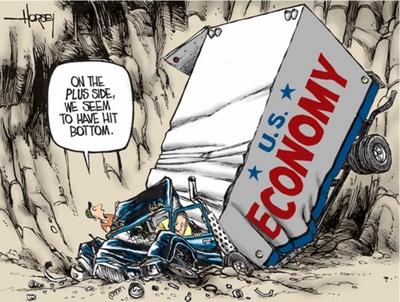
us-economy collapse


Despite doubling the national debt and the expansion of the money supply to some $8 trillion since the beginning of Obummer’s misbegotten presidency, the U.S. economy is once again in a free fall. Actually, there has been no real recovery, but a continual deterioration of living standards despite the lies and distortions from the financial media and government authorities.

Conditions, however, are now descending at an even faster pace.

Recently, the leading manufacturer of heavy equipment, Caterpillar, announced that job cuts would exceed 10,000 through 2018.  Up to 5,000 employees will receive pink slips between now and the end of 2016.  Retail sales for the manufacturing giant have slumped 11% between June and August.*

While Caterpillar’s contraction is an ominous sign, a more telling indicator of worsening economic conditions came from the Federal Reserve’s refusal to raise interest rates at its latest FOMC meeting. Many commentators had speculated that the Fed would raise rates at least a quarter of one percent on the belief that the economy was strengthening.

The Fed, of course, based its refusal to raise rates on “international concerns” – China’s stock market selloff. The real reason is that the nation’s central bank understands, although it will not publicly admit it, that the economy is far too weak to “absorb” a rate hike, no matter how infinitesimal.

More importantly, the Fed cannot raise rates to any significant degree because the entire financial system, which is built on “cheap money,” would immediately plunge into a significant downturn similar to that of 2008, or worse. The federal government and many of the states and municipalities would default since they could not continue to finance their current profligate borrowing and spending patterns with higher interest rates.

Thus, the Fed is trapped in a world of zero interest rates for the foreseeable future. As economic conditions continue to worsen, the central bank will more than likely turn to another round of money printing like its infamous “QE” program.

While the Fed is locked into a zero interest rate policy, the Obama Administration and Congress remain oblivious to economic reality. A few years back, Obama and the one time Democratically-controlled Congress tried a “stimulus” program which did nothing, but increase the national debt. Also weighing down the economy is the disastrous Obamacare program which will only become more burdensome as time passes.

Just as troubling, none of the current crop of presidential hopefuls, with one possible exception, has proposed or suggested any credible measure that will improve matters. None of the fundamental problems that are crippling the economy have been seriously addressed.

The reason why there has been no recovery is that the malinvestments and bubbles created during the last boom have not been allowed to contract and or burst. Instead, the Fed pumped massive amounts of “liquidity” (money printing) into the markets which kept these institutions (mostly banks) and their assets afloat.

A credit implosion will not come about “voluntarily.” The Fed will not increase interest rates nor will the Obama Administration or Congress have the courage to cut spending to relieve pressure on the Fed to finance its unsustainable deficits and continue to inflate the stock market.

Instead, there eventually will be a monetary crisis surrounding the dollar which will force interest rates to rise which will lead to widespread defaults and bankruptcies and an ensuing depression which will dwarf every previous economic downturn in American history.

Alternative financial analysts have, for some time, pointed to the declining living standards not only in the U.S., but throughout the Western world. Egon von Greyerz of Matterhorn Asset Management has predicted some very unpleasant times in the not too distant future: “The coming years will not be easy. I wrote an article a few years ago called ‘The Dark Ages Are Here’ and I now really think they are imminent. These will be difficult times for most of us.” **

Ultimately, the only way the U.S. economy will be turned around is through a change in ideology. The ideas and policies upon which not only the U.S., but the Western world’s economies are predicated upon must be debunked. Until the principles and beliefs of the current economic system are intellectually discredited, the U.S. economy will continue to stagnate and eventually collapse.


* Matt Egan, “Caterpillar to Cut More Than 10,000 Jobs.” CNN Money. http://money.cnn.com/2015/09/24/investing/caterpillar-job-cuts-china-oil/index.html 24 September 2015.
** Egon von Greyerz. “A Stock Market Collapse and Surge in Gold is Imminent. What will be the Trigger?” Gold Switzerland. https://goldswitzerland.com/a-stock-market-collapse-and-surge-in-gold-is-imminent/ 10 October 2015.

Antonius Aquinas@AntoniusAquinas


Big Banks Profit While Main Street Suffers

Bankers v Main Street


If anyone doubts that the Western world’s monetary order is rigged to enrich the banking system, the first quarter financial reports of America’s top banks should disabuse any unbelievers.

The Financial Times reported that four of the five big U.S. trading banks had a combined revenue of $19.4 billion in the first quarter of 2015. Goldman Sachs had a 14.7 percent* return on its equity in the first quarter while J.P. Morgan, the nation’s largest bank, earned $5.91 billion or $1.45 a share, up 3.6% from a year earlier.**  Revenues for J.P. Morgan grew 4% to $24.8 billion.

The enthusiastic coverage of the big banks healthy first quarter proceeds and the chest-thumping of its bank executives left out, not surprisingly, the real reason for their windfall gains – the Federal Reserve. The big banks have been the chief beneficiaries of the Fed’s easy monetary policy since the start of the financial crisis.

The Fed’s “zero interest rate policy” (ZIRP) and its “quantitative easing” (QE) program have been the catalyst for the large banks’ recent record performance. Ostensibly, these policies were instituted to assist the economy in its recovery from the Great Recession, however, in actuality they have been done to save the big banks from collapse while the economy has been flooded with billions of increasingly worthless dollars causing significant price inflation.

Low interest rates have enabled the banksters and financial houses to borrow at next to nothing and invest in all sorts of ventures, many of which are highly risky. Easy money is also the cause for the huge run up in assets prices and the highs in nominal stock prices.

Worse, ZIRP has allowed the federal government to sustain its ridiculous level of spending, borrowing what it cannot raise in taxes at a near zero rate of interest.  When interest rates do rise, the federal government will most likely default, bringing the banks down with them.

While the big banks and Wall Street have done quite well from the Fed’s massive money printing, everyone else has suffered and have seen their standard of living plummet even from official estimates.

The Federal Reserve reported a slowdown in hiring in March, a big drop off in industrial production, and lower housing starts in the first quarter, to mention just a few troubling statistics. Things are getting to the point that the Fed is reconsidering whether it should raise interest rates in the second half of the year as it had hoped to do. Dennis Lockhart, president of the Federal Reserve Bank of Atlanta, admitted, “Data available for the first quarter of this year have been notably weak.”***

The first quarter sizable earnings of the big banks are an example of what a number of commentators have termed “crony capitalism.” Through government assistance, businesses earn wealth not by pleasing customers and satisfying their needs, but by currying favors from the state. In the banksters’ case, instead of making wise and prudent loans, they receive largesse in the form of billions of Federal Reserve notes.

Not only is such a system immoral, but it gives legitimate market activity – those firms that do not receive state assistance – a bad rap as profitable enterprises are lumped in with state favorites. This ultimately leads to greater regulation as calls for the government to tax “windfall profits” would affect all firms even those who earned rightful profits.

The solution to crony capitalism and the ill gotten gains of the banking system is not greater oversight, but instead, the abolition of the Federal Reserve and a return to sound money based on gold or silver. Under such a system, banks and financial houses would profit only if they satisfied consumers’ wants.

In the banks’ case, this would mean safeguarding depositors’ money and making prudent loans with the funds they were entrusted with to lend. For those financial institutions that succeed at such tasks, profits would be their reward; for those who do not and mismanage investment funds they would be out of business and allowed to fail. Banks would operate under the same economic laws as any other enterprise.

The prevailing system of crony capitalism which benefits the 1% must be exposed for the grand redistribution scheme that it has long been. Only when bankers earn their wealth as Main Street does will America return to a just and (sound) monetary order.

*Tom Braithwaite & Ben McLannahan, “Goldman in Robust Return on Equity Showing,” Financial Times, 17 April 2015, 14

**Ciaran MCEvoy, “JPMorgan Profit Beats Wall St. Views, As Does Wells Fargo by Shrinking Less,” Investor’s Business Daily, 15 April 2015, A1.

***Jon Hilsenrath, “Fed Shies Away from June Rate Hike,”  The Wall Street Journal,  17 April 2015.

Antonius Aquinas@AntoniusAquinas