Category Archives: Monarchy

Dick Cheney and the American System of War

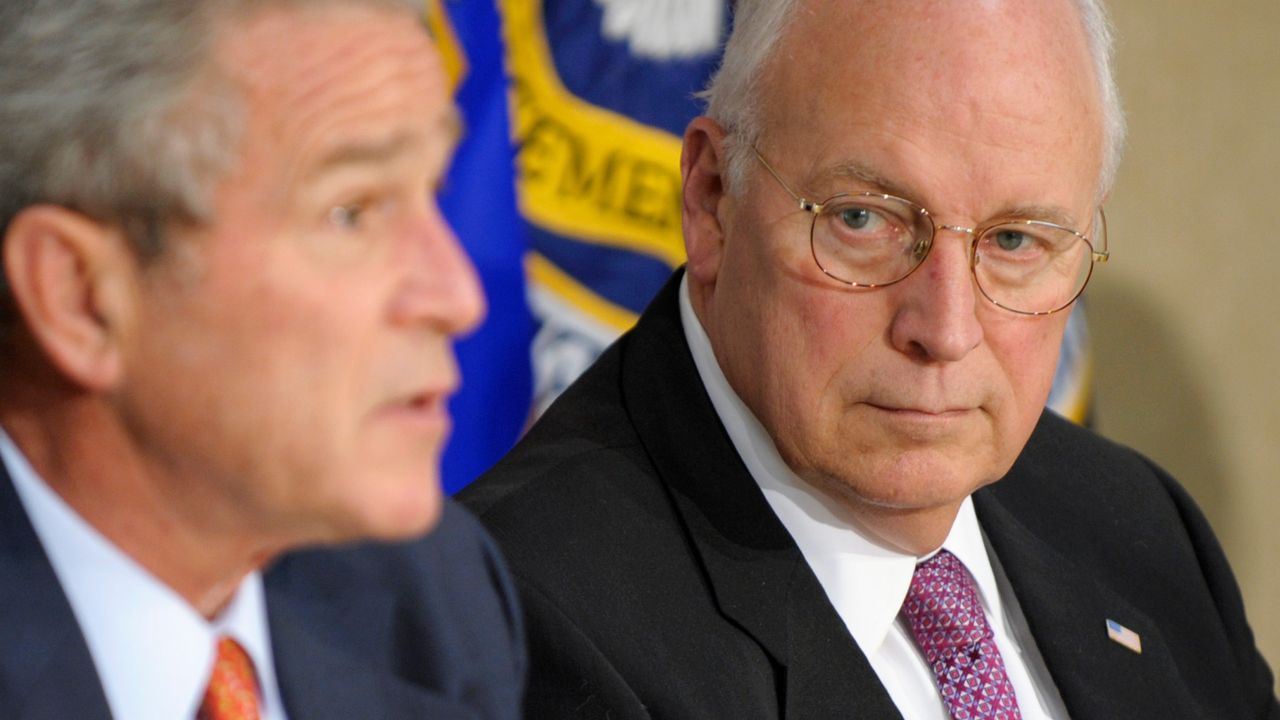
Former Vice President Richard “Dick” Cheney died on November 3, 2025 at the age of 84.  As secretary of Defense under President George H.W. Bush, Cheney was the architect of the 1991 Persian Gulf War and later, as vice president under George W. Bush, he was instrumental in the invasion and eventual conquest of Iraq.

Brown University’s Cost of War Project has modestly estimated that the “wars on terror” have resulted in the deaths of more than 940,000 people including 432,000 civilians and a monetary cost to the United States of about $8 trillion. 

Of course, Brown University’s study calls the post 9/11 U.S. military operations in the Middle East “wars on terror” when, in reality, they have been fought for the benefit of Israel and its Greater Israel Project, which has decimated the Arab world and has accomplished almost all of its objectives.

Cheney’s nefarious activities were not confined to mass murdering peoples that posed no threat to America’s national security.  He was a force behind the U.S. policy of torture (waterboarding), and nearly unlimited domestic surveillance (the Orwellian-labeled Patriot Act).

According to an article on the news and commentary website “Antiwar,” headlined “Dick Cheney: The Dark Legacy of a War Criminal,” Cheney suggested U.S. intelligence agencies must: [O]perate on the ‘dark side,’ spend time in the shadows, and use ‘any means at our disposal’ to achieve its objectives.” 

As if the U.S. Presidency was not unrestrained enough, Cheney advocated a “unitary executive” theory that the “president alone decides matters within the executive branch” without input from opposition voices within the government’s foreign policy agencies. 

The response by libertarian and alternative media outlets to Cheney’s demise were universal in their denunciation of the former vice president, calling him a “war criminal” and that he left this world with a “dark legacy.” 

It should be noted that a number of alternative media’s podcasters who have criticized Cheney regularly host guests and speakers who are former U.S. military and diplomatic personnel, ex-CIA agents and intelligence operatives, a number of whom participated in the Iraq wars and other American covert operations themselves.

Few, if any, who condemned the former vice president for his criminality mentioned or questioned why it was, and still is today, that monsters like Cheney were able to inflict so much death and destruction on peoples and nations across the globe who posed no threat to America. 

Could it be that the political system that Cheney operated under was the problem?  And, what is to be done to prevent future Cheneys from committing similar atrocities?

Unfortunately, “democratic” wars are paid for “by the people” and the costs are socialized among the population through taxation, inflation (money printing), and deficit financing.  Since warmongering politicians do not have to directly pay for conflicts, there will be a tendency for them to be more bellicose.  Moreover, democratic wars are collective enterprises where elected officials are not personally responsible for the actions of the government but are agents of the voters.   

Nor have the supposed checks and balances of constitutional government, so often touted by admirers of the U.S. Constitution, been able to prevent conflicts, as the horrific record of American warmaking sadly proves.

The passage of the U.S. Constitution established a powerful central state which could (and did) tap the resources and men of the individual states to conduct wars which eventually took place the world over. 

A weak national government, like that under the Articles of Confederation, or no central state at all, but instead a political order of numerous sovereigns (a world full of Switzerlands, Liechtensteins, etc.) would make warfare on a massive scale impossible.

Chip Gibbons, writing in the Jacobin magazine, called Cheney an “enemy of democracy whose agenda included war, indefinite detention, warrantless surveillance, and torture,” according to Alan Mosley. *

Cheney was not an enemy of democracy, but the product of a system that enables evil men to carry out the most heinous acts with little consequence, at least in this life. 

Labeling Dick Cheney a war criminal will tarnish his legacy, but it will not alter America’s murderous foreign policy course.  That will only come about when there is a recognition that the governing system itself needs to be abandoned and a decentralized political arrangement adopted.    

*Alan Mosely, “Dick Cheney (1941-2025): The Dark Legacy of a War Criminal,” Antiwar.com, 5 November 2025.  https://original.antiwar.com/Alan_Mosley/2025/11/04/dick-cheney-1941-2025-the-dark-legacy-of-a-war-criminal/

Antonius Aquinas@antoniusaquinas

https://antoniusaquinas.com

Taxes vs. Tariffs: Which is Fairer?

In the final days of his presidential run, Donald Trump floated the idea of eliminating the income tax and replacing it with tariffs as the means to fund federal spending.  He cited the era of U.S. history when the country had no income tax:

When we were a smart country, in the 1890s . .

this is when the country was relatively the

richest it ever was.  It had all tariffs.  It didn’t

have an income tax.*

While Trump was correct about the prosperity at the time, it is wrong to suggest that tariffs were the reason.  While there was no income tax, there was little if any burdensome regulation or government subsidy, and, most importantly, the nation was on a gold standard, which kept increasing the purchasing power of wages, all of which raised living standards to unprecedented heights.

On the surface, the idea of replacing the income tax with tariffs seems equitable. This is why many conservatives, populists, and libertarians have supported the idea. 

Under the present political order, the United States is a constitutional republic that is based on the social contract theory.  Government is established, in part, to protect the persons and property from external threats and internal unrest.  All citizens, in theory at least, are protected by the state.  It follows, therefore, that they are obliged to contribute to their defense.

Tariffs, on the other hand, are borne directly by two groups: consumers who buy imported goods, and businesses who sell imported goods and are impacted by a loss of income. 

Consumers pay the tax levied on foreign goods.  Therefore, those consumers who buy more expensive goods, such as a Mercedes Benz, pay a higher percentage of tax than those who buy trinkets such as Christmas tree ornaments and plastic cutlery from China.

Businesses, too, suffer from tariffs.  While it is often said that the tax is “passed on to consumers,” companies will see a reduction in income, since tariffs raise the price of goods.  Higher prices will cause a fall in demand, resulting in loss revenue.  Moreover, businesses who deal in foreign products have to bear the bureaucratic cost of complying with the government’s ever-changing trade policies while serving as tax collector for the state. 

While the income tax under social contract theory is more “equitable” than tariffs, one of its most egregious features cannot be justified.  Under current law, American citizens that are living abroad or have relocated permanently are still subjected to the income tax.  However, expats are no longer being defended by the U.S. government.  Renouncing citizenship (which is quite costly) is the only way to avoid being taxed.

Why should Americans, who are no longer being defended by their government, still be required to pay for it?  This would be a clear violation of the “social contract” that citizens have supposedly agreed to. 

There are other dangers that have come with government financing through tariffs, or, as some have called for, a national sales tax. Originally, when the income tax was proposed, it was to replace tariffs.  Tariffs, like all sales taxes, burden the poor and middle class disproportionately.  The income tax, which at first only affected the affluent, was accepted by the public since tariffs were to be eliminated.  Unfortunately, the tariffs remained after the two world wars and the income tax was levied on almost everyone. 

A similar situation could occur with the expansion of tariffs or the implementation of a national sales tax.  Governments rarely relinquish their taxing power.  

What is being ignored in the talk about tariffs and the income tax are the exploding government deficits.  Fiddling with what source of revenue the government collects is not addressing an impending financial crisis that could bring down the entire U.S. economy.

Of course, runaway debts and deficits are inherent in democratic republics as politicians are not personally responsible for the debt, unlike a monarch or king.  This is another flaw in the social contract theory. 

Before policy makers change the nation’s tax system, they should carefully consider the ramifications and seek to find the most equitable solution that will not burden only part of the citizenry. Cutting runaway federal spending is a first step.       

*https://www.cnn.com/2024/10/26/politics/trump-income-taxes-tariffs/index.html

The Constitution Myth

One reason for the failure of the modern conservative and libertarian movements to scale back, in even a miniscule way, the now gargantuan US welfare/warfare state has been the misinterpretation of the US Constitution.  Many conservatives have a slavish devotion to the document, placing it on a par with the Ten Commandments and New Testament.

A typical misunderstanding of the Constitution’s history and content appeared in this recent op-ed:


The Constitution was intended to limit 1) the power


of government over the citizenry 2) the power of each branch of


government and 3) the power of political/financial elites over the


government and the citizenry, as the Founders recognized the intrinsic risks


of an all-powerful state, an all-powerful state dominated by one branch of


government and the risks of a financial elite corrupting the state to serve


the interests above those of the citizenry.*

The author, like so many “Constitution enthusiasts” has also been hostile to the Medieval era, denigrating its institutions and social constructs – feudalism, aristocracy, crusading – when, in fact, the Middle Ages, in many respects, were far freer with less government than the present epoch. **

When the founding fathers decided to meet in Philadelphia in 1787, they did so at first to “amend” the Articles of Confederation which had guided the young country through some perilous times.  While the Articles had some defects (some libertarians even contend that they were too statist***), the delegates, at first, did not want it scrapped, however, it was the “leading lights” of the convention which connived to completely do away with it.

By superior political maneuvering, the pro-Constitution forces were able to ramrod their plan through despite being in the minority.  Not only were the majority of the delegates initially against scrapping the Articles, but most Americans were opposed to the creation of a new central government. 

Despite this, the Constitution was ruthlessly pushed through and, as its opponents feared, America would be saddled with a highly centralized national government, the loss of considerable state sovereignty, and the eventual erosion of individual liberties even with the inclusion of a Bill of Rights.

A brief examination of the document reveals that its implicit and explicit language grants wide latitude for the expansion of state power.  In its Preamble, the ambiguous clause to “promote the general welfare” can and has led to all sorts of destructive social engineering schemes.  More ominously, for anyone that is under the illusion that America is governed by a “federal” system, they should reread Article VI which in part says

This Constitution, and the Laws of the United his Constitution, and the Laws of the United States which shall be made in Pursuance thereof; and all Treaties made, or which shall be made, under the Authority of the United States, shall be the supreme Law of the Land. [emphasis added]

An all-powerful central state went against much of Western history after the fall of the Roman Empire and the idea was always feared by philosophers.  Basic political theory and practical experience showed that a multitude of sovereign states were preferable not only for the protection of personal liberty, but for economic growth.  Numerous states and jurisdictions were a far greater check on government than the much celebrated “separation of powers” concept of constitutional government.

Under the Articles of Confederation, each individual state was autonomous while the national government had to rely on the states for most of its support.  Unfortunately, it will never be known what would have happened if the country remained as a confederacy of states, it is likely however, that there would have been less bloodshed, greater economic growth, and more personal freedom under a decentralized regime.

It is curious, therefore, why so many on the Right continue to revere the Constitution as some great bulwark against state power.  Much of it probably stems from ignorance or personal bias against the political conditions which existed prior to the late 18th century. 

Much of European history was under the sway of monarchial and aristocratic rule and the integral presence of the Catholic Church in society with a diffusion of power among kings, princes, dukes and Churchmen.  While far from perfect, the social order which existed under Christendom may not have been as materially or technologically advanced as contemporary times, but in regard to morality, justice, and individual freedom, there is no comparison.  The Christian age saw nothing of the social depravity, war making with its mass murder, the trampling of individual rights, and the existence of totalitarian government as witnessed in the supposedly “enlightened” modern age.

Decentralized Europe of 1300

Until it is realized that the Constitution is an impediment to rolling back the American Leviathan, there will be little progress in the fight for individual liberty and economic progress.


*Charles Hugh Smith, “Let’s Face It: The U.S. Constitution Has Failed.”  Zero Hedge.  20 February 2019. 

**One example, Charles Hugh Smith, “America’s ‘Neo-Feudal’ System is ‘Both False & Precarious.”  Zero Hedge 19 December 2018.

***David Gordon, ed., Strictly Confidential: The Private Volker Fund Memos of Murray N. Rothbard, Auburn, AL.: The Ludwig von Mises Institute, 2015, pp. 96-98.

Antonius Aquinas@antoniusaquinas

https://antoniusaquinas.com

[emphasis added]

St. Gregory VII and the Crusades

gregory vii

Article posted at the Christus Rex page: https://antoniusaquinas.com/christus-rex-page/


In Remembrance of the October Revolution

Oct Rev

The Communist monster, Vladimir Lenin

This October marks the centennial anniversary of the Bolshevik takeover of Russia and the establishment of Soviet-style Communism which tragically, for the Russian people, would last for some seventy interminable years.  Not only did the Soviet regime liquidate and imprison millions, but its idiotic system of central planning impoverished the country, turning it into an economic basket case, the effects of which continue to this day.

Just as bad, the Bolsheviks murdered the last Czar, Nicholas II and his family, brutally ending nearly five hundred years of monarchial rule of Russia.  Within a year of the demise of the Russian aristocracy, two other of Europe’s venerable royal houses – Germany and Austria – met the same fate, all three casualties of their insane decision to participate in World War I.  The end of the German Court and especially that of Austria came at the vengeful insistence of then President Woodrow Wilson, who brought the US into the conflict on the pledge to make the “world safe for democracy.”

The triumph of the Bolsheviks and the downfall of the German and Austrian monarchies ushered in the Age of Democracy as other Western constitutional republics at the time and in each passing year began to resemble and adopt features of their supposed Communist foe.  As the 20th century wore on, each Western nation state became more “democratic,” increasing their welfare/warfare state apparatus, imposing more and more radical egalitarian social and economic measures, and adopting greater amounts of economic planning mostly through central banking.  Not only did economic activity become increasingly effected by monetary policy, but the central banks were instrumental in the eradication of the gold standard throughout the Western world.

Not only did Communism prove to be a disaster economically in Russia and everywhere else tried, but socialism had other debilitating effects.  The quality of the population declined along with the numbers of ethnic Russians, a trend that ominously continues to this day.  While ingenuity was stifled by the Soviet command economy, its culture, although never as advanced as Western Europe, became sterile and overshadowed by the heavy hand of the commissar.  The only memorable literature produced during the period were accounts of the gulag and the repression of dissent.  Music and the arts were similar cultural wastelands.

The West, too, as its nation states became more socialistic and egalitarian, witnessed retrogression in every aspect of society.  The catastrophic drop off in the size of the native populations can largely be attributed to crazed feminism, where women were encouraged and given privileges to pursue careers and become “working moms,” which led to the phenomenon of the “dysfunctional family” and declines in the number of child births.  Hans-Hermann Hoppe explains this effect in the American context:

In the U.S., . . . less than a century of full-blown

democracy has resulted in steadily increasing

moral degeneration, family and social disintegration,

and cultural decay in the form of continually rising

rates of divorce, illegitimacy, abortion, and crime.


As a result of an ever-expanding list of non-

discrimination – ‘affirmative action’ – laws and

nondiscriminatory, multicultural, egalitarian

immigration policies, every nook and cranny of

American society is affected by government

management and forced integration.*

Hoppe Demo 3

Hoppe’s seminal demolition of Democracy

A primary reason why the quality of Western life has crumbled so markedly has been the replacement of its “natural elites” with “political elites” via the democratic process.  Every society is led by its leading individuals who through talent, hard work, brains, foresight, moral fortitude, fairness, and bravery come to the top and are looked to for guidance.  Under democratic conditions, however, the natural elites have, in a sense, been “voted out” by the political class who, instead of out competing their rivals, secure their status by politics mostly through demagogy.

In Soviet Russia, the natural elites were ruthlessly purged by Lenin’s forces and over time any sort of advancement or achievement had to come via the Communist Party.

Despite the overwhelming failure of socialism, Western nation states continue to practice many of its features, a most notorious recent example being that of the passage of Obamacare, the first step on the road to universal health care in the US.  America, itself, resembles more of a police state than ever before with the establishment of the Department of Homeland Security and the passage of draconian legislation such as the Patriot Act and the National Defense Authorization Act (NDAA).

The October Revolution should be remembered for what it was: the inauguration of mankind’s first total state.  It, and the social system which it spawned, should be condemned by all those who seek prosperity and an advanced civilization.

*Hans-Hermann Hoppe, Democracy: The God That Failed: The Economics and Politics of Monarchy, Democracy, and Natural Order. New Brunswick (U.S.A.): Transaction Publishers, 2001, p. xiii.

Antonius Aquinas@AntoniusAquinas

https://antoniusaquinas.com


Bitcoin in an Illusionary Age

Bitcoin III

It is altogether fitting that crypto currencies, in particular Bitcoin, have witnessed a meteoric rise in this illusionary age.  Not only has their monetary value gone to dizzying heights, but they are now being touted as the destroyer of the current, crumbling monetary order and the next paradigm upon which a new money and banking system will emerge.

In an era where sacrifice, hard work, loyalty, ingenuity, tradition, and independent thought are considered anathemas, while affirmative action, sloth, effeminacy, office seeking, and something-for-nothing schemes are endemic in every walk of life, it is not surprising that non-tangible, computer-generated currencies would become a “natural” feature of such a world.

While it has always been a haven for charlatans, traitors, cheats, thieves, liars, and serial adulterers, contemporary political life has become even more of a sham.  The most glaring example of politics’ utter corruption can be seen in the recent departed chief executive officer of the US.  Unless one abandons all critical thinking, Obummer was unqualified to be president because of the obvious fact that he was not born on American soil.  Not only did this disqualify him, but his educational and professional backgrounds have not been verified.  Neither his collegiate records nor his supposed teaching career at the University of Chicago Law School have ever been exposed to public scrutiny.  From the few utterances he has made about his supposed specialty – constitutional law – it appears that he has only a rudimentary knowledge of the subject.

Cultural life has descended to the basest of levels and has abandoned nearly all of Western Civilization’s glorious achievements.  Consider music.  The dominant form of what passes as music today is not the works of the great maestros of the past – Bach, Mozart, Beethoven – but instead, noise in the form of rock, hip hop, rap, grunge, or whatever the latest degenerate trend is in vogue.

Modern democracy is also a fallacy.  Being sold to the masses as a system where the people rule and personal liberties are guaranteed, democratic governance is anything but, and has instead been craftily used by the elites to amass state power to an unprecedented extent not witnessed in human history.  The much maligned monarchial age even during its “absolutist phase” could not come close to the scope and intrusiveness that democratic governments possess today.

Religion, too, is not immune from its share of hypocrisy.  Not only is the supposed head of the Catholic Church a manifest heretic who almost daily blasphemies the Divine Majesty, but he is not qualified to occupy the august chair in which he sits.  Jorge Bergoglio was neither ordained as a priest nor consecrated as a bishop in the traditional, Apostolic rite of Holy Orders.  He is, therefore, an imposter not a priest, nor the bishop of Rome, and scandalously not a true pope.

Now enter crypto currencies.  Not only will they never become money – a general medium of exchange – as gold and silver once were and will become once again, but cryptos lack the necessary requirements to be money.  Yet, their “development” is systematic of the times.  Cryptos are another variant of fiat currencies which digitally can be created by a stroke of a computer key or in cryptos’ case, a code.

Gold and silver – real money – must be mined from the ground, minted and “marketed” before they can be used to facilitate exchange.  This is an arduous, capital-intensive process which takes resources, labor, and time to accomplish.  Something as important as money should require an elaborate procedure not be created out of thin air as are all fiat currencies as well as cryptos.

Money must originate as a tangible, sought-after commodity – the great Misesian insight that crypto enthusiasts do not know or do not understand – then, over time, be recognized as having a “second feature” as a good sought after for “exchange value.”  Once a good is demanded for its use primarily to facilitate exchange, it then becomes a “money.”

In a fundamental sense, crypto currency cultists are rebelling against the natural order of things.  The precious metals were created in their quantity and quality by Divine Wisdom for a purpose – to act as money.  While governments have habitually corrupted the monetary order through coin clipping, fractional-reserve banking, and other nefarious schemes, it does not undo this primordial fact.  It is for the intellectually honest opponents of monetary chicanery to point this out and decry all governments and banksters’ attempts to eradicate gold and silver as money, not attempt to create another unnatural and false monetary order that mirrors the current fiat system.

Money, like all other institutions of society, will reflect its belief system.  Decaying cultures will most likely have debased monetary units.  A turnabout in the status of money will only happen when Western Civilization returns to what money is – gold and silver – and abstains from trying to create illusions of it through computer software schemes.

Antonius Aquinas@AntoniusAquinas

https://antoniusaquinas.com


Can Germany Be Made Great Again?

Holy-Roman-Empire-1789-1024x704

When Germany Was Great!

Ever since the start of the deliberately conceived “migrant crisis,” orchestrated by NWO elites, the news out of Germany has been, to say the least, horrific.  Right before the eyes of the world, a country is being demographically destroyed through a coercive plan of mass migration.  The intended consequences of this – financial strain, widespread crime and property destruction, the breakdown of German culture – will continue to worsen if things are not turned around.

Opposition to the societal destruction within Germany have been harassed and persecuted by the authorities and labeled by the mass media with the usual epithets: “far right,” neo-Nazi, “haters,” and heaven forbid, “separatists.”  Because of this and other factors, there has been no mass movement, as of yet, that has coalesce to challenge the German political establishment.

A possible reversal of German fortunes, however, has come from a recent poll of Bavarians.*

A survey conducted by YouGov, a market research company, found that 32% of Bavarians agreed with the statement that Bavaria “should be independent from Germany.”  This percentage has increased from 25% of secession-minded Bavarians when polled in 2011.

Of the some 2000 surveyed between June 24 and July 5, most supporters of  independence come from the southern portions of the country.

Whether Bavarians or their fellow German separatists realize it or not, the only “political” solution to the migrant crisis is secession.  This is not only true for Germany, but for all Western nation states swamped with unwanted migrants.  Once free from the domination of the national government (and just as important the EU), each jurisdiction could make its own immigration policy and would be better able to control population influx at the local level.

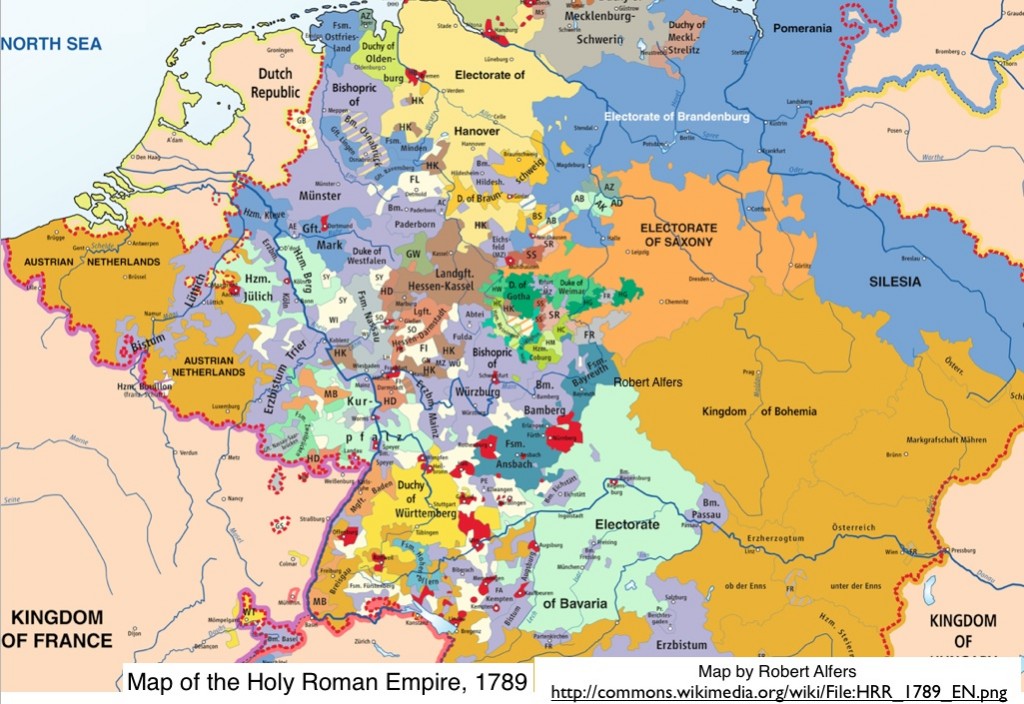
Historically, Germany’s past has much more in common with a decentralized political landscape than with a unitary state.  From the disintegration of the Roman Empire until Napoleon wantonly abolished the Holy Roman Empire in 1806, Germany was an amalgam of different political units – kingdoms, duchies, confederacies, free cities, etc.  With no grand central state, there was considerable freedom and economic growth as each sovereign entity was largely able to conduct its affairs on its own terms.

Decentralized political power is also conducive for the advancement of culture.  Music, the highest art form, found some of its greatest expression from the German peoples.  And, the monumental figures of Western music were financed in large measure by German princes, kings, and emperors.  Johann Sebastian Bach’s sublime Brandenburg concertos were underwritten, so to speak, by Christian Ludwig, Margrave of Brandenburg while Beethoven received support from Archduke Rudolph.  Mozart was funded no less by the Austrian emperor himself, Joseph II.

Political decentralization provides an important mechanism as a check on state power.  A multitude of governments prevents individual state aggrandizement as oppressed populations can “vote with their feet” and move to safer and less repressive regimes.  A unitary state, or just a few, throughout the world would negate such an advantage.

Naturally, if nation states are a constant threat to the liberties and economic well being of their citizens, global organizations and states are that much more of a danger and should always and everywhere be opposed.  The European Union, largely based on the principles of the US Constitution, has pressured nations under their sway, such as Germany, to accept the migrants and has threatened members such as Hungary and Poland with penalties if they do not do their fair share.

The empirical evidence is overwhelming in regard to political decentralization and economic growth.  Since the level of taxation and government regulation are crucial factors in an economy’s ability to produce, the limitation on taxation and government oversight tend to be significantly lower if there are numerous states since there would be amble opportunities for producers to go to more conducive areas to set up shop.  This can be seen in the US as thousands of oppressed businesses and firms have left California to lower tax and restrictive climes such as Texas and Nevada.

If Germany is ever to get a handle on the migration crisis before the country is completely demographically dismembered, its only hope is to return to its decentralized political roots.  Let Bavaria lead the way!

*https://www.rt.com/news/396600-bavaria-independence-germany-poll/

Antonius Aquinas@AntoniusAquinas

https://antoniusaquinas.com

California, Nestle and Decentralization

calexit

Nestle USA has announced that it will move its headquarters from Glendale, California, to Rosslyn, Virginia, taking with it about 1200 jobs.  The once Golden State has lost some 1600 businesses since 2008 and a net outflow of a million of mostly middle-class people from the state from 2004 to 2013 due to its onerous tax rates, the oppressive regulatory burden, and the genuine kookiness which pervades among its ruling elites.* A clueless Glendale official is apparently unconcerned about the financial repercussions of Nestle’s departure saying that it was “no big deal” and saw it as an “opportunity,” whatever that means!

The stampede of businesses out of what was once the most productive and attractive region in all of North America demonstrates again that prosperity and individual freedom are best served in a political environment of decentralization.

That the individual states of America have retained some sovereignty, despite the highly centralized “federal” system of government of which they are a part, has enabled individuals and entrepreneurs living in jurisdictions that have become too tyrannical to “escape” to political environments which are less oppressive.  This, among other reasons (mainly air conditioning), led to the rise of the Sun Belt as people sought to escape the high taxes and regulations of the Northeast to less burdensome (and warmer!) southern destinations.

This can also be seen on a worldwide scale.  The US, for a long time, had been a haven of laissez-faire economic philosophy, which, not surprisingly, became a magnet for those seeking opportunity and a higher standard of living.  No longer is this the case as increasing numbers of companies and individuals are seeking to avoid American confiscatory tax and regulatory burdens and move “offshore” or expatriate to more favorable economic climates.

The idea of political decentralization as a catalyst for economic growth has become a part of a “school of thought” in the interpretation of how Europe became so prosperous compared to other civilizations.  After the fall of the Roman Empire, Europe for centuries was divided politically among numerous jurisdictions and ruling authorities with no dominant central state on the Continent.  The multitude of governing bodies kept in check, to a large degree, the level of taxation and regulation.  If one state became too draconian, it would lose population to less oppressive regimes.

Just as important, Europe’s governing system was aristocratic and monarchical which has proven to be far more conducive for economic growth than democracies.

While the economic oppressed can escape among the various states, there is no avoidance from the wrath of the federal government unless through expatriation and that option has become less viable with those leaving still subject to tax obligations.  This, fundamentally, is the crux of the problem and has been since the ratification of the US Constitution in 1789.

The chance that a totalitarian state such as California or the Leviathan on the Potomac would actually reform themselves or relinquish power through legislative means is a mirage.  Nor will revolution work as revolutionaries while appearing altruistic, typically get a hold of the machinery of government to plunder society for their own self interest on a far grander scale than the supposed despots which they replaced!

The only viable option for the productive members of society to seek redress of state oppression is to argue, work, and eventually fight for political secession and the fragmentation of states as much as possible.  Decentralization is the only hope for those opposed to the modern, omnipotent nation state.  Moreover, any notion or effort to salvage the current centralized political system must be abandoned.

Naturally, before the breakup of the nation state can become a reality, the ideological case for political decentralization must be made.  Public opinion must be convinced of the superiority of a world consisting of many states.  Such a cause, however, will be considerably difficult after generations have been raised and made dependent upon social democracy.

When Nestle and other oppressed businesses and individuals can easily escape the clutches of totalitarian entities like California and, more importantly, the most dangerous government on the face of the earth for freer destinations, then will individual liberty and economic growth be assured.

*Terry Jones, “Another Big Company Departs California – Will Last One to Leave Shut the Lights?”  Investor’s Business Daily. February 3, 2017.  http://www.investors.com/politics/commentary/another-big-company-departs-california-will-last-one-to-leave-shut-the-lights/

Antonius Aquinas@AntoniusAquinas

https://antoniusaquinas.com/


Brahms & Democracy

kyril-kondrashin-brahms-symphony-1-2012

In November of 1876, one hundred and forty years ago, Johannes Brahms’ monumental First Symphony was first heard, performed in Karlsruhe, Germany.  The much anticipated work – which took Brahms over 20 years to complete – has become part of the canon of Western music.  Ironically, the premiere of The Ring by Brahms’ supposed rival and fellow musical genius, Richard Wagner, was performed for the first time in the same year.

While one critic initially called Brahms’ First Symphony “Beethoven’s Tenth,” it has surpassed that unjust description and now stands on its own merit as a distinct masterpiece.  The First Symphony, the three that followed, and the rest of Brahms’ works makes him more than Beethoven’s successor, a unique musical figure in his own right.

In one of his best newspaper articles, H.L. Mencken wrote the following about a Brahms’ performance:

My excuse for writing of the above gentleman is simply

that I can think of nothing else.  A week or so ago, . . . I

heard his sextet for strings, opus 18, and ever since then it

has been sliding and pirouetting through my head.  I have

gone to bed with it and I have got up with it.  Not, of course,

with the whole sextet, nor even with any principal tune of it,

but with the modest and fragile little episode at the end of

the first section of the first movement – a lowly thing of eight

measures, thrown off like a perfume, so to speak, from the

second subject.*

The Sage of Baltimore continued on what made Brahms so special:

In music, as in all the other arts, the dignity of the work is simply

a reflection of the dignity of the man.  The notion that shallow

and trivial men can write great masterpieces is one of the follies

that flow out of the common human taste for scandalous

anecdote. . . .  More than any other art, perhaps, music demands

brains.  It is full of technical complexities.  It calls for a capacity to

do a dozen things at once.  But most of all it is revelatory of what

is called character.  When a trashy man writes it, it is trashy music.


Here is where the immense superiority of such a man as

Brahms becomes manifest.  There is less trashiness in his music

than there is in the music of any other man ever heard of, with

the sole exception, perhaps of Johann Sebastian Bach. . . .

Hearing Brahms, one never gets any sense of being entertained

by a clever mountebank.  One is facing a superior man, and the

fact is evident from the first note.

While Brahms was born in Hamburg, he eventually found his way to the musical capital of the world, Vienna, which, at the time, was part of the Austro- Hungarian Empire.  Vienna was more than the musical center of Europe, but a cultural one as well which was rivaled by few in Brahms’ time.

Although mostly forgotten under an avalanche of pro-democracy historiography, the Vienna where Brahms spent most of his adult life was “ruled” by a monarch.  The rich cultural life which flourished in that political atmosphere was admitted even by those who were, no doubt, hostile and envious of it as the philosopher and economist, Hans-Hermann Hoppe, describes in his seminal book, Democracy: The God That Failed:

Even democratic intellectuals and artists from any field of

intellectual and cultural endeavor could not ignore the

enormous level of productivity of Austro-Hungarian and in

particular Viennese culture.  Indeed, the list of great names

associated with late nineteenth and early twentieth century

Vienna is seemingly endless.**

As Professor Hoppe insightfully shows, the incredible accomplishments of the likes of Brahms came in the pre-democratic era which tragically ended with WWI.

. . . rarely has this enormous intellectual and cultural

productivity been brought in a systematic connection with

the pre-democratic tradition of the Habsburg monarchy.

Instead, if it has not been considered a mere coincidence, the

productivity of Austrian-Viennese culture has been presented

‘politically correctly’ as proof of the positive synergistic effects

of a multiethnic society and of multiculturalism.

Whether the accomplishments were in the arts, music, scientific breakthrough, invention, or entrepreneurial wealth creation, all were the result of individual initiative, skill, tenacity, foresight and intelligence within a society that recognized, praised, and promoted such achievements.  There was no affirmative action or policies that promoted artists based on their skin color or gender.  When Brahms came to Vienna, he did not receive an Austro-Hungarian version of a National Endowment of Arts subsidy!

Just as important, and what is ignored by the Left and many race-denying realists on the respectable Right, is that all of these civilization-enhancing accomplishments in Vienna were made, for the most part, by white men.  No other culture or people have ever produced music comparable to Brahms and his fellow Western musical masters.

The democratic age which followed has been praised by scholars as an advancement of the human condition on all fronts.  In his book and in other places, however, Professor Hoppe has shown that just the opposite has occurred under democratic conditions with a trend toward de-civilization.  Taking the US as an example, he writes:

. . . less than a century of full-blown democracy has resulted in

steadily increasing moral degeneration, family and social

disintegration, and cultural decay in the form of continually rising

rates of divorce, illegitimacy, abortion, and crime.  As a result

of an ever-expanding list of nondiscrimination –

‘affirmative action’ – laws and nondiscriminatory, multicultural ,

egalitarian immigration policies, every nook and cranny of American

society is affected by government management and forced integration;

accordingly, social strife and racial, ethnic, and moral –cultural

tension and hostility have increased dramatically.

As Professor Hoppe notes, the latest phase in the democratic era has been  immigration policies which have been deliberately planned to destroy the various Western cultures with Germany being the most devastated.  Yet, as Mencken wrote of him, Brahms was a product of Germanic blood not that of multiculturalism.  The German people who continue to support and allow those to wantonly destroy the culture that produced a Brahms should consult Mencken:

I give you his Deutsches Requiem as an example. . . .   The thing is

irresistibly moving.  It is moving because a man of the highest

intellectual dignity, a man of exalted feelings, a man of brains,

put into it his love and pride in his country.  That country is

lucky which produces such men.

While Brahms’ music will always be listened to and played for its brilliance, it should always be remembered in what culture his genius was allowed to flourish.  How fortunate for mankind that Brahms lived in the pre-democratic era and what a loss it would have been if the First Symphony would have never been composed.


*Marion Elizabeth Rodgers, ed. The Impossible H.L. Mencken: A Selection of His Best Newspaper Stories.  With a Foreword by Gore Vidal.  New York: Anchor Books, Doubleday, 1991, pp. 465-468.

**Hans-Hermann Hoppe, Democracy: The God That Failed: The Economics and Politics of Monarchy, Democracy and Natural Order.  New Brunswick (U.S.A.): Transaction Publishers, 2001, pp. xii-xiii.

Antonius Aquinas@AntoniusAquinas

https://antoniusaquinas.com/


Presidential Dictatorship

Sic Semper tyrannis II

Executive orders, undeclared wars, drone hits, assassination of citizens and non-citizens alike, the overthrow of foreign regimes, domestic spying, the abetting of known criminal activities through pardons, economic planning, opening borders, monetary manipulations are just some of the nefarious activities that routinely emanate from the most dangerous political office that the world has ever painfully come to know – the United States Presidency!

The U.S. presidents can and have created a veritable “hell on earth” for their opponents, perceived enemies, and the innocent not only in the country in which they reign, but over the lives and fortunes of peoples and places where they have absolutely no authority to interfere.  While other chiefs of state have theoretically had such power, U.S. presidents have been able to inflict their destruction and chaos because, paradoxically, the nation’s free-market system, for a long time, created immense wealth which could be tapped into.

The tyrannical nature of the presidency was recognized long ago by those politically perspicacious men who opposed both the office and the draconian document which created it.  Few groups in history have been so vindicated for their foreboding as those who vainly argued against the ratification of the United States Constitution than the Antifederalists.

“An Old Whig”* aptly sums up the damage that would come about if the Constitution was ratified and the office of president would come into being:

. . . the office of President of the United States appears to me

to be clothed with such powers as are dangerous.  To be the

fountain of all honors in the United States, commander in chief

of the army, navy and militia, with the power of making treaties

and of granting pardons, and to be vested with an authority to

put a negative upon all laws, unless two thirds of both houses

shall persist in enacting it, . . . .**

An Old Whig saw that the president would become a “king” but without the natural and binding checks that even the most absolutist of monarchs were restrained by:

[The president] is in reality to be a KING as much a King

as the King of Great Britain, and a King too of the worst

kind; – an elective King. . . . The election of a King

whether it be in America or Poland, will be a scene of

horror and confusion; and I am perfectly serious when

I declare that, as a friend to my country, I shall despair

of any happiness in the United States until this office

is either reduced to a lower pitch of power or made

perpetual and hereditary.***

One of the Federalists’ counterarguments to the Antifederalists’ concern over the presidential office was the widely held assumption that George Washington would become the new Republic’s first chief executive and the general knowledge of his impeccable character would assuage those worried of potential executive overreach.  Such a lame response neglected to look into the future when the office’s huge potentiality for despotism would be sought after and won by those who had less upstanding personal traits than the father of the country.

The growing decentralized political movements throughout the world with, for instance, the hopefully upcoming British exit from the European Union, can only be enhanced if the office of the president and, for that matter, all other nation state’s chief executives are exposed as tyrannical institutions which are anathema to individual liberty and collective self-determination.  Presidents, premiers, chancellors, prime ministers, and their like along with central banking are the two nefarious pillars of power of the modern nation state whose continued existence guarantees perpetual war and economic regression.

In this seemingly interminable presidential election cycle, populist, libertarians, conservatives, and all sorts of anti-Establishment types are delusional if they believe the totalitarian direction in which the country is now headed will be reversed through elections or choosing the “right” candidate.  “Making American Great Again” will only come about when the chief executive office and the statist document that created it have been repudiated.

Prior to the presidency’s abolition, its ideological justification must be first debunked.  There is no finer place to start for this most necessary task to take place than in the dissemination of the perceptive and enduring words of the much neglected Antifederalists.


*Probably penned by a group of Philadelphia Antifederalists – George Bryan, John Smilie, James Hutchinson and maybe others.  See, John P. Kaminski & Richard Leffler, eds., Federalists and Antifederalists: The Debate Over the Ratification of the Constitution.  Madison, Wisconsin: Madison House Publishers, 1989, p. 18.

**Ibid., p. 86.

***Ibid.

Antonius Aquinas@AntoniusAquinas

https://antoniusaquinas.com/