Category Archives: deficit

Central Banks Hoard Gold, Shed U.S. Treasuries

A lot has been made by gold-money bugs about the roles that central banks have played in the run-up in the gold price that accounts for a 38% increase in the yellow metal’s price this year alone.  Some of these analysts attribute the shedding of central bank holdings of U.S. treasuries and other agencies’ bonds to purchase gold, which has accelerated gold’s recent meteoric rise. 

It is not just those in the gold community that hold this belief, but some in the mainstream financial press cite reports and data that purportedly show that central banks now own more gold than U.S. bonds.  If true, such a shift would be a fundamental change in the world’s financial markets and could mean the end of the post-Bretton Woods monetary order, where the dollar acted as the reserve currency, replaced, ironically, by gold which the dollar replaced in 1971.

A recent Financial Times (FT) article, written by Toby Nangle and titled “Do Central Banks Really Have More Gold Than U.S. Treasury Bonds?,” attempts to shed light on these claims.* It should be a reminder, as the article admits, that it is difficult to get accurate figures from data provided by central banks and international agencies. 

Since the global financial crisis of 2007-2009, central banks’ holdings of gold have steadily risen.  The International Monetary Fund (IMF), which keeps data on central banks’ financial sheets, estimates that banks are holding between 22% to 28% of their assets in gold, which comes to $3.86 trillion of gold as of the end of June. 

The FT article contends that this percentage of reserves is “mostly about recent price action rather than a fundamental and dramatic shift out of treasuries and into the yellow metal.”

While central banks still hold the bulk of their reserves in U.S. treasuries, the gap is narrowing as the price of gold continues to reach new highs which FT admits, but downplays: “the underlying reality isn’t quite as dramatic as it might seem….”

What should be taken from the article, not only by investors, but just about everyone else, is that a mainstream financial organ like FT is noticing not only the rise in gold, but the potential of the greenback losing its reserve status – an event that would have immense and catastrophic consequences for all Americans.  Such talk, up to this point, was only heard from hard-money advocates.

The rising price of gold is signaling that greater price inflation is on the horizon with continuing deterioration of the dollar’s purchasing power along with more job losses, which is the dreaded specter of “stagflation.”

Another of America’s financial elite has sounded the alarm that something ominous is on the horizon.  Morgan Stanley has revised its traditional 60/40 portfolio split, the 40% typically allocated to bonds, to a 60/20/20 portfolio with 20% allocated to gold.  To readjust its portfolio to increase its gold holdings, Morgan Stanley will have to reduce its share of U.S. treasuries, which will put more downward pressure on bond prices and increase yields.

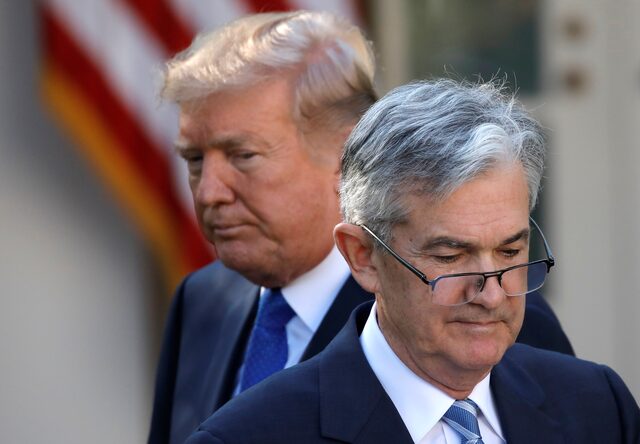
With growing concern over the safety of U.S. treasuries, the continuing rise in prices, and the all-time high in gold and asset prices, the Federal Reserve, at its September meeting, decided to cut the federal funds rate by 25 basis points while indicating that there will be more cuts coming.  The much-anticipated rate cut, of course, was in reaction to the unprecedented pressure brought to bear by President Donald Trump on Fed Chairman, Jerome Powell.

Like his reckless tariff policy, which has driven some allies into the arms of America’s supposed adversaries – see India and its rapprochement with China – Trump’s Fed bashing will have the opposite of its intended effect. 

Trump believes that rate cuts will make the economy “take-off” and he hopes that lower borrowing costs will make service of the gargantuan U.S. debt more manageable. 

As usual, the president talks out of both sides of his mouth.  He has spent most of his second term boasting that the economy is the best it has ever been.  Why then is there a need for interest rate cuts if the economy is booming? 

Trump also promised massive spending cuts via the Department of Government Efficiency but, instead, he passed the “Big Beautiful Bill,” which added more spending, requiring more borrowing.

America is not alone in cutting rates as central banks across the world (whose economies are also debt ridden) are reducing rates which will only encourage more borrowing.  This, of course, will lead to more price inflation as central banks will have to print more money to finance the profligate spending of their governments. 

Eventually there will be a return to gold in the monetary order, not just as a reserve asset, but one used in exchange as fiat currencies collapse. 

If economic trends continue, that day may not be far off.   

*https://www.ft.com/content/0dbc435d-7d7e-43d7-b730-b8ced4b1cba2

Antonius Aquinas@antoniusaquinas
https://antoniusaquinas.com

The Trump – Powell Spat: A Distraction from the Debt Crisis

Since his return to office in January, President Donald Trump has called on Federal Reserve Chairman Jay Powell to cut interest rates which Powell and the Fed’s Board of Governors have refused to do.  In typical child-like behavior when he doesn’t get his way, Trump has hurled insults at Powell calling him a “stupid person,” “too late Powell,” and a “numbskull.” 

Trump’s juvenile attacks, although misplaced, have been quite humorous and a welcome change in tone to the respect, reverence, and almost deification that previous Presidents, Congressmen, and the financial press heap on Federal Reserve Chairmen.

Unfortunately, as with all his policies, Trump’s megalomania is on display.  After the Fed’s June meeting when it once again decided to leave rates unchanged and indicated that there might be only one rate cut in 2025, Trump again slammed Powell and suggested that “Maybe I should go to the Fed.  Am I allowed to appoint myself to the Fed.?” *

While Trump’s ridiculing the head of one of the sacred cows of America’s ruling establishment is welcomed, his crazed notion of putting himself, and presumably future presidents, in charge of monetary policy does not offer any viable alternative to the debt crisis that is staring the nation in the face with the U.S. in the hole in excess of now some $37 trillion. 

Although Trump’s blasting of Powell has provided some comic relief from the dire economic conditions which confront the U.S., in reality both the president and the Fed Chair are wrong over interest rate policy although, in this case, Powell is less wrong.  Like most of Trump’s kooky ideas – taking over Greenland, making Canada the 51st state – not only is the slashing of interest rates counterproductive, but the idea of giving the executive branch of government control of monetary policy would turn the nation into a complete dictatorship.

Powell, too, has been mistaken in his policy of holding rates steady. Interest rates, in fact, are too low and need to be higher.  At current levels, rates are too “accommodative” as price inflation remains above the Fed’s 2% target.  Of course, in reality prices are rising at a much briskier pace than official government estimates. 

Hiking rates would encourage savings and discourage consumption both of which would put downward pressure on consumer prices.  If Trump wants to achieve his goal of a reindustrialized America, there needs to be an increase in savings. Production of goods takes place over time and without savings to fund the construction of factories, the purchase of machines and equipment, and the payment of wages, there can be no economic growth.

Trump wrongly believes that lower rates will spur economic growth.  Sustained prosperity can only take place through savings and investment not money creation via credit expansion which the president is a fan of.    

More fundamentally, both Trump and Powell are wrong: interest rates should not be set by governments or monetary authorities, but be determined by market forces – the aggregate decision making of individuals on how much to save or how much to consume their income.  Concomitant with non-state involvement with the setting of interest rates, a return to a metallic monetary standard would prevent price inflation which would make saving more attractive.

Another reason why Trump wants lower rates is that servicing the mammoth U.S. debt would be somewhat more palatable. His “big, beautiful bill,” working its way through the Senate, will need to be financed.  Lower rates would reduce the government’s borrowing costs.  This irresponsible argument was also made by former Federal Reserve Chair and later Treasury Secretary Janet Yellen.   

Since Donald Trump has no ideological core that shapes his world vision, his outlook and policies are more often than not based on what affects him personally or who strokes his ego or lines his pockets.  The proper monetary policy for the nation is not to cut interest rates, but to raise them and reduce the national debt through spending cuts.  While there would certainly be short-term pain from such a policy, eventually matters would turn around and economic activity would be placed on a sound footing.

Ultimately, if sound money is ever to return to America and the Western world, its control must be taken away from central banks and the influence of mercurial politicians.  The creation of money, its distribution, authenticity, and safe keeping should be left up to a decentralized non-governmental arrangement. 

*Tyler Durden, “Trump Slams ‘Stupid’ Powell: ‘I Think He Hates Me.  I Call Him Every Name in the Book to Try and Get Him to Cut,’” Zero Hedge, 18 June 2025. https://www.zerohedge.com/markets/trump-slams-stupid-powell-i-think-he-hates-me-i-call-him-every-name-book-try-and-get-him

Antonius Aquinas@AntoniusAquinas

Treasury Secretary Janet Yellen Apologizes for Out-of-Control Debt

Outgoing Treasury Secretary Janet Yellen has apologized (sort of) for the Biden administration’s failure to reign in the U.S. financial house and presiding over an increase in trillions of dollars in debt for the nation. According to Tyler Durden, writing for Zero Hedge, Yellen said at a Wall Street Journal organized event in December:

I am concerned about fiscal sustainability and I am sorry that we haven’t made progress . . . . [T]he deficit needs to be brought down especially now that we’re in an environment of higher interest rates.*

A little too late – don’t you think, Janet? 

Yellen was Federal Reserve chairman from February 2014 to February 2018 and, before that, served as vice chairman under Ben Bernanke.  She was replaced by President Donald Trump with Jerome Powell. 

Yellen, as do all Fed officials, reiterated the point that the central bank remains “independent” to pursue its mandate of full employment and price stability.

This is nonsense like most of what she has said over the course of her long and disastrous career.  Instead of independence, her move from Fed chair to Treasury secretary is a striking demonstration of just how political the Fed and the nation’s entire monetary and financial system truly is. 

Nevertheless, she continued to espouse the hypocrisy:

I see from my own experience is that countries perform better – they have not only inflation performance – but real performance in terms of job creation and growth is also stronger when a central bank is left to use its best judgement without political influence.

Under Yellen as Fed chair (the direct subordinate to Ben Bernanke), and as Treasury secretary, it has been estimated that the U.S. debt skyrocketed to the unfathomable amount of $15 trillion.  Yet, it is only when she is about to depart her post that Yellen is lamenting the Biden administration’s efforts to reign in the debt. In fact, there were none.

Besides the debt, the interest on it under Yellen’s watch stands at $1.2 trillion yearly, which is now the second-largest federal expenditure only topped by Social Security.  In her mea culpa, Yellen ignored this ticking timebomb.

One of the non-sensical reasons that Yellen often gave to justify massive U.S. borrowing was that interest rates over the past decade had been historically low.  She argued that the federal government should take advantage – and did – of the low-interest rate environment. 

Economic nincompoops like Yellen apparently didn’t understand that interest rates were low because the Fed was artificially suppressing them through currency debasement.

Recklessly borrowing for this reason would be similar to a drunk refusing to sober up because liquor prices had fallen to all-time lows.  Yet, this is what a secretary of the U.S. Treasury espouses for monetary policy.  Worse, few in the financial press or Congress, where Fed officials routinely testify, are ever questioned about such a dangerous idea. 

Most sensible people, if given the chance, would ask: “What would happen to the debt and interest on the debt if rates would go up?”  The United States may soon see this unpleasant reality come to fruition. 

Sadly, Yellen’s replacement, Scott Bessent, who was a business associate of George Soros, is an “easy money” advocate, as is Trump, who continually badgered Fed Chairman Powell during his first term for not cutting interest rates. 

It will be interesting to see what actions the new Treasury secretary will take if the long-anticipated debt crisis arrives.  More likely than not, the second Trump administration will follow the monetary policies of the disgraced Janet Yellen. 

*Tyler Durden, “Janet Yellen ‘Sorry After Presiding Over $15 Trillion Increase in US Debt.”  13 December 2024 https://www.zerohedge.com/markets/janet-yellen-sorry-after-presiding-over-15-trillion-increase-us-debt

Antonius Aquinas@antoniusaquinas
https://antoniusaquinas.com

Many Americans Say They Will Never Retire

A recent AARP poll provides further evidence of the deterioration of American living standards, especially for those approaching retirement age.  The study contradicts what most policy makers have believed to be a “soft landing” for the economy after two years of rampant inflation.

“More than one quarter of U.S. adults over the age of 59,” the survey found, “say they expect to never retire.”  One in four have no retirement savings while one third of “older adults” have credit card debt of more than $10,000 and 12% hold a balance of $20,000 or more.” The Headline of an April 25 Washington Times article by Fatima Hussein says it all: “More Than 25% of U.S. Adults Over 50 Expect Never to Retire.”*

Not surprisingly, the report conducted with the NORC Center for Public Affairs Research, points out that the lack of savings is due to the rising cost of living: “Everyday expenses and housing costs, including rent and mortgage payments, are the biggest reasons why people are unable to save for retirement.”

While AARP zeroed in on rising prices as the culprit for the financial pinch that potential retirees are feeling, it did not delve into who or what was the catalyst for the increase in living costs.  Neither has the financial press, which has always been a cheerleader for the Uniparty, been diligent in its duty about the ultimate source for soaring prices. 

While the trend of Americans working well into their retirement years has been going on for years, the situation has accelerated under both the Trump and Biden presidencies.  In concert with the Federal Reserve, the fiscal policies of the two administrations have been the primary factor for why many Americans cannot retire. 

Even before the start of the hyped Covid pandemic, the Trump administration, in just one term, was on pace to become the biggest spender in U.S. history.  The astronomical increase in government spending and money printing which took place in response to Covid are now being felt.

The Fed’s balance sheet before the Covid lockdowns in January of 2020 stood at $4.15 trillion. By the end of Trump’s presidency, it had nearly doubled to $7.3 trillion as the government doled out “stimulus checks” to non-working Americans and transferred billions to business favorites and cronies in an unimaginable grab of power and wealth. 

Under Biden, the balance sheet had risen to a little short of $9 trillion in mid-2022 and has come down, now standing at $7.4 trillion, according to American Action Forum.**  

Expanding the balance sheet means that the Fed issues more dollars it takes and buys assets (mostly government bonds). This is actually debt monetization.  The increase in the money supply is the classic – and true – definition of inflation.  Rising prices are not inflation, but its consequence.   

At first, the new money went into financial assets increasing their nominal values. However, because of the “lag effect,” the inflation the Fed created is now pushing up consumer prices.  The Fed has had to do this because of profligate government spending which must be sustained through borrowing, since tax revenues are not enough to meet expenditures. 

When asked in his current re-election campaign on what he would do to solve the rising cost of living, Trump said that he would “drill baby drill.”  Such a statement demonstrates again that the former president, like the current occupant of the office, does not understand the problem.

Increasing domestic oil production is certainly good in itself, which will create jobs and bring more oil to the market. But it will not address general price inflation which is a monetary phenomenon

Rising prices can be reversed if the Fed increases interest rates, or better yet, lets rates be set by the market.  Higher rates will entice people to save, which will take money out of circulation, thus putting downward pressure on prices.

Just as important, the government needs to cut spending and eliminate departments and programs which will mean less money printing by the Fed.  The likelihood of this taking place in a presidential election year is next to zero.      

Even if the government and the Fed took the proper steps and began to put the nation on a sound financial footing, it will take years for the damage that has been done to be rectified.

Sadly, the Uniparty has no intention of doing the right thing and as economic conditions worsen, the number of people who must work until they drop will continue to rise.

*Fatima Hussein, “More than 25% of U.S. adults over 50 expect never to retire.” The Washington Times, 25 April 2024, A7. **https://www.americanactionforum.org/insight/tracker-the-federal-reserves-balance-sheet/

What the Rising Gold Price Signals

The recent run-up in the gold price has not garnered the attention among the mainstream financial media outlets as it should.  Gold has, in part, been overshadowed by the rise in the price of bitcoin and other cryptocurrencies. 

Naturally, the financial press, which is really an arm of the government and its central bank, wants to ignore, as much as possible, references to gold as protection against the continuing increase in the price level which itself has been deliberately understated by monetary officials.  The media and government understand that precious metals are the ultimate security against runaway inflation and economic collapse.

While the increase in the gold price has reached nominal highs, it and the price of silver have not passed their all-time 1980 highs in real terms.  Adjusted for inflation, gold would have to rise to about $3590 an ounce while silver would have to surpass $50 an ounce.  Both are poised to exceed these watermarks in the not-too-distant future.

Precious metals will continue to escalate unless the Federal Reserve radically changes its interest rate policy to combat inflation as former Fed Chairman Paul Volcker once did.  Volcker raised interest rates to double-digit levels which caused gold prices to fall.  While Volcker could get away with such actions (because, at the time, the U.S. was still a creditor nation), current Chair Jerome Powell cannot because of the enormity of public and private debt.  Double-digit interest rates would collapse the economy and plunge millions of Americans into bankruptcy.

The rising price of gold is anticipating some of the promised policy actions of the Fed.  Since the end of last year, the central bank has indicated that it would be cutting interest rates.  In addition, Powell is considering ending the Fed’s “Quantitative Tightening” (QT) program.  Both are highly inflationary. 

While commentators have focused on gold’s spectacular price rise, there is an underlying issue that is also taking place.  The record setting gold price is signaling that the present fiat monetary order, which is based on the dollar as the world’s reserve currency, is coming to a financially unpleasant end. 

Ever since 1971, when the Nixon Administration closed the “gold window,” refusing to redeem gold for dollars held by foreign central banks, the world has been on a “dollar standard” where bank reserves are held in Greenbacks.  If the Fed continues to print dollars to sustain government spending at this rate, the dollar will continue to lose purchasing power and foreigners will no longer want to hold them.  Foreign central banks will then turn to gold.  In fact, central banks are already increasing their positions in gold which has been a catalyst that has fueled the latest rally.

Not surprisingly, the Fed has not purchased much gold (or is not admitting publicly that it has) since it would be a bad look for the issuer of the world’s reserve currency to be abandoning its own currency for gold.

Besides the severe financial implications if the dollar is dethroned, there will be dramatic geopolitical repercussions from the loss of its hegemony.  Just like the British pound was replaced as the dominant world currency after England insanely exhausted itself in fighting WWII and ending its empire, America will face a similar future when the dollar becomes just another money.  Many will see it as a “blessing” if and when the U.S. Empire comes to an end.

While it would appear logical and morally sound to replace the present crumbling monetary order with one based on gold and silver, a far worse paradigm than even the present one is, no doubt, being planned.  The new system will be one of central bank digital currency (CBDC) which would give governments and bankers the power to monitor and control all aspects of economic and social life. 

Some states have passed legislation to counter CBDC, such as Florida in 2023 under Governor Ron DeSantis who said: “The Biden administration’s efforts to inject a Centralized Bank Digital Currency is about surveillance and control.  Today’s announcement will protect Florida consumers and businesses from the reckless adoption of a ‘centralized digital dollar’ which will stifle and promote government-sanctioned surveillance. . . .”*

While the press and policy makers have ignored the surge in precious metal prices, it should be a warning to everyone that difficult economic times are still yet to come with the potential of a new draconian monetary order to be installed on the horizon.  Observant individuals should heed gold’s signals and take appropriate measures to safeguard their futures.

*https://www.flgov.com/2023/03/20/governor-ron-desantis-announces-legislation-to-protect-floridians-from-a-federally-controlled-central-bank-digital-currency-and-surveillance-state/

Antonius Aquinas@AntoniusAquinas

https://antoniusaquinas.com

The U.S. Is Spending $1 Trillion Every 100 Days On The Deficit

While it made some headlines in the financial press, neither policy makers nor the two presumptive presidential nominees have paid much attention to the fact that the U.S. is adding a mind-boggling $1 trillion to the national debt every 100 days.  This amounts to around $3.6 trillion annually. 

As law makers remain willfully ignorant of the financial elephant in the room, it is most likely that the only way that the debt will be addressed is through a monetary crisis which will involve the status of the dollar as the world’s reserve currency.  Such a scenario would then force authorities to take action.

As if there needed to be more evidence of how impervious Congress and the Biden Administration are to the burgeoning debt spiral, the House and Senate passed two stop-gap funding packages to avoid a government shut down on March 22, 2024.  One Senator called it “a pork fest of epic proportions.”*

Despite the ominous prognostications of a dollar collapse by financial doomsayers, the Greenback has remained the best of all competing currencies.  Yet, this time could be different, since interest rates – which have been artificially suppressed by the Federal Reserve (Fed) – have risen, making servicing of the national debt more expensive as Moody’s Investors Service noted: “In the context of higher interest rates, without effective fiscal policy measures to reduce government spending or increase revenues Moody’s expects that the US’ fiscal deficits will remain very large, significantly weakening debt affordability.”** 

While “King Dollar” has continued its financial hegemony, the running of a staggering national debt – which now stands at over $34 trillion – has had baneful repercussions for the average American.  The funding of the debt has led to a resurgence in 1970s-style stagflation with a decline in productive job growth such as manufacturing and near double-digit price inflation.  This, of course, has had a deleterious effect on the middle and lower classes’ standards of living since rising prices disproportionately effect these groups harder than the more affluent.

Of course, the simplest approach (although politically unpalatable) to the problem would be to dramatically cut government spending by eliminating agencies and programs.  With the Uniparty in charge, however, there is virtually no chance of budget cuts, especially in an election year.  Whatever happened to the “deficit hawks” and those calling for a balance budget amendment to the Constitution?

The funding of the debt is the primary factor for the rise in consumer and producer prices.  Since federal spending is beyond what the government receives in revenues, it must borrow through the issuance of debt/bonds to make up for the shortfall. 

The principal buyer of government debt has been the Fed, which pays for the bonds by the creation of money, “out of thin air.”  The printing of money (now done through the stroke of a computer key) bids up prices in the market.  Federal Reserve officials have innocuously called this scam “Quantitative Easing” (QE), which is in realty a monetization of the debt. 

Since the Fed has begun hiking interest rates, it has been doing “Quantitative Tightening” (QT) where it ostensibly has not been buying U.S. debt, but selling it.  This would lead to a contraction of the money supply and a fall in prices. The central bank has not been aggressive enough in its tightening nor has it raised interest rates enough to have any real effect on soaring prices. 

It is highly doubtful that the U.S. will escape the fate of other republics who have pursued reckless fiscal and monetary policies.  It is almost a mathematical certainty that the nation will default on its debt by either hyperinflating the currency or discounting bonds with massive haircuts to their premiums. 

The most likely path is hyperinflation; then the dollar will once again fulfill Voltaire’s dictum that all “paper money eventually returns to its intrinsic value – zero.”  While there will be massive social misery from a dollar collapse, the one bright spot from its demise is that it will mean an end of the murderous U.S. Empire.

*Tyler Durden, “’A Pork Fest of Epic Proportions:’ Congress Passes Spending Package to Avert Shutdown.” Zero Hedge 8 March 2024.  https://www.zerohedge.com/markets/pork-fest-epic-proportions-congress-passes-spending-package-avert-shutdown

**Quoted in Michelle Fox, “The U.S. national debt is rising by $1 trillion about every 100 days,” cnbc.com   https://www.cnbc.com/2024/03/01/the-us-national-debt-is-rising-by-1-trillion-about-every-100-days.html   Updated, 4 March 2024.

Antonius Aquinas@AntoniusAquinas

https://antoniusaquinas.com

“Don’t Buy Government Bonds”

As another farcical “debt-ceiling raising” saga unfolds, conducted by the two indistinguishable political parties hell-bent on driving America into economic ruin, it would be instructive to look at how some earlier conservative/libertarian thinkers viewed public debt.  Unlike the present generation – with the notable exception of Ron Paul – these intellectuals asked fundamental questions about such matters as debt, taxation, central banking, and foreign policy.

One of the leading lights of what was known as the “Old Right” of the 1950’s, which opposed the Cold-War globalism of the likes of William Buckley and domestically sought to overturn the New Deal, was Frank Chodorov (1887-1966).  In his books and essays, Chodorov challenged the pillars which social democracy rested and sought to return America to small government, free trade, and “isolationism.” 

In one of his provocative essays, Chodorov pervasively argued that those who purchase public debt are complicit in the enhancement of state power.  Unlike many present-day economists who only see the baneful economic effects of profligate government borrowing, he makes a moral case against debt financing.*

He points out that public borrowing burdens future generations for the benefit of the present.  Despite reasons often given for the necessity of borrowing – war, natural disaster, infrastructure, etc., – Chodorov contends that the practice of shifting the cost to later generations, whatever the reason, is unjust:

This is exactly what you do when you
cooperate with the State’s borrowing
program. You are loading on your children
and your children’s children an obligation to
pay for something they had no voice in, and
for which they may not care at all. Your
‘investment for posterity’ may earn you
nothing but the curses of posterity.

Chodorov understood, as most commentators do not today, that a gold-backed currency restrained State largesse: “When money was redeemable in gold, the inherent profligacy of government was somewhat retrained; for, if the citizen lost faith in his money, or his bond, he could demand gold in exchange, and since the government did not have enough gold on hand to meet the demand, it had to curtail its spending proclivity accordingly.”

It was Franklin Delano Roosevelt’s despicable and criminal act of taking the U.S. off the gold standard domestically that led to the expansion of the public debt as Chodorov describes: “. . . Mr. Roosevelt removed this shackle and thus opened the flood gates.  The only limit to the inclination of every politician to spend money, in order to acquire power, is the refusal of the public to lend its money to the government. . . . the government can then resort to printing of money, to make money out of nothing. . . .” 

Not realized at the time, but the ability of the American government to expand its revenue base fit nicely into FDR’s later nefarious foreign policy objectives. 

Chodorov’s viewpoint on public debt can also easily be applied to FDR’s decision to eradicate the gold standard through which the U.S. currency could be redeemed for precious metals.  FDR’s act, however, was a “violation of contract” with American citizens since the U.S. government defaulted on its obligations.

In Orwellian fashion, the verbiage used with most government operations is often misused to legitimize State functions.  “Investment” is one such term that has been corrupted in relations to spending and debt.

In promoting their spending schemes, politicians will often use the term investment, “investment in education,” “investment in infrastructure,” etc.  This is deliberate, since it tries to equate government spending with a vital component of the market process.

In a market economy, investment means the lending of savings, which is used to expand and/or start an enterprise.  In return, the lender receives a stock or a bond.  If the business is successful, the lender’s investment will receive a return – dividends from a stock or interest from a bond.  Business investment is, therefore, a necessary aspect of capitalism which results in economic growth and increased living standards.

As Chodorov incisively points out, however, government investment is the antithesis of what takes place in the marketplace:  

The State, however, does not put your money into production.  The State spends it – that is all the State is capable of doing – and your savings disappear.  The interest you get comes out of the tax fund, to which you contribute your share, and your share is increased by the cost of servicing your bond.

Chodorov’s solution to deficit financing was not to buy government bonds.  While this would certainly be a step in the right direction, a more radical approach is needed since the problem has now become so immense. 

Simply put: there should be a prohibition on government borrowing of any kind.  State revenues should only come through tax receipts and fees paid by those in the present.  This would completely eliminate the “moral hazard” of debt financing and drastically reduce the size and scope of government over society.

For those who seek to put an end to the current debt-ceiling charade and rectify the immoral practice of burdening future generations by the irresponsibility of the present, the works of Frank Chodorov are essential.

* “Don’t Buy Government Bonds,” The Mises Institute, 13 January 2011. https://cdn.mises.org/Out%20of%20Step_4.pdf

Antonius Aquinas@AntoniusAquinas

https://antoniusaquinas.com

Trump’s Inflation

Former President Donald Trump attends a rally in support of Arizona GOP candidates, Prescott, Ariz., on July 22, 2022. (Mario Tama/Getty Images)

Once again, former president Donald Trump criticized the Biden Administration for the record consumer price increases that Americans are now paying.  His remarks followed up on his July 4th speech in Wyoming where he lamented about the state of the nation: “I know it’s not looking good for our Country right now, with a major War raging out of control in Europe, the Highest Inflation in memory, the worst 6 month Stock Market in History, the highest energy prices ever.”* 

In his most recent campaign rally for GOP hopeful Kari Lake, Trump lambasted President Biden for creating the “worst inflation in 47 years”** and for his “war on American energy” which Trump believes has contributed to the record hike in fuel prices.

The former president boasted that had he been re-elected “none of these terrible events would have happened.”  He reassured his audience “not to worry” and that “we will make America great again.” 

As with all of his post-presidential rallies, Trump’s criticism of the Biden regime comes with touting his own accomplishments as chief executive.  Most of these claims are so outrageous they damage or totally negate his critique of Biden’s policies and make Trump sound like a fool.

Take, for instance, his rally in Arizona for Kari Lake, where he had the audacity to say that under his watch the country “had the greatest economy in the history of the world with no inflation.” [!]  Such nonsense needs no comment.

Like his boasts about the economy, the former president deftly left out his Administration’s role in the drastic rise in prices which Americans are currently suffering from. 

First, however, the meaning of “inflation” should be explained.

Inflation, properly defined, as it was understood until the present era, meant an expansion of the money supply.  “Deflation,” its opposite is a decrease in the money supply.  The rise or fall in prices – usually a rise in producer and consumer prices – is a consequence of the expansion or contraction of the money supply.  Once understood, the rampant rise in prices in America and throughout the world has been the result of the increase in the money supply not only by the Federal Reserve, but all central banks.

Another important tenet of monetary theory long since forgotten has been the notion of a “lagging indicator.”  Between the expansion of the money supply – inflation – and the resultant increase in prices, there is often a lag which could take months or years to appear. 

The increase in consumer and producer prices is due to the dramatic explosion of money and credit which took place during the Trump Administration not only in response to the scamdemic, but in the years leading up to it.  In fact, the plandemic was a convenient excuse to inject massive liquidity into a system that began to hemorrhage in September, 2019.  In the early months of 2020, the markets began to implode before the unnecessary lockdowns as the air began to come out of the financial bubble.  This has been ignored by the financial press and Trump himself.

Prior to the covid hysteria, Trump had repeatedly lobbied for “cheap” money, calling for a renewal of quantitative easing, reduction in interest rates, and he even spoke about “negative” rates.  The former president threatened to fire Jerome Powell, whom he had picked to head the Federal Reserve, for not reducing interest rates far enough.  Trump complained that President Obama benefited from the Fed’s accommodative monetary policy and wanted similar treatment so as to keep the financial bubble going.

Trump’s fiscal policy was also highly inflationary as he ran record deficits long before covid.  His tax cuts and failure to cut government spending led to greater government borrowing which the Fed was forced to monetize.  Trump was on pace, well before the 2020 lockdowns, to spend more money in four years than Obama spent in his two terms.  By 2019, the deficit had grown to $1 trillion dollars, up $205 billion, 26 percent from 2018.***  Again, all before covid had begun.   

It was the Trump Administration’s wrongheaded response to the corona virus which is largely responsible for the rising prices of today.  If the lockdowns were necessary (which a growing number of officials now admit they were not), the proper policy would have been to reduce the money supply (and government spending in general) since the lockdowns reduced production meaning less goods and employment.  The massive increase in the Fed’s balance sheet from $4 trillion to some $9 trillion meant more money “chasing fewer goods” causing the prices of the available goods to increase – some dramatically.

What was needed was a reduction in consumer spending since there was less goods being produced with the lockdowns.  Less demand would have offset the reduction in supply and would have kept prices from spiraling.

Instead, Trump – as did his successor – following the doctrines of Lord Keynes, attempted to maintain aggregate demand at pre-covid levels and sent out stimulus checks even to those still employed.  While the money given out to American workers pales in comparison to the massive transfer of wealth to politically-favorite corporations, big business, and the expansion of the government itself, the propping up of aggregate demand led to supply chain shortages.   

Trump is not alone in his ignorance of economics.  His handlers, economic advisors, and the vast majority of his loyal supporters do not understand what took place under his administration.  The current financial mess can be laid at his – and the Federal Reserve’s – feet.  To be fair, his predecessor, Barrack Obama, is also liable.    

The “inflation,” and now recession, which the country is suffering through cannot be fully attributed to the Biden Administration although it too has added to the crisis with more profligate spending. 

The remedy for the current mess is not the re-election of a very flawed former president who does not understand the problem at hand and throughout his term was constantly outfoxed by the Swap which he was elected to drain.  The solution is a return to sound money, the abolition of central banking, and the allowance for the necessary cleansing of the financial bubble. Until a presidential contender speaks in these terms, America’s financial woes will continue.

*https://www.zerohedge.com/political/heres-what-trump-says-inflation-would-be-if-he-were-still-president

**https://www.zerohedge.com/political/trump-blasts-biden-over-soaring-prices-says-true-inflation-rate-much-much-higher-91

***https://www.washingtonpost.com/business/2019/10/25/us-deficit-hit-billion-marking-nearly-percent-increase-during-trump-era/

Antonius Aquinas@AntoniusAquinas

https://antoniusaquinas.com

A Warning of Economic Collapse

Eleison Comments by His Excellency Bishop Richard Williamson

Traditional Catholic Bishop Richard Williamson’s latest missive should be a wake- up call for those who naively believe that the worst is behind for the US and Western economies after the March financial sell off and the long-anticipated implosion of the bubble economy.  His Excellency asserts that the US and much of the world are on a financial precipice:

At this moment the United States has been brought to the brink of a tremendous

economic crisis, and with the USA, the rest of the world.*

Bishop Williamson contends that it has not only been the response to the virus, but more importantly, the response to the bursting of the financial bubble, created by the Fed, which will ultimately lead to a cataclysmic collapse:

By 2019 as the public was more and more hooked on fantasy money, the

Fed’s public balance sheet took off into complete unreality, seven trillion dollars

and counting, and it is now crashing the real economy with the corona-panic,

then ‘paying’ the crash debts that everybody gets into with its unreal trillions, but

turning the whole world into real slaves.

The bishop’s brief analysis of the history of the Fed is right on as he explains that the central bank has been the engine of monetary mischief since its inception:

These money men had promised that the Fed . . . would solve the problem

of reoccurring economic crises. . . .  It did nothing of the kind.  On the contrary,

it made them even worse, like the Great Depression of 1929 and the years following,

and now the Depression of the 2020s which risks making 1929 look like a picnic, and

risks stripping the United States of its prosperity and enslaving its liberty by making all

American citizens into debt-slaves. The middle class will soon be no more.

One quibble: Bishop Williamson rightly sees the problem of the money supply controlled by “private individuals” (central banksters):

It is not normal for private citizens to control their State’s money because they risk

doing so in their own interests, and not for the common good.

Yet, the alternative – State control – is no better and, under “democratic conditions,” maybe even worse considering the State’s horrific record in the debasement of money, the creation of booms and busts, hyperinflations, the destruction of savings, etc.

The only economically sound, morally defensible monetary system is one based on gold/silver where money and credit cannot be created “out of thin air” and where competing gold and silver producers vie with one another to produce the “best money.”  Such a system requires no central bank while fractional-reserve banking is prosecuted as fraud.  The creation of money is what is mined out of the earth not government and central bank fiat.

America’s current financial condition has ominous parallels to ancient Jerusalem before its destruction by the forces of Vespasian and Titus.  A couple of years before its final destruction, a Roman army, under Cestius Gallus, had stationed troops under the walls of Jerusalem posed to launch an assault.  Yet, Gallus did not attack and ultimately pulled back.  This was a clear fulfillment of Christ’s prophecy about the city’s destruction:

And when you shall hear of wars and seditions, be not terrified: these things must first

come to pass, but the end is not yet immediately.  [St. Luke Ch. XXI; vs. 9]


And when you shall see Jerusalem compassed about with an army: then know that

the desolations thereof is at hand. [Ibid., vs. 20]

Rome’s hesitation – a clear result of Divine intervention – gave Christians a chance to escape the coming conflagration which many wisely took advantage of:

Then let them that are in Judea, flee to the mountains: and let them that

are in the midst thereof depart out: and let not them that are in the

countries, enter into it. [Ibid., vs. 21]

Destruction of Jerusalem

50. The First Jewish-Roman War; the destruction of the ...

Since the March lows, Americans have been in a situation not unlike the denizens of ancient Jerusalem.  The relief programs and bailouts of businesses (mostly large corporations and banks) has staved off an even greater downturn, however, this has come at a tremendous cost as the Fed has had to print trillions, the consequence of which will mean either a collapse of the dollar or, at the very least, a dramatic loss in its purchasing power.      

At present, it does not appear that the US has much time before the final unraveling of the economy takes place.  The current debt levels and the new debt that will have to be created to maintain the status quo will lead to a monumental monetary crisis.    

Many have interpreted Jerusalem’s fall as a punishment for its sins.  Likewise, the coming collapse can also be seen as retribution for the US’s crazed monetary and fiscal policies which have bankrupted the nation while enriching the few at the expense of the many. 

While Jerusalem’s destruction had little reverberations on the wider Roman Empire at the time, the demise of the dollar will have global implications since it is the world’s reserve currency.  Like those who heeded the Divine prophecy two millennium ago the present generation should take Bishop Williamson’s words to heart and prepare for the coming financial storm.

*His Excellency Richard Williamson, “Economic Reality,” Eleison Comments, 12 September 2020.  https://stmarcelinitiative.com/eleison-comments/

Antonius Aquinas@AntoniusAquinas

https://antoniusaquinas.com


Memo to The Donald: Cut Tariffs NOT Rates

trump tariff

So far, President Trump’s economic response to a potential coronavirus outbreak and a further stock market sell off has been expected – calls for more interest rate cuts and an additional round of monetary stimulus.  For the stock market, economy, and the virus itself, neither measure will have their desired effect and, in fact, may exacerbate things.

Further rate cuts and more money printing will not alleviate the situation since it has been the Federal Reserve’s recent “repo operations” which has pushed the market to its unsustainable highs.  For President Trump’s re-election hopes, the current “correction” better be short lived since he has repeatedly boasted about the stock market and has tied its success with the supposed health of the economy.  He will pay a political price if the market continues to tank and brings the economy down with it.

While President Trump and economic nationalists have bashed China for its trade practices, they are now going to see first hand how dependent the US and the West are on Chinese exports, as supply chains are disrupted over the coronavirus.

A Bloomberg article describes China’s weakest factory activity ever recorded:

The manufacturing purchasing managers’ index plunged to 35.7 in

February form 50 the previous month, according to data received by the

National bureau Statistics on Saturday, much lower than the median

estimate of economists.  Both were well below 50, which denotes

contraction.*

The expected reduction of Chinese goods will mean higher US domestic prices, however, the increase in prices can be offset somewhat not by rate cuts, but by tariff reductions, or, better still, elimination of duties on imports.  Increasing the money supply or cutting interest rates, which is what Trump, the market, and 95% of economists favor, will only mean higher prices for dwindling imports as greater amounts of money will chase fewer goods.

In the President’s comments on the coronavirus and the stock market plunge, he has repeatedly cited other nations’ (Japan, Germany) – lower interest rates as a policy that the Fed should pursue.  Apparently, the President is not aware that recent data out of Japan has shown that the economy shrank at an annualized rate of 6.3% for the fourth quarter of 2019 while the German economy only grew at 0.6% last year.**  Low rates have not helped either economy or anywhere else where they have been foolishly tried.

What President Trump, world policy makers, and central bankers do not understand, whether deliberately or from willful ignorance, is that the artificial suppression of interest rates and money printing does not lead to economic growth. Instead, prosperity can only come about by the arduous process of saving (abstention from consumption), which provides the means for capital formation, which leads to production.  Employment, wage growth, and income are also ultimately tied to savings.  For the creation of wealth, there is no way around this elementary economic principle – one that few profession economists comprehend.

For saving and investment to have their most efficacious impact and for individuals to engage in such sacrificial behavior, a sound monetary order must be in place.  Unfortunately, ever since the US went off the gold standard internationally in 1971, its monetary system has grown increasingly unstable.

If the Trump Administration would eliminate, or at least reduce significantly, tariffs, it would more than likely induce China to do the same.  The benefits of lower import prices for the millions of out of work Chinese due to the coronavirus shut downs would be a tremendous help and would also boost America’s export industries.  Such action would show to those who elected him that Donald Trump was not a typical politician, but one who thought outside the box.

While it did not cause the Great Depression, the Smoot-Hawley Tariff of 1930 contributed to its severity.  If the recent sell-off is indeed the beginning of the long anticipated bust, following a supposed decade long expansion, then policy makers should do all in their power to alleviate the coming suffering.  The reduction of tariffs not only on Chinese goods, but those the world over would be a step in the right direction.

Let us hope that someone will convince Donald Trump that tariff reduction and not rate cuts will help Americans better deal with the troublesome and potentially economic and socially devastating coronavirus.

*China Posts Weakest Factory Activity on Record,” Bloomberg News, 29 February 2020.  https://www.bloomberg.com/news/articles/2020-02-29/china-feb-manufacturing-pmi-at-35-7-est-45-0

**Megumi Fujikawa, “Japan’s Economy Shrinks Faster Than Expected.”  Market Watch.  16 February 2020.  https://www.marketwatch.com/story/japans-economy-shrinks-faster-than-expected-2020-02-16;  “German Economy Stagnates as Eurozone Growth Hits Seven-Year-Low,”  The Guardian,  14 February 2020, https://www.theguardian.com/business/live/2020/feb/14/german-economy-stagnates-growth-eurozone-gdp-business-live

Antonius Aquinas@AntoniusAquinas

https://antoniusaquinas.com