Category Archives: Constitution

Dick Cheney and the American System of War

Former Vice President Richard “Dick” Cheney died on November 3, 2025 at the age of 84.  As secretary of Defense under President George H.W. Bush, Cheney was the architect of the 1991 Persian Gulf War and later, as vice president under George W. Bush, he was instrumental in the invasion and eventual conquest of Iraq.

Brown University’s Cost of War Project has modestly estimated that the “wars on terror” have resulted in the deaths of more than 940,000 people including 432,000 civilians and a monetary cost to the United States of about $8 trillion. 

Of course, Brown University’s study calls the post 9/11 U.S. military operations in the Middle East “wars on terror” when, in reality, they have been fought for the benefit of Israel and its Greater Israel Project, which has decimated the Arab world and has accomplished almost all of its objectives.

Cheney’s nefarious activities were not confined to mass murdering peoples that posed no threat to America’s national security.  He was a force behind the U.S. policy of torture (waterboarding), and nearly unlimited domestic surveillance (the Orwellian-labeled Patriot Act).

According to an article on the news and commentary website “Antiwar,” headlined “Dick Cheney: The Dark Legacy of a War Criminal,” Cheney suggested U.S. intelligence agencies must: [O]perate on the ‘dark side,’ spend time in the shadows, and use ‘any means at our disposal’ to achieve its objectives.” 

As if the U.S. Presidency was not unrestrained enough, Cheney advocated a “unitary executive” theory that the “president alone decides matters within the executive branch” without input from opposition voices within the government’s foreign policy agencies. 

The response by libertarian and alternative media outlets to Cheney’s demise were universal in their denunciation of the former vice president, calling him a “war criminal” and that he left this world with a “dark legacy.” 

It should be noted that a number of alternative media’s podcasters who have criticized Cheney regularly host guests and speakers who are former U.S. military and diplomatic personnel, ex-CIA agents and intelligence operatives, a number of whom participated in the Iraq wars and other American covert operations themselves.

Few, if any, who condemned the former vice president for his criminality mentioned or questioned why it was, and still is today, that monsters like Cheney were able to inflict so much death and destruction on peoples and nations across the globe who posed no threat to America. 

Could it be that the political system that Cheney operated under was the problem?  And, what is to be done to prevent future Cheneys from committing similar atrocities?

Unfortunately, “democratic” wars are paid for “by the people” and the costs are socialized among the population through taxation, inflation (money printing), and deficit financing.  Since warmongering politicians do not have to directly pay for conflicts, there will be a tendency for them to be more bellicose.  Moreover, democratic wars are collective enterprises where elected officials are not personally responsible for the actions of the government but are agents of the voters.   

Nor have the supposed checks and balances of constitutional government, so often touted by admirers of the U.S. Constitution, been able to prevent conflicts, as the horrific record of American warmaking sadly proves.

The passage of the U.S. Constitution established a powerful central state which could (and did) tap the resources and men of the individual states to conduct wars which eventually took place the world over. 

A weak national government, like that under the Articles of Confederation, or no central state at all, but instead a political order of numerous sovereigns (a world full of Switzerlands, Liechtensteins, etc.) would make warfare on a massive scale impossible.

Chip Gibbons, writing in the Jacobin magazine, called Cheney an “enemy of democracy whose agenda included war, indefinite detention, warrantless surveillance, and torture,” according to Alan Mosley. *

Cheney was not an enemy of democracy, but the product of a system that enables evil men to carry out the most heinous acts with little consequence, at least in this life. 

Labeling Dick Cheney a war criminal will tarnish his legacy, but it will not alter America’s murderous foreign policy course.  That will only come about when there is a recognition that the governing system itself needs to be abandoned and a decentralized political arrangement adopted.    

*Alan Mosely, “Dick Cheney (1941-2025): The Dark Legacy of a War Criminal,” Antiwar.com, 5 November 2025.  https://original.antiwar.com/Alan_Mosley/2025/11/04/dick-cheney-1941-2025-the-dark-legacy-of-a-war-criminal/

Antonius Aquinas@antoniusaquinas

https://antoniusaquinas.com

Taxes vs. Tariffs: Which is Fairer?

In the final days of his presidential run, Donald Trump floated the idea of eliminating the income tax and replacing it with tariffs as the means to fund federal spending.  He cited the era of U.S. history when the country had no income tax:

When we were a smart country, in the 1890s . .

this is when the country was relatively the

richest it ever was.  It had all tariffs.  It didn’t

have an income tax.*

While Trump was correct about the prosperity at the time, it is wrong to suggest that tariffs were the reason.  While there was no income tax, there was little if any burdensome regulation or government subsidy, and, most importantly, the nation was on a gold standard, which kept increasing the purchasing power of wages, all of which raised living standards to unprecedented heights.

On the surface, the idea of replacing the income tax with tariffs seems equitable. This is why many conservatives, populists, and libertarians have supported the idea. 

Under the present political order, the United States is a constitutional republic that is based on the social contract theory.  Government is established, in part, to protect the persons and property from external threats and internal unrest.  All citizens, in theory at least, are protected by the state.  It follows, therefore, that they are obliged to contribute to their defense.

Tariffs, on the other hand, are borne directly by two groups: consumers who buy imported goods, and businesses who sell imported goods and are impacted by a loss of income. 

Consumers pay the tax levied on foreign goods.  Therefore, those consumers who buy more expensive goods, such as a Mercedes Benz, pay a higher percentage of tax than those who buy trinkets such as Christmas tree ornaments and plastic cutlery from China.

Businesses, too, suffer from tariffs.  While it is often said that the tax is “passed on to consumers,” companies will see a reduction in income, since tariffs raise the price of goods.  Higher prices will cause a fall in demand, resulting in loss revenue.  Moreover, businesses who deal in foreign products have to bear the bureaucratic cost of complying with the government’s ever-changing trade policies while serving as tax collector for the state. 

While the income tax under social contract theory is more “equitable” than tariffs, one of its most egregious features cannot be justified.  Under current law, American citizens that are living abroad or have relocated permanently are still subjected to the income tax.  However, expats are no longer being defended by the U.S. government.  Renouncing citizenship (which is quite costly) is the only way to avoid being taxed.

Why should Americans, who are no longer being defended by their government, still be required to pay for it?  This would be a clear violation of the “social contract” that citizens have supposedly agreed to. 

There are other dangers that have come with government financing through tariffs, or, as some have called for, a national sales tax. Originally, when the income tax was proposed, it was to replace tariffs.  Tariffs, like all sales taxes, burden the poor and middle class disproportionately.  The income tax, which at first only affected the affluent, was accepted by the public since tariffs were to be eliminated.  Unfortunately, the tariffs remained after the two world wars and the income tax was levied on almost everyone. 

A similar situation could occur with the expansion of tariffs or the implementation of a national sales tax.  Governments rarely relinquish their taxing power.  

What is being ignored in the talk about tariffs and the income tax are the exploding government deficits.  Fiddling with what source of revenue the government collects is not addressing an impending financial crisis that could bring down the entire U.S. economy.

Of course, runaway debts and deficits are inherent in democratic republics as politicians are not personally responsible for the debt, unlike a monarch or king.  This is another flaw in the social contract theory. 

Before policy makers change the nation’s tax system, they should carefully consider the ramifications and seek to find the most equitable solution that will not burden only part of the citizenry. Cutting runaway federal spending is a first step.       

*https://www.cnn.com/2024/10/26/politics/trump-income-taxes-tariffs/index.html

School Choice: A Bad Idea

While the school choice movement has been a popular policy initiative for conservative politicians and parents who are disgusted with the failing and, in many areas, debauched public school system, a closer look at “choice” in education, which includes charter schools, vouchers, and scholarships, may not be the panacea for educational reform as many believe.

One of the latest developments in school choice involves the funding of an Oklahoma religious charter school. The state’s Supreme Court has ruled that the public funding of St. Isidore of Seville Catholic Virtual School is unconstitutional.* While privately run, charter schools are tax financed and “must abide by many of the rules that govern traditional public schools” says Laura Meckler in an article titled “Oklahoma Weighs Nation’s First Religious Charter School,” published in The Washington Post, April 3, 2024.

The “constitutionality” of the case was challenged by Oklahoma Attorney General Gentner Drummond, who cited state law that says “charter schools may not be sectarian or affiliated with a religious institution.” The attorney general contended that, if the school is allowed to exist, it would have “unlimited unintended consequences” and thus “the state of Oklahoma effectively has control over the school.”

Drummond said, “That’s the state controlling religion. That is a slope for which there is no end.”

While the Oklahoma Supreme Court has concurred with Drummond’s assessment in the St. Isidore school case, it is disturbing as to why the school’s backers, as well as other proponents of charter schools, do not see the obvious danger of government interference in religious education which necessarily comes once state monies are allocated.

In the past, religious institutions would have recognized the threat to their independence and would have no part in such an arrangement no matter how lucrative. The appeal of private schools has always been that the government has little oversight over the curricula, and that parents have a say in what their children are taught. Many private schools today, however, are little different than their public school counterparts in curriculum offered, discipline, and cultural outlook.

Besides the obvious constitutional issue of forcing taxpayers to support religious institutions, there is another moral issue which is rarely, if ever, discussed that exists not only with charter schools, but public education in general. Why should those that are single, childless couples, and those parents who send their children to private schools be forced to pay for public education? While taxpayers are protected from being coerced to contribute to religious institutions, why are the rights of those who do not use public schools not observed?

While constitutional conservatives have ignored this aspect of tax-funded schooling, there is another troubling aspect of public education. The public school has always been a vehicle for the left’s social-engineering schemes. One of the most egregious of these was Brown vs. Board of Education, which inaugurated the coercive racial integration movement.

It is little wonder why the American electorate has moved decidedly leftward. Several generations of young minds have spent their formative years exposed to some of the most radical ideas that are now presented as normal. At one time conservative commentators spoke about this, but, like nearly all of their other principles (except for their love of war), the right has abandoned this important aspect of American life.

The entire concept of school choice is confused, put forward by its proponents to somehow reform and act as an alternative to public education. Because of its nature – “one size fist all” – a bureaucracy cannot be reformed or offer diverse products or services to its customers.

If reformers want real choice, they should call for an end to public schooling and substitute in its place a decentralized system of education provision, where a wide variety of schools and institutions offer families genuine alternatives. In a market for education, parents can choose their children’s curriculum and also who instructs them.

Of course, a truly free educational system includes home schooling, which would be completely liberated from state interference.

Removing government from schooling would be a gigantic blow against the nanny state and, once again, place the responsibility for the education of youngsters with the family. The societal benefit of such a change would be incalculable.

Choice in education is another example of conservatives attempting to amend the welfare/warfare state. While it has gained in popularity and may receive in the future judicial approval, school choice will not fix public education, which will continue to be a breeding ground for the left. However, the elimination of government involvement in schooling would not only provide families with superior educational opportunities, but would remove a key component of the left’s power and control over society.

*https://apnews.com/article/public-religious-catholic-charter-school-unconstitutional-oklahoma-e4ef414605094313331a39cc645ede8a

Antonius Aquinas@AntoniusAquinas

https://antoniusaquinas.com

The U.S. Is Spending $1 Trillion Every 100 Days On The Deficit

While it made some headlines in the financial press, neither policy makers nor the two presumptive presidential nominees have paid much attention to the fact that the U.S. is adding a mind-boggling $1 trillion to the national debt every 100 days.  This amounts to around $3.6 trillion annually. 

As law makers remain willfully ignorant of the financial elephant in the room, it is most likely that the only way that the debt will be addressed is through a monetary crisis which will involve the status of the dollar as the world’s reserve currency.  Such a scenario would then force authorities to take action.

As if there needed to be more evidence of how impervious Congress and the Biden Administration are to the burgeoning debt spiral, the House and Senate passed two stop-gap funding packages to avoid a government shut down on March 22, 2024.  One Senator called it “a pork fest of epic proportions.”*

Despite the ominous prognostications of a dollar collapse by financial doomsayers, the Greenback has remained the best of all competing currencies.  Yet, this time could be different, since interest rates – which have been artificially suppressed by the Federal Reserve (Fed) – have risen, making servicing of the national debt more expensive as Moody’s Investors Service noted: “In the context of higher interest rates, without effective fiscal policy measures to reduce government spending or increase revenues Moody’s expects that the US’ fiscal deficits will remain very large, significantly weakening debt affordability.”** 

While “King Dollar” has continued its financial hegemony, the running of a staggering national debt – which now stands at over $34 trillion – has had baneful repercussions for the average American.  The funding of the debt has led to a resurgence in 1970s-style stagflation with a decline in productive job growth such as manufacturing and near double-digit price inflation.  This, of course, has had a deleterious effect on the middle and lower classes’ standards of living since rising prices disproportionately effect these groups harder than the more affluent.

Of course, the simplest approach (although politically unpalatable) to the problem would be to dramatically cut government spending by eliminating agencies and programs.  With the Uniparty in charge, however, there is virtually no chance of budget cuts, especially in an election year.  Whatever happened to the “deficit hawks” and those calling for a balance budget amendment to the Constitution?

The funding of the debt is the primary factor for the rise in consumer and producer prices.  Since federal spending is beyond what the government receives in revenues, it must borrow through the issuance of debt/bonds to make up for the shortfall. 

The principal buyer of government debt has been the Fed, which pays for the bonds by the creation of money, “out of thin air.”  The printing of money (now done through the stroke of a computer key) bids up prices in the market.  Federal Reserve officials have innocuously called this scam “Quantitative Easing” (QE), which is in realty a monetization of the debt. 

Since the Fed has begun hiking interest rates, it has been doing “Quantitative Tightening” (QT) where it ostensibly has not been buying U.S. debt, but selling it.  This would lead to a contraction of the money supply and a fall in prices. The central bank has not been aggressive enough in its tightening nor has it raised interest rates enough to have any real effect on soaring prices. 

It is highly doubtful that the U.S. will escape the fate of other republics who have pursued reckless fiscal and monetary policies.  It is almost a mathematical certainty that the nation will default on its debt by either hyperinflating the currency or discounting bonds with massive haircuts to their premiums. 

The most likely path is hyperinflation; then the dollar will once again fulfill Voltaire’s dictum that all “paper money eventually returns to its intrinsic value – zero.”  While there will be massive social misery from a dollar collapse, the one bright spot from its demise is that it will mean an end of the murderous U.S. Empire.

*Tyler Durden, “’A Pork Fest of Epic Proportions:’ Congress Passes Spending Package to Avert Shutdown.” Zero Hedge 8 March 2024.  https://www.zerohedge.com/markets/pork-fest-epic-proportions-congress-passes-spending-package-avert-shutdown

**Quoted in Michelle Fox, “The U.S. national debt is rising by $1 trillion about every 100 days,” cnbc.com   https://www.cnbc.com/2024/03/01/the-us-national-debt-is-rising-by-1-trillion-about-every-100-days.html   Updated, 4 March 2024.

Antonius Aquinas@AntoniusAquinas

https://antoniusaquinas.com

What Tucker Carlson and the Pro-Life Movement Miss about Abortion

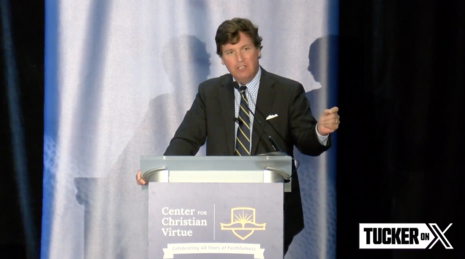
In a recent talk to the Center for Christian Virtue, Tucker Carlson railed against abortion asserting that it is “no benefit to society” and “it erode[s] its very foundation.”*  The former Fox News anchor called the battle over infanticide not a “political debate,” but a “spiritual battle.”**  The speech comes as the issue of abortion has heated up in the Republican presidential campaign.

Carlson is certainly correct in his assessment that the fight over abortion is a spiritual struggle, but he, like most of the pro-life movement, does not understand the larger tragedy of abortion.  The failure of the pro-life movement to stress this fundamental aspect, and to see abortion in the light of eternity, is one of the reasons why the evil is still a legalized part of the so-called civilized world.

While the killing of the unborn is a crime, a greater injustice of that heinous offense is committed.  Most Christians, including presumably Tucker Carlson (who was brought up Episcopalian) and the Center for Christian Virtue, would agree that one must be baptized to have a chance at salvation.  Abortion denies that opportunity.  Unbaptized infants neither go to heaven or hell, but to the “limbo of the children” where they do not suffer the pains of hell, but neither can they receive the beatific vision.

Abortion is not only the killing of the unborn, which is heinous in its own right, but it denies one from entering heaven.  If this aspect had been emphasized from the start, it may have mobilized even greater public and judicial support to outlaw the abominable practice.

Tucker Carlson’s Christian priorities are also skewed as he states:

The point of life is to have children and to watch

them have grandchildren.  Nothing will bring you

joy like that will.  Nothing comes close.  Would

trade your job for your children?  Would you trade                                                

anything for your children?  Of course not.***

The point of life is to save one’s soul and, as the Divine Savior taught, this is done by loving God with “thy whole heart, and with thy whole soul, and with thy whole mind” and loving “thy neighbor as thyself.”

Christ is very clear about those who put either parents or children above Him:

He that loveth father or mother more than

me, is not worthy of me; and he that loveth

son or daughter more than me, is not worthy                                                

of me.  [Matthew 10: 37]

Of course, children are precious gifts from God who add enjoyment and fulfillment to one’s life for those who can have them.  Children, however, are sinners and are in need of nurturing and instruction in how to live a moral life.  Sadly, despite the efforts and best intentions of parents, some children turn out badly. 

The fact that abortion is now a part of the political discourse demonstrates just how far the natural authority figures and institutions of society have failed in fulfilling their roles as moral guideposts.  Yet, this was bound to happen with the increased power of the state in all aspects of society, usurping the role that the family (and its extension – uncles, aunts, grandparents), churches, ministers, arbitrators, employers, philanthropists and scholars once held.  Where at one time ethical matters were discussed and decided outside of the state apparatus, now nearly every personal decision is subjected to government interference which has become the supreme arbitrator of what is moral and what is not.

That society’s non-governmental authority elements have little clout is also a factor in why most young people do not have much of a moral compass in how to conduct their lives and are susceptible to support the most debauched aspects of society. 

The left has long recognized this and has used the state to push through their agenda on all sorts of social and economic issues.  Using the levers of the state, a small, determined minority can impose its will on an unorganized majority.  This is another argument as to why pro-lifers should be for radical political de-centralization and the restoration of natural authority in society.    

Ultimately, the eradication of legalized abortion will not come via politics.  Instead of political wrangling, what should be made clear to the pro-abortion crowd is the real eternal consequences of their actions where the Divine Judge, who is not subject to legislative interference or some perverted, phony “right to choose” nonsense, will deliver perfect justice.

*https://www.zerohedge.com/political/watch-tucker-carlson-spits-fire-anti-abortion-speech

**https://www.breitbart.com/politics/2023/09/26/tucker-carlson-abortion-not-political-debate-spiritual-battle/

***Ibid.

Antonius Aquinas@AntoniusAquinas

https://antoniusaquinas.com

The Convention of States Project: A Bad Idea

Similar to Patrick Buchanan’s campaigns, Newt Gingrich’s “Contract with America,” the Tea Party, and to some extent Donald Trump’s presidency, the Convention of States Project* will not solve the crises that America faces.  It will, undoubtedly, like most of the previous reform and populist movements be sabotaged by the ruling class if it ever gets close to accomplishing its goals.

The Project’s rhetoric is “old-style” conservative/populist-speak which seeks to “[propose] amendments that impose fiscal restraint on the federal government, limit the power and jurisdiction of the federal government, and limit the terms of office for its officials and for members of Congress.”** Some of the proposed amendments include:

  • Congressional term limits
  • Requiring a two-thirds vote of the House and Senate to increase the public debt
  • Restoring the Commerce Clause to its original intent and scope
  • Repeal of the 16th Amendment, which gave us the income tax
  • Giving states, by a three-fifths vote, the power to negate any federal law, regulation or executive order giving Congress an easy means of overriding regulation

So far, 19 state legislatures have called for a constitutional convention, 34 states are needed for a convention to be called and, for an amendment to be passed, it must be approved by three quarters of state legislatures. 

The state legislatures who have signed on have realized that the federal government has become omnipotent and the individual states are now merely appendages to Washington.  “The states,” said South Carolina state representative Bill Taylor, “have sort of lost their voice, and all we can do now is beg from the cheap seats and say, ‘Hey, don’t do that.’”***

After the totalitarian and draconian efforts of the U.S. government and those around the world the past two years in response to the “pandemic,” Mr. Taylor’s sentiment is, to say the least, an understatement!

The fundamental problem with efforts such as the Convention of States Project is that they do not understand the nature of the crises that both America and most of the world face.  For America, its current malaise can be traced shortly after its independence with the adoption of the Constitution itself. 

While it has long been touted as a great document of freedom and liberty, it is anything but.  The “founding fathers” knowingly created a powerful central government and decreased the sovereignty of the individual state governments which had existed under the Articles of Confederation. 

In the words of Murry Rothbard, the Constitution was a coup that, for the most part, was the antithesis of the spirit and drive of the American Revolution which was a movement against political centralization and empire:

It was a bloodless coup d’etat against an unresisting

Confederation Congress. . . . .  The Federalists, by use

of propaganda, chicanery, fraud, malapportionment of

delegates, blackmail threats of secession and even

coercive laws, had managed to sustain enough delegates

to defy the wishes of the majority of the American people

and create a new Constitution.****

Worse than the power grab was the establishment of an omnipotent state as Rothbard incisively continues:

The drive [for ratification] was managed by a

corps of brilliant members and representatives

of the financial and landed oligarchy.  These

wealthy merchants and large landowners were

joined by the urban artisans of the large cities in

their drive to create a strong overriding central

government – a supreme government with its

own absolute power to tax, regulate commerce,

and raise armies.*****

410jXD-zO+L


The celebrated “separation of powers,” and “checks and balances” within the federal system and even the Bill of Rights, so often lauded by conservative and populist commentators, have proven from the very start to be ineffectual in stopping the expansion of state power. 

The Constitution itself declares that it is the ultimate authority as Article VI states:

This Constitution and the laws of the United States which

shall be made in pursuance thereof, and all treaties made,

or which shall be made, under the authority of the United States,

shall be the supreme law of the land. . . . [Italics mine.]

The massive and now unresolvable social, economic and political troubles both in the U.S. and around the world stems from a concentration of political power that is inherent in the nature of constitutional government.  This power is augmented and sustained by a system of central banking which provides the nation state with seemingly unlimited financial power to implement its various social engineering schemes, conduct continuous warfare, and has the ability to crush any opposition to its hegemony. 

The solution, which is all too obvious, but not attainable in the current ideological atmosphere dominated by statist thinking, is political decentralization.

The smaller political alignments under decentralization would probably coalesce around peoples with similar economic, social and religious affiliations and status and those with similar ethnic and racial backgrounds.  Such a system would be truly diverse and undoubtedly lower social tensions which derive from the central state’s forced integration polices. 

Once political decentralization became a reality, the natural and mutually beneficial relationships and interactions between peoples would emerge.  The immense advantage of free trade – the widening of the division of labor and specialization – would be the norm between societies since smaller countries could not afford to restrict trade since doing so would lead to autarky and the resultant fall in standards of living to primitive levels. 

Likewise, a universal monetary standard, most likely based on gold and silver, would arise among differing communities since a multitude of currencies would lead to monetary chaos and render economic calculation an impossibility.  Since no central state could impose its currency, the only honest and sound money – gold/silver – would be quickly adopted by all.

The mass invasion of the U.S. taking place under the negligence and encouragement of the Biden Administration could also be thwarted through political decentralization.  Areas where the lives and property of people are threatened by invaders have more of an incentive to effectively deal with unwanted groups than bureaucrats living often times thousands of miles away. 

Each jurisdiction would make its own policies on who or how many it wanted in its territory.  Moreover, each community could expel undesirables without interference from those who are not property owners or members of such communities.

While those behind the Convention of States Project and the state legislatures which have called for a constitutional convention may be well meaning, they will ultimately fail.  Such efforts are a wrongheaded approach to address the myriad of problems that plague the U.S. and, for that matter, the entire world.

Instead of attempts to amend the Constitution or though the electoral process by finding the “right candidate,” the very viable and historically proven alternative of de-centralization through secession is the only pathway to ultimate success.  Until the break-up of the nation state is accomplished, America and the world’s future will be considerably bleak.

*https://conventionofstates.com/

**https://starkrealities.substack.com/p/activists-more-than-halfway-to-forcing

***Ibid

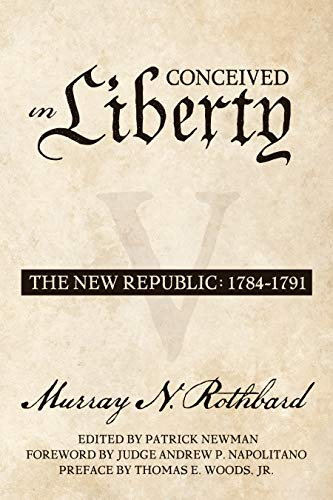
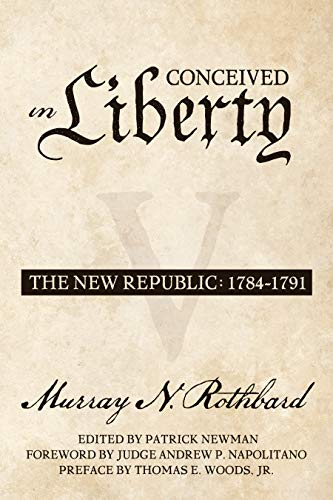
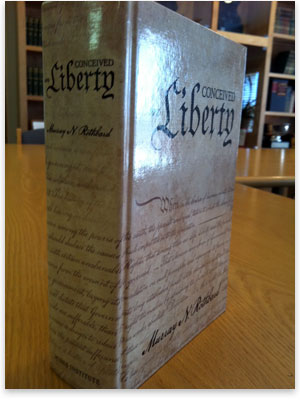
**** Murray N. Rothbard, Conceived in Liberty. Vol. 5, The New Republic, 1784-1791, ed., Patrick Newman.  Auburn, AL.: Mises Institute, 2019, p. 306.

*****Ibid.

Antonius Aquinas@AntoniusAquinas

https://antoniusaquinas.com


The Constitution IS the Crisis

410jXD-zO+L
A Review of Murray N. Rothbard’s Conceived in Liberty, Vol. 5The posthumous release of Murray Rothbard’s fifth volume of his early American history series, Conceived in Liberty, is a cause of celebration not only for those interested in the country’s constitutional period, but also for the present day as the nation is faced with acute social, economic, and political crises.  The fifth volume, The New Republic: 1784-1791, stands with Boston T. Party’s 1997 release, Hologram of Liberty, as a grand rebuttal of the cherished notion held by most contemporary scholars, pundits on the Right, and, surprisingly, many libertarians who believe that the US Constitution is some great bulwark in defense of individual liberty and a promoter of economic success.

ConceivedInLiberty4in1 Volumes 1-4

Rothbard’s narrative highlights the crucial years after the American Revolution focusing on the events and personalities that led to the calling for, drafting, and eventual promulgation of the Constitution in 1789.  Not only does he describe the key factors that led to the creation of the American nation-state, but he gives an insightful account of the machinations which took place in Philadelphia and a trenchant analysis of the document itself which has become, in the eyes of most conservatives, on a par with Holy Writ.

What Might Have Been

While Rothbard writes in a lively and engaging manner, the eventual outcome and triumph of the nationalist forces leaves the reader with a certain sadness.  Despite the fears expressed by the Antifederalists that the new government was too powerful and would lead to tyranny, through coercion, threats, lies, bribery, and arm twisting by the politically astute Federalists, the Constitution came into being.  Yet, what if it had been the other way around and the forces against it had prevailed?

It is safe to assume that America would have been a far more prosperous and less war-like place.  The common held notion that the Constitution was needed to keep peace among the contending states is countered by Rothbard, who points out a number of instances where states settled their differences, most notably Maryland and Virginia as they came to an agreement on the navigation of the Chesapeake Bay.  [129-30]

Without a powerful central state to extract resources and manpower, overseas intervention by the country would have been difficult to undertake.  Thus, the US’s disastrous participation in the two world wars would have been avoided.  Furthermore, it would have been extremely unlikely for a Confederation Congress to impose an income tax as the federal government successfully did through a constitutional amendment in 1913.

Nor would the horrific misnamed “Civil War” ever take place with its immense loss of life and the destruction of the once flourishing Southern civilization.  The triumph of the Federal government ended forever “states rights” in the US and, no doubt, inspired centralizing tendencies throughout the world, most notably in Germany which became unified under Prussian domination.

In a failed attempt in 1786 to enact an impost tax under the Confederation, Abraham Yates, a New York lawyer and prominent Antifederalist, spoke of decentralization as the key to liberty as Rothbard aptly summarizes:

Yates also warned that true republicanism can only be preserved in small states, and

keenly pointed out that in the successful Republics of Switzerland and the

Netherlands the local provinces retained full control over their finances.  A taxing

power in Congress would demolish state sovereignty and reduce the states, where

the people could keep watch on their representatives, to mere adjuncts of

congressional power, and liberty would be gone.  [64]

Antifederalists, such as Yates, had a far greater understanding of how liberty and individual rights would be protected than their statist opponents such as Alexander Hamilton and James Madison.  The Antifederalists looked to Europe as a model, which, for most of its history, was made up of decentralized political configurations.  The Federalists, on the other hand, got much of their inspiration from the Roman Republic and later Empire.  There is little question that an America, with the political attributes of a multi-state Europe, would be far less menacing to both its own inhabitants and to the rest of the world than what it has become under the current Federal Leviathan if the Constitution never passed.

Speculation aside, historical reality meant that America would be fundamentally different than it would have been had the Articles of Confederation survived, as Rothbard points out:

The enactment of the Constitution in 1788 drastically changed the course of

American history from its natural decentralized and libertarian direction to an

omnipresent leviathan that fulfilled all of the Antifederalists’ fears.  [312]

Limited Government Myth

One of the great myths surrounding the American Constitution – which continues within conservative circles to this very day – is that the document limits government power.  After reading Rothbard, such a notion can only be considered a fairy tale!

The supposed “defects” of the Articles of Confederation were adroitly used by the wily nationalists as a cover to hide their real motives.  Simply put – the Articles had to be scrapped and a new national government, far more powerful than what had existed under the Articles, had to be created as Rothbard asserts: “The nationalists who went into the convention agreed on certain broad objectives, crucial for a new government, all designed to remodel the United States into a country with the British political structure.”  [145]

In passing the Constitution, the nationalist forces gained almost all they had set out to accomplish – a powerful central state and with it a strong chief executive office, and the destruction of the states as sovereign entities.  The supposed “checks and balances,” so much beloved by Constitution enthusiasts, has proven worthless in checking the central state’s largesse.  Checks and balances exist within the central government and is not offset by any prevailing power, be it the states or citizenry.

There was no reform of the system as it stood, but a new state was erected on the decentralized foundation of the Confederation.  Why the idea of the founding fathers as some limited government proponents is a mystery.

The Chief Executive

As it developed, the Presidency has become the most powerful and, thus, the most dangerous office in the world.  While its occupants certainly took advantage of situations and created crises themselves over the years, the Presidency, especially in foreign policy, is largely immune from any real oversight either from the legislature or judiciary.  This was not by happenstance.  From the start, the nationalists envisioned a powerful executive branch, and though the most extreme among the group were eventually thwarted in their desire to recreate a British-style monarchy in America, the final draft of the Constitution granted considerable power to the presidential office.

As they did throughout the Constitutional proceedings, the nationalists cleverly altered the concept of what an executive office in a republic should be, by subtle changes in the wording of the document as Rothbard incisively explains:

[T]he nationalists proceeded to alter . . .  and exult the executive in a highly

important textual change.  Whenever the draft had stated that the president ‘may

recommend’ measures to the Congress, the convention changed ‘may’ to ‘shall,’

which provided a ready conduit to the president for wielding effective law-making

powers, while the legislature was essentially reduced to a ratification agency of laws

proposed by the president.  [190-91]

As if this was not bad enough the office was given the ability to create departments within its own domain.

In another fateful change, the president was given the power to create a

bureaucracy within the executive by filling all offices not otherwise provided for in

the Constitution, in addition to those later created by laws.  [191]

The totalitarian federal agencies that plague the daily lives of Americans were not some later innovation by the Progressive movement or New Dealers, but had been provided for within the document itself.  The efforts of those opposed to the various social welfare schemes of the past, which have been put into effect through the various Cabinet departments, have been in vain since the power was given to the Presidency and has been taken advantage of by nearly all of its occupants.

Rothbard’s analysis of the chief executive office is especially pertinent since the nation is once again in the midst of another seemingly endless presidential election cycle.  The reason that the office has attracted so many of the worst sort (which is being kind) is because of its power.  If elected, the ability to control, regulate, impoverish, and kill not only one’s fellow citizen, but peoples across the globe is an immense attraction for sociopaths!

A Coup d’état and Counter Revolution

Rothbard makes the compelling case that the Constitution was a counter revolution, which was a betrayal of the ideology that brought about the Revolution:

The Americans were struggling not primarily for independence but for political-

economic liberty against the mercantilism of the British Empire.  The struggle was

waged against taxes, prohibitions, and regulations – a whole failure of repression

that the Americans, upheld by an ideology of liberty, had fought and torn

asunder. . . .   [T]he American Revolution was in essence not so much against Britain

as against British Big Government – and specially against an all-powerful central

government and a supreme executive.  [307]

He continues:

[T]he American Revolution was liberal, democratic, and quasi-anarchistic; for

decentralization, free markets, and individual liberty; for natural rights of

life, liberty, and property; against monarchy, mercantilism, and especially

against strong central government.  [307-08]

There was, however, always a “conservative” element within the revolutionary leadership that admired Great Britain and wanted to replicate it in America.  It was only when there was no alternative to British political and economic oppression that they joined with their more liberal-libertarian brethren and decided for independence.

Conservatives did not go away after independence, but would continue to push for an expansion of government under the Articles and finally, after most of their designs were consistently thwarted, did they scheme to impose a powerful central state upon the unsuspecting country.

Yet, they would not have triumphed had a number of key liberal-libertarians of the revolutionary generation moved to the Right during the decade following independence.  Rothbard shows why he is the master in power-elite historical analysis in his discussion of this tragic shift, which would spell the death knell to any future politically decentralized America:

[O]ne of the . . .  reasons for the defeat of the Antifederalists, though they

commanded a majority of the public, was the decimation that had taken place in

radical and liberal leadership during the 1780s.  A whole galaxy of ex-radicals, ex-

decentralists, and ex-libertarians, found in their old age that they could comfortably

live in the new Establishment.  The list of such defections is impressive, including

John Adams, Sam Adams, John Hancock, Benjamin Rush, Thomas Paine, Alexander

McDougall, Isaac Sears, and Christopher Gadsden.  [308-09]

As the country’s elite became more statist and as political (Shays Rebellion) and  economic (a depression) factors played into their hands, conservatives seized the opportunity to erect on America a powerful national government:

It was a bloodless coup d’état against an unresisting Confederation Congress. . . .

The drive was managed by a corps of brilliant members and representatives

of the financial and landed oligarchy.  These wealthy merchants and large

landowners were joined by the urban artisans of the large cities in their

drive to create a strong overriding central government – a supreme government

with its own absolute power to tax, regulate commerce, and raise armies.  [306]

Conclusion

The Mises Institute and the editor of the book, Patrick Neumann, must be given immense credit for bringing this important piece of scholarship into print.  Once read, any notion of the “founding fathers” as disinterested statesmen who sublimated their own interests and that of their constituents to that of their country will be disavowed.  Moreover, The New Republic:1784-1791 is the most important in the series since the grave crises that the nation now faces can be traced to those fateful days in Philadelphia when a powerful central state was created.

Volume Five shows that the problems of America’s past and the ones it now faces are due to the Constitution.  The remedy to the present societal ills is not electing the “right” congressman, or president, but to “devolve” politically into a multitude of states and jurisdictions.  For the future of liberty and economic well-being, this is where efforts should be placed and Murray Rothbard’s final volume of Conceived in Liberty is essential reading if that long, arduous, but much necessary task is to be undertaken.

Antonius Aquinas@AntoniusAquinas

https://antoniusaquinas.com

posted 02-10-’20


The Constitution Myth

One reason for the failure of the modern conservative and libertarian movements to scale back, in even a miniscule way, the now gargantuan US welfare/warfare state has been the misinterpretation of the US Constitution.  Many conservatives have a slavish devotion to the document, placing it on a par with the Ten Commandments and New Testament.

A typical misunderstanding of the Constitution’s history and content appeared in this recent op-ed:


The Constitution was intended to limit 1) the power


of government over the citizenry 2) the power of each branch of


government and 3) the power of political/financial elites over the


government and the citizenry, as the Founders recognized the intrinsic risks


of an all-powerful state, an all-powerful state dominated by one branch of


government and the risks of a financial elite corrupting the state to serve


the interests above those of the citizenry.*

The author, like so many “Constitution enthusiasts” has also been hostile to the Medieval era, denigrating its institutions and social constructs – feudalism, aristocracy, crusading – when, in fact, the Middle Ages, in many respects, were far freer with less government than the present epoch. **

When the founding fathers decided to meet in Philadelphia in 1787, they did so at first to “amend” the Articles of Confederation which had guided the young country through some perilous times.  While the Articles had some defects (some libertarians even contend that they were too statist***), the delegates, at first, did not want it scrapped, however, it was the “leading lights” of the convention which connived to completely do away with it.

By superior political maneuvering, the pro-Constitution forces were able to ramrod their plan through despite being in the minority.  Not only were the majority of the delegates initially against scrapping the Articles, but most Americans were opposed to the creation of a new central government. 

Despite this, the Constitution was ruthlessly pushed through and, as its opponents feared, America would be saddled with a highly centralized national government, the loss of considerable state sovereignty, and the eventual erosion of individual liberties even with the inclusion of a Bill of Rights.

A brief examination of the document reveals that its implicit and explicit language grants wide latitude for the expansion of state power.  In its Preamble, the ambiguous clause to “promote the general welfare” can and has led to all sorts of destructive social engineering schemes.  More ominously, for anyone that is under the illusion that America is governed by a “federal” system, they should reread Article VI which in part says

This Constitution, and the Laws of the United his Constitution, and the Laws of the United States which shall be made in Pursuance thereof; and all Treaties made, or which shall be made, under the Authority of the United States, shall be the supreme Law of the Land. [emphasis added]

An all-powerful central state went against much of Western history after the fall of the Roman Empire and the idea was always feared by philosophers.  Basic political theory and practical experience showed that a multitude of sovereign states were preferable not only for the protection of personal liberty, but for economic growth.  Numerous states and jurisdictions were a far greater check on government than the much celebrated “separation of powers” concept of constitutional government.

Under the Articles of Confederation, each individual state was autonomous while the national government had to rely on the states for most of its support.  Unfortunately, it will never be known what would have happened if the country remained as a confederacy of states, it is likely however, that there would have been less bloodshed, greater economic growth, and more personal freedom under a decentralized regime.

It is curious, therefore, why so many on the Right continue to revere the Constitution as some great bulwark against state power.  Much of it probably stems from ignorance or personal bias against the political conditions which existed prior to the late 18th century. 

Much of European history was under the sway of monarchial and aristocratic rule and the integral presence of the Catholic Church in society with a diffusion of power among kings, princes, dukes and Churchmen.  While far from perfect, the social order which existed under Christendom may not have been as materially or technologically advanced as contemporary times, but in regard to morality, justice, and individual freedom, there is no comparison.  The Christian age saw nothing of the social depravity, war making with its mass murder, the trampling of individual rights, and the existence of totalitarian government as witnessed in the supposedly “enlightened” modern age.

Decentralized Europe of 1300

Until it is realized that the Constitution is an impediment to rolling back the American Leviathan, there will be little progress in the fight for individual liberty and economic progress.


*Charles Hugh Smith, “Let’s Face It: The U.S. Constitution Has Failed.”  Zero Hedge.  20 February 2019. 

**One example, Charles Hugh Smith, “America’s ‘Neo-Feudal’ System is ‘Both False & Precarious.”  Zero Hedge 19 December 2018.

***David Gordon, ed., Strictly Confidential: The Private Volker Fund Memos of Murray N. Rothbard, Auburn, AL.: The Ludwig von Mises Institute, 2015, pp. 96-98.

Antonius Aquinas@antoniusaquinas

https://antoniusaquinas.com

[emphasis added]

The Gold Standard: Protector of Individual Liberty and Economic Prosperity

goldstandard vs.    the-bill-of-rights


The idea of a constitution and/or written legislation to secure individual rights so beloved by conservatives and among many libertarians has proven to be a myth. The US Constitution and all those that have been written and ratified in its wake throughout the world have done little to protect individual liberties or keep a check on State largesse.  Instead, in the American case, the Constitution created a powerful central government which eliminated much of the sovereignty and independence that the individual states possessed under the Articles of Confederation.

While the US Constitution contains a “Bill of Rights,” the interpreter of those rights and protections thereof is the very entity which has enumerated them.  It is only natural that decisions on whether, or if such rights have been violated will be in favor of the state.  Moreover, nearly every amendment which has come in the wake of the Bill of Rights, has augmented federal power at the expense of the individual states and that of property owners.

History has shown the steady erosion of individual rights and the creation of “new rights” and entitlements (education, health care, employment, etc.) which have occurred under constitutional rule.  Instead of limitation on government power, constitutions have given cover for the vast expansion of taxation, regulation, debt, and money creation.

While taxation has always been a facet of constitutional governments, it has been the advent of central banking and with it the elimination of the gold standard which has provided the means for the state to become such an omnipresent force in everyday life.  Irredeemable fiat paper money issued by central banks has also led to the entrenchment of political parties which has allowed these elites to create and subsidize dependency groups which, in turn, repeatedly vote to keep the political class in office.

Without the ability to create money and credit, the many bureaucracies, regulations, and laws could neither be created or enforced.  This would mean that the vast and powerful security and surveillance agencies could not exist or would be far less intrusive than they currently are.  With commodity money, debt creation would have to be repaid in gold, not monetized as it is currently done through the issuance of paper currency.

Just as important, it would have been next to impossible for the two world wars to have been fought and carried to their unimaginable destructive ends.  None of the populations involved would have put up with the level of taxation necessary to wage such costly undertakings.  Few of the wars which followed (most of which have been instigated by the US) could have taken place without central banking.  Nor could the level of “defense” spending – currently at a whopping $717 billion for fiscal year 2018 – be financed if the US was on a commodity standard.*

Under a gold standard, governments would have to rely on taxation alone.  Since citizens directly feel the effects of taxation, there is a “natural level” that it can be raised.  Punitive tax rates usually lead to a backlash and potential social insurrection which strike fear in the hearts of political elites.

Recent projections by the Congressional Budget Office again demonstrate that constitutional government provides little restraint on spending.

If present trends continue, the federal government will spend more on its interest serving its debt than it spends on the military, Medicare, or children’s programs.  It is also expected that next year’s interest on the debt will be some $390 billion, up an astonishing 50 percent from 2017.** And, for the entire fiscal year of 2018, the gross national debt surged by $1.271 trillion, to a mind-boggling $21.52 trillion.***

At one time, economists used to speak of the pernicious effects that “crowding out” had on an economy.  Since the onset of the “bubble era,” talk about deficits has almost dropped out of financial discussions.  Yet, the reality remains the same: public spending and borrowing divert scarce resources away from private capital markets to unproductive wasteful government projects and endeavors.

For those who seek a reduction in State power, defense of individual rights, and economic prosperity, the re-establishment of a monetary order based on the precious metals is the most efficacious path to take.  Such a social system would not require elaborate legislation or fancy proclamations of man’s inalienable rights, but simply a return to honest money – gold!

*Amanda Macias, “Trump Gives $717 Billion Defense Bill a Green Light. Here’s What the Pentagon is Poised to Get.”  CNBC.com 14 August 2018. https://www.cnbc.com/2018/08/13/trump-signs-717-billion-defense-bill.html

**Nelson D. Schwartz, “As Debt Rises, the Government Will Soon Spend More on Interest Than on the Military.”  The New York Times. 25 September 2018 https://www.nytimes.com/2018/09/25/business/economy/us-government-debt-interest.html

***Tyler Durden, “US Gross National Debt Soars $1.27 Trillion in Fiscal 2018, Hits $21.5 Trillion.” Zero Hedge.  2 October 2018.   https://www.zerohedge.com/news/2018-10-02/us-gross-national-debt-soars-127-trillion-fiscal-2018-hits-215-trillion

Antonius Aquinas@AntoniusAquinas

https://antoniusaquinas.com

A Constitutional Anniversary to Forget

constitutionstupid

While not a jubilee year, last week marked the 230th anniversary of the US Constitution.  Naturally, most of its devotees enthusiastically praised the document which by now is seen on a par with Holy Writ itself.  An editorial from Investor’s Business Daily provides an example of such hagiography:

The Constitution’s beauty is that it not only delineates our rights

as Americans, but expressly limits and defines government’s ability

to interfere in our private lives.   This equipoise between citizens’

duties, responsibilities and rights makes it the defining document

or our nation’s glorious freedom.


But America is wonderful largely because of the Constitution and

those who framed it . . . .


What we have is too precious to squander . . . .*

Most of the piece laments about the widespread ignorance of its sacred contents among the denizens in which it rules over and encourages the unlearned “to bone up a bit on your constitutional heritage . . . .”  The editorial fails, as do most others on the Right, to understand that it is not a lack of knowledge of the Constitution’s contents among the populace which lies at the heart of America’s social, economic, and political problems, but the very document itself.

One of the main reasons why the Constitution continues to be so widely venerated is due to the deliberate distortion of history that its “founders” promoted and that generations of its sycophants have continued to perpetuate to this very day.  The official narrative runs that the Constitution was enacted because of widespread popular support for a change to the supposed inadequacies and deficiencies of the Articles of Confederation.

This is a myth.  Instead, the Constitution was a coup deliberately schemed by the leading political and mercantile classes to set up a powerful central government where ultimate authority rested in the national state.  The use of the term “federal” to describe what was created in Philadelphia in those fateful days was a ruse much like the banksters and politicos used “Federal Reserve” to describe the central bank created in 1913.  It was neither “federal” – a decentralized monetary order – nor a “reserve” of gold, but a monetary institution which could create money out of thin air and eventually eliminate the gold standard.

It was a similar political maneuver 230 years ago as a new American national state was established and touted as a decentralized form of government where power was evenly divided between state and national levels and between the different branches of the government itself  – “separation of powers.”  In actuality, however, the “federal system” was the elevation of central power at the expense of local authority which had previously existed.  Section VI of the Constitution says it all:

The Constitution and the laws of the United States  . . .

shall be the supreme law of the land; and the

judges in every state shall be bound thereby, anything in the

Constitution or laws of any state to the contrary notwithstanding.

Elementary political science has shown and plain common sense knows that any person or institution given “supreme authority” will misuse and abuse such power.  Power tends to corrupt and absolute power corrupts absolutely is an undeniable dictum of human nature.  A truly decentralized system of governance would not contain a plank as “supreme law of the land” as part of its foundation.  Instead, real federalism would be dispersed, as it existed in the past in such political arrangements as confederacies, leagues, and, certainly, under the much maligned feudal social order.

Even the Constitution’s celebrated Bill of Rights is flawed and has proven to be ineffective in protecting basic human freedoms.  It is the federal government which enumerates and interprets what freedom individuals should possess.  Thus, the meaning and extent of individual liberties will be in the hands of federal jurists and courts who will invariably rule on cases in favor of the state.  The ensnaring of individual rights within the central government’s authority did away with the venerable common law which was a far greater defender of liberty than federal courts.

Just as important, the enactment of the Constitution, which brought all the individual states under it suzerainty, did away with one of the most significant checks on state power – “voting with one’s feet.”  When there are multiple governing authorities, if one jurisdiction becomes too oppressive, its subjects can move to freer domains.  This still happens on a local level as high tax and regulatory states such as California and New York have lost demographically to freer places like Nevada and Texas.  Yet, from the Federal Leviathan there is no escape, except expatriation.

Unless and until Americans and all the other peoples of the Western world who live under constitutional rule recognize that it is the type of government which is the cause of most of the political turmoil, social unrest, and economic malaise  which they face, there is no hope of turning things around.

*”Sturdy Constitution, ” Investor’s Business Daily, Week of September 18, 2017, A20.

Antonius Aquinas@AntoniusAquinas

https://antoniusaquinas.com