Category Archives: American Empire

Dick Cheney and the American System of War

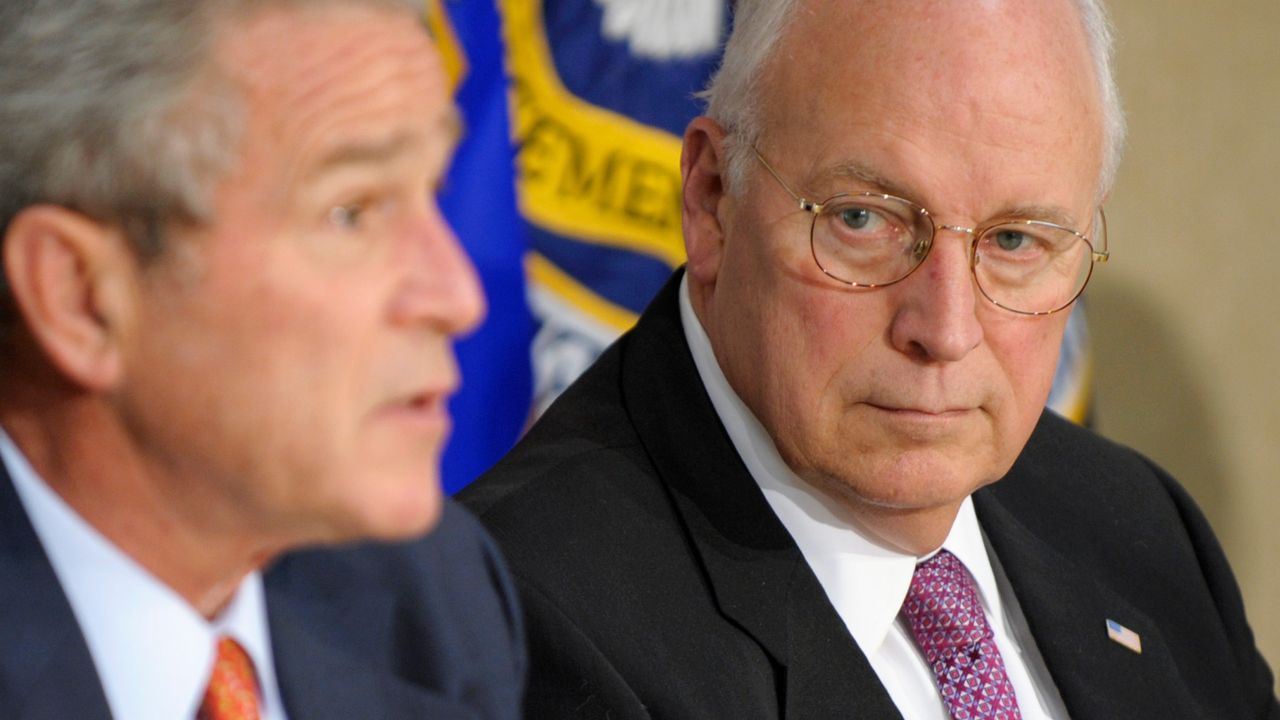
Former Vice President Richard “Dick” Cheney died on November 3, 2025 at the age of 84.  As secretary of Defense under President George H.W. Bush, Cheney was the architect of the 1991 Persian Gulf War and later, as vice president under George W. Bush, he was instrumental in the invasion and eventual conquest of Iraq.

Brown University’s Cost of War Project has modestly estimated that the “wars on terror” have resulted in the deaths of more than 940,000 people including 432,000 civilians and a monetary cost to the United States of about $8 trillion. 

Of course, Brown University’s study calls the post 9/11 U.S. military operations in the Middle East “wars on terror” when, in reality, they have been fought for the benefit of Israel and its Greater Israel Project, which has decimated the Arab world and has accomplished almost all of its objectives.

Cheney’s nefarious activities were not confined to mass murdering peoples that posed no threat to America’s national security.  He was a force behind the U.S. policy of torture (waterboarding), and nearly unlimited domestic surveillance (the Orwellian-labeled Patriot Act).

According to an article on the news and commentary website “Antiwar,” headlined “Dick Cheney: The Dark Legacy of a War Criminal,” Cheney suggested U.S. intelligence agencies must: [O]perate on the ‘dark side,’ spend time in the shadows, and use ‘any means at our disposal’ to achieve its objectives.” 

As if the U.S. Presidency was not unrestrained enough, Cheney advocated a “unitary executive” theory that the “president alone decides matters within the executive branch” without input from opposition voices within the government’s foreign policy agencies. 

The response by libertarian and alternative media outlets to Cheney’s demise were universal in their denunciation of the former vice president, calling him a “war criminal” and that he left this world with a “dark legacy.” 

It should be noted that a number of alternative media’s podcasters who have criticized Cheney regularly host guests and speakers who are former U.S. military and diplomatic personnel, ex-CIA agents and intelligence operatives, a number of whom participated in the Iraq wars and other American covert operations themselves.

Few, if any, who condemned the former vice president for his criminality mentioned or questioned why it was, and still is today, that monsters like Cheney were able to inflict so much death and destruction on peoples and nations across the globe who posed no threat to America. 

Could it be that the political system that Cheney operated under was the problem?  And, what is to be done to prevent future Cheneys from committing similar atrocities?

Unfortunately, “democratic” wars are paid for “by the people” and the costs are socialized among the population through taxation, inflation (money printing), and deficit financing.  Since warmongering politicians do not have to directly pay for conflicts, there will be a tendency for them to be more bellicose.  Moreover, democratic wars are collective enterprises where elected officials are not personally responsible for the actions of the government but are agents of the voters.   

Nor have the supposed checks and balances of constitutional government, so often touted by admirers of the U.S. Constitution, been able to prevent conflicts, as the horrific record of American warmaking sadly proves.

The passage of the U.S. Constitution established a powerful central state which could (and did) tap the resources and men of the individual states to conduct wars which eventually took place the world over. 

A weak national government, like that under the Articles of Confederation, or no central state at all, but instead a political order of numerous sovereigns (a world full of Switzerlands, Liechtensteins, etc.) would make warfare on a massive scale impossible.

Chip Gibbons, writing in the Jacobin magazine, called Cheney an “enemy of democracy whose agenda included war, indefinite detention, warrantless surveillance, and torture,” according to Alan Mosley. *

Cheney was not an enemy of democracy, but the product of a system that enables evil men to carry out the most heinous acts with little consequence, at least in this life. 

Labeling Dick Cheney a war criminal will tarnish his legacy, but it will not alter America’s murderous foreign policy course.  That will only come about when there is a recognition that the governing system itself needs to be abandoned and a decentralized political arrangement adopted.    

*Alan Mosely, “Dick Cheney (1941-2025): The Dark Legacy of a War Criminal,” Antiwar.com, 5 November 2025.  https://original.antiwar.com/Alan_Mosley/2025/11/04/dick-cheney-1941-2025-the-dark-legacy-of-a-war-criminal/

Antonius Aquinas@antoniusaquinas

https://antoniusaquinas.com

Venezuela Next on Trump Hit List for Regime-Change Operation

While it appears that the United States has finally realized that it has little leverage over Russia in the Ukraine war either to halt hostilities or alter battlefield conditions, it has, for now, begun to disengage from the contest despite the desperate pleas from Ukraine and its European backers.  President Donald Trump has said that he will no longer provide the besieged Eastern European country with aid, but will sell weapons to NATO nations who will then give them to the Volodymyr Zelensky regime.

As an aside, that there has been little criticism of Trump’s arms sales, which will be used for mass slaughter, the destruction of private property, and the enrichment of the military industrial complex, is a sad commentary on the ethical standing of the Western world.  At one time, there was an adherence to the concept of a “just war” and the protection of the lives of non-combatants and their property. These topics have, however, long since perished into the Orwellian memory hole.

Trump’s decision to abandon his demand for a ceasefire and begin shifting the burden for the war to Europe was, no doubt, influenced by the MAGA supporters who were pushing him to fulfill his campaign promise of ending the war or, at least, America’s involvement in it.  While some analysts have called the Alaska summit only a “tactical retreat” for the U.S. Empire, it was enough of a gesture to assuage MAGA that the president was going to at last put America first in foreign policy.

These hopes, however, have been dashed with Trump’s recent actions toward Latin America. 

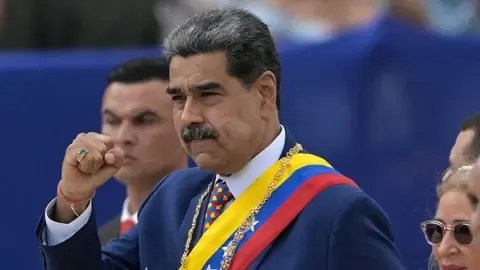
Earlier this month, Trump reignited hostilities with Venezuela and its president, Nicolas Maduro.  It must not be forgotten that, in his first term, Trump supported efforts to overthrow Maduro in a failed coup led by then Venezuela National Assembly president Juan Guaido.  

Attorney General Pam Bondi announced that the U.S. would double the reward (now $50 million) for information that would lead to the arrest of Maduro, who the Trump administration has accused of being “one of the largest narco-traffickers in the world.”

Venezuelan Foreign Minister Yvan Gil dismissed Bondi charge, calling it “pathetic” and a “desperate distraction” from her handling of the Jeffrey Epstein case and Trump’s refusal to release the files pertaining to his former close friend’s heinous crimes according to the BBC.*

On Aug. 19, the United States escalated matters further by deploying three Navy destroyers, accompanied by 4,000 troops, off the Venezuelan coast.  Not only was the move aimed at combatting Maduro’s supposed drug ties – denied by him and Mexican President Claudia Sheinbaum – but the action appears to be another attempt at regime change. According to the Trump administration, it does not consider Maduro a legitimate president. This opinion was seconded by White House Press Secretary Karolin Leavitt:

The Maduro regime is not the legitimate government of

                                Venezuela. It is a narco-terror cartel, and Maduro, it is the

                                view of this administration, is not a legitimate president.

                                He is a fugitive head of this cartel, he has been indicted in

                                the United States for trafficking drugs into the country. **

That’s funny. When Russian President Vladimir Putin makes similar claims about the legitimacy of the Zelensky regime in Ukraine, they are dismissed by the United States and its European partners even though Zelensky has suspended democratic elections and locked up regime critics. 

If Trump believes his bellicose actions in the Caribbean, which also includes talk of attacking Mexican drug cartels, will stop the flow of illicit drugs to the United States, he is delusional.  The war on drugs in the 1980s, Lyndon Johnson’s war on poverty, the war on alcohol in the 1920s (Prohibition), and all of America’s overseas wars have made the problems they intended to solve that much worse.  The only constant from these follies has been the expansion of state power.

Drug addiction and alcohol abuse are vices that should be handled by families, churches, organizations, and,when necessary, professional medical personnel.  The government cannot fix such problems nor is it constituted to do so.  Even if Trump were to reduce the flow of narcotics, it may simply drive domestic illicit drug prices up, which will entice more sinister criminal elements into the trade.

Despite Trump’s campaign rhetoric, he is once again meddling in the affairs of another sovereign nation with threats of armed intervention if there is not regime change.  While Venezuela has taken no military action against the United States.S. nor is it likely that a conflict between the two could lead to a nuclear conflagration like in Eastern Europe, Trump’s actions demonstrate that he has no intention of pursuing an America-first foreign policy.

Unfortunately for Venezuela – and whoever is next on Trump’s list for aggression – until America cannot financially afford to police the world, the United States it will continue its hegemonic path.   

*Sean Seddon, “US Offers $50m reward for arrest of Venezuelan leader Nicolas Maduro,” BBC, 7 August 2025,  https://www.bbc.com/news/articles/cwy1wn1x521o

** Dave DeCamp, “Trump Administration Deploys Three US Navy Destroyers and 4,000 Troops Near Venezuela,” Antiwar.com, 19 August 2025.   https://news.antiwar.com/2025/08/19/trump-administration-deploys-three-us-navy-destroyers-and-4000-troops-near-venezuela/

Antonius Aquinas@antoniusaquinas

https://antoniusaquinas.com

Trump’s Grandiose Political Centralization Scheme Not America-First in Spirit

Colorful houses of the coastal town of Ilulissat in western Greenland.

Although Donald Trump is now in office, his statements since the election indicated he has forgotten his pledge to follow an “America first” foreign policy. This is what he promised during the recent presidential contest and what he pledged in the 2016 campaign, but failed to deliver during his first term.  While domestic issues are what a president is mostly concerned with, the most important decisions surround foreign affairs, since they often involve war.

Since his lopsided victory over the hapless Kamala Harris, Trump has made few references about reigning in the murderous U.S. Empire, but instead has talked about buying or invading Greenland, seizing the Panama Canal, and making Canada an American state.  After the resignation of Prime Minister Justin Trudeau, Trump said that “many people in Canada love being the 51st state,” according to The New York Times, Jan. 7.*

If Joe Biden or Kamala Harris said such things, the MAGA crowd would be up in arms and accuse them of moving the country in the direction of the New World Order.

Whether Trump follows through with such fanciful plans, it shows that he does not understand what lies at the heart of the social and economic problems that America and the Western world face.  Trump’s ideas would create greater political centralization, as an American-Canadian or American-Canadian-Mexican-Greenland union would create a gigantic North American state.

For anyone concerned with individual liberty, prosperity, and the No. 1 social issue that confronts the U.S. – illegal immigration – a North American superstate would be a nightmare. Gone would be the vital ability of “dissenters” to “vote with their feet” and move to less burdensome political jurisdictions.

In the United States, one can see this taking place on a daily basis as Americans move from high-tax and high regulatory states to those less onerous.  Of course, citizens cannot escape the federal government’s dictates unless one decides to expatriate. Students of the nation’s history know the often-overlooked Anti-federalists made this argument in their opposition to the Constitution which has, over time, proven to be quite prescient.

The idea that more political entities lead to greater freedom has been proven by history.  The best example of this is pre-modern Europe which was made up of a host of kingdoms, duchies, and free states with no dominant central government that could tax without impunity.  It is well accepted by historians that Europe’s rise in its standard of living was the result of its political decentralization that resulted in low levels of taxation.

A multitude of nation states allows for “competition,” where if one government becomes too tyrannical, people have an opportunity to flee to another land.  In recent U.S. history, a number of draft-aged men fled to Canada instead of being sent off to Vietnam to fight in what they considered an immoral war.  A colossal North American state would have ended such an option.

Although not explicitly discussed by Trump, a North American Union would more than likely mean the creation of a new monetary unit as was done with the euro when the European Union was formed.  Despite the warnings of some economists, price inflation in Europe escalated for countries like Germany once they relinquished their monetary autonomy. 

Currently, national currencies “float” against one another in terms of exchange rates. If one central bank inflates its currency too much, its money will lose purchasing power to less inflationary nations.  While not nearly as good as a gold standard, there is a sort of a “check and balance” on central bank monetary debasement with floating exchange rates.

A single North American monetary unit would not face the kind of limit that now exists, where the Canadian dollar, Mexican peso and U.S. dollar vie against each other.  A North American currency would be another ominous step to a one-world currency – a dream of New World Order proponents. 

While Trump’s disappointing talk about political centralization looks like a betrayal of the principles of America first principles, there may be a glimmer of hope.  In a recent Truth Social post, Trump reposted a video of Prof. Jeffery Sachs, a longtime critic of American foreign policy, criticizing Israeli Prime Minister Benjamin Netanyahu’s genocidal actions in Gaza and throughout the Middle East calling him a “deep, dark SOB.”

Since the video has been posted, Netanyahu has canceled his plans to attend Trump’s inauguration, the implication being the Israeli leader was offended by the comment.

Only time will tell if Trump will abandon his promised America-first policies or pursue a drive to a New World Order.

*David E. Sanger and Michael D. Shear, “Trump Floats Using Force to Take Greenland and the Panama Canal,”  The New York Times, 7 January 2025. 

Antonius Aquinas@antoniusaquinas

https://antoniusaquinas.com

Economic Collapse May Be the Only Way to Prevent World War III

The tensions between the West and Russia over the Ukraine have escalated over the past few months with an almost daily occurrence of provocations and belligerent talk mostly from members of NATO.  In response, Russia sent a naval contingent to the Caribbean in a show of force.  Some of the Western provocations include:

  • Polish President Andrzej Duda’s willingness to place U.S. nuclear weapons on Polish soil;
  • German Defense Minister Boris Pistorius’ s call for reinstitution of a draft;
  • A hand-delivered check by Biden to Volodymyr Zelensky as part of the $95 billion U.S. “defense” package for Ukraine
  • A request by Zelensky for Westerners to train troops on Ukrainian soil; and
  • US and NATO okaying Ukraine to fire long-range American weapons as much as 12 miles into Russian territory

It is apparent that, until Russian President Vladimir Putin capitulates to Western demands in regard to Ukraine, NATO will continue to push the envelop.  In hindsight, analysts such as Paul Craig Roberts have, from the start, urged Putin to swiftly finish off Ukraine militarily and replace the Zelensky regime with one favorable to Russia.  A protracted struggle, Roberts warned, would give the West more time to supplement Ukraine: “The conflict dragged on, because having declared the intervention limited, the Kremlin left Kiev to continue the war, thus playing into Western hands as the West gradually widened the war.” *

Unfortunately for Russia, Paul Craig Roberts’s prognostication is now coming to fruition. 

The counter argument to a more aggressive Russia is that Putin realizes that the West is run by a pack of sociopaths who would have no qualms launching WWIII, which would include the use of nuclear weapons, or ignite a major military conflagration in the area.  The Russian president sees that the West holds a decisive military advantage over Russia even if it allied with China.  The U.S. alone spends more than the combined expenditures of the top nine militaries in the world.

The United States has thus the ability and means to operate and intervene in almost any sector of the world.  It is able to do so because it has had, for the longest time, an economy which was able to not only produce goods for the domestic market and also for its foreign adventures.  It takes wealth to be able to arm, transport, deploy, and maintain men in distant lands.

Because of America’s relatively free economy, it could produce a seemingly endless supply of military hardware for itself, but also to buy off client states and fund proxy wars.  In contrast, the Soviet Union could never export communism in any significant way after World War II because it lacked the means to do so.  Its economy was a basket case that could barely feed its citizens. 

While the U.S. may have the military capability to be the world’s policeman, its actions in the Ukraine are ultimately controlled by ideology.  And, for the longest time, U.S. foreign policy has been one of interventionism and war with the ultimate goal of the establishment of a one-world state.  Its proxy war in Ukraine is designed to cripple Russia, which stands as a roadblock to this long-desired goal.

Since it is apparent that the principles guiding U.S. foreign policy are not going to change anytime soon, the nation will continue on its bellicose course until it no longer has the means to do so.  This would mean a financial crisis, most likely in the form of a dollar collapse, which would ground the economy to a halt. 

In such a scenario, the United States would be following the course that Great Britain took after World War II, when its empire could no longer be sustained since the country insanely exhausted itself in the conduct of fighting two world wars. 

A similar, earlier historical example was the Western Roman empire, which, through currency debasement, heavy taxation and government largesse, ruined its economy and then could no longer maintain its empire.

 The ideology of Great Britain and Rome did not change, however, they simply no longer had the means to sustain and expand their empires.

Despite massive deficits, record-setting inflation, and a recent bank crisis in March, 2023, a financial crisis does not appear to be on the horizon.  Although things can change quickly, for the foreseeable future, the U.S. empire is in no danger from internal collapse.

While an economic collapse would mean misery for millions of Americans, it would be, in a sense, retribution for the nation’s murderous and costly foreign policy, which has brought, and still is bringing, untold death and destruction to millions of people.  

*Paul Craig Roberts, “Normalizing War with Russia,” PaulCraigRoberts.org, 6 June 2016, https://www.paulcraigroberts.org/2024/06/06/normalizing-war-with-russia/

The U.S. Is Spending $1 Trillion Every 100 Days On The Deficit

While it made some headlines in the financial press, neither policy makers nor the two presumptive presidential nominees have paid much attention to the fact that the U.S. is adding a mind-boggling $1 trillion to the national debt every 100 days.  This amounts to around $3.6 trillion annually. 

As law makers remain willfully ignorant of the financial elephant in the room, it is most likely that the only way that the debt will be addressed is through a monetary crisis which will involve the status of the dollar as the world’s reserve currency.  Such a scenario would then force authorities to take action.

As if there needed to be more evidence of how impervious Congress and the Biden Administration are to the burgeoning debt spiral, the House and Senate passed two stop-gap funding packages to avoid a government shut down on March 22, 2024.  One Senator called it “a pork fest of epic proportions.”*

Despite the ominous prognostications of a dollar collapse by financial doomsayers, the Greenback has remained the best of all competing currencies.  Yet, this time could be different, since interest rates – which have been artificially suppressed by the Federal Reserve (Fed) – have risen, making servicing of the national debt more expensive as Moody’s Investors Service noted: “In the context of higher interest rates, without effective fiscal policy measures to reduce government spending or increase revenues Moody’s expects that the US’ fiscal deficits will remain very large, significantly weakening debt affordability.”** 

While “King Dollar” has continued its financial hegemony, the running of a staggering national debt – which now stands at over $34 trillion – has had baneful repercussions for the average American.  The funding of the debt has led to a resurgence in 1970s-style stagflation with a decline in productive job growth such as manufacturing and near double-digit price inflation.  This, of course, has had a deleterious effect on the middle and lower classes’ standards of living since rising prices disproportionately effect these groups harder than the more affluent.

Of course, the simplest approach (although politically unpalatable) to the problem would be to dramatically cut government spending by eliminating agencies and programs.  With the Uniparty in charge, however, there is virtually no chance of budget cuts, especially in an election year.  Whatever happened to the “deficit hawks” and those calling for a balance budget amendment to the Constitution?

The funding of the debt is the primary factor for the rise in consumer and producer prices.  Since federal spending is beyond what the government receives in revenues, it must borrow through the issuance of debt/bonds to make up for the shortfall. 

The principal buyer of government debt has been the Fed, which pays for the bonds by the creation of money, “out of thin air.”  The printing of money (now done through the stroke of a computer key) bids up prices in the market.  Federal Reserve officials have innocuously called this scam “Quantitative Easing” (QE), which is in realty a monetization of the debt. 

Since the Fed has begun hiking interest rates, it has been doing “Quantitative Tightening” (QT) where it ostensibly has not been buying U.S. debt, but selling it.  This would lead to a contraction of the money supply and a fall in prices. The central bank has not been aggressive enough in its tightening nor has it raised interest rates enough to have any real effect on soaring prices. 

It is highly doubtful that the U.S. will escape the fate of other republics who have pursued reckless fiscal and monetary policies.  It is almost a mathematical certainty that the nation will default on its debt by either hyperinflating the currency or discounting bonds with massive haircuts to their premiums. 

The most likely path is hyperinflation; then the dollar will once again fulfill Voltaire’s dictum that all “paper money eventually returns to its intrinsic value – zero.”  While there will be massive social misery from a dollar collapse, the one bright spot from its demise is that it will mean an end of the murderous U.S. Empire.

*Tyler Durden, “’A Pork Fest of Epic Proportions:’ Congress Passes Spending Package to Avert Shutdown.” Zero Hedge 8 March 2024.  https://www.zerohedge.com/markets/pork-fest-epic-proportions-congress-passes-spending-package-avert-shutdown

**Quoted in Michelle Fox, “The U.S. national debt is rising by $1 trillion about every 100 days,” cnbc.com   https://www.cnbc.com/2024/03/01/the-us-national-debt-is-rising-by-1-trillion-about-every-100-days.html   Updated, 4 March 2024.

Antonius Aquinas@AntoniusAquinas

https://antoniusaquinas.com

President Trump’s Role in the Ukraine War

With his usual braggadocio, former President Donald Trump has promised that if returned to the White House he would end the Ukraine conflict within hours and claims, as many of his supporters do, that the war would never have taken place had he been in office.  Like most of his campaign promises during his 2016 presidential run – drain the swamp, pull troops out of Afghanistan, build a wall – very few were accomplished, despite the fact that the former president had a Republican House and Senate at the start of his first term.

Listening to Trump’s often incoherent statements on the Ukrainian imbroglio shows that the ex-chief executive has learned little from his four years in the Oval Office.  While talk of ending wars in a few hours may garner popular support, translating them into actual results is a far different and, to say the least, difficult matter, as Trump should now realize after his fruitless years as president.

Trump had a chance to de-escalate tensions in the Ukraine that had been building especially after the Western-inspired coup of February, 2014 which replaced the democratically-elected government of Viktor Yanukovych.  Yet, the former president did nothing to remedy the situation and, in fact, worsened matters by providing military hardware to the Ukraine, which the Obama Administration had denied.

Demonstrating a lack of understanding of the region’s geo-political realities, Trump decided to provide the Ukraine with military equipment.  In December, 2017 the U.S. shipped, among other weaponry, Javelin anti-tank missile systems, with the first sale completed in March of the following year to the sum of $47 million.  Reportedly, the former president was convinced by his advisors that the military aid would be “good for U.S. business.” 

If one considers the military industrial complex a vibrant part of the U.S. economy and not a parasitical drain that redistributes scarce resources away from the production of useful consumer goods into the creation of destabilizing and murderous weapons of war, then – “yes” – military spending is good for business.  For those, like Trump, who support such an idea are apparently unfamiliar with Brigadier General Smedley D. Butler who rightly called “defense spending” a racket:

I spent 33 years in the Marines, most of my time being a high-class muscle man for big business, for Wall Street and the bankers.  In short, I was a racketeer for Capitalism.*

After the provocative action of supplying the Ukraine with military hardware, the Trump Administration inflamed relations further by pulling out of the Intermediate-Range Nuclear Forces Treaty (INF) which was agreed to by President Ronald Reagan and Soviet leader Mikhail Gorbachev in 1987. The landmark treaty banned missiles with range between 500 and 5,500 km (310-3,400 miles).**

The U.S. accused Russia of non-compliance to the terms of the treaty, a charge that the Russians and many military analysts denied.  This, of course, led to a greater level of distrust between the two nations and went against candidate Trump’s aims of lessening tensions between the two powers.

Trump, as with the pro-war Western media, is ignorant of the historical context that played into Vladimir Putin’s decision to invade the Ukraine.  It is a well-established fact that the U.S. and Western powers gave assurances to Russia as far back as when the Berlin Wall came down that NATO would not expand eastward.  That promise has been repeatedly broken as NATO now includes 31 nations with Sweden set to come on board in 2024.***

Making matters worse, the Biden Administration, the war mongers in Congress, and the U.S.’s NATO lapdogs have escalated matters with tremendous financial and military assistance, which has done little to stop the Russians, but has resulted in the needless slaughter of thousands and the wholesale destruction of Ukrainian territory.  The introduction of cluster bombs into the fray and the promise of F-16 fighter-jets capable of carrying nuclear war heads has heightened the possibility of a general conflagration. 

 None of the declared Republican presidential contenders have critiqued the former president’s reckless Ukrainian policy.  Some of the candidates (Chris Christie, Nikki Haley) have instead insanely called for greater support of the Zelensky regime!    

The American involvement in the Ukrainian War has nothing to do with its national security, but with the interests of the U.S. Empire.  The tragedy of the Trump Presidency is that things were supposed to be different.  Instead of non-intervention, the Administration armed Ukraine, stationed troops in Syria, assassinated an Iranian general on a Middle East peace mission, and committed a host of other head scratching acts which went against candidate Trump’s pledge of an “America First” foreign policy that propelled him to victory in 2016.

To think that things will be different in a second go-around is clearly delusional, as the former president is now campaigning with never-ending war proponent Senator Lindsey Graham.   

*See War is a Racket, Port Townsend, WA.: Feral House, 2003; 1935.

**“INF Nuclear Treaty: US Pulls Out of Cold War-Era Pact With Russia,” BBC, 2 August 2019.   https://www.bbc.com/news/world-us-canada-49198565

***Patrick Wintour, The Guardian, 22 January 2022 ttps://www.theguardian.com/world/2022/jan/12/russias-belief-in-nato-betrayal-and-why-it-matters-today

Antonius Aquinas@AntoniusAquinas

https://antoniusaquinas.com

On the 75th Anniversary of V-E Day and the Coronavirus Scamdemic

VE Day Coronavirus

The iconic Champs-Élysées and its Arc de Triomphe stand eerily empty before V-E Day ceremonies Friday in Paris.

This month (May 8th) marks the 75th anniversary of “V-E Day” when German forces unconditionally surrendered to the “Allies.”  Numerous articles, essays, and monographs have appeared commemorating the anniversary and while all are mostly laudatory, some have acknowledged that the outcome had its “drawbacks.”

By any objective rendering, for Western Civilization WWII was an unmitigated catastrophe whose reverberations continue to this day.  Forty-three million troops were senselessly killed between American, British and Continental forces while 38 million civilians perished.  Europe’s current demographic nightmare had its unfruitful seeds cut down with the depopulation of the Continent’s finest for the maniacal aims of the world’s power elites.  Not only the loss of life, but the destruction of property and the cultures upon which they were built have been incalculable.  Although the US emerged in the post-war world as the dominant economic and political power (as its mainland remained unscathed from wartime destruction), its participation in the conflict was a titanic geopolitical blunder.

The defeat of Germany and Japan, which would have not come about without US military might, left vast power vacuums in Eastern Europe and the Far East that Soviet Russia and Red China ruthlessly filled.  Half of Europe would fall behind the Iron Curtain, subjected to fierce political repression and debilitating socialistic economic planning.  In Asia, Communist regimes sprang up with the assistance of China and the Soviet Union which America attempted to counter in Korea and Vietnam at a staggering cost to its domestic economy and social tranquility.

Even after the fall of Soviet Communism, the US’s supposed lethal enemy, America maintained its empire as its “defense” spending continued to escalate beyond all reasonable levels which has led, in part, to the decline of domestic living standards of nearly all except, of course, for the politically well-connected. Not only has military adventurism bankrupted the country, but there is now “blowback” from the countless enemies either real, imagined, or contrived – created by US overseas meddling.  Moreover, the nation’s military-industrial and security complex has turned on its own citizens with spying, surveillance, and data gathering that would be the envy of Stalin’s Cheka. Yet, it was US participation in WWII which cemented the nation on its ruinous course as global policeman.  This was predicted and feared by “isolationists” at the time which is why they so courageously fought to keep the country neutral.

While the peoples of the world suffered from the Apocalyptic-like destruction of the war, certain groups did gain.  The benefactors were obvious – Stalin and the Soviet state which was given free reign in Eastern Europe; the US military and security industrial complex which had a world empire to police; Chinese Communists, with Imperial Japan decimated, it left little opposition for them to gain control in China and beyond.  For almost everyone else, even the so called “victors,” WWII was a Pyrrhic victory at best.

For the remainder of 20th century American history, US entry into the Second World War proved to be the catalyst which led to the immense cultural, economic, and political changes, which many conservatives, libertarians, and traditional-minded people at the time and afterwards opposed.  Yet, it was US participation in the war which meant that all of those changes would become permanent.  Harry Elmer Barnes, who was a keen social theorist and wrote extensively in sociology, clearly understood the effects of US entry into the war:

Drastic changes in the domestic realm can also be attributed to the impact of our

entry into the second World War.  The old rural society that had dominated

humanity for millennia was already disintegrating rapidly as the result of

urbanization and technological advances, but the latter failed to supply adequate

new institutions and agencies to control and direct an urban civilization.  This

situation faced the American public before 1941 but the momentous transformation

was given intensified rapidity and scope as a result of the extensive dislocations

produced by years of warfare and recovery.*

Harry Elmer Barnes Harry Elmer Barnes

While every sector of American life was unalterably changed, the most ominous took place in the political order.  Although the federal government had begun to expand during the Progressive Era, its scope and involvement in society drastically accelerated during and after the war.  Barnes, holding many libertarian beliefs, observed the totalitarian features of the post-war nation:

The complex and cumulative aftermath of [WWII] has played the dominant role in

producing the menacing military pattern and political impasse of our time, and the

military-industrial-political Establishment that controls this country and has sought

to determine world policy.**

The rise of America to world power status diverted attention and scarce resources away from the domestic front, which further exacerbated social and economic changes.  The societal strife would become more and more acute as the nation’s overseas commitments mushroomed, as Barnes incisively explains:

The social problems of an urban age were enlarged and intensified, crime increased

and took on new forms that became ever more difficult to combat, juvenile

disorganization became rampant, racial problems increased beyond precedent, and

the difficulties of dealing with this unprecedented and complicated mass of domestic

issues were both parried and intensified by giving primary but evasive

consideration to foreign affairs in our national policy and operations.***

While domestic problems received less attention as the American empire expanded, foreign lands which held different patterns of social order or had non “democratic” forms of government, were targeted for “regime change,” even if they had taken no hostile action toward the US:

. . .  the results of [WWII] already indicate that this produced drastic and possibly

ominous changes in the pattern of American relations to the rest of the world.  We

voluntarily and arbitrarily assumed unprecedented burdens in feeding and

financing a world badly disrupted by war. . . .  The United States sought to police the

world and extend the rule of law on a planetary basis, which actually meant

imposing the ideology of our eastern seaboard Establishment throughout the world,

by force, if necessary. . . .****

Had the US remained neutral as the isolationists and American First supporters had pleaded, the world today would be markedly different – undoubtedly freer, more prosperous, and likely more peaceful.  Since every society is governed, in part, by its understanding of the past, the post-WWII world is built on a lie.  The lie, of course, was that the attack on Pearl Harbor was unprovoked and that the Roosevelt Administration had negotiated in good faith with the Japanese in the months and years leading up to it.

While not recognized at the time and even today the outcome of WWII ushered in the totalitarian nation state which would become a permanent and intimate fixture in the lives of its citizens.  There was no appeal to its dictates and as the decades rolled on it accrued unthinkable power over the society and economy.  It attempted to solve every social and economic problem or inequality (most of which it created) and in each action enhanced its power and control dramatically.

The corona scamdemic may be the state’s greatest power grab yet.  Besides the infringement of civil liberties, the shut down has been adroitly used to cover for the titanic economic collapse which began in the weeks prior to the draconian response measures.  Actually, the financial breakdown began last September with the Fed’s “repo” operations.

All of this has been quietly and deliberately forgotten by the financial press and under the cover of fighting the virus, the Fed and the rest of the world’s central banks have expanded their power and control of financial markets to unprecedented levels, making a mockery that the economy is in any sense “capitalistic.”

The adage that “history is written by the victors” has never been more apparent than in regard to V-E Day, however, the coronavirus scam has shown once again that the consequences of the day and the war which it commemorates are now being ominously fulfilled.

*Harry Elmer Barnes, “Pearl Harbor After a Quarter of a Century.”  In Left and Right: A Journal of Libertarian Thought.  Vol. IV, 1968, p. 11.

**Ibid., pp. 9-10.

***Ibid., p. 11.

****Ibid., pp. 10-11.

Antonius Aquinas@AntoniusAquinas

https://antoniusaquinas.com

Memo to The Donald: Cut Tariffs NOT Rates

trump tariff

So far, President Trump’s economic response to a potential coronavirus outbreak and a further stock market sell off has been expected – calls for more interest rate cuts and an additional round of monetary stimulus.  For the stock market, economy, and the virus itself, neither measure will have their desired effect and, in fact, may exacerbate things.

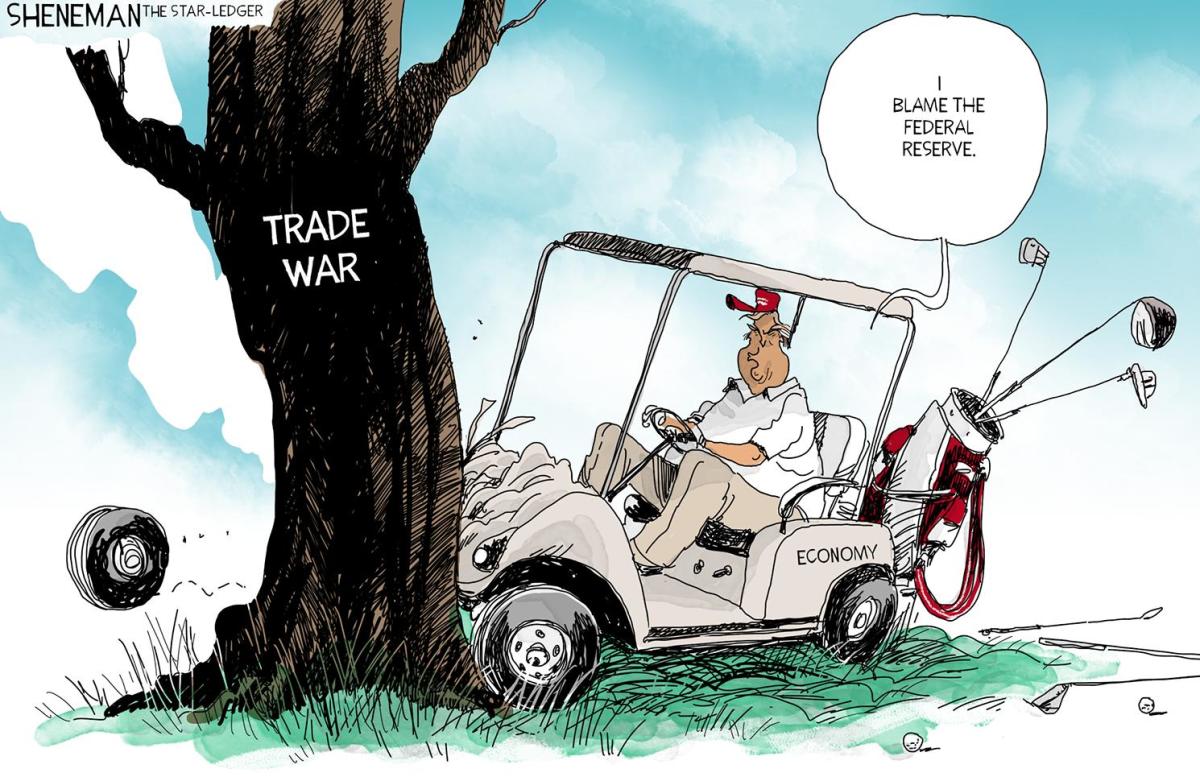
Further rate cuts and more money printing will not alleviate the situation since it has been the Federal Reserve’s recent “repo operations” which has pushed the market to its unsustainable highs.  For President Trump’s re-election hopes, the current “correction” better be short lived since he has repeatedly boasted about the stock market and has tied its success with the supposed health of the economy.  He will pay a political price if the market continues to tank and brings the economy down with it.

While President Trump and economic nationalists have bashed China for its trade practices, they are now going to see first hand how dependent the US and the West are on Chinese exports, as supply chains are disrupted over the coronavirus.

A Bloomberg article describes China’s weakest factory activity ever recorded:

The manufacturing purchasing managers’ index plunged to 35.7 in

February form 50 the previous month, according to data received by the

National bureau Statistics on Saturday, much lower than the median

estimate of economists.  Both were well below 50, which denotes

contraction.*

The expected reduction of Chinese goods will mean higher US domestic prices, however, the increase in prices can be offset somewhat not by rate cuts, but by tariff reductions, or, better still, elimination of duties on imports.  Increasing the money supply or cutting interest rates, which is what Trump, the market, and 95% of economists favor, will only mean higher prices for dwindling imports as greater amounts of money will chase fewer goods.

In the President’s comments on the coronavirus and the stock market plunge, he has repeatedly cited other nations’ (Japan, Germany) – lower interest rates as a policy that the Fed should pursue.  Apparently, the President is not aware that recent data out of Japan has shown that the economy shrank at an annualized rate of 6.3% for the fourth quarter of 2019 while the German economy only grew at 0.6% last year.**  Low rates have not helped either economy or anywhere else where they have been foolishly tried.

What President Trump, world policy makers, and central bankers do not understand, whether deliberately or from willful ignorance, is that the artificial suppression of interest rates and money printing does not lead to economic growth. Instead, prosperity can only come about by the arduous process of saving (abstention from consumption), which provides the means for capital formation, which leads to production.  Employment, wage growth, and income are also ultimately tied to savings.  For the creation of wealth, there is no way around this elementary economic principle – one that few profession economists comprehend.

For saving and investment to have their most efficacious impact and for individuals to engage in such sacrificial behavior, a sound monetary order must be in place.  Unfortunately, ever since the US went off the gold standard internationally in 1971, its monetary system has grown increasingly unstable.

If the Trump Administration would eliminate, or at least reduce significantly, tariffs, it would more than likely induce China to do the same.  The benefits of lower import prices for the millions of out of work Chinese due to the coronavirus shut downs would be a tremendous help and would also boost America’s export industries.  Such action would show to those who elected him that Donald Trump was not a typical politician, but one who thought outside the box.

While it did not cause the Great Depression, the Smoot-Hawley Tariff of 1930 contributed to its severity.  If the recent sell-off is indeed the beginning of the long anticipated bust, following a supposed decade long expansion, then policy makers should do all in their power to alleviate the coming suffering.  The reduction of tariffs not only on Chinese goods, but those the world over would be a step in the right direction.

Let us hope that someone will convince Donald Trump that tariff reduction and not rate cuts will help Americans better deal with the troublesome and potentially economic and socially devastating coronavirus.

*China Posts Weakest Factory Activity on Record,” Bloomberg News, 29 February 2020.  https://www.bloomberg.com/news/articles/2020-02-29/china-feb-manufacturing-pmi-at-35-7-est-45-0

**Megumi Fujikawa, “Japan’s Economy Shrinks Faster Than Expected.”  Market Watch.  16 February 2020.  https://www.marketwatch.com/story/japans-economy-shrinks-faster-than-expected-2020-02-16;  “German Economy Stagnates as Eurozone Growth Hits Seven-Year-Low,”  The Guardian,  14 February 2020, https://www.theguardian.com/business/live/2020/feb/14/german-economy-stagnates-growth-eurozone-gdp-business-live

Antonius Aquinas@AntoniusAquinas

https://antoniusaquinas.com

The Constitution IS the Crisis

410jXD-zO+L
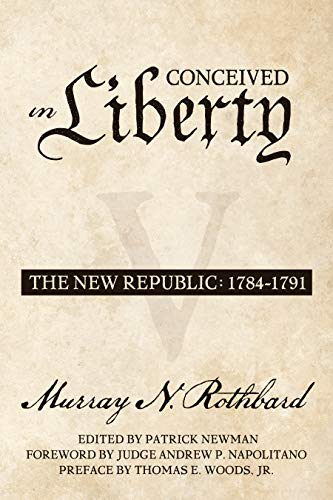
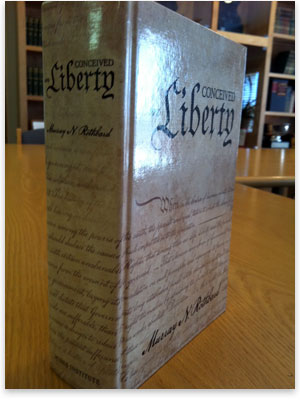
A Review of Murray N. Rothbard’s Conceived in Liberty, Vol. 5The posthumous release of Murray Rothbard’s fifth volume of his early American history series, Conceived in Liberty, is a cause of celebration not only for those interested in the country’s constitutional period, but also for the present day as the nation is faced with acute social, economic, and political crises.  The fifth volume, The New Republic: 1784-1791, stands with Boston T. Party’s 1997 release, Hologram of Liberty, as a grand rebuttal of the cherished notion held by most contemporary scholars, pundits on the Right, and, surprisingly, many libertarians who believe that the US Constitution is some great bulwark in defense of individual liberty and a promoter of economic success.

ConceivedInLiberty4in1 Volumes 1-4

Rothbard’s narrative highlights the crucial years after the American Revolution focusing on the events and personalities that led to the calling for, drafting, and eventual promulgation of the Constitution in 1789.  Not only does he describe the key factors that led to the creation of the American nation-state, but he gives an insightful account of the machinations which took place in Philadelphia and a trenchant analysis of the document itself which has become, in the eyes of most conservatives, on a par with Holy Writ.

What Might Have Been

While Rothbard writes in a lively and engaging manner, the eventual outcome and triumph of the nationalist forces leaves the reader with a certain sadness.  Despite the fears expressed by the Antifederalists that the new government was too powerful and would lead to tyranny, through coercion, threats, lies, bribery, and arm twisting by the politically astute Federalists, the Constitution came into being.  Yet, what if it had been the other way around and the forces against it had prevailed?

It is safe to assume that America would have been a far more prosperous and less war-like place.  The common held notion that the Constitution was needed to keep peace among the contending states is countered by Rothbard, who points out a number of instances where states settled their differences, most notably Maryland and Virginia as they came to an agreement on the navigation of the Chesapeake Bay.  [129-30]

Without a powerful central state to extract resources and manpower, overseas intervention by the country would have been difficult to undertake.  Thus, the US’s disastrous participation in the two world wars would have been avoided.  Furthermore, it would have been extremely unlikely for a Confederation Congress to impose an income tax as the federal government successfully did through a constitutional amendment in 1913.

Nor would the horrific misnamed “Civil War” ever take place with its immense loss of life and the destruction of the once flourishing Southern civilization.  The triumph of the Federal government ended forever “states rights” in the US and, no doubt, inspired centralizing tendencies throughout the world, most notably in Germany which became unified under Prussian domination.

In a failed attempt in 1786 to enact an impost tax under the Confederation, Abraham Yates, a New York lawyer and prominent Antifederalist, spoke of decentralization as the key to liberty as Rothbard aptly summarizes:

Yates also warned that true republicanism can only be preserved in small states, and

keenly pointed out that in the successful Republics of Switzerland and the

Netherlands the local provinces retained full control over their finances.  A taxing

power in Congress would demolish state sovereignty and reduce the states, where

the people could keep watch on their representatives, to mere adjuncts of

congressional power, and liberty would be gone.  [64]

Antifederalists, such as Yates, had a far greater understanding of how liberty and individual rights would be protected than their statist opponents such as Alexander Hamilton and James Madison.  The Antifederalists looked to Europe as a model, which, for most of its history, was made up of decentralized political configurations.  The Federalists, on the other hand, got much of their inspiration from the Roman Republic and later Empire.  There is little question that an America, with the political attributes of a multi-state Europe, would be far less menacing to both its own inhabitants and to the rest of the world than what it has become under the current Federal Leviathan if the Constitution never passed.

Speculation aside, historical reality meant that America would be fundamentally different than it would have been had the Articles of Confederation survived, as Rothbard points out:

The enactment of the Constitution in 1788 drastically changed the course of

American history from its natural decentralized and libertarian direction to an

omnipresent leviathan that fulfilled all of the Antifederalists’ fears.  [312]

Limited Government Myth

One of the great myths surrounding the American Constitution – which continues within conservative circles to this very day – is that the document limits government power.  After reading Rothbard, such a notion can only be considered a fairy tale!

The supposed “defects” of the Articles of Confederation were adroitly used by the wily nationalists as a cover to hide their real motives.  Simply put – the Articles had to be scrapped and a new national government, far more powerful than what had existed under the Articles, had to be created as Rothbard asserts: “The nationalists who went into the convention agreed on certain broad objectives, crucial for a new government, all designed to remodel the United States into a country with the British political structure.”  [145]

In passing the Constitution, the nationalist forces gained almost all they had set out to accomplish – a powerful central state and with it a strong chief executive office, and the destruction of the states as sovereign entities.  The supposed “checks and balances,” so much beloved by Constitution enthusiasts, has proven worthless in checking the central state’s largesse.  Checks and balances exist within the central government and is not offset by any prevailing power, be it the states or citizenry.

There was no reform of the system as it stood, but a new state was erected on the decentralized foundation of the Confederation.  Why the idea of the founding fathers as some limited government proponents is a mystery.

The Chief Executive

As it developed, the Presidency has become the most powerful and, thus, the most dangerous office in the world.  While its occupants certainly took advantage of situations and created crises themselves over the years, the Presidency, especially in foreign policy, is largely immune from any real oversight either from the legislature or judiciary.  This was not by happenstance.  From the start, the nationalists envisioned a powerful executive branch, and though the most extreme among the group were eventually thwarted in their desire to recreate a British-style monarchy in America, the final draft of the Constitution granted considerable power to the presidential office.

As they did throughout the Constitutional proceedings, the nationalists cleverly altered the concept of what an executive office in a republic should be, by subtle changes in the wording of the document as Rothbard incisively explains:

[T]he nationalists proceeded to alter . . .  and exult the executive in a highly

important textual change.  Whenever the draft had stated that the president ‘may

recommend’ measures to the Congress, the convention changed ‘may’ to ‘shall,’

which provided a ready conduit to the president for wielding effective law-making

powers, while the legislature was essentially reduced to a ratification agency of laws

proposed by the president.  [190-91]

As if this was not bad enough the office was given the ability to create departments within its own domain.

In another fateful change, the president was given the power to create a

bureaucracy within the executive by filling all offices not otherwise provided for in

the Constitution, in addition to those later created by laws.  [191]

The totalitarian federal agencies that plague the daily lives of Americans were not some later innovation by the Progressive movement or New Dealers, but had been provided for within the document itself.  The efforts of those opposed to the various social welfare schemes of the past, which have been put into effect through the various Cabinet departments, have been in vain since the power was given to the Presidency and has been taken advantage of by nearly all of its occupants.

Rothbard’s analysis of the chief executive office is especially pertinent since the nation is once again in the midst of another seemingly endless presidential election cycle.  The reason that the office has attracted so many of the worst sort (which is being kind) is because of its power.  If elected, the ability to control, regulate, impoverish, and kill not only one’s fellow citizen, but peoples across the globe is an immense attraction for sociopaths!

A Coup d’état and Counter Revolution

Rothbard makes the compelling case that the Constitution was a counter revolution, which was a betrayal of the ideology that brought about the Revolution:

The Americans were struggling not primarily for independence but for political-

economic liberty against the mercantilism of the British Empire.  The struggle was

waged against taxes, prohibitions, and regulations – a whole failure of repression

that the Americans, upheld by an ideology of liberty, had fought and torn

asunder. . . .   [T]he American Revolution was in essence not so much against Britain

as against British Big Government – and specially against an all-powerful central

government and a supreme executive.  [307]

He continues:

[T]he American Revolution was liberal, democratic, and quasi-anarchistic; for

decentralization, free markets, and individual liberty; for natural rights of

life, liberty, and property; against monarchy, mercantilism, and especially

against strong central government.  [307-08]

There was, however, always a “conservative” element within the revolutionary leadership that admired Great Britain and wanted to replicate it in America.  It was only when there was no alternative to British political and economic oppression that they joined with their more liberal-libertarian brethren and decided for independence.

Conservatives did not go away after independence, but would continue to push for an expansion of government under the Articles and finally, after most of their designs were consistently thwarted, did they scheme to impose a powerful central state upon the unsuspecting country.

Yet, they would not have triumphed had a number of key liberal-libertarians of the revolutionary generation moved to the Right during the decade following independence.  Rothbard shows why he is the master in power-elite historical analysis in his discussion of this tragic shift, which would spell the death knell to any future politically decentralized America:

[O]ne of the . . .  reasons for the defeat of the Antifederalists, though they

commanded a majority of the public, was the decimation that had taken place in

radical and liberal leadership during the 1780s.  A whole galaxy of ex-radicals, ex-

decentralists, and ex-libertarians, found in their old age that they could comfortably

live in the new Establishment.  The list of such defections is impressive, including

John Adams, Sam Adams, John Hancock, Benjamin Rush, Thomas Paine, Alexander

McDougall, Isaac Sears, and Christopher Gadsden.  [308-09]

As the country’s elite became more statist and as political (Shays Rebellion) and  economic (a depression) factors played into their hands, conservatives seized the opportunity to erect on America a powerful national government:

It was a bloodless coup d’état against an unresisting Confederation Congress. . . .

The drive was managed by a corps of brilliant members and representatives

of the financial and landed oligarchy.  These wealthy merchants and large

landowners were joined by the urban artisans of the large cities in their

drive to create a strong overriding central government – a supreme government

with its own absolute power to tax, regulate commerce, and raise armies.  [306]

Conclusion

The Mises Institute and the editor of the book, Patrick Neumann, must be given immense credit for bringing this important piece of scholarship into print.  Once read, any notion of the “founding fathers” as disinterested statesmen who sublimated their own interests and that of their constituents to that of their country will be disavowed.  Moreover, The New Republic:1784-1791 is the most important in the series since the grave crises that the nation now faces can be traced to those fateful days in Philadelphia when a powerful central state was created.

Volume Five shows that the problems of America’s past and the ones it now faces are due to the Constitution.  The remedy to the present societal ills is not electing the “right” congressman, or president, but to “devolve” politically into a multitude of states and jurisdictions.  For the future of liberty and economic well-being, this is where efforts should be placed and Murray Rothbard’s final volume of Conceived in Liberty is essential reading if that long, arduous, but much necessary task is to be undertaken.

Antonius Aquinas@AntoniusAquinas

https://antoniusaquinas.com

posted 02-10-’20


Maybe the West Should Adopt Iran’s Nuclear Weapons Policy

Iran Nuclear Weapons

Prior to the modern age, when war was engaged in, combatants, for the most part, acted by a code of conduct which attempted to minimize civilian deaths and the destruction of non-participants’ property. With the onset of the democratic age and the idea of “total war” such modes of conduct have tragically fallen by the wayside, the consequence of which has made warfare far more bloody and destructive.

The ultimate violation of “just warfare” has been the possession and use of nuclear weapons which by their very nature cannot be reconciled with any notion of a civilized society.  Of all the hysteria over “terrorism,” nuclear weapons are rarely discussed anymore, but are the ultimate form of terror.

Despite the obvious fact that nuclear weapons cannot be reconciled with any moral code of warfare, Western nation-states continue to possess them and the US has actually used them in the final stages of WWII as it mercilessly bombed the Japanese civilian centers of Hiroshima and Nagasaki.

While most modern scholarship has abandoned the older idea of moral conduct in warfare, the great libertarian theorist, Murray Rothbard, continued the venerable tradition in his thought and applied it not only to nuclear weapons, but bombing as well:

    Not only should there be joint disarmament

of nuclear weapons, but also of all weapons

capable of being fired massively across national

borders; in particular bombers.  It is precisely

such weapons of mass destruction as the missile

and the bomber which can never be pinpoint-

targeted to avoid their use against innocent

civilians.*

He continues:

. . .  since modern air and missile weapons

cannot be pinpoint-targeted to avoid harming

civilians, their very existence must be condemned.

For a New Liverty II

It is beyond hypocritical, therefore, that the US has repeatedly accused Iran of seeking to build nuclear weapons despite the fact that the nation’s leadership has consistently declared that it will not do so because of its religious beliefs. In June, President Trump called off retaliatory raids on Iranian targets after it downed a US drone (which had flown into Iranian airspace), citing that it would cost the lives of some 150 people.  In response, Iran’s Foreign Minister Mohammad Javad Zarif exposed the hypocrisy of the US’s position on nuclear weapons:

You were really worried about 150 people?

How many people have you killed with a

nuclear weapon?  How many generations have

you wiped out with these weapons?**

Zarif added:

It is us who, because of our religious views,

will never pursue a nuclear weapon.

Not only has Iran’s leadership consistently declared that it would not use or build nuclear weapons, but it has stood by its words.  During the Iran-Iraq War (1980-88), Iraq (with US knowledge) repeatedly used chemical weapons.  Despite Iran’s  protests to the U.N., it refused to take action – mainly because the US through its position on the Security Council tabled any attempt to curtail Iraq’s nefarious actions.***

Despite the flagrant violation of international law, Iran refused to retaliate, although it had the capacity and certain justification in doing so.  The Ayatollah, in a religious ruling – fatwa – at the time of the war, asserted that such an act (the use of chemical/nuclear weapons) was “forbidden by god.”

This has been the position of the Ayatollahs since the formation of the Islamic Republic.  Ayatollah Ali Khamenei stated that “from an ideological and fighi [Islamic jurisprudence] perspective, we consider developing nuclear weapons as unlawful.  We consider using such weapons as a big sin.”  A top-ranking cleric, Grand Ayatollah Yusef Saanei, confirmed that this is part of Islamic doctrine:

There is complete consensus on this issue.  It is

self-evident in Islam that it is prohibited to have

nuclear bombs. It is eternal law, because the

basic function of these weapons is to kill innocent

people.  This cannot be reversed.

Sounds Rothbardian!

Despite Iranian claims to the contrary, the US and the controlled press continue to mischaracterize Iran’s position on nuclear weapons. Not only has it lied, but it continues to enact crippling sanctions on the beleaguered nation causing untold suffering which itself is an act of war.

The fact that Iran follows a moral principle which was once part of Western thought shows how far the Western world, especially the US, has declined in civility.  A return to a saner, more just position on nuclear weapons will only take place when there is a change in ideology. Under current intellectual conditions, such a change appears unlikely.  A rethinking will only take place of necessity when America has exhausted itself through debt and money printing and can no longer sustain its Empire and nuclear capabilities.

*See, Murray N. Rothbard, For A New Liberty: The Libertarian Manifesto, 293.

**Reuters, “Iran Will Never Pursue a Nuclear Weapon, Says Foreign Minister.”  24 April 2019.

***Ted Snider, “Iran, Islam, and Banning the Bomb.”  Antiwar.com 30 September 2019.


Antonius Aquinas@antoniusaquinas

https://antoniusaquinas.comhttps://antoniusaquinas.com