Tag Archives: savings

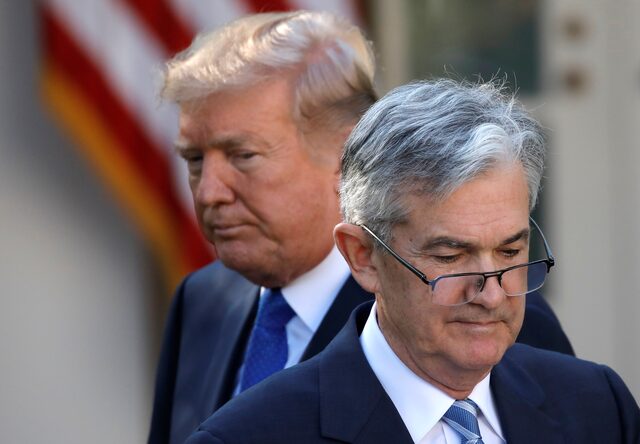
The Trump – Powell Spat: A Distraction from the Debt Crisis

Since his return to office in January, President Donald Trump has called on Federal Reserve Chairman Jay Powell to cut interest rates which Powell and the Fed’s Board of Governors have refused to do.  In typical child-like behavior when he doesn’t get his way, Trump has hurled insults at Powell calling him a “stupid person,” “too late Powell,” and a “numbskull.” 

Trump’s juvenile attacks, although misplaced, have been quite humorous and a welcome change in tone to the respect, reverence, and almost deification that previous Presidents, Congressmen, and the financial press heap on Federal Reserve Chairmen.

Unfortunately, as with all his policies, Trump’s megalomania is on display.  After the Fed’s June meeting when it once again decided to leave rates unchanged and indicated that there might be only one rate cut in 2025, Trump again slammed Powell and suggested that “Maybe I should go to the Fed.  Am I allowed to appoint myself to the Fed.?” *

While Trump’s ridiculing the head of one of the sacred cows of America’s ruling establishment is welcomed, his crazed notion of putting himself, and presumably future presidents, in charge of monetary policy does not offer any viable alternative to the debt crisis that is staring the nation in the face with the U.S. in the hole in excess of now some $37 trillion. 

Although Trump’s blasting of Powell has provided some comic relief from the dire economic conditions which confront the U.S., in reality both the president and the Fed Chair are wrong over interest rate policy although, in this case, Powell is less wrong.  Like most of Trump’s kooky ideas – taking over Greenland, making Canada the 51st state – not only is the slashing of interest rates counterproductive, but the idea of giving the executive branch of government control of monetary policy would turn the nation into a complete dictatorship.

Powell, too, has been mistaken in his policy of holding rates steady. Interest rates, in fact, are too low and need to be higher.  At current levels, rates are too “accommodative” as price inflation remains above the Fed’s 2% target.  Of course, in reality prices are rising at a much briskier pace than official government estimates. 

Hiking rates would encourage savings and discourage consumption both of which would put downward pressure on consumer prices.  If Trump wants to achieve his goal of a reindustrialized America, there needs to be an increase in savings. Production of goods takes place over time and without savings to fund the construction of factories, the purchase of machines and equipment, and the payment of wages, there can be no economic growth.

Trump wrongly believes that lower rates will spur economic growth.  Sustained prosperity can only take place through savings and investment not money creation via credit expansion which the president is a fan of.    

More fundamentally, both Trump and Powell are wrong: interest rates should not be set by governments or monetary authorities, but be determined by market forces – the aggregate decision making of individuals on how much to save or how much to consume their income.  Concomitant with non-state involvement with the setting of interest rates, a return to a metallic monetary standard would prevent price inflation which would make saving more attractive.

Another reason why Trump wants lower rates is that servicing the mammoth U.S. debt would be somewhat more palatable. His “big, beautiful bill,” working its way through the Senate, will need to be financed.  Lower rates would reduce the government’s borrowing costs.  This irresponsible argument was also made by former Federal Reserve Chair and later Treasury Secretary Janet Yellen.   

Since Donald Trump has no ideological core that shapes his world vision, his outlook and policies are more often than not based on what affects him personally or who strokes his ego or lines his pockets.  The proper monetary policy for the nation is not to cut interest rates, but to raise them and reduce the national debt through spending cuts.  While there would certainly be short-term pain from such a policy, eventually matters would turn around and economic activity would be placed on a sound footing.

Ultimately, if sound money is ever to return to America and the Western world, its control must be taken away from central banks and the influence of mercurial politicians.  The creation of money, its distribution, authenticity, and safe keeping should be left up to a decentralized non-governmental arrangement. 

*Tyler Durden, “Trump Slams ‘Stupid’ Powell: ‘I Think He Hates Me.  I Call Him Every Name in the Book to Try and Get Him to Cut,’” Zero Hedge, 18 June 2025. https://www.zerohedge.com/markets/trump-slams-stupid-powell-i-think-he-hates-me-i-call-him-every-name-book-try-and-get-him

Antonius Aquinas@AntoniusAquinas
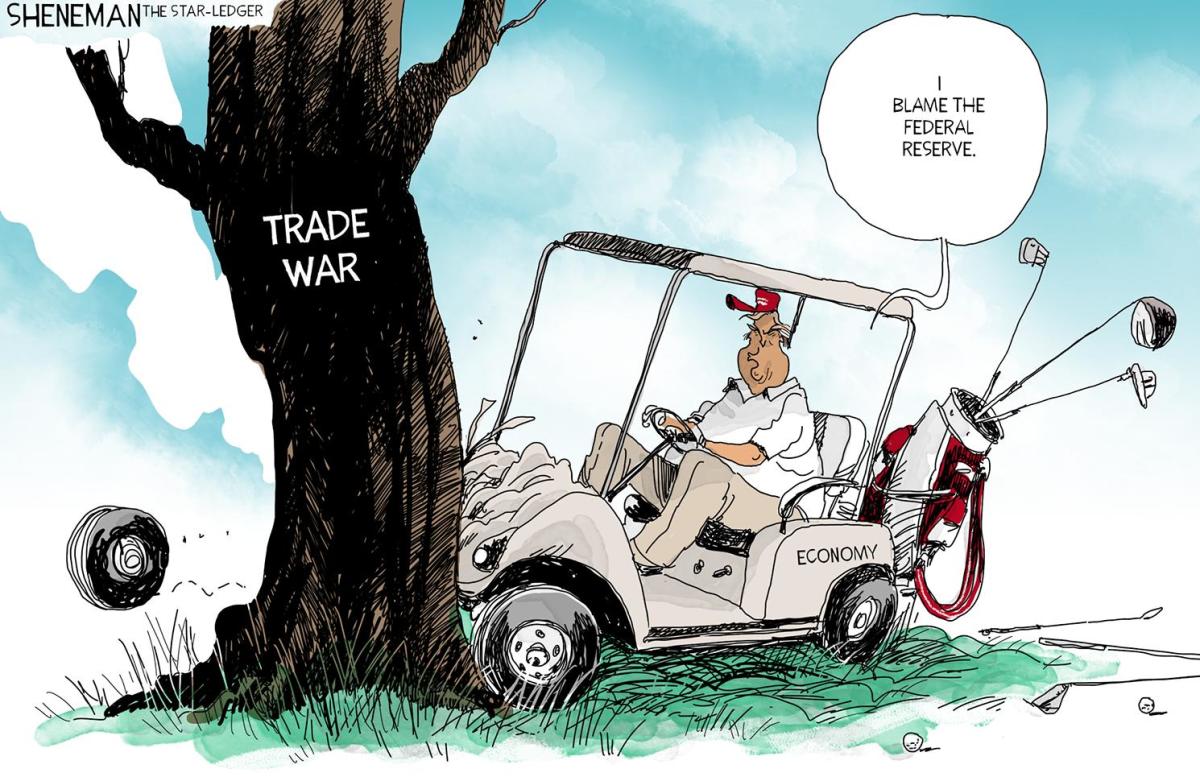
Memo to The Donald: Cut Tariffs NOT Rates

trump tariff

So far, President Trump’s economic response to a potential coronavirus outbreak and a further stock market sell off has been expected – calls for more interest rate cuts and an additional round of monetary stimulus.  For the stock market, economy, and the virus itself, neither measure will have their desired effect and, in fact, may exacerbate things.

Further rate cuts and more money printing will not alleviate the situation since it has been the Federal Reserve’s recent “repo operations” which has pushed the market to its unsustainable highs.  For President Trump’s re-election hopes, the current “correction” better be short lived since he has repeatedly boasted about the stock market and has tied its success with the supposed health of the economy.  He will pay a political price if the market continues to tank and brings the economy down with it.

While President Trump and economic nationalists have bashed China for its trade practices, they are now going to see first hand how dependent the US and the West are on Chinese exports, as supply chains are disrupted over the coronavirus.

A Bloomberg article describes China’s weakest factory activity ever recorded:

The manufacturing purchasing managers’ index plunged to 35.7 in

February form 50 the previous month, according to data received by the

National bureau Statistics on Saturday, much lower than the median

estimate of economists.  Both were well below 50, which denotes

contraction.*

The expected reduction of Chinese goods will mean higher US domestic prices, however, the increase in prices can be offset somewhat not by rate cuts, but by tariff reductions, or, better still, elimination of duties on imports.  Increasing the money supply or cutting interest rates, which is what Trump, the market, and 95% of economists favor, will only mean higher prices for dwindling imports as greater amounts of money will chase fewer goods.

In the President’s comments on the coronavirus and the stock market plunge, he has repeatedly cited other nations’ (Japan, Germany) – lower interest rates as a policy that the Fed should pursue.  Apparently, the President is not aware that recent data out of Japan has shown that the economy shrank at an annualized rate of 6.3% for the fourth quarter of 2019 while the German economy only grew at 0.6% last year.**  Low rates have not helped either economy or anywhere else where they have been foolishly tried.

What President Trump, world policy makers, and central bankers do not understand, whether deliberately or from willful ignorance, is that the artificial suppression of interest rates and money printing does not lead to economic growth. Instead, prosperity can only come about by the arduous process of saving (abstention from consumption), which provides the means for capital formation, which leads to production.  Employment, wage growth, and income are also ultimately tied to savings.  For the creation of wealth, there is no way around this elementary economic principle – one that few profession economists comprehend.

For saving and investment to have their most efficacious impact and for individuals to engage in such sacrificial behavior, a sound monetary order must be in place.  Unfortunately, ever since the US went off the gold standard internationally in 1971, its monetary system has grown increasingly unstable.

If the Trump Administration would eliminate, or at least reduce significantly, tariffs, it would more than likely induce China to do the same.  The benefits of lower import prices for the millions of out of work Chinese due to the coronavirus shut downs would be a tremendous help and would also boost America’s export industries.  Such action would show to those who elected him that Donald Trump was not a typical politician, but one who thought outside the box.

While it did not cause the Great Depression, the Smoot-Hawley Tariff of 1930 contributed to its severity.  If the recent sell-off is indeed the beginning of the long anticipated bust, following a supposed decade long expansion, then policy makers should do all in their power to alleviate the coming suffering.  The reduction of tariffs not only on Chinese goods, but those the world over would be a step in the right direction.

Let us hope that someone will convince Donald Trump that tariff reduction and not rate cuts will help Americans better deal with the troublesome and potentially economic and socially devastating coronavirus.

*China Posts Weakest Factory Activity on Record,” Bloomberg News, 29 February 2020.  https://www.bloomberg.com/news/articles/2020-02-29/china-feb-manufacturing-pmi-at-35-7-est-45-0

**Megumi Fujikawa, “Japan’s Economy Shrinks Faster Than Expected.”  Market Watch.  16 February 2020.  https://www.marketwatch.com/story/japans-economy-shrinks-faster-than-expected-2020-02-16;  “German Economy Stagnates as Eurozone Growth Hits Seven-Year-Low,”  The Guardian,  14 February 2020, https://www.theguardian.com/business/live/2020/feb/14/german-economy-stagnates-growth-eurozone-gdp-business-live

Antonius Aquinas@AntoniusAquinas

https://antoniusaquinas.com