Tag Archives: finance

Central Banks Hoard Gold, Shed U.S. Treasuries

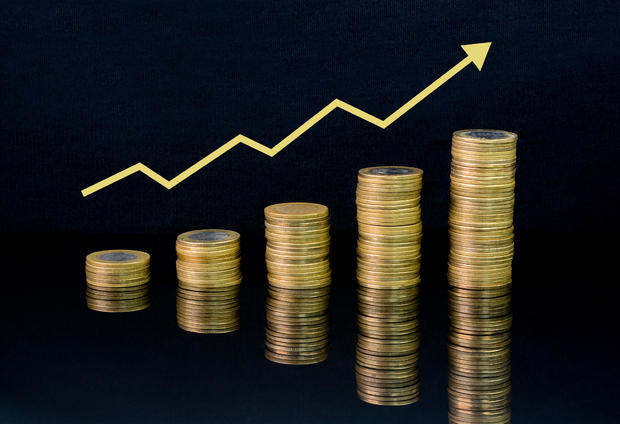
A lot has been made by gold-money bugs about the roles that central banks have played in the run-up in the gold price that accounts for a 38% increase in the yellow metal’s price this year alone.  Some of these analysts attribute the shedding of central bank holdings of U.S. treasuries and other agencies’ bonds to purchase gold, which has accelerated gold’s recent meteoric rise. 

It is not just those in the gold community that hold this belief, but some in the mainstream financial press cite reports and data that purportedly show that central banks now own more gold than U.S. bonds.  If true, such a shift would be a fundamental change in the world’s financial markets and could mean the end of the post-Bretton Woods monetary order, where the dollar acted as the reserve currency, replaced, ironically, by gold which the dollar replaced in 1971.

A recent Financial Times (FT) article, written by Toby Nangle and titled “Do Central Banks Really Have More Gold Than U.S. Treasury Bonds?,” attempts to shed light on these claims.* It should be a reminder, as the article admits, that it is difficult to get accurate figures from data provided by central banks and international agencies. 

Since the global financial crisis of 2007-2009, central banks’ holdings of gold have steadily risen.  The International Monetary Fund (IMF), which keeps data on central banks’ financial sheets, estimates that banks are holding between 22% to 28% of their assets in gold, which comes to $3.86 trillion of gold as of the end of June. 

The FT article contends that this percentage of reserves is “mostly about recent price action rather than a fundamental and dramatic shift out of treasuries and into the yellow metal.”

While central banks still hold the bulk of their reserves in U.S. treasuries, the gap is narrowing as the price of gold continues to reach new highs which FT admits, but downplays: “the underlying reality isn’t quite as dramatic as it might seem….”

What should be taken from the article, not only by investors, but just about everyone else, is that a mainstream financial organ like FT is noticing not only the rise in gold, but the potential of the greenback losing its reserve status – an event that would have immense and catastrophic consequences for all Americans.  Such talk, up to this point, was only heard from hard-money advocates.

The rising price of gold is signaling that greater price inflation is on the horizon with continuing deterioration of the dollar’s purchasing power along with more job losses, which is the dreaded specter of “stagflation.”

Another of America’s financial elite has sounded the alarm that something ominous is on the horizon.  Morgan Stanley has revised its traditional 60/40 portfolio split, the 40% typically allocated to bonds, to a 60/20/20 portfolio with 20% allocated to gold.  To readjust its portfolio to increase its gold holdings, Morgan Stanley will have to reduce its share of U.S. treasuries, which will put more downward pressure on bond prices and increase yields.

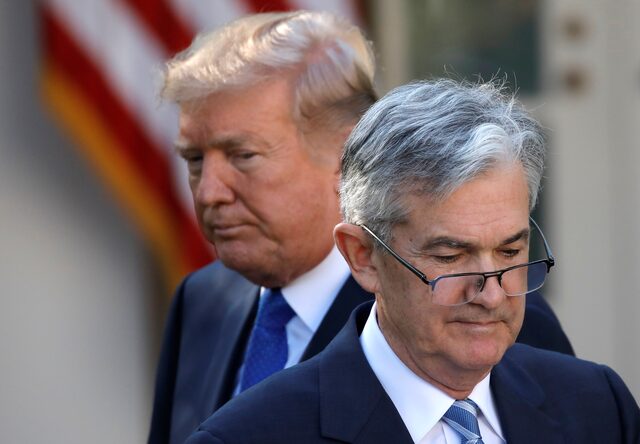
With growing concern over the safety of U.S. treasuries, the continuing rise in prices, and the all-time high in gold and asset prices, the Federal Reserve, at its September meeting, decided to cut the federal funds rate by 25 basis points while indicating that there will be more cuts coming.  The much-anticipated rate cut, of course, was in reaction to the unprecedented pressure brought to bear by President Donald Trump on Fed Chairman, Jerome Powell.

Like his reckless tariff policy, which has driven some allies into the arms of America’s supposed adversaries – see India and its rapprochement with China – Trump’s Fed bashing will have the opposite of its intended effect. 

Trump believes that rate cuts will make the economy “take-off” and he hopes that lower borrowing costs will make service of the gargantuan U.S. debt more manageable. 

As usual, the president talks out of both sides of his mouth.  He has spent most of his second term boasting that the economy is the best it has ever been.  Why then is there a need for interest rate cuts if the economy is booming? 

Trump also promised massive spending cuts via the Department of Government Efficiency but, instead, he passed the “Big Beautiful Bill,” which added more spending, requiring more borrowing.

America is not alone in cutting rates as central banks across the world (whose economies are also debt ridden) are reducing rates which will only encourage more borrowing.  This, of course, will lead to more price inflation as central banks will have to print more money to finance the profligate spending of their governments. 

Eventually there will be a return to gold in the monetary order, not just as a reserve asset, but one used in exchange as fiat currencies collapse. 

If economic trends continue, that day may not be far off.   

*https://www.ft.com/content/0dbc435d-7d7e-43d7-b730-b8ced4b1cba2

Antonius Aquinas@antoniusaquinas
https://antoniusaquinas.com

The Trump – Powell Spat: A Distraction from the Debt Crisis

Since his return to office in January, President Donald Trump has called on Federal Reserve Chairman Jay Powell to cut interest rates which Powell and the Fed’s Board of Governors have refused to do.  In typical child-like behavior when he doesn’t get his way, Trump has hurled insults at Powell calling him a “stupid person,” “too late Powell,” and a “numbskull.” 

Trump’s juvenile attacks, although misplaced, have been quite humorous and a welcome change in tone to the respect, reverence, and almost deification that previous Presidents, Congressmen, and the financial press heap on Federal Reserve Chairmen.

Unfortunately, as with all his policies, Trump’s megalomania is on display.  After the Fed’s June meeting when it once again decided to leave rates unchanged and indicated that there might be only one rate cut in 2025, Trump again slammed Powell and suggested that “Maybe I should go to the Fed.  Am I allowed to appoint myself to the Fed.?” *

While Trump’s ridiculing the head of one of the sacred cows of America’s ruling establishment is welcomed, his crazed notion of putting himself, and presumably future presidents, in charge of monetary policy does not offer any viable alternative to the debt crisis that is staring the nation in the face with the U.S. in the hole in excess of now some $37 trillion. 

Although Trump’s blasting of Powell has provided some comic relief from the dire economic conditions which confront the U.S., in reality both the president and the Fed Chair are wrong over interest rate policy although, in this case, Powell is less wrong.  Like most of Trump’s kooky ideas – taking over Greenland, making Canada the 51st state – not only is the slashing of interest rates counterproductive, but the idea of giving the executive branch of government control of monetary policy would turn the nation into a complete dictatorship.

Powell, too, has been mistaken in his policy of holding rates steady. Interest rates, in fact, are too low and need to be higher.  At current levels, rates are too “accommodative” as price inflation remains above the Fed’s 2% target.  Of course, in reality prices are rising at a much briskier pace than official government estimates. 

Hiking rates would encourage savings and discourage consumption both of which would put downward pressure on consumer prices.  If Trump wants to achieve his goal of a reindustrialized America, there needs to be an increase in savings. Production of goods takes place over time and without savings to fund the construction of factories, the purchase of machines and equipment, and the payment of wages, there can be no economic growth.

Trump wrongly believes that lower rates will spur economic growth.  Sustained prosperity can only take place through savings and investment not money creation via credit expansion which the president is a fan of.    

More fundamentally, both Trump and Powell are wrong: interest rates should not be set by governments or monetary authorities, but be determined by market forces – the aggregate decision making of individuals on how much to save or how much to consume their income.  Concomitant with non-state involvement with the setting of interest rates, a return to a metallic monetary standard would prevent price inflation which would make saving more attractive.

Another reason why Trump wants lower rates is that servicing the mammoth U.S. debt would be somewhat more palatable. His “big, beautiful bill,” working its way through the Senate, will need to be financed.  Lower rates would reduce the government’s borrowing costs.  This irresponsible argument was also made by former Federal Reserve Chair and later Treasury Secretary Janet Yellen.   

Since Donald Trump has no ideological core that shapes his world vision, his outlook and policies are more often than not based on what affects him personally or who strokes his ego or lines his pockets.  The proper monetary policy for the nation is not to cut interest rates, but to raise them and reduce the national debt through spending cuts.  While there would certainly be short-term pain from such a policy, eventually matters would turn around and economic activity would be placed on a sound footing.

Ultimately, if sound money is ever to return to America and the Western world, its control must be taken away from central banks and the influence of mercurial politicians.  The creation of money, its distribution, authenticity, and safe keeping should be left up to a decentralized non-governmental arrangement. 

*Tyler Durden, “Trump Slams ‘Stupid’ Powell: ‘I Think He Hates Me.  I Call Him Every Name in the Book to Try and Get Him to Cut,’” Zero Hedge, 18 June 2025. https://www.zerohedge.com/markets/trump-slams-stupid-powell-i-think-he-hates-me-i-call-him-every-name-book-try-and-get-him

Antonius Aquinas@AntoniusAquinas

Big Spending Continues Under Trump

While DOGE (the Department of Government Efficiency) has made almost daily headlines pointing out fraud and waste in government, the real battle over federal spending is beginning to take place.  From what has been proposed, it looks like it will be business as usual in Washington.

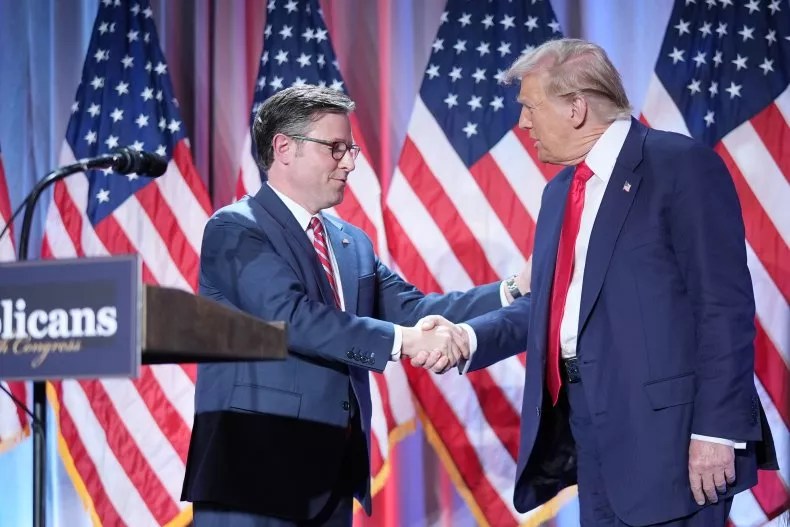
Last week, the full House of Representatives passed the House Budget Committee’s plan (budget resolution) which specifies cuts in both taxes and spending over the next decade.  The key phrase here is “over the next decade.”

In a Feb. 13, 2025 Tax Foundation article titled “House Budget Resolution Aims to Balance Tax Cut and Spending Reduction Goals,” William McBride, explains that:

The resolution caps the deficit increase resulting from

                   tax cuts at $4.5 trillion over the next decade and requires

                   a minimum of $1.2 trillion in spending cuts.  Additionally,

                   it sets as a goal to reduce mandatory spending by $2 trillion

                   over the next decade, and, if not accomplished, the cap on

                   tax cuts would be reduced commensurately. *

The resolution calls for certain committees to implement the cuts:

  • Energy and Commerce Committee ($880 billion)
  • Education and Workforce Committee ($330 billion)
  • Agriculture Committee ($230 billion)

Programs that more than likely face budget reductions include: Medicaid, student loan relief, and the Supplemental Nutrition Program. 

Despite Defense Secretary Pete Hegseth’s call for an 8% yearly cut in defense spending over the next five years, the current House resolution would increase defense spending by $100 billion. There is an additional increase of $230 billion for border control and “deportation plans to be executed” according to Brett Samuels of the political website The Hill, in an article he penned titled “Trump Backs House GOP Reconciliation Bill Over Senate Version.”  ** 

Like Trump and most of his administration, Hegseth has sent conflicting signals on defense spending.  While in Germany, the defense secretary said: “I think the US needs to spend more than the Biden administration was willing to, who historically under-invested in the capabilities of our military.”

Hegseth bombastically added that he wants “the biggest most badass military on the planet,” as quoted by Dave DeCamp of news and commentary website Antiwar.com in a Feb 2025 analysis. *** So much for an America first foreign policy. 

The House’s estimate for spending and tax cuts are based on a real rate of growth of 2.6%.  This optimistic forecast, of course, does not account for any downturn in the economy, war, or continued uptick in price inflation.  Any of these, or some exogeneous shock to the economy would lower gross domestic product and tax revenues and jeopardize any long-term projected tax or spending cuts.

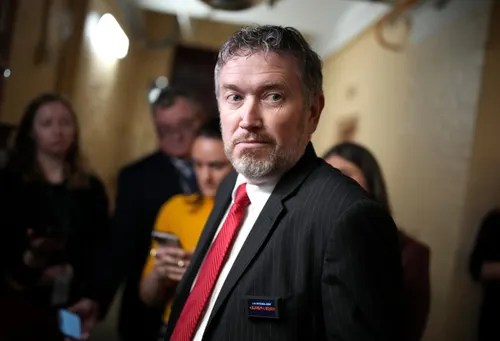
In the end, the budget resolution will increase spending, which Trump vowed to curb, as Rep. Thomas Massie (KY), who courageously voted against, succinctly summarized:

If the Republican plan passes under the rosiest

                                                assumptions, which aren’t even true, we’re gonna

                                                add $328 billion to the deficit this year, we’re gonna

                                                add $295 billion to the deficit the year after that, and

                                                $242 billion to the deficit after that. . . . ****

Trump, who enthusiastically supports the budget resolution, fails to realize that without deep and significant spending cuts, the cost of living will continue to escalate.  The president blamed the Biden Administration’s policies for the run-up in prices, when, in fact, it was Trump who began the present inflation cycle with the passage of the CARES Act in 2020, expanding the budget an unimaginable $2.2 trillion.

Without spending cuts, the burgeoning federal deficit ($2 trillion) and the interest on the national debt ($1 trillion) will need to be continually financed through borrowing.  The borrowing by the federal government is “paid for” through money printing (the real definition of inflation) by the Federal Reserve which buys U.S. debt with money “created out of thin air” which in essence is debt monetization.  The new money puts pressure on prices as it filters through the economy increasing the cost of living. 

While cuts in spending and reducing the amount of dollars in circulation will lower the cost of living, it will not come without severe economic pain.  The fall in prices will pop the bubble that stocks and other financial assets have been in which will result in widespread unemployment and business failures.  This is necessary to cleanse the malinvestment caused by the money printing and credit expansion and is necessary if America is to be put on a sound financial footing.

Of course, no politician wants to be blamed for such misery and even though Trump will not be up for re-election, he still does not want to be holding the bag when the economy implodes.  Yet, if such a scenario happens, the president should bear much of the blame for his policies ignited the present problem.

If President Trump truly wants to make America great again, cutting government spending must be undertaken no matter how painful. 

It appears, however, that he will join the long list of chief executives who have spent the nation into a horrific debt spiral which will inevitably end in economic ruin.

*William McBride, “House Budget Resolution Aims to Balance Tax Cut and Spending Reduction Goals,” Tax Foundation, 13 February 2025.  https://taxfoundation.org/blog/house-budget-resolution-tax-cuts-spending/

**Brett Samuels, “Trump backs House GOP reconciliation bill over Senate version,” The Hill, 19 February 2025.   https://thehill.com/homenews/administration/5152871-trump-endorses-house-gop-strategy/

***Dave DeCamp, “Pentagon Says Hegseth’s Order Will Redirect Spending, Not Make Actual Cuts,” Antiwar.com, 20 February 2025.

****Tyler Durden, “House Republicans Advance Trump Agenda as Final Vote Looms Tonight.” Zero Hedge, 25 February 2025,  https://www.zerohedge.com/political/house-republicans-advance-trump-agenda-final-vote-looms-tonight

Antonius Aquinas@AntoniusAquinas

Treasury Secretary Janet Yellen Apologizes for Out-of-Control Debt

Outgoing Treasury Secretary Janet Yellen has apologized (sort of) for the Biden administration’s failure to reign in the U.S. financial house and presiding over an increase in trillions of dollars in debt for the nation. According to Tyler Durden, writing for Zero Hedge, Yellen said at a Wall Street Journal organized event in December:

I am concerned about fiscal sustainability and I am sorry that we haven’t made progress . . . . [T]he deficit needs to be brought down especially now that we’re in an environment of higher interest rates.*

A little too late – don’t you think, Janet? 

Yellen was Federal Reserve chairman from February 2014 to February 2018 and, before that, served as vice chairman under Ben Bernanke.  She was replaced by President Donald Trump with Jerome Powell. 

Yellen, as do all Fed officials, reiterated the point that the central bank remains “independent” to pursue its mandate of full employment and price stability.

This is nonsense like most of what she has said over the course of her long and disastrous career.  Instead of independence, her move from Fed chair to Treasury secretary is a striking demonstration of just how political the Fed and the nation’s entire monetary and financial system truly is. 

Nevertheless, she continued to espouse the hypocrisy:

I see from my own experience is that countries perform better – they have not only inflation performance – but real performance in terms of job creation and growth is also stronger when a central bank is left to use its best judgement without political influence.

Under Yellen as Fed chair (the direct subordinate to Ben Bernanke), and as Treasury secretary, it has been estimated that the U.S. debt skyrocketed to the unfathomable amount of $15 trillion.  Yet, it is only when she is about to depart her post that Yellen is lamenting the Biden administration’s efforts to reign in the debt. In fact, there were none.

Besides the debt, the interest on it under Yellen’s watch stands at $1.2 trillion yearly, which is now the second-largest federal expenditure only topped by Social Security.  In her mea culpa, Yellen ignored this ticking timebomb.

One of the non-sensical reasons that Yellen often gave to justify massive U.S. borrowing was that interest rates over the past decade had been historically low.  She argued that the federal government should take advantage – and did – of the low-interest rate environment. 

Economic nincompoops like Yellen apparently didn’t understand that interest rates were low because the Fed was artificially suppressing them through currency debasement.

Recklessly borrowing for this reason would be similar to a drunk refusing to sober up because liquor prices had fallen to all-time lows.  Yet, this is what a secretary of the U.S. Treasury espouses for monetary policy.  Worse, few in the financial press or Congress, where Fed officials routinely testify, are ever questioned about such a dangerous idea. 

Most sensible people, if given the chance, would ask: “What would happen to the debt and interest on the debt if rates would go up?”  The United States may soon see this unpleasant reality come to fruition. 

Sadly, Yellen’s replacement, Scott Bessent, who was a business associate of George Soros, is an “easy money” advocate, as is Trump, who continually badgered Fed Chairman Powell during his first term for not cutting interest rates. 

It will be interesting to see what actions the new Treasury secretary will take if the long-anticipated debt crisis arrives.  More likely than not, the second Trump administration will follow the monetary policies of the disgraced Janet Yellen. 

*Tyler Durden, “Janet Yellen ‘Sorry After Presiding Over $15 Trillion Increase in US Debt.”  13 December 2024 https://www.zerohedge.com/markets/janet-yellen-sorry-after-presiding-over-15-trillion-increase-us-debt

Antonius Aquinas@antoniusaquinas

https://antoniusaquinas.com

What the Rising Gold Price Signals

The recent run-up in the gold price has not garnered the attention among the mainstream financial media outlets as it should.  Gold has, in part, been overshadowed by the rise in the price of bitcoin and other cryptocurrencies. 

Naturally, the financial press, which is really an arm of the government and its central bank, wants to ignore, as much as possible, references to gold as protection against the continuing increase in the price level which itself has been deliberately understated by monetary officials.  The media and government understand that precious metals are the ultimate security against runaway inflation and economic collapse.

While the increase in the gold price has reached nominal highs, it and the price of silver have not passed their all-time 1980 highs in real terms.  Adjusted for inflation, gold would have to rise to about $3590 an ounce while silver would have to surpass $50 an ounce.  Both are poised to exceed these watermarks in the not-too-distant future.

Precious metals will continue to escalate unless the Federal Reserve radically changes its interest rate policy to combat inflation as former Fed Chairman Paul Volcker once did.  Volcker raised interest rates to double-digit levels which caused gold prices to fall.  While Volcker could get away with such actions (because, at the time, the U.S. was still a creditor nation), current Chair Jerome Powell cannot because of the enormity of public and private debt.  Double-digit interest rates would collapse the economy and plunge millions of Americans into bankruptcy.

The rising price of gold is anticipating some of the promised policy actions of the Fed.  Since the end of last year, the central bank has indicated that it would be cutting interest rates.  In addition, Powell is considering ending the Fed’s “Quantitative Tightening” (QT) program.  Both are highly inflationary. 

While commentators have focused on gold’s spectacular price rise, there is an underlying issue that is also taking place.  The record setting gold price is signaling that the present fiat monetary order, which is based on the dollar as the world’s reserve currency, is coming to a financially unpleasant end. 

Ever since 1971, when the Nixon Administration closed the “gold window,” refusing to redeem gold for dollars held by foreign central banks, the world has been on a “dollar standard” where bank reserves are held in Greenbacks.  If the Fed continues to print dollars to sustain government spending at this rate, the dollar will continue to lose purchasing power and foreigners will no longer want to hold them.  Foreign central banks will then turn to gold.  In fact, central banks are already increasing their positions in gold which has been a catalyst that has fueled the latest rally.

Not surprisingly, the Fed has not purchased much gold (or is not admitting publicly that it has) since it would be a bad look for the issuer of the world’s reserve currency to be abandoning its own currency for gold.

Besides the severe financial implications if the dollar is dethroned, there will be dramatic geopolitical repercussions from the loss of its hegemony.  Just like the British pound was replaced as the dominant world currency after England insanely exhausted itself in fighting WWII and ending its empire, America will face a similar future when the dollar becomes just another money.  Many will see it as a “blessing” if and when the U.S. Empire comes to an end.

While it would appear logical and morally sound to replace the present crumbling monetary order with one based on gold and silver, a far worse paradigm than even the present one is, no doubt, being planned.  The new system will be one of central bank digital currency (CBDC) which would give governments and bankers the power to monitor and control all aspects of economic and social life. 

Some states have passed legislation to counter CBDC, such as Florida in 2023 under Governor Ron DeSantis who said: “The Biden administration’s efforts to inject a Centralized Bank Digital Currency is about surveillance and control.  Today’s announcement will protect Florida consumers and businesses from the reckless adoption of a ‘centralized digital dollar’ which will stifle and promote government-sanctioned surveillance. . . .”*

While the press and policy makers have ignored the surge in precious metal prices, it should be a warning to everyone that difficult economic times are still yet to come with the potential of a new draconian monetary order to be installed on the horizon.  Observant individuals should heed gold’s signals and take appropriate measures to safeguard their futures.

*https://www.flgov.com/2023/03/20/governor-ron-desantis-announces-legislation-to-protect-floridians-from-a-federally-controlled-central-bank-digital-currency-and-surveillance-state/

Antonius Aquinas@AntoniusAquinas

https://antoniusaquinas.com