Tag Archives: Economy

Central Banks Hoard Gold, Shed U.S. Treasuries

A lot has been made by gold-money bugs about the roles that central banks have played in the run-up in the gold price that accounts for a 38% increase in the yellow metal’s price this year alone.  Some of these analysts attribute the shedding of central bank holdings of U.S. treasuries and other agencies’ bonds to purchase gold, which has accelerated gold’s recent meteoric rise. 

It is not just those in the gold community that hold this belief, but some in the mainstream financial press cite reports and data that purportedly show that central banks now own more gold than U.S. bonds.  If true, such a shift would be a fundamental change in the world’s financial markets and could mean the end of the post-Bretton Woods monetary order, where the dollar acted as the reserve currency, replaced, ironically, by gold which the dollar replaced in 1971.

A recent Financial Times (FT) article, written by Toby Nangle and titled “Do Central Banks Really Have More Gold Than U.S. Treasury Bonds?,” attempts to shed light on these claims.* It should be a reminder, as the article admits, that it is difficult to get accurate figures from data provided by central banks and international agencies. 

Since the global financial crisis of 2007-2009, central banks’ holdings of gold have steadily risen.  The International Monetary Fund (IMF), which keeps data on central banks’ financial sheets, estimates that banks are holding between 22% to 28% of their assets in gold, which comes to $3.86 trillion of gold as of the end of June. 

The FT article contends that this percentage of reserves is “mostly about recent price action rather than a fundamental and dramatic shift out of treasuries and into the yellow metal.”

While central banks still hold the bulk of their reserves in U.S. treasuries, the gap is narrowing as the price of gold continues to reach new highs which FT admits, but downplays: “the underlying reality isn’t quite as dramatic as it might seem….”

What should be taken from the article, not only by investors, but just about everyone else, is that a mainstream financial organ like FT is noticing not only the rise in gold, but the potential of the greenback losing its reserve status – an event that would have immense and catastrophic consequences for all Americans.  Such talk, up to this point, was only heard from hard-money advocates.

The rising price of gold is signaling that greater price inflation is on the horizon with continuing deterioration of the dollar’s purchasing power along with more job losses, which is the dreaded specter of “stagflation.”

Another of America’s financial elite has sounded the alarm that something ominous is on the horizon.  Morgan Stanley has revised its traditional 60/40 portfolio split, the 40% typically allocated to bonds, to a 60/20/20 portfolio with 20% allocated to gold.  To readjust its portfolio to increase its gold holdings, Morgan Stanley will have to reduce its share of U.S. treasuries, which will put more downward pressure on bond prices and increase yields.

With growing concern over the safety of U.S. treasuries, the continuing rise in prices, and the all-time high in gold and asset prices, the Federal Reserve, at its September meeting, decided to cut the federal funds rate by 25 basis points while indicating that there will be more cuts coming.  The much-anticipated rate cut, of course, was in reaction to the unprecedented pressure brought to bear by President Donald Trump on Fed Chairman, Jerome Powell.

Like his reckless tariff policy, which has driven some allies into the arms of America’s supposed adversaries – see India and its rapprochement with China – Trump’s Fed bashing will have the opposite of its intended effect. 

Trump believes that rate cuts will make the economy “take-off” and he hopes that lower borrowing costs will make service of the gargantuan U.S. debt more manageable. 

As usual, the president talks out of both sides of his mouth.  He has spent most of his second term boasting that the economy is the best it has ever been.  Why then is there a need for interest rate cuts if the economy is booming? 

Trump also promised massive spending cuts via the Department of Government Efficiency but, instead, he passed the “Big Beautiful Bill,” which added more spending, requiring more borrowing.

America is not alone in cutting rates as central banks across the world (whose economies are also debt ridden) are reducing rates which will only encourage more borrowing.  This, of course, will lead to more price inflation as central banks will have to print more money to finance the profligate spending of their governments. 

Eventually there will be a return to gold in the monetary order, not just as a reserve asset, but one used in exchange as fiat currencies collapse. 

If economic trends continue, that day may not be far off.   

*https://www.ft.com/content/0dbc435d-7d7e-43d7-b730-b8ced4b1cba2

Antonius Aquinas@antoniusaquinas
https://antoniusaquinas.com

Trump’s “Big Beautiful Bill” and the Ultimate Demise of the Dollar

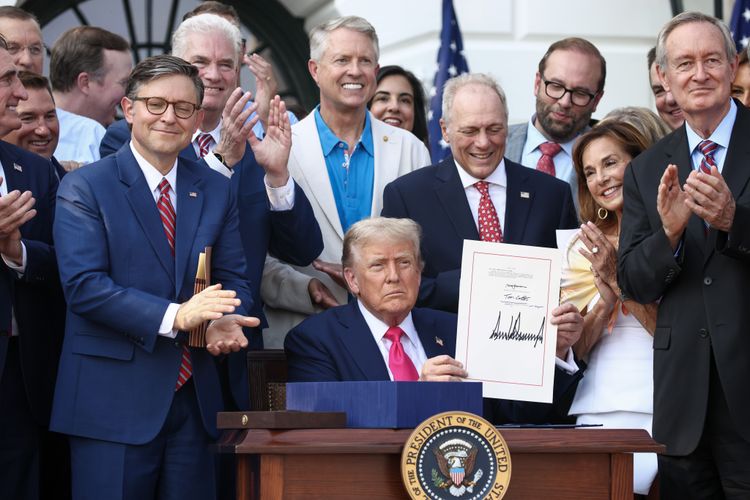
Despite considerable arm-twisting, President Donald Trump’s laughably misnamed “Big Beautiful Bill” (actually a Big Ugly Atrocity) barely passed both houses of Congress.  Such a monstrosity, which has been conservatively estimated to add $5 trillion to the national debt including interest over the next decade, is a slap in the face to those souls who believed Trump’s campaign rhetoric of cutting federal spending.*  This vindicates, once again, those who have correctly seen Trump for what he truly is – a big-spending liberal New York democrat.

Arguably, the most reprehensible aspect of the legislation is the $150 billion increase in “defense” outlays which will boost Uncle Sam’s military budget to a neat $1 trillion a year.  This will provide plenty of lucre to keep the military industrial complex well-oiled to continue its world-wide mass slaughter of innocents.  So much for lightweight Secretary of Defense Pete Hegseth’s initial, and now long forgotten, talk of cutting the Department’s budget by 8% per year over the next decade.

While Trump and nearly every Congressional Republican continue to spend the nation into oblivion, little attention was given to the continuing and financially ominous decline in the U.S. dollar.  The greenback has fallen more than 7% in 2025, the worst since 1973, with some analysts predicting another 10% drop by the end of the year.**

Concomitantly, the dollar’s decline has seen a historic rise in the gold price with silver reaching highs not attained since 2012.  Precious metals are signaling economic troubles ahead, especially in the currency markets.

While some have pointed to Trump’s harmful tariff policy for the dollar’s fall, the real culprit is the massive U.S. debt and interest payments, which increased even further with the passage of the Big Beautiful Bill Act.  To finance the exploding debt and interest (which has now surpassed $1 trillion per year), the government will have to borrow even more. 

This will force the Federal Reserve to print more money to service the debt putting added downward pressure on the greenback.  More dollars printed will obviously mean a fall in its purchasing power, not only domestically but in relative terms to foreign currencies.  The inverse of a decrease in the purchasing power of the dollar will be an increase in the prices of goods. 

It is a vicious circle exacerbated by Trump’s latest budget.

A larger question that U.S. policy makers will have to face if the dollar continues to slide is its current status as the world’s reserve currency.  The loss of this privileged position would be the death knell to the ability of the United States to project its financial and military power throughout the world. 

Most international transactions are settled in dollars that bolsters its demand in foreign exchange markets.  If countries settle trade in another currency or, as some have speculated, in terms of precious metals, the demand for dollars would fall.  If the supply of dollars has to increase due to continued profligate U.S. federal spending and demand for dollars internationally falls, the “price” of dollars (their purchasing power) would tank. 

Moreover, if foreign nations do not need dollars in trade, eventually the dollars they hold will make their way back to America, causing domestic prices to sharply escalate. 

Of course, the one bright spot of losing its world’s reserve currency status would mean the collapse, or at least a catastrophic pull back, in America’s vast overseas military commitments and interventions.  No longer could the U.S. maintain its mammoth military expenditures to police the world.

Massive deficits are also an impediment (although Trump apparently does not realize it) to the president’s hopes of lowering interest rates.  Even if he can get Federal Reserve Chairman Jerome Powell to cut rates, the Fed does not control long-term rates which will undoubtedly spike putting upward pressure on all rates.  This will increase borrowing costs for the government, which will likely end in a sovereign debt crisis.

At this point, there is no turning back.  The only way to save the dollar is to cut spending, which would mean less borrowing and thus less money printing. 

Trump and the Republicans with their Big Beautiful Bill have hasten the dollar’s ultimate demise and the economic collapse and social misery that will follow. 

*Committee for a Responsible Federal Budget, “Breaking Down the One Big Beautiful Bill.”  4 June 2025, ww.crfb.org/blogs/breaking-down-one-big-beautiful-bill 

**Liz Hoffman, “The US dollar is on track for its worst year in modern history.”  Semafor, 3 July 2025, https://www.semafor.com/article/07/03/2025/the-us-dollar-is-on-track-for-its-worst-year-in-modern-history

Antonius Aquinas@AntoniusAquinas

The Trump – Powell Spat: A Distraction from the Debt Crisis

Since his return to office in January, President Donald Trump has called on Federal Reserve Chairman Jay Powell to cut interest rates which Powell and the Fed’s Board of Governors have refused to do.  In typical child-like behavior when he doesn’t get his way, Trump has hurled insults at Powell calling him a “stupid person,” “too late Powell,” and a “numbskull.” 

Trump’s juvenile attacks, although misplaced, have been quite humorous and a welcome change in tone to the respect, reverence, and almost deification that previous Presidents, Congressmen, and the financial press heap on Federal Reserve Chairmen.

Unfortunately, as with all his policies, Trump’s megalomania is on display.  After the Fed’s June meeting when it once again decided to leave rates unchanged and indicated that there might be only one rate cut in 2025, Trump again slammed Powell and suggested that “Maybe I should go to the Fed.  Am I allowed to appoint myself to the Fed.?” *

While Trump’s ridiculing the head of one of the sacred cows of America’s ruling establishment is welcomed, his crazed notion of putting himself, and presumably future presidents, in charge of monetary policy does not offer any viable alternative to the debt crisis that is staring the nation in the face with the U.S. in the hole in excess of now some $37 trillion. 

Although Trump’s blasting of Powell has provided some comic relief from the dire economic conditions which confront the U.S., in reality both the president and the Fed Chair are wrong over interest rate policy although, in this case, Powell is less wrong.  Like most of Trump’s kooky ideas – taking over Greenland, making Canada the 51st state – not only is the slashing of interest rates counterproductive, but the idea of giving the executive branch of government control of monetary policy would turn the nation into a complete dictatorship.

Powell, too, has been mistaken in his policy of holding rates steady. Interest rates, in fact, are too low and need to be higher.  At current levels, rates are too “accommodative” as price inflation remains above the Fed’s 2% target.  Of course, in reality prices are rising at a much briskier pace than official government estimates. 

Hiking rates would encourage savings and discourage consumption both of which would put downward pressure on consumer prices.  If Trump wants to achieve his goal of a reindustrialized America, there needs to be an increase in savings. Production of goods takes place over time and without savings to fund the construction of factories, the purchase of machines and equipment, and the payment of wages, there can be no economic growth.

Trump wrongly believes that lower rates will spur economic growth.  Sustained prosperity can only take place through savings and investment not money creation via credit expansion which the president is a fan of.    

More fundamentally, both Trump and Powell are wrong: interest rates should not be set by governments or monetary authorities, but be determined by market forces – the aggregate decision making of individuals on how much to save or how much to consume their income.  Concomitant with non-state involvement with the setting of interest rates, a return to a metallic monetary standard would prevent price inflation which would make saving more attractive.

Another reason why Trump wants lower rates is that servicing the mammoth U.S. debt would be somewhat more palatable. His “big, beautiful bill,” working its way through the Senate, will need to be financed.  Lower rates would reduce the government’s borrowing costs.  This irresponsible argument was also made by former Federal Reserve Chair and later Treasury Secretary Janet Yellen.   

Since Donald Trump has no ideological core that shapes his world vision, his outlook and policies are more often than not based on what affects him personally or who strokes his ego or lines his pockets.  The proper monetary policy for the nation is not to cut interest rates, but to raise them and reduce the national debt through spending cuts.  While there would certainly be short-term pain from such a policy, eventually matters would turn around and economic activity would be placed on a sound footing.

Ultimately, if sound money is ever to return to America and the Western world, its control must be taken away from central banks and the influence of mercurial politicians.  The creation of money, its distribution, authenticity, and safe keeping should be left up to a decentralized non-governmental arrangement. 

*Tyler Durden, “Trump Slams ‘Stupid’ Powell: ‘I Think He Hates Me.  I Call Him Every Name in the Book to Try and Get Him to Cut,’” Zero Hedge, 18 June 2025. https://www.zerohedge.com/markets/trump-slams-stupid-powell-i-think-he-hates-me-i-call-him-every-name-book-try-and-get-him

Antonius Aquinas@AntoniusAquinas

Big Spending Continues Under Trump

While DOGE (the Department of Government Efficiency) has made almost daily headlines pointing out fraud and waste in government, the real battle over federal spending is beginning to take place.  From what has been proposed, it looks like it will be business as usual in Washington.

Last week, the full House of Representatives passed the House Budget Committee’s plan (budget resolution) which specifies cuts in both taxes and spending over the next decade.  The key phrase here is “over the next decade.”

In a Feb. 13, 2025 Tax Foundation article titled “House Budget Resolution Aims to Balance Tax Cut and Spending Reduction Goals,” William McBride, explains that:

The resolution caps the deficit increase resulting from

                   tax cuts at $4.5 trillion over the next decade and requires

                   a minimum of $1.2 trillion in spending cuts.  Additionally,

                   it sets as a goal to reduce mandatory spending by $2 trillion

                   over the next decade, and, if not accomplished, the cap on

                   tax cuts would be reduced commensurately. *

The resolution calls for certain committees to implement the cuts:

  • Energy and Commerce Committee ($880 billion)
  • Education and Workforce Committee ($330 billion)
  • Agriculture Committee ($230 billion)

Programs that more than likely face budget reductions include: Medicaid, student loan relief, and the Supplemental Nutrition Program. 

Despite Defense Secretary Pete Hegseth’s call for an 8% yearly cut in defense spending over the next five years, the current House resolution would increase defense spending by $100 billion. There is an additional increase of $230 billion for border control and “deportation plans to be executed” according to Brett Samuels of the political website The Hill, in an article he penned titled “Trump Backs House GOP Reconciliation Bill Over Senate Version.”  ** 

Like Trump and most of his administration, Hegseth has sent conflicting signals on defense spending.  While in Germany, the defense secretary said: “I think the US needs to spend more than the Biden administration was willing to, who historically under-invested in the capabilities of our military.”

Hegseth bombastically added that he wants “the biggest most badass military on the planet,” as quoted by Dave DeCamp of news and commentary website Antiwar.com in a Feb 2025 analysis. *** So much for an America first foreign policy. 

The House’s estimate for spending and tax cuts are based on a real rate of growth of 2.6%.  This optimistic forecast, of course, does not account for any downturn in the economy, war, or continued uptick in price inflation.  Any of these, or some exogeneous shock to the economy would lower gross domestic product and tax revenues and jeopardize any long-term projected tax or spending cuts.

In the end, the budget resolution will increase spending, which Trump vowed to curb, as Rep. Thomas Massie (KY), who courageously voted against, succinctly summarized:

If the Republican plan passes under the rosiest

                                                assumptions, which aren’t even true, we’re gonna

                                                add $328 billion to the deficit this year, we’re gonna

                                                add $295 billion to the deficit the year after that, and

                                                $242 billion to the deficit after that. . . . ****

Trump, who enthusiastically supports the budget resolution, fails to realize that without deep and significant spending cuts, the cost of living will continue to escalate.  The president blamed the Biden Administration’s policies for the run-up in prices, when, in fact, it was Trump who began the present inflation cycle with the passage of the CARES Act in 2020, expanding the budget an unimaginable $2.2 trillion.

Without spending cuts, the burgeoning federal deficit ($2 trillion) and the interest on the national debt ($1 trillion) will need to be continually financed through borrowing.  The borrowing by the federal government is “paid for” through money printing (the real definition of inflation) by the Federal Reserve which buys U.S. debt with money “created out of thin air” which in essence is debt monetization.  The new money puts pressure on prices as it filters through the economy increasing the cost of living. 

While cuts in spending and reducing the amount of dollars in circulation will lower the cost of living, it will not come without severe economic pain.  The fall in prices will pop the bubble that stocks and other financial assets have been in which will result in widespread unemployment and business failures.  This is necessary to cleanse the malinvestment caused by the money printing and credit expansion and is necessary if America is to be put on a sound financial footing.

Of course, no politician wants to be blamed for such misery and even though Trump will not be up for re-election, he still does not want to be holding the bag when the economy implodes.  Yet, if such a scenario happens, the president should bear much of the blame for his policies ignited the present problem.

If President Trump truly wants to make America great again, cutting government spending must be undertaken no matter how painful. 

It appears, however, that he will join the long list of chief executives who have spent the nation into a horrific debt spiral which will inevitably end in economic ruin.

*William McBride, “House Budget Resolution Aims to Balance Tax Cut and Spending Reduction Goals,” Tax Foundation, 13 February 2025.  https://taxfoundation.org/blog/house-budget-resolution-tax-cuts-spending/

**Brett Samuels, “Trump backs House GOP reconciliation bill over Senate version,” The Hill, 19 February 2025.   https://thehill.com/homenews/administration/5152871-trump-endorses-house-gop-strategy/

***Dave DeCamp, “Pentagon Says Hegseth’s Order Will Redirect Spending, Not Make Actual Cuts,” Antiwar.com, 20 February 2025.

****Tyler Durden, “House Republicans Advance Trump Agenda as Final Vote Looms Tonight.” Zero Hedge, 25 February 2025,  https://www.zerohedge.com/political/house-republicans-advance-trump-agenda-final-vote-looms-tonight

Antonius Aquinas@AntoniusAquinas

Treasury Secretary Janet Yellen Apologizes for Out-of-Control Debt

Outgoing Treasury Secretary Janet Yellen has apologized (sort of) for the Biden administration’s failure to reign in the U.S. financial house and presiding over an increase in trillions of dollars in debt for the nation. According to Tyler Durden, writing for Zero Hedge, Yellen said at a Wall Street Journal organized event in December:

I am concerned about fiscal sustainability and I am sorry that we haven’t made progress . . . . [T]he deficit needs to be brought down especially now that we’re in an environment of higher interest rates.*

A little too late – don’t you think, Janet? 

Yellen was Federal Reserve chairman from February 2014 to February 2018 and, before that, served as vice chairman under Ben Bernanke.  She was replaced by President Donald Trump with Jerome Powell. 

Yellen, as do all Fed officials, reiterated the point that the central bank remains “independent” to pursue its mandate of full employment and price stability.

This is nonsense like most of what she has said over the course of her long and disastrous career.  Instead of independence, her move from Fed chair to Treasury secretary is a striking demonstration of just how political the Fed and the nation’s entire monetary and financial system truly is. 

Nevertheless, she continued to espouse the hypocrisy:

I see from my own experience is that countries perform better – they have not only inflation performance – but real performance in terms of job creation and growth is also stronger when a central bank is left to use its best judgement without political influence.

Under Yellen as Fed chair (the direct subordinate to Ben Bernanke), and as Treasury secretary, it has been estimated that the U.S. debt skyrocketed to the unfathomable amount of $15 trillion.  Yet, it is only when she is about to depart her post that Yellen is lamenting the Biden administration’s efforts to reign in the debt. In fact, there were none.

Besides the debt, the interest on it under Yellen’s watch stands at $1.2 trillion yearly, which is now the second-largest federal expenditure only topped by Social Security.  In her mea culpa, Yellen ignored this ticking timebomb.

One of the non-sensical reasons that Yellen often gave to justify massive U.S. borrowing was that interest rates over the past decade had been historically low.  She argued that the federal government should take advantage – and did – of the low-interest rate environment. 

Economic nincompoops like Yellen apparently didn’t understand that interest rates were low because the Fed was artificially suppressing them through currency debasement.

Recklessly borrowing for this reason would be similar to a drunk refusing to sober up because liquor prices had fallen to all-time lows.  Yet, this is what a secretary of the U.S. Treasury espouses for monetary policy.  Worse, few in the financial press or Congress, where Fed officials routinely testify, are ever questioned about such a dangerous idea. 

Most sensible people, if given the chance, would ask: “What would happen to the debt and interest on the debt if rates would go up?”  The United States may soon see this unpleasant reality come to fruition. 

Sadly, Yellen’s replacement, Scott Bessent, who was a business associate of George Soros, is an “easy money” advocate, as is Trump, who continually badgered Fed Chairman Powell during his first term for not cutting interest rates. 

It will be interesting to see what actions the new Treasury secretary will take if the long-anticipated debt crisis arrives.  More likely than not, the second Trump administration will follow the monetary policies of the disgraced Janet Yellen. 

*Tyler Durden, “Janet Yellen ‘Sorry After Presiding Over $15 Trillion Increase in US Debt.”  13 December 2024 https://www.zerohedge.com/markets/janet-yellen-sorry-after-presiding-over-15-trillion-increase-us-debt

Antonius Aquinas@antoniusaquinas
https://antoniusaquinas.com

Taxes vs. Tariffs: Which is Fairer?

In the final days of his presidential run, Donald Trump floated the idea of eliminating the income tax and replacing it with tariffs as the means to fund federal spending.  He cited the era of U.S. history when the country had no income tax:

When we were a smart country, in the 1890s . .

this is when the country was relatively the

richest it ever was.  It had all tariffs.  It didn’t

have an income tax.*

While Trump was correct about the prosperity at the time, it is wrong to suggest that tariffs were the reason.  While there was no income tax, there was little if any burdensome regulation or government subsidy, and, most importantly, the nation was on a gold standard, which kept increasing the purchasing power of wages, all of which raised living standards to unprecedented heights.

On the surface, the idea of replacing the income tax with tariffs seems equitable. This is why many conservatives, populists, and libertarians have supported the idea. 

Under the present political order, the United States is a constitutional republic that is based on the social contract theory.  Government is established, in part, to protect the persons and property from external threats and internal unrest.  All citizens, in theory at least, are protected by the state.  It follows, therefore, that they are obliged to contribute to their defense.

Tariffs, on the other hand, are borne directly by two groups: consumers who buy imported goods, and businesses who sell imported goods and are impacted by a loss of income. 

Consumers pay the tax levied on foreign goods.  Therefore, those consumers who buy more expensive goods, such as a Mercedes Benz, pay a higher percentage of tax than those who buy trinkets such as Christmas tree ornaments and plastic cutlery from China.

Businesses, too, suffer from tariffs.  While it is often said that the tax is “passed on to consumers,” companies will see a reduction in income, since tariffs raise the price of goods.  Higher prices will cause a fall in demand, resulting in loss revenue.  Moreover, businesses who deal in foreign products have to bear the bureaucratic cost of complying with the government’s ever-changing trade policies while serving as tax collector for the state. 

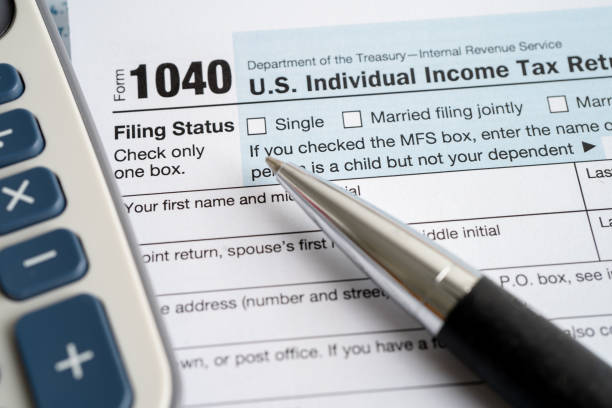
While the income tax under social contract theory is more “equitable” than tariffs, one of its most egregious features cannot be justified.  Under current law, American citizens that are living abroad or have relocated permanently are still subjected to the income tax.  However, expats are no longer being defended by the U.S. government.  Renouncing citizenship (which is quite costly) is the only way to avoid being taxed.

Why should Americans, who are no longer being defended by their government, still be required to pay for it?  This would be a clear violation of the “social contract” that citizens have supposedly agreed to. 

There are other dangers that have come with government financing through tariffs, or, as some have called for, a national sales tax. Originally, when the income tax was proposed, it was to replace tariffs.  Tariffs, like all sales taxes, burden the poor and middle class disproportionately.  The income tax, which at first only affected the affluent, was accepted by the public since tariffs were to be eliminated.  Unfortunately, the tariffs remained after the two world wars and the income tax was levied on almost everyone. 

A similar situation could occur with the expansion of tariffs or the implementation of a national sales tax.  Governments rarely relinquish their taxing power.  

What is being ignored in the talk about tariffs and the income tax are the exploding government deficits.  Fiddling with what source of revenue the government collects is not addressing an impending financial crisis that could bring down the entire U.S. economy.

Of course, runaway debts and deficits are inherent in democratic republics as politicians are not personally responsible for the debt, unlike a monarch or king.  This is another flaw in the social contract theory. 

Before policy makers change the nation’s tax system, they should carefully consider the ramifications and seek to find the most equitable solution that will not burden only part of the citizenry. Cutting runaway federal spending is a first step.       

*https://www.cnn.com/2024/10/26/politics/trump-income-taxes-tariffs/index.html

What the Rising Gold Price Signals

The recent run-up in the gold price has not garnered the attention among the mainstream financial media outlets as it should.  Gold has, in part, been overshadowed by the rise in the price of bitcoin and other cryptocurrencies. 

Naturally, the financial press, which is really an arm of the government and its central bank, wants to ignore, as much as possible, references to gold as protection against the continuing increase in the price level which itself has been deliberately understated by monetary officials.  The media and government understand that precious metals are the ultimate security against runaway inflation and economic collapse.

While the increase in the gold price has reached nominal highs, it and the price of silver have not passed their all-time 1980 highs in real terms.  Adjusted for inflation, gold would have to rise to about $3590 an ounce while silver would have to surpass $50 an ounce.  Both are poised to exceed these watermarks in the not-too-distant future.

Precious metals will continue to escalate unless the Federal Reserve radically changes its interest rate policy to combat inflation as former Fed Chairman Paul Volcker once did.  Volcker raised interest rates to double-digit levels which caused gold prices to fall.  While Volcker could get away with such actions (because, at the time, the U.S. was still a creditor nation), current Chair Jerome Powell cannot because of the enormity of public and private debt.  Double-digit interest rates would collapse the economy and plunge millions of Americans into bankruptcy.

The rising price of gold is anticipating some of the promised policy actions of the Fed.  Since the end of last year, the central bank has indicated that it would be cutting interest rates.  In addition, Powell is considering ending the Fed’s “Quantitative Tightening” (QT) program.  Both are highly inflationary. 

While commentators have focused on gold’s spectacular price rise, there is an underlying issue that is also taking place.  The record setting gold price is signaling that the present fiat monetary order, which is based on the dollar as the world’s reserve currency, is coming to a financially unpleasant end. 

Ever since 1971, when the Nixon Administration closed the “gold window,” refusing to redeem gold for dollars held by foreign central banks, the world has been on a “dollar standard” where bank reserves are held in Greenbacks.  If the Fed continues to print dollars to sustain government spending at this rate, the dollar will continue to lose purchasing power and foreigners will no longer want to hold them.  Foreign central banks will then turn to gold.  In fact, central banks are already increasing their positions in gold which has been a catalyst that has fueled the latest rally.

Not surprisingly, the Fed has not purchased much gold (or is not admitting publicly that it has) since it would be a bad look for the issuer of the world’s reserve currency to be abandoning its own currency for gold.

Besides the severe financial implications if the dollar is dethroned, there will be dramatic geopolitical repercussions from the loss of its hegemony.  Just like the British pound was replaced as the dominant world currency after England insanely exhausted itself in fighting WWII and ending its empire, America will face a similar future when the dollar becomes just another money.  Many will see it as a “blessing” if and when the U.S. Empire comes to an end.

While it would appear logical and morally sound to replace the present crumbling monetary order with one based on gold and silver, a far worse paradigm than even the present one is, no doubt, being planned.  The new system will be one of central bank digital currency (CBDC) which would give governments and bankers the power to monitor and control all aspects of economic and social life. 

Some states have passed legislation to counter CBDC, such as Florida in 2023 under Governor Ron DeSantis who said: “The Biden administration’s efforts to inject a Centralized Bank Digital Currency is about surveillance and control.  Today’s announcement will protect Florida consumers and businesses from the reckless adoption of a ‘centralized digital dollar’ which will stifle and promote government-sanctioned surveillance. . . .”*

While the press and policy makers have ignored the surge in precious metal prices, it should be a warning to everyone that difficult economic times are still yet to come with the potential of a new draconian monetary order to be installed on the horizon.  Observant individuals should heed gold’s signals and take appropriate measures to safeguard their futures.

*https://www.flgov.com/2023/03/20/governor-ron-desantis-announces-legislation-to-protect-floridians-from-a-federally-controlled-central-bank-digital-currency-and-surveillance-state/

Antonius Aquinas@AntoniusAquinas

https://antoniusaquinas.com

The U.S. Is Spending $1 Trillion Every 100 Days On The Deficit

While it made some headlines in the financial press, neither policy makers nor the two presumptive presidential nominees have paid much attention to the fact that the U.S. is adding a mind-boggling $1 trillion to the national debt every 100 days.  This amounts to around $3.6 trillion annually. 

As law makers remain willfully ignorant of the financial elephant in the room, it is most likely that the only way that the debt will be addressed is through a monetary crisis which will involve the status of the dollar as the world’s reserve currency.  Such a scenario would then force authorities to take action.

As if there needed to be more evidence of how impervious Congress and the Biden Administration are to the burgeoning debt spiral, the House and Senate passed two stop-gap funding packages to avoid a government shut down on March 22, 2024.  One Senator called it “a pork fest of epic proportions.”*

Despite the ominous prognostications of a dollar collapse by financial doomsayers, the Greenback has remained the best of all competing currencies.  Yet, this time could be different, since interest rates – which have been artificially suppressed by the Federal Reserve (Fed) – have risen, making servicing of the national debt more expensive as Moody’s Investors Service noted: “In the context of higher interest rates, without effective fiscal policy measures to reduce government spending or increase revenues Moody’s expects that the US’ fiscal deficits will remain very large, significantly weakening debt affordability.”** 

While “King Dollar” has continued its financial hegemony, the running of a staggering national debt – which now stands at over $34 trillion – has had baneful repercussions for the average American.  The funding of the debt has led to a resurgence in 1970s-style stagflation with a decline in productive job growth such as manufacturing and near double-digit price inflation.  This, of course, has had a deleterious effect on the middle and lower classes’ standards of living since rising prices disproportionately effect these groups harder than the more affluent.

Of course, the simplest approach (although politically unpalatable) to the problem would be to dramatically cut government spending by eliminating agencies and programs.  With the Uniparty in charge, however, there is virtually no chance of budget cuts, especially in an election year.  Whatever happened to the “deficit hawks” and those calling for a balance budget amendment to the Constitution?

The funding of the debt is the primary factor for the rise in consumer and producer prices.  Since federal spending is beyond what the government receives in revenues, it must borrow through the issuance of debt/bonds to make up for the shortfall. 

The principal buyer of government debt has been the Fed, which pays for the bonds by the creation of money, “out of thin air.”  The printing of money (now done through the stroke of a computer key) bids up prices in the market.  Federal Reserve officials have innocuously called this scam “Quantitative Easing” (QE), which is in realty a monetization of the debt. 

Since the Fed has begun hiking interest rates, it has been doing “Quantitative Tightening” (QT) where it ostensibly has not been buying U.S. debt, but selling it.  This would lead to a contraction of the money supply and a fall in prices. The central bank has not been aggressive enough in its tightening nor has it raised interest rates enough to have any real effect on soaring prices. 

It is highly doubtful that the U.S. will escape the fate of other republics who have pursued reckless fiscal and monetary policies.  It is almost a mathematical certainty that the nation will default on its debt by either hyperinflating the currency or discounting bonds with massive haircuts to their premiums. 

The most likely path is hyperinflation; then the dollar will once again fulfill Voltaire’s dictum that all “paper money eventually returns to its intrinsic value – zero.”  While there will be massive social misery from a dollar collapse, the one bright spot from its demise is that it will mean an end of the murderous U.S. Empire.

*Tyler Durden, “’A Pork Fest of Epic Proportions:’ Congress Passes Spending Package to Avert Shutdown.” Zero Hedge 8 March 2024.  https://www.zerohedge.com/markets/pork-fest-epic-proportions-congress-passes-spending-package-avert-shutdown

**Quoted in Michelle Fox, “The U.S. national debt is rising by $1 trillion about every 100 days,” cnbc.com   https://www.cnbc.com/2024/03/01/the-us-national-debt-is-rising-by-1-trillion-about-every-100-days.html   Updated, 4 March 2024.

Antonius Aquinas@AntoniusAquinas

https://antoniusaquinas.com

America’s Trade Deficit: An Enormous Concern

Another milestone (or more accurately millstone) was recently passed by the U.S. economy as the January trade deficit surged to an all-time record high of $107.6 billion, up some $26 billion from December’s $80.7 billion imbalance.*

Like the gigantic federal budget deficit, the trade imbalance is no longer talked about by the financial press.  There has been little criticism of President Biden on either matter nor are Administration officials questioned about how things can be reversed.  In fact, some commentators bizarrely contend that trade deficits show how robust an economy actually is!     

The trade deficit was supposed to be alleviated by former President Trump who vowed throughout the 2016 campaign that he would rectify the situation and repeatedly ridiculed U.S. trade negotiators for their lack of financial acumen.  He touted that his “friendship” with world leaders, most notably Chinese President Xi Jinping, would result in favorable trade deals for the country. 

Trade hawks got on board with Trump’s economic nationalism believing that he would not only fix imbalances, but create an American industrial renaissance.  Optimism ran high after his unexpected win in 2016. 

As president, after a couple of contentious years of on-again, off-again negotiations a first phase of an agreement with China was signed in early 2018.  During the negotiations, he boasted:

When a country (USA) is losing many billions of dollars

on trade with virtually every country it does business with,

trade wars are good and easy to win.**

In actuality, nothing significant was agreed upon with China despite the Trump Administration bragging that it was the first phase of a more comprehensive deal to come.  Despite all of the hoopla, the trade imbalance continued to grow and no deal was ever finalized. 

Besides the initial agreement with China, the next biggest trade policy act was the scrapping of NAFTA and its replacement with a new treaty, “The U.S.-Mexico-Canada Agreement” (USMCA).  The new agreement was little different than the original treaty.

Thus, by the time he left office in 2020, the U.S.’s trade gap ($68.2 billion) was greater than during his predecessor, Barrack Obama’s term, who Trump lambasted for his ruinous trade policy.***

Trump wisely spoke little about trade during his unsuccessful 2020 re-election bid and, surprisingly, his opponents, despite the president’s miserable failure, steered clear of the issue.  Of course, the Democrats were limited in what they could do with an obvious feeble, senile, and vile candidate at the top of their ticket.

Like the Democrats, Trump’s trade-hawk cheerleaders have remained reticent about the escalating trade numbers and like the former president they too, are now discredited when it comes to trade.  If America could not overcome its trade gap with an economic nationalist as president for four years, then there must be a problem with their thinking.      

The reason why Trump failed – as will Biden – is that he, his negotiators, and the trade hawks who supported him are ignorant of basic economics. The burgeoning trade deficits are not the result of bad trade deals or that of ineffective tariff policies, but are the result of a deteriorating U.S. economy which is no longer one of production, but of consumption and debt.  A growing economy creates trade surpluses not deficits; it produces more than it consume.

Because of decades of anti-capitalistic economic legislation – confiscatory taxation, regulatory burdens, inflationary monetary policy, “crowding out” budget deficits, unemployment subsidies, minimum wage laws, and an overemphasis by the Establishment on higher education – the U.S. is no longer an industrial power and not a conducive environment for economic growth.    

Because it possesses the world’s reserve currency, the U.S. has been able to offset its trade imbalances by importing goods in exchange for dollars.  Even with this advantage, however, trade deficits have continued to grow.  It appears that even its status as the possessor of the world’s reserve currency may be coming to an end as the dollar’s preeminence will fall with the surge in price inflation.  This will have a devastating effect not only for the domestic economy but its foreign trade as well as the country will not be able to export dollars for goods in the future. 

The burgeoning trade deficit is a far more accurate indicator of the health of an economy than GDP, unemployment figures, or the government’s “official” rate of price inflation.  All these statistics are so manipulated that they do not come close to showing what is actually happening in the real world.  The trade deficit is a more reflective gauge of an economy’s productive capacity.    

That Trump posted the largest trade deficit in history also explodes his claim that under his watch, the U.S. had the greatest economy ever!  How he calculated and supported such nonsense (which was not challenged by the financial press) is hard to maintain with trade deficits in the stratosphere.

When America’s economy was at its zenith, it was a creditor nation with trade surpluses and producing goods which were sold the world over.  It had a high savings rate, a low inflationary environment, little public debt, and respect for private property, particularly the right for entrepreneurs to hire and fire whom they pleased.  All socio-economic groups prospered from the free market and free trade, not just the 1%. 

The trade deficit can be turned around, but not through bureaucratic state orchestrated deals which favor big business and multi-national corporations at the expense of American consumers.  The proper trade policy is no policy at all, except the freeing of the economy from government intervention.     

*https://www.reuters.com/business/us-goods-trade-deficit-hits-record-high-january-2022-02-28/

**https://www.reuters.com/article/us-usa-trade-trump/trump-tweets-trade-wars-are-good-and-easy-to-win-idUSKCN1GE1E9

***https://www.cnbc.com/2021/03/05/us-trade-deficit-january-2021.html

Antonius Aquinas@AntoniusAquinas

https://antoniusaquinas.com


On the 75th Anniversary of V-E Day and the Coronavirus Scamdemic

VE Day Coronavirus

The iconic Champs-Élysées and its Arc de Triomphe stand eerily empty before V-E Day ceremonies Friday in Paris.

This month (May 8th) marks the 75th anniversary of “V-E Day” when German forces unconditionally surrendered to the “Allies.”  Numerous articles, essays, and monographs have appeared commemorating the anniversary and while all are mostly laudatory, some have acknowledged that the outcome had its “drawbacks.”

By any objective rendering, for Western Civilization WWII was an unmitigated catastrophe whose reverberations continue to this day.  Forty-three million troops were senselessly killed between American, British and Continental forces while 38 million civilians perished.  Europe’s current demographic nightmare had its unfruitful seeds cut down with the depopulation of the Continent’s finest for the maniacal aims of the world’s power elites.  Not only the loss of life, but the destruction of property and the cultures upon which they were built have been incalculable.  Although the US emerged in the post-war world as the dominant economic and political power (as its mainland remained unscathed from wartime destruction), its participation in the conflict was a titanic geopolitical blunder.

The defeat of Germany and Japan, which would have not come about without US military might, left vast power vacuums in Eastern Europe and the Far East that Soviet Russia and Red China ruthlessly filled.  Half of Europe would fall behind the Iron Curtain, subjected to fierce political repression and debilitating socialistic economic planning.  In Asia, Communist regimes sprang up with the assistance of China and the Soviet Union which America attempted to counter in Korea and Vietnam at a staggering cost to its domestic economy and social tranquility.

Even after the fall of Soviet Communism, the US’s supposed lethal enemy, America maintained its empire as its “defense” spending continued to escalate beyond all reasonable levels which has led, in part, to the decline of domestic living standards of nearly all except, of course, for the politically well-connected. Not only has military adventurism bankrupted the country, but there is now “blowback” from the countless enemies either real, imagined, or contrived – created by US overseas meddling.  Moreover, the nation’s military-industrial and security complex has turned on its own citizens with spying, surveillance, and data gathering that would be the envy of Stalin’s Cheka. Yet, it was US participation in WWII which cemented the nation on its ruinous course as global policeman.  This was predicted and feared by “isolationists” at the time which is why they so courageously fought to keep the country neutral.

While the peoples of the world suffered from the Apocalyptic-like destruction of the war, certain groups did gain.  The benefactors were obvious – Stalin and the Soviet state which was given free reign in Eastern Europe; the US military and security industrial complex which had a world empire to police; Chinese Communists, with Imperial Japan decimated, it left little opposition for them to gain control in China and beyond.  For almost everyone else, even the so called “victors,” WWII was a Pyrrhic victory at best.

For the remainder of 20th century American history, US entry into the Second World War proved to be the catalyst which led to the immense cultural, economic, and political changes, which many conservatives, libertarians, and traditional-minded people at the time and afterwards opposed.  Yet, it was US participation in the war which meant that all of those changes would become permanent.  Harry Elmer Barnes, who was a keen social theorist and wrote extensively in sociology, clearly understood the effects of US entry into the war:

Drastic changes in the domestic realm can also be attributed to the impact of our

entry into the second World War.  The old rural society that had dominated

humanity for millennia was already disintegrating rapidly as the result of

urbanization and technological advances, but the latter failed to supply adequate

new institutions and agencies to control and direct an urban civilization.  This

situation faced the American public before 1941 but the momentous transformation

was given intensified rapidity and scope as a result of the extensive dislocations

produced by years of warfare and recovery.*

Harry Elmer Barnes Harry Elmer Barnes

While every sector of American life was unalterably changed, the most ominous took place in the political order.  Although the federal government had begun to expand during the Progressive Era, its scope and involvement in society drastically accelerated during and after the war.  Barnes, holding many libertarian beliefs, observed the totalitarian features of the post-war nation:

The complex and cumulative aftermath of [WWII] has played the dominant role in

producing the menacing military pattern and political impasse of our time, and the

military-industrial-political Establishment that controls this country and has sought

to determine world policy.**

The rise of America to world power status diverted attention and scarce resources away from the domestic front, which further exacerbated social and economic changes.  The societal strife would become more and more acute as the nation’s overseas commitments mushroomed, as Barnes incisively explains:

The social problems of an urban age were enlarged and intensified, crime increased

and took on new forms that became ever more difficult to combat, juvenile

disorganization became rampant, racial problems increased beyond precedent, and

the difficulties of dealing with this unprecedented and complicated mass of domestic

issues were both parried and intensified by giving primary but evasive

consideration to foreign affairs in our national policy and operations.***

While domestic problems received less attention as the American empire expanded, foreign lands which held different patterns of social order or had non “democratic” forms of government, were targeted for “regime change,” even if they had taken no hostile action toward the US:

. . .  the results of [WWII] already indicate that this produced drastic and possibly

ominous changes in the pattern of American relations to the rest of the world.  We

voluntarily and arbitrarily assumed unprecedented burdens in feeding and

financing a world badly disrupted by war. . . .  The United States sought to police the

world and extend the rule of law on a planetary basis, which actually meant

imposing the ideology of our eastern seaboard Establishment throughout the world,

by force, if necessary. . . .****

Had the US remained neutral as the isolationists and American First supporters had pleaded, the world today would be markedly different – undoubtedly freer, more prosperous, and likely more peaceful.  Since every society is governed, in part, by its understanding of the past, the post-WWII world is built on a lie.  The lie, of course, was that the attack on Pearl Harbor was unprovoked and that the Roosevelt Administration had negotiated in good faith with the Japanese in the months and years leading up to it.

While not recognized at the time and even today the outcome of WWII ushered in the totalitarian nation state which would become a permanent and intimate fixture in the lives of its citizens.  There was no appeal to its dictates and as the decades rolled on it accrued unthinkable power over the society and economy.  It attempted to solve every social and economic problem or inequality (most of which it created) and in each action enhanced its power and control dramatically.

The corona scamdemic may be the state’s greatest power grab yet.  Besides the infringement of civil liberties, the shut down has been adroitly used to cover for the titanic economic collapse which began in the weeks prior to the draconian response measures.  Actually, the financial breakdown began last September with the Fed’s “repo” operations.

All of this has been quietly and deliberately forgotten by the financial press and under the cover of fighting the virus, the Fed and the rest of the world’s central banks have expanded their power and control of financial markets to unprecedented levels, making a mockery that the economy is in any sense “capitalistic.”

The adage that “history is written by the victors” has never been more apparent than in regard to V-E Day, however, the coronavirus scam has shown once again that the consequences of the day and the war which it commemorates are now being ominously fulfilled.

*Harry Elmer Barnes, “Pearl Harbor After a Quarter of a Century.”  In Left and Right: A Journal of Libertarian Thought.  Vol. IV, 1968, p. 11.

**Ibid., pp. 9-10.

***Ibid., p. 11.

****Ibid., pp. 10-11.

Antonius Aquinas@AntoniusAquinas

https://antoniusaquinas.com