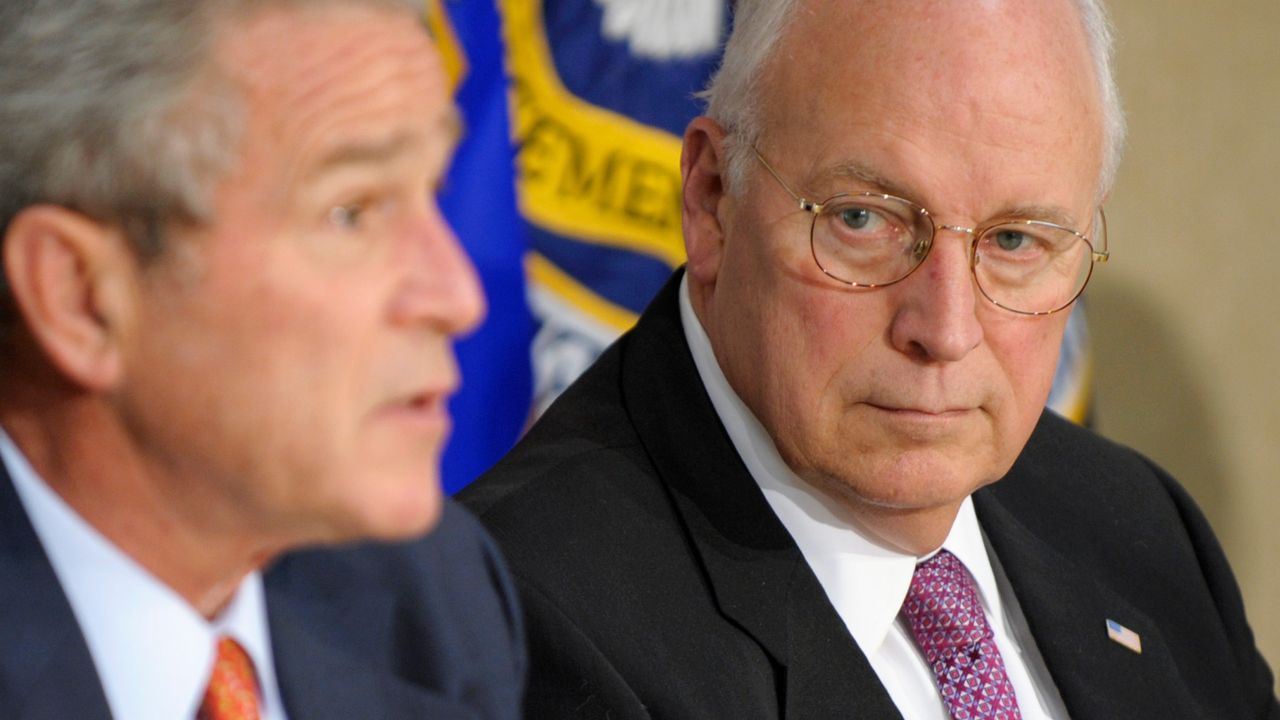
Former Vice President Richard “Dick” Cheney died on November 3, 2025 at the age of 84. As secretary of Defense under President George H.W. Bush, Cheney was the architect of the 1991 Persian Gulf War and later, as vice president under George W. Bush, he was instrumental in the invasion and eventual conquest of Iraq.
Brown University’s Cost of War Project has modestly estimated that the “wars on terror” have resulted in the deaths of more than 940,000 people including 432,000 civilians and a monetary cost to the United States of about $8 trillion.
Of course, Brown University’s study calls the post 9/11 U.S. military operations in the Middle East “wars on terror” when, in reality, they have been fought for the benefit of Israel and its Greater Israel Project, which has decimated the Arab world and has accomplished almost all of its objectives.
Cheney’s nefarious activities were not confined to mass murdering peoples that posed no threat to America’s national security. He was a force behind the U.S. policy of torture (waterboarding), and nearly unlimited domestic surveillance (the Orwellian-labeled Patriot Act).
According to an article on the news and commentary website “Antiwar,” headlined “Dick Cheney: The Dark Legacy of a War Criminal,” Cheney suggested U.S. intelligence agencies must: [O]perate on the ‘dark side,’ spend time in the shadows, and use ‘any means at our disposal’ to achieve its objectives.”
As if the U.S. Presidency was not unrestrained enough, Cheney advocated a “unitary executive” theory that the “president alone decides matters within the executive branch” without input from opposition voices within the government’s foreign policy agencies.
The response by libertarian and alternative media outlets to Cheney’s demise were universal in their denunciation of the former vice president, calling him a “war criminal” and that he left this world with a “dark legacy.”
It should be noted that a number of alternative media’s podcasters who have criticized Cheney regularly host guests and speakers who are former U.S. military and diplomatic personnel, ex-CIA agents and intelligence operatives, a number of whom participated in the Iraq wars and other American covert operations themselves.
Few, if any, who condemned the former vice president for his criminality mentioned or questioned why it was, and still is today, that monsters like Cheney were able to inflict so much death and destruction on peoples and nations across the globe who posed no threat to America.
Could it be that the political system that Cheney operated under was the problem? And, what is to be done to prevent future Cheneys from committing similar atrocities?
Unfortunately, “democratic” wars are paid for “by the people” and the costs are socialized among the population through taxation, inflation (money printing), and deficit financing. Since warmongering politicians do not have to directly pay for conflicts, there will be a tendency for them to be more bellicose. Moreover, democratic wars are collective enterprises where elected officials are not personally responsible for the actions of the government but are agents of the voters.
Nor have the supposed checks and balances of constitutional government, so often touted by admirers of the U.S. Constitution, been able to prevent conflicts, as the horrific record of American warmaking sadly proves.
The passage of the U.S. Constitution established a powerful central state which could (and did) tap the resources and men of the individual states to conduct wars which eventually took place the world over.
A weak national government, like that under the Articles of Confederation, or no central state at all, but instead a political order of numerous sovereigns (a world full of Switzerlands, Liechtensteins, etc.) would make warfare on a massive scale impossible.
Chip Gibbons, writing in the Jacobin magazine, called Cheney an “enemy of democracy whose agenda included war, indefinite detention, warrantless surveillance, and torture,” according to Alan Mosley. *
Cheney was not an enemy of democracy, but the product of a system that enables evil men to carry out the most heinous acts with little consequence, at least in this life.
Labeling Dick Cheney a war criminal will tarnish his legacy, but it will not alter America’s murderous foreign policy course. That will only come about when there is a recognition that the governing system itself needs to be abandoned and a decentralized political arrangement adopted.
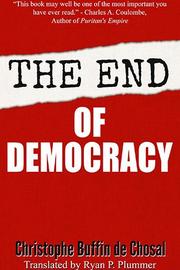
Review: Christophe Buffin de Chosal, The End of Democracy, Translated by Ryan P. Plummer. Printed in the U.S.A.: Tumblar House, 2017.
Introduction
One cannot speak too highly of Christophe Buffin de Chosal’s The End of Democracy. In a fast paced, readable, yet scholarly fashion, Professor Buffin de Chosal* demolishes the ideological justification in which modern democracy rests while he describes the disastrous effects that democratic rule has had on Western societies. He explodes the myth of Democracy as a protector of individual liberty, a prerequisite for economic progress, and a promoter of the higher arts. Once Democracy is seen in this light, a far more accurate interpretation of modern history can be undertaken. The book is a very suitable companion to Hans-Hermann Hoppe’s iconoclastic take down of democracy in Democracy: The God That Failed, released at the beginning of this century. Buffin de Chosal has spoken of a follow up which will be eagerly awaited for.
Democratic Governance
The idea of rule by the people is a scam, one perpetuated by those who, in actuality, are in control of the government. Through the “democratic process” of voting and elections, a small, determined minority can impose its will despite majority opposition:
We often hear it said that ‘in a democracy,
it is the people who rule. . . .’ Rule by the
people is a myth which loses all substance
once confronted with the real practice in
democracy. [13]
Quoting from a Russian philosopher, Buffin de Chosal continues his criticism:
The best definition [of democracy] was
given by the Russian philosopher Vasily Rozanov.
‘Democracy is the system by which an
organized minority governs an unorganized
majority.’ This ‘unorganized majority’ is the
people, aggregated and individualistic,
incapable of reaction because disjointed. [28]
He expands upon Rozanov’s theme:
. . . [C]ontrary to what [democracy’s] principles
proclaim: one can say that the majority
almost never wins. Democracy is not the
system of the majority, but that of the most
powerful minority, and it has this power
not simply due to its numbers, but also and
above all due to its organization. [31]
Power does not reside in “the people” and certainly not in the individual. In democracy, the only way to express one’s preference or protect one’s rights is through the ballot box every so often. “Each voter,” writes Buffin de Chosal, “in a democracy, is the depositary of a tiny particle of sovereignty, in itself unusable. His sole power consists in dropping a ballot into a box, whereby he is immediately dispossessed of his particle of sovereignty at the profit of those who are going to represent him.” [Ibid.]
Popular democracy has always been condemned and feared by most thinkers since the beginning of human societies. It was not until intellectuals saw democracy as a way they could attain power that they began to advocate it as a system of social order. Prior to the democratic age, most of the learned understood that democracy would result in mob rule and the displacement of natural authority with demagogues. In short, the worst would rise to the top as the author describes the characteristics of a contemporary politician:
The ideal politician, on the other hand, is
pliable, convincing, and a liar by instinct. He is
not attached to any platform and has no
ideological objective. The single thing to which
he is truly committed is power. He wants its
prestige and advantages, and seeks above all
to be personally enriched by it. Any politician
who presents this aspect is recognized as fit for
power in a democracy. . . . It is therefore not
surprising that democratically elected assemblies
are almost exclusively comprised of
these kinds of men and women. Elected
heads of state almost always fit this profile,
and international institutions, such as the
European Union, consider it the only
acceptable profile. . . . [35]
Democracy and the State
Since the advent of modern democracy, the principle benefactor of its rule has been the State and the politically-connected financial elites who are in actuality the true rulers of societies. Instead of putting an end to the supposedly despotic rule of the Ancien Régime, which Democracy’s proponents claim to have existed throughout the monarchial and aristocratic age, governance by the people, has instead witnessed an increase in state power and control of individual lives to an unprecedented level in human history. Few, if any, pope, emperor, king, prince, or duke have ever possessed such suzerainty.
In contrast to what has been taught in classrooms, on university campuses, and espoused throughout the media, individual rights and freedoms were far better guarded in the age prior to Democracy’s ascendancy. Pre-revolutionary Europe had social structures which insulated individuals from State power far more effectively than under modern democracy:
The concept of an organic society was abolished at
the time of the French Revolution. The corps and
orders were suppressed, the privileges were abolished,
and everything which allowed the people to protect
themselves from the power of the state was banished
in the name of liberty. [24]
And in return for giving up the order that protected them from state depredations, the people received “sovereignty:”
They were given the false promise that they
would no longer need to defend themselves
from the state since they themselves were the
state. But if a people organized into corps and
orders are incapable of exercising sovereignty,
how much more so a people comprising a formless
mass of individuals! [Ibid.]
Historically, all of the democratic movements which supposedly stemmed from the people were, in fact, a falsehood, perpetuated largely by revolutionaries who sought to replace the established order with themselves. While legislatures, congresses, and democratic bodies of all sorts have been interpreted as the fruition of the masses’ desire for representation, the reality was quite different:
Democracy is not, in its origin, a system of
the people. In England with the advent of the
parliamentary system just as in France during the
Revolution, it was not the people who were seen
at work. Even the Russian Revolution was not a
phenomenon of the people. To regard the people
or what the communist elegantly call the ‘masses’
as the agent of change or political upheaval is purely
a theoretical view, a historical myth, of which
one sees no trace in reality. The ‘people’ were
the pretext, the dupes, and almost always the
victims of the revolutions, not the engines. [13]
Not only was propagation of the myth of popular support for democratic ideals propounded for the survival of the new social order, but putting these tenets into practice was accomplished, in large part, by the role of the “intellectual” an often neglected feature of standard historical analysis and the reason behind much social transformation:
The ‘nation’ met the desires of the philosophers
who wanted to transfer power from the monarch
to an enlightened, philosophical, and philanthropic
class who, moreover, ought to be financially
comfortable. The educated bourgeoisie of the
time were the protagonists of this idea, and a
portion of the nobility formed their audience. [13-14]
The intellectuals promoted Democracy because it would open up for them considerable opportunities for position and income in the nation state. It must be remembered that it was the intellectuals who justified the idea of Absolutism. Later, the intellectuals turned on the monarchies and sided with the emerging republican classes rightly believing that democratic governance would give them greater opportunities for power in the emerging nation states.
Democracy and Modern History
While most historians see the advancement of democracy and the development of legislative bodies over the course of the last centuries as an advancement in the human condition and one that has emanated from the people’s desire for greater political representation, Buffin de Chosal presents a far different and more accurate interpretation. “Democracy,” he asserts, “is not, in its origin a system of the people.” [13] All of the social movements which eventually led to the destruction of Christendom did not come from the people seeking a greater “voice” in their governance.
“The ‘people,’” he argues, “were the pretext, the dupes, and almost always the victims of the revolutions, not the engines.” [Ibid.] Liberty, Equality and Fraternity was not a popular cry, but one coined and used by the “enlightened” classes to mobilize and justify their overthrow of the French monarchy and with it the destruction of the Church.
The French Revolution was built on the
idea of the ‘nation,’ which claimed to bring
together the intellectual, social, and financial
elite of the country. It was on this foundation
that democracy was established and that it
functioned during almost all of the nineteenth
century. [Ibid.]
A similar historical narrative can be seen in England.
The rise and eventual triumph of representative democracy in England was not one that percolated from the masses itching for more freedom. “The appearance of the parliamentary system in England,” Buffin de Chosal contends, “was tied to the great movement of Church property confiscation begun under Henry VIII and continuing until the coming of the Stuarts.” [14]
After Henry gorged himself on the Church’s wealth, he sought to bribe as much of the nobility as possible with his ill-gotten gains to insure his power. An envious Parliament, however, wanted its cut of the loot which led to the great internecine struggle between Crown and Parliament which eventually ended in the suzerainty of the latter with the Glorious Revolution of 1688. The real power from then on rested with an oligarchical legislative branch:
The families who had thus helped themselves
to the Church’s goods, morally justified by
Protestant ethics, formed the gentry, the class
of landowners who sat in Parliament. Parliament
was not then, as one might believe today, an organ
of poplar representation. It was an instrument
in the hands of the gentry to defend its own class
interests. [16-17]
That Parliament and the monarchy would become the two dominant ruling structures was the result of the breakdown of the feudal structure which was taking place not only in England, but across Europe. European monarchs continued to gain more and more power at the expense of the feudal landed elite. The gentry’s power and wealth was also on the wane with the rise of commercial centers which most of the time aligned themselves first with the kings and then later with Parliament. The eventual triumph of Parliament, however, did not mean greater democracy for the people:
The financial incentives for England’s adoption
of the Protestant Reformation are therefore
intimately connected with the bolstering of
Parliamentary power. The Parliament in England
was used to put the monarchy in check and to
replace it with an oligarchic class of wealthy
Protestants to whom the kings were required to
submit. This is why the overthrow of James II
in 1688 was a true revolution. It was not a
popular revolution or the overthrowing of a
tyranny, but it was the rebellion of a class
implementing the transfer of sovereign power
for its own profit. [17]
The Market Economy
The author takes a refreshing look at the market economy that sets straight the inaccurate and often times hostile analysis of it that frequently comes from conservative circles. He distinguishes and rightly points out that “pure capitalism” or the “unhampered market” is an “excellent thing” [123]. The free market is intimately tied with private property which is a prerequisite for a just society:
[Capitalism] proceeds from respect for private property.
As capitalism is the reinvestment or saved money for the
purpose of making new profits, it presupposes respect for
property rights and free enterprise. It has existed in Europe
since the Middle Ages and has contributed significantly to
the development of Western society. [Ibid.]
He insightfully notes that “bad capitalism” often gets lumped in with its “good form” while the latter gets the blame for the baneful excesses of the former. “Monopoly capitalism,” “corporatism,” “the mixed economy,” and “crony capitalism” are not the result of the market process, but stem from “intervention” brought about by the State in favor of its business favorites through participatory democracy. In a truly free market, entrenched wealth is rarely maintained but is constantly subjected to challenges by competitors:
But what one ought to designate as bad
capitalism is the concentration of wealth and
power this wealth procures. This danger does
not stem from capitalism itself but rather from
parliamentary democracy, for it is democracy
that enables money powers to dominate the
political realm. [Ibid.]
The “monied interest” did not exist under “traditional monarchy,” but was a product of Democracy and the protection and extension of the “bad capitalistic” paradigm that came into being and was expanded by the rise of popular representative bodies. Assemblies, legislatures, and congresses, which emerged, became aligned with the banking and financial interests to bring about the downfall of the monarchies.
The concentration of political power could only be attained after the control of money and credit were centralized in the form of central banking and the gold standard was eliminated. Central banks have been an instrumental part of the democratic age, funding the nation state’s initiatives and enriching the politically- tied financial elites at the expense of everyone else.
Wealth concentration is not a by-product of the free market. Rarely are firms able to maintain their dominance for long periods of time. Many turn to the State to get protection and monopoly grants to ensure their position in the economy:
. . . capitalism only becomes harmful when
it grants political power to the money powers.
This was only made possible thanks to the advent
of parliamentary democracy, which was an
invention of liberalism. It is therefore the
foundational principles of political liberalism
(equality before the law, suppression of privileges,
centralization of political power, censitary suffrage,
and the accountability of ministers to the legislative
houses) which have enabled the rise of a wealthy class
and its power over society. [124]
Such sound economic analysis abounds throughout his tome.
Future Prospects
The author rightly sees that because of its nature and the type of personalities that it attracts, modern democracy cannot reform itself, but will eventually collapse from financial stress, war, and/or civil strife:
Parliamentary democracy rarely produces true
statesmen, as its party system more often
promotes ambitious and self-interested persons,
demagogues, and even communication experts.
These are generally superficial and egocentric
individuals with a very limited understanding
of society and man. These politicians do not
have the makings of statesmen. They are
adventurers who use the state to satiate their
hunger for power and money or to benefit
their party. [147]
Efforts to reform it, however, should not be totally dismissed since they could lead to more fundamental change and ultimately the creation of a new political paradigm for Western governance. Populism and the various movements around the globe which fall into that category should be encouraged. Populism, because of is lack of definite ideological underpinnings, has meant different things at different times to different people. Most populists, however, do not want to get rid of democratic forms of government, but want the system to be more “responsive” of its constituents instead of favoring entrenched political elites. Populism is a symptom of the growing failure of modern democracy’s inability to “deliver the goods” that it promises to a now growing dependency class.
As a means of getting rid of totalitarian democracy, populist movements and themes should always be encouraged:
In Europe, the only political forces today
which could, in the more extreme of circumstances
assume this rescue role are found on the side of
populism. Conservative in its values, sometimes
classically liberal when it is a matter of opposing
the stifling interventionism of the state, and yet ready
to defend social gains . . . populism is the only
political current which comes to the defense of
those interests of the population denied or ignored
by the parties in power. [148]
He adds:
Populist parties, from the simple fact that they
can bring together voters from both the left
and the right, have a chance of coming to power
in the near enough future. The deterioration of
security conditions in Europe due to mass
immigration plays in their favor. [148-49]
While he does not explicitly discuss it, a more concrete and ideological coherent idea and one of historical precedent, is that of secession. For all those who oppose the democratic order, secession is the most justifiable, logical, and practical strategy for the dissolution of the nation state. Secession movements, therefore, whether they do not outwardly condemn parliamentary democracy and only seek to establish a “better run” system, should always be supported.
Conclusion
The most likely scenario if there is to be a change in Western democratic life will be from a world-wide economic crisis and collapse of the financial system which will render the nation states unable to meet their financial obligations to their citizens. All economies are hopelessly indebted from their welfare state excesses and can never hope to meet their promises which now runs in the trillions. What will emerge in the aftermath of a collapse is hard to predict, but some form of authoritarianism is likely which will be centered on a one-world state with a single, irredeemable currency.
While the financial demise of Western-styled democracy will be evident for all to see, its ideological underpinnings which have justified its existence needs to be extirpated. Any hope of it being reconstituted to better serve “the people” needs to be shot down. There is no better place to start the de-mystification of Democracy than with Christophe Buffin de Chosal’s magnificent, The End of Democracy.
*Professor Christophe Buffin de Chosal teaches economic history at the United Business Institutes.
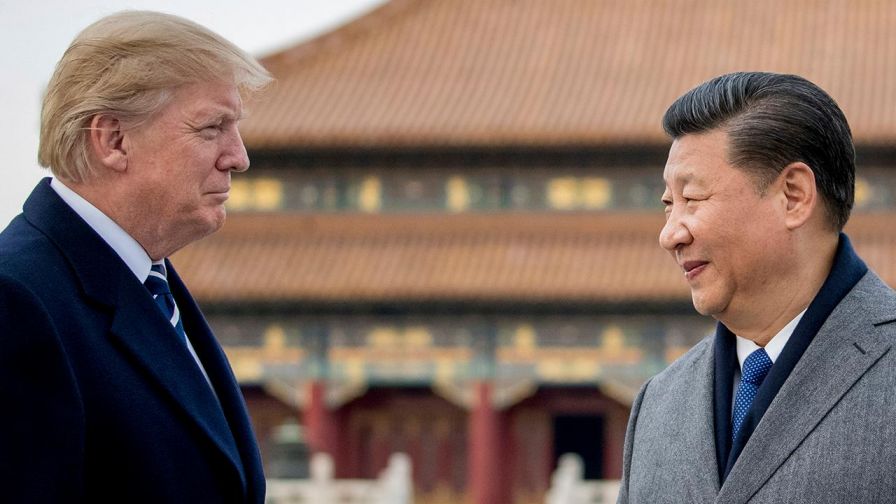
Instead of a demonstration of its overwhelming military might intended to intimidate tiny North Korea and pressure China to lean on its defiant communist neighbor, President Trump and the West should try to learn a few things from China.
The President’s trip to the Far East came on the heels of the completion of China’s 19th National Congress where the current president, Xi Jinping, has cunningly positioned himself as China’s unchallenged leader. In an address at the opening of the Congress, Xi cautioned that the country faced “challenges” that are “extremely grim” yet, despite these, the nation’s future is “extremely bright.”*
While Western politicos and pundits bemoan the lack of political pluralism that exists within China and President Trump complained about bad trade “deals,” they miss an important factor as to why China has transformed itself from a socialist basket case some three decades ago into an economic powerhouse which now boasts over a third of the world’s billionaires!
China’s economic ascendancy can be attributed not only to the implementation of market reforms in the 1990s, but also its lack of “political competition.” As a one-party state, resources, time, energy, and capital are not allowed to be channeled into wasteful political processes, but instead are used and “invested” in wealth-creation activities – construction, factories, plants, equipment, research, technology – all of which leads to more and cheaper consumer goods.
The US and the West spend too much on elections, campaigns, polling, political consultation, etc., which diverts scarce resources away from the private wealth sectors of society. For example, in her last failed presidential campaign run, the Wicked Witch of Chappaqua alone spent over a half of billion dollars.
Under Western democratic pluralism, public debt and state spending have increased to unsustainable levels. In the US alone – history’s greatest debtor nation – the national debt is in excess of $20 trillion, while its total debt officially is $68 billion with a federal deficit (GAAP) running yearly at $5 ½ trillion.
Such staggering numbers are the result, in part, from political parties seeking public office and once elected exploiting their position to enrich themselves, their constituents, and create dependent classes among the ever shrinking productive segments of society.
China’s foreign policy – an extension of politics – has also been conducive for wealth creation. Instead of wasteful spending on military hardware, the maintenance of a far-flung global empire, and involvement in incessant wars, China has a rather meek military compared to its national income and has conducted a pretty much non-interventionist foreign policy – witness its diplomacy with North Korea.
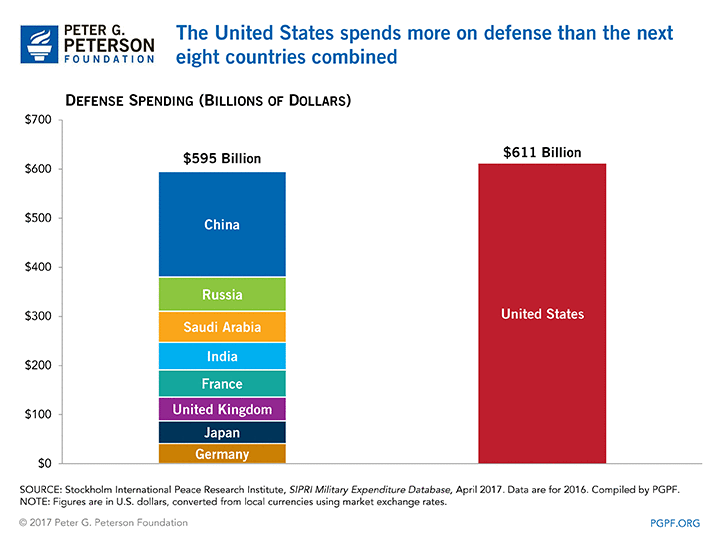
The US is almost the polar opposite. It spends more on “defense” than the next eight countries combined.** Instead of the production of useful consumer goods, billions are siphoned off into the military/security industrial complex. Not only does this impoverish Americans at home, but it leads to never ending involvement in wars, conflicts, and disputes, most of which are created or exacerbated by US spy organizations.
After meeting with Chinese leadership, President Trump tweeted:
I don’t blame China, I blame the incompetence
of past Admins for allowing China to take advantage
of the U.S. on trade leading up to a point where the
U.S. is losing $100’s of billions. How can you blame
China for taking advantage of people that had no clue?
I would’ve done the same!
Making better trade deals will not revitalize the moribund US economy. Instead, there should be less politicization of society and adoption of market reforms as China has done. The most important plank of such a policy would be the encouragement of real savings – not the creation of bank credit – through the normalization of interest rates. This would begin the arduous process of capital accumulation, the basis upon which any economy can be built.
Another sign of the divergence between the two is China’s continued push to make the yuan the world’s reserve currency with apparently some sort of gold backing to it. Contrarily, the Trump Administration has continued the same disastrous policies of its predecessors and has chosen a Janet Yellen clone to head the Federal Reserve with a continuation, no doubt, of the suppression of interest rates. On the other hand, China continues to import massive quantities of gold and encourages its citizens to own the yellow metal while the West is in the midst of a crypto currency mania, another fraudulent monetary scheme.
China’s economic miracle, while certainly impressive, would not look as astounding if Western economies had not been in a state of stagnation and decline over the past half century. It was not political liberalization that led to China’s phenomenal growth, but economic freedom which used to be a staple of Western life. The lesson that should be taken from President Trump’s trip is less politics domestically and more free markets.
*Chris Buckley, “Xi Jinping Opens China’s Party Congress, His Hold Tighter Than Ever.” The New York Times, 17 October 2017. https://www.nytimes.com/2017/10/17/world/asia/xi-jinping-communist-party-china.html


 Antonius Aquinas