Tag Archives: deficit

Trump’s “Big Beautiful Bill” and the Ultimate Demise of the Dollar

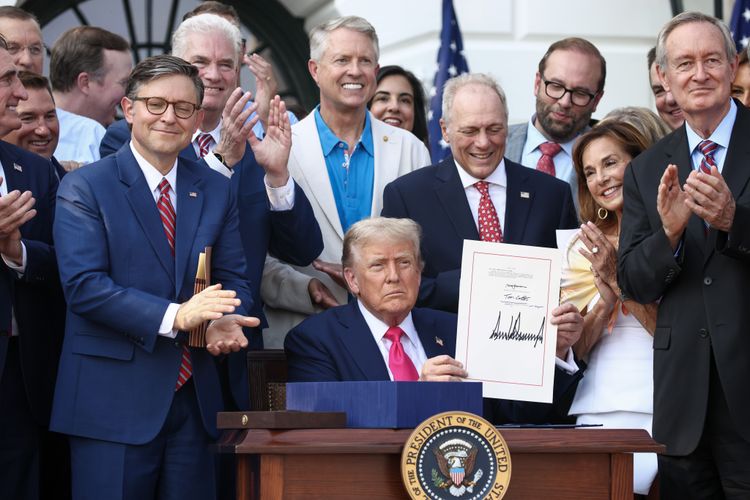
Despite considerable arm-twisting, President Donald Trump’s laughably misnamed “Big Beautiful Bill” (actually a Big Ugly Atrocity) barely passed both houses of Congress.  Such a monstrosity, which has been conservatively estimated to add $5 trillion to the national debt including interest over the next decade, is a slap in the face to those souls who believed Trump’s campaign rhetoric of cutting federal spending.*  This vindicates, once again, those who have correctly seen Trump for what he truly is – a big-spending liberal New York democrat.

Arguably, the most reprehensible aspect of the legislation is the $150 billion increase in “defense” outlays which will boost Uncle Sam’s military budget to a neat $1 trillion a year.  This will provide plenty of lucre to keep the military industrial complex well-oiled to continue its world-wide mass slaughter of innocents.  So much for lightweight Secretary of Defense Pete Hegseth’s initial, and now long forgotten, talk of cutting the Department’s budget by 8% per year over the next decade.

While Trump and nearly every Congressional Republican continue to spend the nation into oblivion, little attention was given to the continuing and financially ominous decline in the U.S. dollar.  The greenback has fallen more than 7% in 2025, the worst since 1973, with some analysts predicting another 10% drop by the end of the year.**
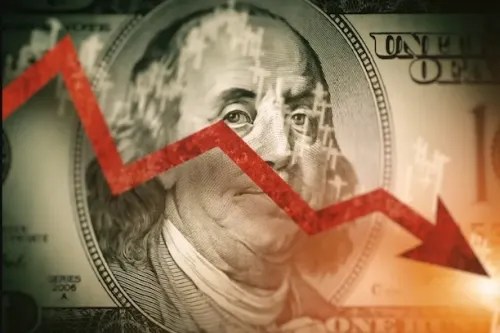
Concomitantly, the dollar’s decline has seen a historic rise in the gold price with silver reaching highs not attained since 2012.  Precious metals are signaling economic troubles ahead, especially in the currency markets.

While some have pointed to Trump’s harmful tariff policy for the dollar’s fall, the real culprit is the massive U.S. debt and interest payments, which increased even further with the passage of the Big Beautiful Bill Act.  To finance the exploding debt and interest (which has now surpassed $1 trillion per year), the government will have to borrow even more. 

This will force the Federal Reserve to print more money to service the debt putting added downward pressure on the greenback.  More dollars printed will obviously mean a fall in its purchasing power, not only domestically but in relative terms to foreign currencies.  The inverse of a decrease in the purchasing power of the dollar will be an increase in the prices of goods. 

It is a vicious circle exacerbated by Trump’s latest budget.

A larger question that U.S. policy makers will have to face if the dollar continues to slide is its current status as the world’s reserve currency.  The loss of this privileged position would be the death knell to the ability of the United States to project its financial and military power throughout the world. 

Most international transactions are settled in dollars that bolsters its demand in foreign exchange markets.  If countries settle trade in another currency or, as some have speculated, in terms of precious metals, the demand for dollars would fall.  If the supply of dollars has to increase due to continued profligate U.S. federal spending and demand for dollars internationally falls, the “price” of dollars (their purchasing power) would tank. 

Moreover, if foreign nations do not need dollars in trade, eventually the dollars they hold will make their way back to America, causing domestic prices to sharply escalate. 

Of course, the one bright spot of losing its world’s reserve currency status would mean the collapse, or at least a catastrophic pull back, in America’s vast overseas military commitments and interventions.  No longer could the U.S. maintain its mammoth military expenditures to police the world.

Massive deficits are also an impediment (although Trump apparently does not realize it) to the president’s hopes of lowering interest rates.  Even if he can get Federal Reserve Chairman Jerome Powell to cut rates, the Fed does not control long-term rates which will undoubtedly spike putting upward pressure on all rates.  This will increase borrowing costs for the government, which will likely end in a sovereign debt crisis.

At this point, there is no turning back.  The only way to save the dollar is to cut spending, which would mean less borrowing and thus less money printing. 

Trump and the Republicans with their Big Beautiful Bill have hasten the dollar’s ultimate demise and the economic collapse and social misery that will follow. 

*Committee for a Responsible Federal Budget, “Breaking Down the One Big Beautiful Bill.”  4 June 2025, ww.crfb.org/blogs/breaking-down-one-big-beautiful-bill 

**Liz Hoffman, “The US dollar is on track for its worst year in modern history.”  Semafor, 3 July 2025, https://www.semafor.com/article/07/03/2025/the-us-dollar-is-on-track-for-its-worst-year-in-modern-history

Antonius Aquinas@AntoniusAquinas

The U.S. Is Spending $1 Trillion Every 100 Days On The Deficit

While it made some headlines in the financial press, neither policy makers nor the two presumptive presidential nominees have paid much attention to the fact that the U.S. is adding a mind-boggling $1 trillion to the national debt every 100 days.  This amounts to around $3.6 trillion annually. 

As law makers remain willfully ignorant of the financial elephant in the room, it is most likely that the only way that the debt will be addressed is through a monetary crisis which will involve the status of the dollar as the world’s reserve currency.  Such a scenario would then force authorities to take action.

As if there needed to be more evidence of how impervious Congress and the Biden Administration are to the burgeoning debt spiral, the House and Senate passed two stop-gap funding packages to avoid a government shut down on March 22, 2024.  One Senator called it “a pork fest of epic proportions.”*

Despite the ominous prognostications of a dollar collapse by financial doomsayers, the Greenback has remained the best of all competing currencies.  Yet, this time could be different, since interest rates – which have been artificially suppressed by the Federal Reserve (Fed) – have risen, making servicing of the national debt more expensive as Moody’s Investors Service noted: “In the context of higher interest rates, without effective fiscal policy measures to reduce government spending or increase revenues Moody’s expects that the US’ fiscal deficits will remain very large, significantly weakening debt affordability.”** 

While “King Dollar” has continued its financial hegemony, the running of a staggering national debt – which now stands at over $34 trillion – has had baneful repercussions for the average American.  The funding of the debt has led to a resurgence in 1970s-style stagflation with a decline in productive job growth such as manufacturing and near double-digit price inflation.  This, of course, has had a deleterious effect on the middle and lower classes’ standards of living since rising prices disproportionately effect these groups harder than the more affluent.

Of course, the simplest approach (although politically unpalatable) to the problem would be to dramatically cut government spending by eliminating agencies and programs.  With the Uniparty in charge, however, there is virtually no chance of budget cuts, especially in an election year.  Whatever happened to the “deficit hawks” and those calling for a balance budget amendment to the Constitution?

The funding of the debt is the primary factor for the rise in consumer and producer prices.  Since federal spending is beyond what the government receives in revenues, it must borrow through the issuance of debt/bonds to make up for the shortfall. 

The principal buyer of government debt has been the Fed, which pays for the bonds by the creation of money, “out of thin air.”  The printing of money (now done through the stroke of a computer key) bids up prices in the market.  Federal Reserve officials have innocuously called this scam “Quantitative Easing” (QE), which is in realty a monetization of the debt. 

Since the Fed has begun hiking interest rates, it has been doing “Quantitative Tightening” (QT) where it ostensibly has not been buying U.S. debt, but selling it.  This would lead to a contraction of the money supply and a fall in prices. The central bank has not been aggressive enough in its tightening nor has it raised interest rates enough to have any real effect on soaring prices. 

It is highly doubtful that the U.S. will escape the fate of other republics who have pursued reckless fiscal and monetary policies.  It is almost a mathematical certainty that the nation will default on its debt by either hyperinflating the currency or discounting bonds with massive haircuts to their premiums. 

The most likely path is hyperinflation; then the dollar will once again fulfill Voltaire’s dictum that all “paper money eventually returns to its intrinsic value – zero.”  While there will be massive social misery from a dollar collapse, the one bright spot from its demise is that it will mean an end of the murderous U.S. Empire.

*Tyler Durden, “’A Pork Fest of Epic Proportions:’ Congress Passes Spending Package to Avert Shutdown.” Zero Hedge 8 March 2024.  https://www.zerohedge.com/markets/pork-fest-epic-proportions-congress-passes-spending-package-avert-shutdown

**Quoted in Michelle Fox, “The U.S. national debt is rising by $1 trillion about every 100 days,” cnbc.com   https://www.cnbc.com/2024/03/01/the-us-national-debt-is-rising-by-1-trillion-about-every-100-days.html   Updated, 4 March 2024.

Antonius Aquinas@AntoniusAquinas

https://antoniusaquinas.com