Tag Archives: debt ceiling

The U.S. Is Spending $1 Trillion Every 100 Days On The Deficit

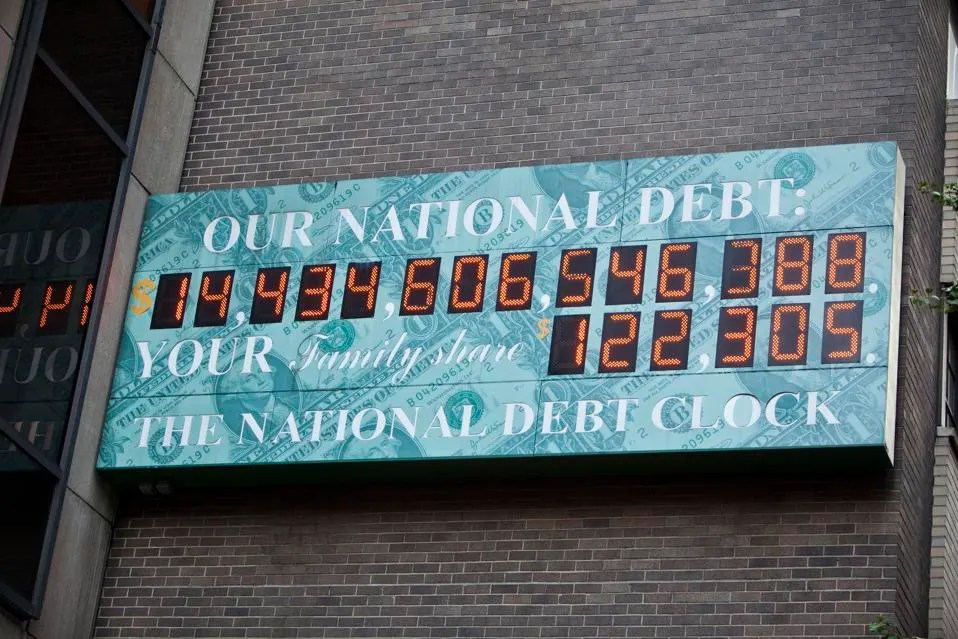
While it made some headlines in the financial press, neither policy makers nor the two presumptive presidential nominees have paid much attention to the fact that the U.S. is adding a mind-boggling $1 trillion to the national debt every 100 days.  This amounts to around $3.6 trillion annually. 

As law makers remain willfully ignorant of the financial elephant in the room, it is most likely that the only way that the debt will be addressed is through a monetary crisis which will involve the status of the dollar as the world’s reserve currency.  Such a scenario would then force authorities to take action.

As if there needed to be more evidence of how impervious Congress and the Biden Administration are to the burgeoning debt spiral, the House and Senate passed two stop-gap funding packages to avoid a government shut down on March 22, 2024.  One Senator called it “a pork fest of epic proportions.”*

Despite the ominous prognostications of a dollar collapse by financial doomsayers, the Greenback has remained the best of all competing currencies.  Yet, this time could be different, since interest rates – which have been artificially suppressed by the Federal Reserve (Fed) – have risen, making servicing of the national debt more expensive as Moody’s Investors Service noted: “In the context of higher interest rates, without effective fiscal policy measures to reduce government spending or increase revenues Moody’s expects that the US’ fiscal deficits will remain very large, significantly weakening debt affordability.”** 

While “King Dollar” has continued its financial hegemony, the running of a staggering national debt – which now stands at over $34 trillion – has had baneful repercussions for the average American.  The funding of the debt has led to a resurgence in 1970s-style stagflation with a decline in productive job growth such as manufacturing and near double-digit price inflation.  This, of course, has had a deleterious effect on the middle and lower classes’ standards of living since rising prices disproportionately effect these groups harder than the more affluent.

Of course, the simplest approach (although politically unpalatable) to the problem would be to dramatically cut government spending by eliminating agencies and programs.  With the Uniparty in charge, however, there is virtually no chance of budget cuts, especially in an election year.  Whatever happened to the “deficit hawks” and those calling for a balance budget amendment to the Constitution?

The funding of the debt is the primary factor for the rise in consumer and producer prices.  Since federal spending is beyond what the government receives in revenues, it must borrow through the issuance of debt/bonds to make up for the shortfall. 

The principal buyer of government debt has been the Fed, which pays for the bonds by the creation of money, “out of thin air.”  The printing of money (now done through the stroke of a computer key) bids up prices in the market.  Federal Reserve officials have innocuously called this scam “Quantitative Easing” (QE), which is in realty a monetization of the debt. 

Since the Fed has begun hiking interest rates, it has been doing “Quantitative Tightening” (QT) where it ostensibly has not been buying U.S. debt, but selling it.  This would lead to a contraction of the money supply and a fall in prices. The central bank has not been aggressive enough in its tightening nor has it raised interest rates enough to have any real effect on soaring prices. 

It is highly doubtful that the U.S. will escape the fate of other republics who have pursued reckless fiscal and monetary policies.  It is almost a mathematical certainty that the nation will default on its debt by either hyperinflating the currency or discounting bonds with massive haircuts to their premiums. 

The most likely path is hyperinflation; then the dollar will once again fulfill Voltaire’s dictum that all “paper money eventually returns to its intrinsic value – zero.”  While there will be massive social misery from a dollar collapse, the one bright spot from its demise is that it will mean an end of the murderous U.S. Empire.

*Tyler Durden, “’A Pork Fest of Epic Proportions:’ Congress Passes Spending Package to Avert Shutdown.” Zero Hedge 8 March 2024.  https://www.zerohedge.com/markets/pork-fest-epic-proportions-congress-passes-spending-package-avert-shutdown

**Quoted in Michelle Fox, “The U.S. national debt is rising by $1 trillion about every 100 days,” cnbc.com   https://www.cnbc.com/2024/03/01/the-us-national-debt-is-rising-by-1-trillion-about-every-100-days.html   Updated, 4 March 2024.

Antonius Aquinas@AntoniusAquinas
https://antoniusaquinas.com

“Don’t Buy Government Bonds”

As another farcical “debt-ceiling raising” saga unfolds, conducted by the two indistinguishable political parties hell-bent on driving America into economic ruin, it would be instructive to look at how some earlier conservative/libertarian thinkers viewed public debt.  Unlike the present generation – with the notable exception of Ron Paul – these intellectuals asked fundamental questions about such matters as debt, taxation, central banking, and foreign policy.

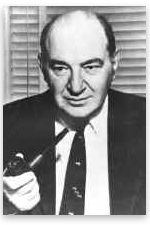
One of the leading lights of what was known as the “Old Right” of the 1950’s, which opposed the Cold-War globalism of the likes of William Buckley and domestically sought to overturn the New Deal, was Frank Chodorov (1887-1966).  In his books and essays, Chodorov challenged the pillars which social democracy rested and sought to return America to small government, free trade, and “isolationism.” 

In one of his provocative essays, Chodorov pervasively argued that those who purchase public debt are complicit in the enhancement of state power.  Unlike many present-day economists who only see the baneful economic effects of profligate government borrowing, he makes a moral case against debt financing.*

He points out that public borrowing burdens future generations for the benefit of the present.  Despite reasons often given for the necessity of borrowing – war, natural disaster, infrastructure, etc., – Chodorov contends that the practice of shifting the cost to later generations, whatever the reason, is unjust:

This is exactly what you do when you
cooperate with the State’s borrowing
program. You are loading on your children
and your children’s children an obligation to
pay for something they had no voice in, and
for which they may not care at all. Your
‘investment for posterity’ may earn you
nothing but the curses of posterity.

Chodorov understood, as most commentators do not today, that a gold-backed currency restrained State largesse: “When money was redeemable in gold, the inherent profligacy of government was somewhat retrained; for, if the citizen lost faith in his money, or his bond, he could demand gold in exchange, and since the government did not have enough gold on hand to meet the demand, it had to curtail its spending proclivity accordingly.”

It was Franklin Delano Roosevelt’s despicable and criminal act of taking the U.S. off the gold standard domestically that led to the expansion of the public debt as Chodorov describes: “. . . Mr. Roosevelt removed this shackle and thus opened the flood gates.  The only limit to the inclination of every politician to spend money, in order to acquire power, is the refusal of the public to lend its money to the government. . . . the government can then resort to printing of money, to make money out of nothing. . . .” 

Not realized at the time, but the ability of the American government to expand its revenue base fit nicely into FDR’s later nefarious foreign policy objectives. 

Chodorov’s viewpoint on public debt can also easily be applied to FDR’s decision to eradicate the gold standard through which the U.S. currency could be redeemed for precious metals.  FDR’s act, however, was a “violation of contract” with American citizens since the U.S. government defaulted on its obligations.

In Orwellian fashion, the verbiage used with most government operations is often misused to legitimize State functions.  “Investment” is one such term that has been corrupted in relations to spending and debt.

In promoting their spending schemes, politicians will often use the term investment, “investment in education,” “investment in infrastructure,” etc.  This is deliberate, since it tries to equate government spending with a vital component of the market process.

In a market economy, investment means the lending of savings, which is used to expand and/or start an enterprise.  In return, the lender receives a stock or a bond.  If the business is successful, the lender’s investment will receive a return – dividends from a stock or interest from a bond.  Business investment is, therefore, a necessary aspect of capitalism which results in economic growth and increased living standards.

As Chodorov incisively points out, however, government investment is the antithesis of what takes place in the marketplace:  

The State, however, does not put your money into production.  The State spends it – that is all the State is capable of doing – and your savings disappear.  The interest you get comes out of the tax fund, to which you contribute your share, and your share is increased by the cost of servicing your bond.

Chodorov’s solution to deficit financing was not to buy government bonds.  While this would certainly be a step in the right direction, a more radical approach is needed since the problem has now become so immense. 

Simply put: there should be a prohibition on government borrowing of any kind.  State revenues should only come through tax receipts and fees paid by those in the present.  This would completely eliminate the “moral hazard” of debt financing and drastically reduce the size and scope of government over society.

For those who seek to put an end to the current debt-ceiling charade and rectify the immoral practice of burdening future generations by the irresponsibility of the present, the works of Frank Chodorov are essential.

* “Don’t Buy Government Bonds,” The Mises Institute, 13 January 2011. https://cdn.mises.org/Out%20of%20Step_4.pdf

Antonius Aquinas@AntoniusAquinas

https://antoniusaquinas.com