
Tag Archives: covid

Many Americans Say They Will Never Retire

A recent AARP poll provides further evidence of the deterioration of American living standards, especially for those approaching retirement age.  The study contradicts what most policy makers have believed to be a “soft landing” for the economy after two years of rampant inflation.

“More than one quarter of U.S. adults over the age of 59,” the survey found, “say they expect to never retire.”  One in four have no retirement savings while one third of “older adults” have credit card debt of more than $10,000 and 12% hold a balance of $20,000 or more.” The Headline of an April 25 Washington Times article by Fatima Hussein says it all: “More Than 25% of U.S. Adults Over 50 Expect Never to Retire.”*

Not surprisingly, the report conducted with the NORC Center for Public Affairs Research, points out that the lack of savings is due to the rising cost of living: “Everyday expenses and housing costs, including rent and mortgage payments, are the biggest reasons why people are unable to save for retirement.”

While AARP zeroed in on rising prices as the culprit for the financial pinch that potential retirees are feeling, it did not delve into who or what was the catalyst for the increase in living costs.  Neither has the financial press, which has always been a cheerleader for the Uniparty, been diligent in its duty about the ultimate source for soaring prices. 

While the trend of Americans working well into their retirement years has been going on for years, the situation has accelerated under both the Trump and Biden presidencies.  In concert with the Federal Reserve, the fiscal policies of the two administrations have been the primary factor for why many Americans cannot retire. 

Even before the start of the hyped Covid pandemic, the Trump administration, in just one term, was on pace to become the biggest spender in U.S. history.  The astronomical increase in government spending and money printing which took place in response to Covid are now being felt.

The Fed’s balance sheet before the Covid lockdowns in January of 2020 stood at $4.15 trillion. By the end of Trump’s presidency, it had nearly doubled to $7.3 trillion as the government doled out “stimulus checks” to non-working Americans and transferred billions to business favorites and cronies in an unimaginable grab of power and wealth. 

Under Biden, the balance sheet had risen to a little short of $9 trillion in mid-2022 and has come down, now standing at $7.4 trillion, according to American Action Forum.**  

Expanding the balance sheet means that the Fed issues more dollars it takes and buys assets (mostly government bonds). This is actually debt monetization.  The increase in the money supply is the classic – and true – definition of inflation.  Rising prices are not inflation, but its consequence.   

At first, the new money went into financial assets increasing their nominal values. However, because of the “lag effect,” the inflation the Fed created is now pushing up consumer prices.  The Fed has had to do this because of profligate government spending which must be sustained through borrowing, since tax revenues are not enough to meet expenditures. 

When asked in his current re-election campaign on what he would do to solve the rising cost of living, Trump said that he would “drill baby drill.”  Such a statement demonstrates again that the former president, like the current occupant of the office, does not understand the problem.

Increasing domestic oil production is certainly good in itself, which will create jobs and bring more oil to the market. But it will not address general price inflation which is a monetary phenomenon

Rising prices can be reversed if the Fed increases interest rates, or better yet, lets rates be set by the market.  Higher rates will entice people to save, which will take money out of circulation, thus putting downward pressure on prices.

Just as important, the government needs to cut spending and eliminate departments and programs which will mean less money printing by the Fed.  The likelihood of this taking place in a presidential election year is next to zero.      

Even if the government and the Fed took the proper steps and began to put the nation on a sound financial footing, it will take years for the damage that has been done to be rectified.

Sadly, the Uniparty has no intention of doing the right thing and as economic conditions worsen, the number of people who must work until they drop will continue to rise.

*Fatima Hussein, “More than 25% of U.S. adults over 50 expect never to retire.” The Washington Times, 25 April 2024, A7. **https://www.americanactionforum.org/insight/tracker-the-federal-reserves-balance-sheet/
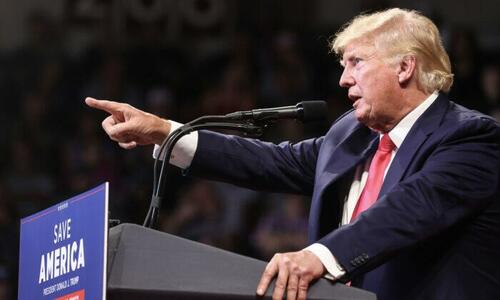
Trump’s Inflation

Former President Donald Trump attends a rally in support of Arizona GOP candidates, Prescott, Ariz., on July 22, 2022. (Mario Tama/Getty Images)

Once again, former president Donald Trump criticized the Biden Administration for the record consumer price increases that Americans are now paying.  His remarks followed up on his July 4th speech in Wyoming where he lamented about the state of the nation: “I know it’s not looking good for our Country right now, with a major War raging out of control in Europe, the Highest Inflation in memory, the worst 6 month Stock Market in History, the highest energy prices ever.”* 

In his most recent campaign rally for GOP hopeful Kari Lake, Trump lambasted President Biden for creating the “worst inflation in 47 years”** and for his “war on American energy” which Trump believes has contributed to the record hike in fuel prices.

The former president boasted that had he been re-elected “none of these terrible events would have happened.”  He reassured his audience “not to worry” and that “we will make America great again.” 

As with all of his post-presidential rallies, Trump’s criticism of the Biden regime comes with touting his own accomplishments as chief executive.  Most of these claims are so outrageous they damage or totally negate his critique of Biden’s policies and make Trump sound like a fool.

Take, for instance, his rally in Arizona for Kari Lake, where he had the audacity to say that under his watch the country “had the greatest economy in the history of the world with no inflation.” [!]  Such nonsense needs no comment.

Like his boasts about the economy, the former president deftly left out his Administration’s role in the drastic rise in prices which Americans are currently suffering from. 

First, however, the meaning of “inflation” should be explained.

Inflation, properly defined, as it was understood until the present era, meant an expansion of the money supply.  “Deflation,” its opposite is a decrease in the money supply.  The rise or fall in prices – usually a rise in producer and consumer prices – is a consequence of the expansion or contraction of the money supply.  Once understood, the rampant rise in prices in America and throughout the world has been the result of the increase in the money supply not only by the Federal Reserve, but all central banks.

Another important tenet of monetary theory long since forgotten has been the notion of a “lagging indicator.”  Between the expansion of the money supply – inflation – and the resultant increase in prices, there is often a lag which could take months or years to appear. 

The increase in consumer and producer prices is due to the dramatic explosion of money and credit which took place during the Trump Administration not only in response to the scamdemic, but in the years leading up to it.  In fact, the plandemic was a convenient excuse to inject massive liquidity into a system that began to hemorrhage in September, 2019.  In the early months of 2020, the markets began to implode before the unnecessary lockdowns as the air began to come out of the financial bubble.  This has been ignored by the financial press and Trump himself.

Prior to the covid hysteria, Trump had repeatedly lobbied for “cheap” money, calling for a renewal of quantitative easing, reduction in interest rates, and he even spoke about “negative” rates.  The former president threatened to fire Jerome Powell, whom he had picked to head the Federal Reserve, for not reducing interest rates far enough.  Trump complained that President Obama benefited from the Fed’s accommodative monetary policy and wanted similar treatment so as to keep the financial bubble going.

Trump’s fiscal policy was also highly inflationary as he ran record deficits long before covid.  His tax cuts and failure to cut government spending led to greater government borrowing which the Fed was forced to monetize.  Trump was on pace, well before the 2020 lockdowns, to spend more money in four years than Obama spent in his two terms.  By 2019, the deficit had grown to $1 trillion dollars, up $205 billion, 26 percent from 2018.***  Again, all before covid had begun.   

It was the Trump Administration’s wrongheaded response to the corona virus which is largely responsible for the rising prices of today.  If the lockdowns were necessary (which a growing number of officials now admit they were not), the proper policy would have been to reduce the money supply (and government spending in general) since the lockdowns reduced production meaning less goods and employment.  The massive increase in the Fed’s balance sheet from $4 trillion to some $9 trillion meant more money “chasing fewer goods” causing the prices of the available goods to increase – some dramatically.

What was needed was a reduction in consumer spending since there was less goods being produced with the lockdowns.  Less demand would have offset the reduction in supply and would have kept prices from spiraling.

Instead, Trump – as did his successor – following the doctrines of Lord Keynes, attempted to maintain aggregate demand at pre-covid levels and sent out stimulus checks even to those still employed.  While the money given out to American workers pales in comparison to the massive transfer of wealth to politically-favorite corporations, big business, and the expansion of the government itself, the propping up of aggregate demand led to supply chain shortages.   

Trump is not alone in his ignorance of economics.  His handlers, economic advisors, and the vast majority of his loyal supporters do not understand what took place under his administration.  The current financial mess can be laid at his – and the Federal Reserve’s – feet.  To be fair, his predecessor, Barrack Obama, is also liable.    

The “inflation,” and now recession, which the country is suffering through cannot be fully attributed to the Biden Administration although it too has added to the crisis with more profligate spending. 

The remedy for the current mess is not the re-election of a very flawed former president who does not understand the problem at hand and throughout his term was constantly outfoxed by the Swap which he was elected to drain.  The solution is a return to sound money, the abolition of central banking, and the allowance for the necessary cleansing of the financial bubble. Until a presidential contender speaks in these terms, America’s financial woes will continue.

*https://www.zerohedge.com/political/heres-what-trump-says-inflation-would-be-if-he-were-still-president

**https://www.zerohedge.com/political/trump-blasts-biden-over-soaring-prices-says-true-inflation-rate-much-much-higher-91

***https://www.washingtonpost.com/business/2019/10/25/us-deficit-hit-billion-marking-nearly-percent-increase-during-trump-era/

Antonius Aquinas@AntoniusAquinas

https://antoniusaquinas.com