Tag Archives: Central Banking

Big Banks Profit While Main Street Suffers

Bankers v Main Street


If anyone doubts that the Western world’s monetary order is rigged to enrich the banking system, the first quarter financial reports of America’s top banks should disabuse any unbelievers.

The Financial Times reported that four of the five big U.S. trading banks had a combined revenue of $19.4 billion in the first quarter of 2015. Goldman Sachs had a 14.7 percent* return on its equity in the first quarter while J.P. Morgan, the nation’s largest bank, earned $5.91 billion or $1.45 a share, up 3.6% from a year earlier.**  Revenues for J.P. Morgan grew 4% to $24.8 billion.

The enthusiastic coverage of the big banks healthy first quarter proceeds and the chest-thumping of its bank executives left out, not surprisingly, the real reason for their windfall gains – the Federal Reserve. The big banks have been the chief beneficiaries of the Fed’s easy monetary policy since the start of the financial crisis.

The Fed’s “zero interest rate policy” (ZIRP) and its “quantitative easing” (QE) program have been the catalyst for the large banks’ recent record performance. Ostensibly, these policies were instituted to assist the economy in its recovery from the Great Recession, however, in actuality they have been done to save the big banks from collapse while the economy has been flooded with billions of increasingly worthless dollars causing significant price inflation.

Low interest rates have enabled the banksters and financial houses to borrow at next to nothing and invest in all sorts of ventures, many of which are highly risky. Easy money is also the cause for the huge run up in assets prices and the highs in nominal stock prices.

Worse, ZIRP has allowed the federal government to sustain its ridiculous level of spending, borrowing what it cannot raise in taxes at a near zero rate of interest.  When interest rates do rise, the federal government will most likely default, bringing the banks down with them.

While the big banks and Wall Street have done quite well from the Fed’s massive money printing, everyone else has suffered and have seen their standard of living plummet even from official estimates.

The Federal Reserve reported a slowdown in hiring in March, a big drop off in industrial production, and lower housing starts in the first quarter, to mention just a few troubling statistics. Things are getting to the point that the Fed is reconsidering whether it should raise interest rates in the second half of the year as it had hoped to do. Dennis Lockhart, president of the Federal Reserve Bank of Atlanta, admitted, “Data available for the first quarter of this year have been notably weak.”***

The first quarter sizable earnings of the big banks are an example of what a number of commentators have termed “crony capitalism.” Through government assistance, businesses earn wealth not by pleasing customers and satisfying their needs, but by currying favors from the state. In the banksters’ case, instead of making wise and prudent loans, they receive largesse in the form of billions of Federal Reserve notes.

Not only is such a system immoral, but it gives legitimate market activity – those firms that do not receive state assistance – a bad rap as profitable enterprises are lumped in with state favorites. This ultimately leads to greater regulation as calls for the government to tax “windfall profits” would affect all firms even those who earned rightful profits.

The solution to crony capitalism and the ill gotten gains of the banking system is not greater oversight, but instead, the abolition of the Federal Reserve and a return to sound money based on gold or silver. Under such a system, banks and financial houses would profit only if they satisfied consumers’ wants.

In the banks’ case, this would mean safeguarding depositors’ money and making prudent loans with the funds they were entrusted with to lend. For those financial institutions that succeed at such tasks, profits would be their reward; for those who do not and mismanage investment funds they would be out of business and allowed to fail. Banks would operate under the same economic laws as any other enterprise.

The prevailing system of crony capitalism which benefits the 1% must be exposed for the grand redistribution scheme that it has long been. Only when bankers earn their wealth as Main Street does will America return to a just and (sound) monetary order.

*Tom Braithwaite & Ben McLannahan, “Goldman in Robust Return on Equity Showing,” Financial Times, 17 April 2015, 14

**Ciaran MCEvoy, “JPMorgan Profit Beats Wall St. Views, As Does Wells Fargo by Shrinking Less,” Investor’s Business Daily, 15 April 2015, A1.

***Jon Hilsenrath, “Fed Shies Away from June Rate Hike,”  The Wall Street Journal,  17 April 2015.

Antonius Aquinas@AntoniusAquinas


Don’t “Audit the Fed,” Abolish It

audit-the-fed-reserve-1207                  


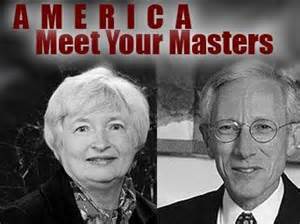
In recent remarks to the Senate Banking Committee, Federal Reserve Chairwoman Janet Yellen was her typical evasive and non committal self when the topic of interest rate hikes were broached. When the subject of potential oversight of the Fed came up, however, Ms. Yellen became quite forthright in her response.

When asked about a bill introduced by Kentucky Senator Rand Paul to “Audit the Fed,” Ms. Yellen declared: “I want to be completely clear: I strongly oppose ‘Audit the Fed.'”*  Ms. Yellen defended her position on the grounds, which have been given by every previous Fed Chairman, that oversight would lead to politicized monetary decision making thus compromising the central bank’s “independence.”

Senate Banking Chairman, Richard Shelby (R., Ala.) countered the Chairwoman saying “there is an even greater need for additional oversight” of the Fed since the onset of the financial crisis in 2007.

Ms. Yellen, her predecessors, and every other Fed apologist are simply wrong when they assert that the central bank is an independent agency that is free of political influence. The Federal Reserve System was created by an act of Congress (1913) and can ultimately be “reformed,” altered, and or abolished by Congressional fiat if so desired.

That Congress does not oversee Fed policy is a result of its charter, which was originally crafted by the Big Banksters of the time (mostly the Rockefellers and Morgans) in concert with their bought for and paid politicians. The lack of oversight was a deliberate part of their plan to give bankers and financers free reign to conduct monetary policy for their own benefit.

The Federal Reserve is and has always been a political creature designed for the benefit of financial elites. It is a highly privileged cartel with monopoly control of the nation’s money supply. Unlike the propaganda which emits from Fed officials, the central bank was instituted to protect banksters from financial collapse and bank runs. Fine tuning the economy, reducing unemployment, or fighting inflation are all ancillary concerns for the Fed.

These are the simple facts which are deliberately kept from the public at large by the political establishment, academia and the media.

The Audit the Fed movement, which began in earnest with Ron Paul’s first presidential run, is a wrongheaded approach to solve the nation’s ongoing financial crisis. Senator Rand Paul’s bill is mostly grandstanding to bolster his status among the Republican Party’s populist contingent in his anticipated race for the nomination.

In fact, instead of meaningful reform, greater public oversight of the Fed would most likely lead to worse results. Every Congressman and Senator would be pressuring the central bank to fund their pet projects. Can one imagine what the growth rate of the money supply would be if 535 ravenous politicians had a say in the conduct monetary policy?!

Those who want to reverse the nation’s economic malaise should seek the Federal Reserve’s abolition and advocate its replacement with a de-politicized monetary order free of central banking. Such a system would most likely be based on a commodity (gold and/or silver) where “money producers” are free to engage in the creation of the “best money” and banking services to satisfy customers’ needs.

In such an order, banks would function as any other enterprise by profit and loss. If banks loan funds wisely, they will succeed; if not, they will fail and go out of business replaced in the marketplace by more savvy entrepreneurs. There will be no bailouts at taxpayers’ expense for reckless financial speculation. Money and banking would become a sound and honest undertaking.

To actually believe that an Audit the Fed initiative would become law is beyond naïve. The political establishment will never voluntarily relinquish or allow any legitimate oversight of one of its chief pillars of power.

Instead of seeking change via politics, reformers must first change the climate of public opinion which can only be accomplished when the prevailing ideology is debunked. Until the Federal Reserve is seen as an engine of inflation and the creator of economic disorder which needs to be eradicated, America’s financial woes will, unfortunately, continue.

* Jon Hilsenrath, “Yellen Puts Fed on Path to Lift Rates,” The Wall Street Journal, Wednesday, 25February 2015, A1, A2.

Antonius Aquinas@AntoniusAquinas

The World Bank and Rising Food Prices

world bank

A recent World Bank report warned of rising global food prices as if a study (no doubt an expensive one) is needed to explain what everyone who buys food or, for that matter, any commodity, is keenly aware of. “Food price shock,” the report cautioned, “can both spark and exacerbate conflict and political instability, and it is vital to promote polices that work to mitigate these effects.”

Naturally, the report fails to explain the real reason for increases in food prices. Like the lies, distortions, and half truths which used to emanate from the Soviet news agency, Pravda, the World Bank report misleads its readers citing “increasing weather concerns,” “import demand” pressure from China, and “geopolitical tension in the Ukraine” for the escalating food costs.

All of this, of course, is nonsense spoken to bamboozle the public and the naïve financial press who will swallow just about anything that a governmental authority shovels out.

The fundamental reason for skyrocketing food prices is the massive amount of money which has been issued since the start of the financial crisis by the likes of the World Bank, IMF, the Fed, Bank of England, and the ECB.

Not surprisingly, the report contradicts itself. Despite the reasons that it gives for the sharp rise in food prices, it admits that the supply of food worldwide is at an all time high: “. . . prices increased despite bumper crops in 2013 and continued projections of record grain harvests and stronger stocks expected for 2014.” It added that even the political turmoil in the Ukraine “have not disrupted exports so far.”

So, if supply is at record levels and demand has increased only significantly in China, what accounts for the massive price hikes across the globe? Simple: money creation.

The report, and others like it, speak of the devastating effect that high food prices have on the poor and impoverished. Instead of pointing the finger at themselves or the other international inflation generating agencies, the World Bank has in the past called for income redistribution which never help the poor, but just line the pockets of politicians and enlarge the balance sheets of the banksters.

Without the unprecedented money creation of the past half dozen years, food prices would have fallen. Instead, the trillions printed have done inestimable harm to the world’s economies while the banking and financial sectors have seen record “profits.”

If the World Bank was truly concerned about the impact of higher food prices, it would immediately fold up shop, call for the liquidation of all central banks and advocate a return to honest money based on a commodity be it gold or silver. Moreover, any bank or financial institution that did not maintain a reserve requirement of 100% would be shut down, charged with fraud and embezzlement while its perpetrators would be rounded up either scourged, tarred and feathered, or, at the very least, face a life time of hard manual labor.

Such measures are more than justified after what has taken place over the past decade and all of the mischief and ruination banks have committed throughout history. These or any other meaningful punishments will also act as a deterrent to anyone contemplating such nefarious activity in the future.

The solution to rising food prices is straight forward, however, its implementation is the problem. To achieve a sound monetary order, public opinion must be shown and then persuaded that the cause of most of the current financial difficulties stem from central and fractional-reserve banking practices. Until a majority is convinced of this evil, things will most likely not turn around.

Unfortunately, until food prices go a lot higher, or there is another crisis or general collapse, no significant alteration of the present fiat monetary system will take place. Nor can it be assumed that as things get worse, a “new system” or a “reform” of the present one will be necessarily better. Under the current statist ideological conditions, it will more than likely be a lot worse.

In sum, erroneous World Bank reports on escalating food prices will continue to be released.

Antonius Aquinas@AntoniusAquinas

The Consumer Spending Myth

consumer spending

There is no bigger misconception held among the financial press and within academia than that of consumer spending. A typical example of this comes from a recent Reuters release entitled: “Strong Consumer Spending, Factory Data Buoy U.S. Growth Outlook.” The first sentence of the article reads, “U.S. consumer spending recorded its largest gain in more than 4½ years in March . . . reinforcing views the economy was regaining steam.”

The supposed importance of consumer spending as a gauge of economic well being is a modern notion ushered in during the Keynesian Revolution which took place in the 1930s. J.M. Keynes, a British economist, mistakenly believed that the Great Depression was the result of a “lack of aggregate demand.” Thus, demand had to be stimulated (mostly through government spending) to revive a moribund economy.

Keynes’ theory has, unfortunately, held sway ever since despite being contrary to what had been believed up until that time and the many of criticism of it since.

An individual’s income can be distributed in one of three ways: it can be spent, saved, or held in cash. If individuals do not spend and decide to save more of their income, it will have no negative economic impact. In fact, the increased savings will expand the capital base which will provide the vital means necessary for lengthier periods of production, a situation that will eventually generate more and cheaper goods – granted there is no artificial increase in the money supply.

If income is kept in cash (checking accounts, bills, coins, stuffed in mattresses), money is taken out of “circulation,” so to speak, which will eventually lead to an increase in the purchasing power of the monetary unit – a scenario rarely seen in the modern era, but one which would be of tremendous benefit to just about everyone especially retirees and those on fixed incomes.

The manner in which individuals divert their income, therefore, has little if any effect on output. Historically, this ratio has remained relatively stable with only gradual change over time.

Furthermore, consumption always takes place as long as there is life. One “consumes” without even walking out of the house – turning on lights, running water, eating, etc., – are all consumption activities. If there was a sudden drop off in purchases, it would not lead to a recession. Some retail sectors would likely suffer, however, it would only be for a short period until entrepreneurs adjust to the new saving and consumption patterns.

Instead of consumer spending, there are more accurate areas to “measure” economic performance.

First, the trend of overall prices: are prices falling or rising? If prices continually rise, it is the result of money creation (inflation) by the central bank – in America’s case, the Federal Reserve.

Second, the tax burden – what percentage of income is taken by the state? There are many pernicious effects of high taxes, the most damaging is that they sap an economy of the capital necessary for production and employment.

The personal savings rate is often overlooked as a barometer of economic well being. A low or negative rate of savings indicates, among other factors, that income levels are not sufficient enough for individuals to save. The individual savings rate in most Western nations is abysmally low and under current monetary and economic policies will remain so.

All three areas of Western economic life show negative trends: prices have continued to rise due to the central banks massive money creation to bail out, in part, the banking and financial sector. Taxes remain confiscatory and have not been cut in any meaningful way. And, the personal savings rate has hovered around zero.

Until the idea of consumer spending has been debunked as a meaningful index of economic conditions, the public will be continued to be misled by the actual state of market affairs. When more accurate indices of economic conditions are looked to, then the notion of what constitutes real prosperity and or economic recovery will have different connotations. Applying such indicators to current reality shows a stark and gloomy contrast to the rosy portrait of things that consumer spending enthusiasts so often espouse.

Antonius Aquinas@AntoniusAquinas