Category Archives: Trump

International Affairs Analyst Says Putin’s Time May Be Winding Down

Vladimir Putin has sky-high presidential approval ratings among Russians (the envy, no doubt, of every Western chief executive).  He recently triumphed at the Alaska summit, where he got President Donald Trump to back off of his demand for a cease fire in Ukraine.  The Russian president’s participation at the 2025 China Victory Day parade further cemented Russo-Chinese relations, and he has been credited with a reproachment between China and India.  So, why is at least one prominent analyst predicting Putin’s time is coming to an end? 

It seems that, after all of these achievements, Putin’s handling of the Ukraine war is coming under growing criticism – not so much from the populace, but from elements within the Russian “thinking class.”  They want an end to the conflict and the punishment and/or elimination of the Western-backed Volodymyr Zelensky regime.

Thus, Putin’s political exit has been predicted by American historian and longtime Russian affairs analyst Prof. Gilbert Doctorow, the author of War Diaries. Vol. 1: The Russian-Ukraine War, 2022-2023. Doctorow now believes that Putin’s slow, methodical war of attrition against Ukraine has taken too long and, if continued, could lead to the regional conflict spinning out of control and igniting a nuclear conflagration. 

Doctorow has also criticized Putin’s lenient attitude toward the many Western provocations taken against Russia, with the latest talk of the U.S. supplying Tomahawk missiles to Ukraine, which could be fitted with nuclear warheads.  The issuance of Tomahawks is on top of the massive aid – military, strategic, intelligence, and financial – that the West has provided without which Ukraine would completely collapse.

While Doctorow advises that Putin end the war as quickly as possible, it must be noted that the perspicacious Paul Craig Roberts has been one of the few, from almost the start of the war, who called for Putin to take decisive action to end what the Russians call a “special military operation.”

Roberts believes that the West is using the conflict as a means to ultimately collapse Russia, divide it politically, and plunder its resources. A fragmented Russia will provide no opposition to a unipolar world dominated by the United States.     

In his latest article, Roberts asks:

    Will he again be ‘Putin-the-Unready’ as he was in

South Ossetia in 2008, in Ukraine in 2014, in 2022

when Russia was forced to intervene in Donbas,

and when the Russian strategic bomber force was

attacked on June 1. *  

In recent podcasts and essays, Doctorow has broken from most of the foreign policy analysts of the alternative media who continue to speak in positive terms of Putin’s deliberate, painstaking approach of slow attrition in Ukraine and his continuing leniency to hostile Western action toward Russia, with now demeaning talk from U.S. politicians including President Donald Trump that call Russia a “paper tiger.” 

Doctorow believes that Putin’s reign has run its course:

                                    I am suggesting that the era of Vladimir Putin is coming to

                                a close.  . . . He no longer has the courage of his convictions,

                                that his threats meant to deter Western enemies are empty

                                verbiage.  . . . He has pulled up the red lines

                                he clearly set out one year ago with respect to long range

                                missiles being supplied to Ukraine, and that he is drawing

                                out the war in Ukraine by not using . . . hypersonic missiles to

                                end the war now. **

Whether such a seemingly implausible scenario comes about or that Russia eventually attains its goals with Putin in charge, the West will continue to escalate.  One bright spot, however, is that the current leadership of Europe’s most war-like states – Keir Starmer of Great Britain, Friedrich Merz of Germany and Emmanuel Macron of France – are widely unpopular and most likely do not have a long political shelf life.  Hopefully, their respective replacements will focus on the monumental economic and social problems that confront each nation and the Ukraine war will be put on the back burner.

One theme sometimes heard by alternative media commentators is that the Russian economy has improved since the start of the special military operation. While Western sanctions have proved to be mostly ineffectual, wars are always a detriment to economic life except, of course, to the arms makers and their bought politicians. 

The opportunity cost of producing guns, bullets, and missiles is the loss of the production of consumer goods – refrigerators, cars, computers, etc.  While it might not be directly seen, Putin’s slow march through Ukraine is taking a toll on the Russian economy.

More important than the economic degradation of society is that the war is being fought between two largely white populations.  The slaughter of whites will mean a decline in birth rates.  This unspoken aspect of the war, no doubt, has always been a policy of the enemies of the Occidental peoples.

While a certain segment of the Russian political elite may want to replace Putin, the ultimate responsibility for the Ukraine war and (God forbid) a possible nuclear exchange is with the collective West, in particular the United States. 

If President Trump really wanted to stop the killing, he merely has to cut off financial aid, end the considerable U.S. military and intelligence assistance to the Zelensky regime, and the war would be over in days.

If these ominous trends continue, it appears that only an act of Divine intervention can avoid a nuclear disaster. 

*https://www.paulcraigroberts.org/2025/10/03/putin-the-unready/

**https://gilbertdoctorow.com/2025/10/04/conversation-with-professor-glenn-diesen-restoring-russias-deterrent-or-emboldening-nato/

Antonius Aquinas@antoniusaquinas

https://antoniusaquinas.com

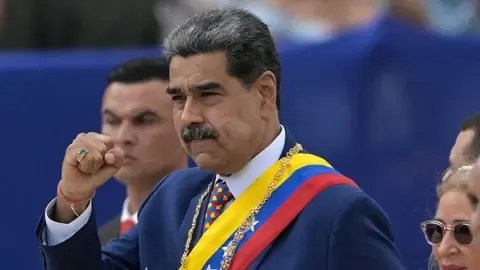
Venezuela Next on Trump Hit List for Regime-Change Operation

While it appears that the United States has finally realized that it has little leverage over Russia in the Ukraine war either to halt hostilities or alter battlefield conditions, it has, for now, begun to disengage from the contest despite the desperate pleas from Ukraine and its European backers.  President Donald Trump has said that he will no longer provide the besieged Eastern European country with aid, but will sell weapons to NATO nations who will then give them to the Volodymyr Zelensky regime.

As an aside, that there has been little criticism of Trump’s arms sales, which will be used for mass slaughter, the destruction of private property, and the enrichment of the military industrial complex, is a sad commentary on the ethical standing of the Western world.  At one time, there was an adherence to the concept of a “just war” and the protection of the lives of non-combatants and their property. These topics have, however, long since perished into the Orwellian memory hole.

Trump’s decision to abandon his demand for a ceasefire and begin shifting the burden for the war to Europe was, no doubt, influenced by the MAGA supporters who were pushing him to fulfill his campaign promise of ending the war or, at least, America’s involvement in it.  While some analysts have called the Alaska summit only a “tactical retreat” for the U.S. Empire, it was enough of a gesture to assuage MAGA that the president was going to at last put America first in foreign policy.

These hopes, however, have been dashed with Trump’s recent actions toward Latin America. 

Earlier this month, Trump reignited hostilities with Venezuela and its president, Nicolas Maduro.  It must not be forgotten that, in his first term, Trump supported efforts to overthrow Maduro in a failed coup led by then Venezuela National Assembly president Juan Guaido.  

Attorney General Pam Bondi announced that the U.S. would double the reward (now $50 million) for information that would lead to the arrest of Maduro, who the Trump administration has accused of being “one of the largest narco-traffickers in the world.”

Venezuelan Foreign Minister Yvan Gil dismissed Bondi charge, calling it “pathetic” and a “desperate distraction” from her handling of the Jeffrey Epstein case and Trump’s refusal to release the files pertaining to his former close friend’s heinous crimes according to the BBC.*

On Aug. 19, the United States escalated matters further by deploying three Navy destroyers, accompanied by 4,000 troops, off the Venezuelan coast.  Not only was the move aimed at combatting Maduro’s supposed drug ties – denied by him and Mexican President Claudia Sheinbaum – but the action appears to be another attempt at regime change. According to the Trump administration, it does not consider Maduro a legitimate president. This opinion was seconded by White House Press Secretary Karolin Leavitt:

The Maduro regime is not the legitimate government of

                                Venezuela. It is a narco-terror cartel, and Maduro, it is the

                                view of this administration, is not a legitimate president.

                                He is a fugitive head of this cartel, he has been indicted in

                                the United States for trafficking drugs into the country. **

That’s funny. When Russian President Vladimir Putin makes similar claims about the legitimacy of the Zelensky regime in Ukraine, they are dismissed by the United States and its European partners even though Zelensky has suspended democratic elections and locked up regime critics. 

If Trump believes his bellicose actions in the Caribbean, which also includes talk of attacking Mexican drug cartels, will stop the flow of illicit drugs to the United States, he is delusional.  The war on drugs in the 1980s, Lyndon Johnson’s war on poverty, the war on alcohol in the 1920s (Prohibition), and all of America’s overseas wars have made the problems they intended to solve that much worse.  The only constant from these follies has been the expansion of state power.

Drug addiction and alcohol abuse are vices that should be handled by families, churches, organizations, and,when necessary, professional medical personnel.  The government cannot fix such problems nor is it constituted to do so.  Even if Trump were to reduce the flow of narcotics, it may simply drive domestic illicit drug prices up, which will entice more sinister criminal elements into the trade.

Despite Trump’s campaign rhetoric, he is once again meddling in the affairs of another sovereign nation with threats of armed intervention if there is not regime change.  While Venezuela has taken no military action against the United States.S. nor is it likely that a conflict between the two could lead to a nuclear conflagration like in Eastern Europe, Trump’s actions demonstrate that he has no intention of pursuing an America-first foreign policy.

Unfortunately for Venezuela – and whoever is next on Trump’s list for aggression – until America cannot financially afford to police the world, the United States it will continue its hegemonic path.   

*Sean Seddon, “US Offers $50m reward for arrest of Venezuelan leader Nicolas Maduro,” BBC, 7 August 2025,  https://www.bbc.com/news/articles/cwy1wn1x521o

** Dave DeCamp, “Trump Administration Deploys Three US Navy Destroyers and 4,000 Troops Near Venezuela,” Antiwar.com, 19 August 2025.   https://news.antiwar.com/2025/08/19/trump-administration-deploys-three-us-navy-destroyers-and-4000-troops-near-venezuela/

Antonius Aquinas@antoniusaquinas

https://antoniusaquinas.com

Trump’s “Big Beautiful Bill” and the Ultimate Demise of the Dollar

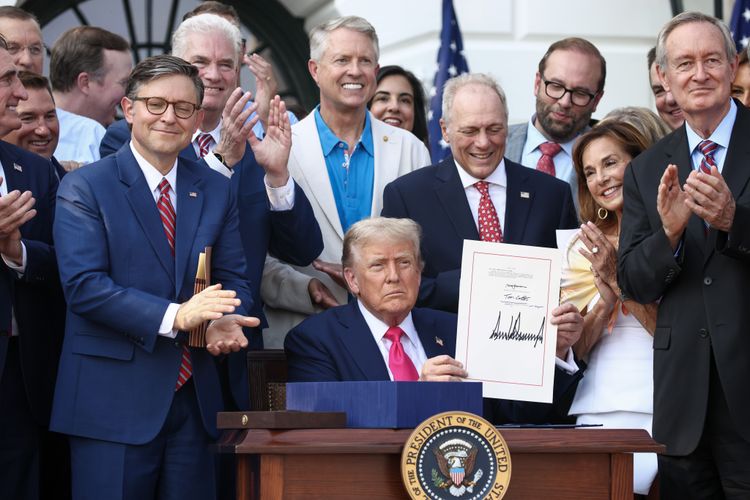
Despite considerable arm-twisting, President Donald Trump’s laughably misnamed “Big Beautiful Bill” (actually a Big Ugly Atrocity) barely passed both houses of Congress.  Such a monstrosity, which has been conservatively estimated to add $5 trillion to the national debt including interest over the next decade, is a slap in the face to those souls who believed Trump’s campaign rhetoric of cutting federal spending.*  This vindicates, once again, those who have correctly seen Trump for what he truly is – a big-spending liberal New York democrat.

Arguably, the most reprehensible aspect of the legislation is the $150 billion increase in “defense” outlays which will boost Uncle Sam’s military budget to a neat $1 trillion a year.  This will provide plenty of lucre to keep the military industrial complex well-oiled to continue its world-wide mass slaughter of innocents.  So much for lightweight Secretary of Defense Pete Hegseth’s initial, and now long forgotten, talk of cutting the Department’s budget by 8% per year over the next decade.

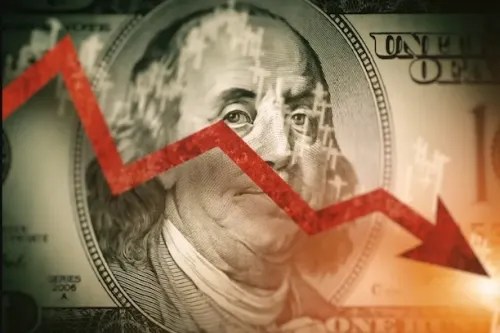
While Trump and nearly every Congressional Republican continue to spend the nation into oblivion, little attention was given to the continuing and financially ominous decline in the U.S. dollar.  The greenback has fallen more than 7% in 2025, the worst since 1973, with some analysts predicting another 10% drop by the end of the year.**

Concomitantly, the dollar’s decline has seen a historic rise in the gold price with silver reaching highs not attained since 2012.  Precious metals are signaling economic troubles ahead, especially in the currency markets.

While some have pointed to Trump’s harmful tariff policy for the dollar’s fall, the real culprit is the massive U.S. debt and interest payments, which increased even further with the passage of the Big Beautiful Bill Act.  To finance the exploding debt and interest (which has now surpassed $1 trillion per year), the government will have to borrow even more. 

This will force the Federal Reserve to print more money to service the debt putting added downward pressure on the greenback.  More dollars printed will obviously mean a fall in its purchasing power, not only domestically but in relative terms to foreign currencies.  The inverse of a decrease in the purchasing power of the dollar will be an increase in the prices of goods. 

It is a vicious circle exacerbated by Trump’s latest budget.

A larger question that U.S. policy makers will have to face if the dollar continues to slide is its current status as the world’s reserve currency.  The loss of this privileged position would be the death knell to the ability of the United States to project its financial and military power throughout the world. 

Most international transactions are settled in dollars that bolsters its demand in foreign exchange markets.  If countries settle trade in another currency or, as some have speculated, in terms of precious metals, the demand for dollars would fall.  If the supply of dollars has to increase due to continued profligate U.S. federal spending and demand for dollars internationally falls, the “price” of dollars (their purchasing power) would tank. 

Moreover, if foreign nations do not need dollars in trade, eventually the dollars they hold will make their way back to America, causing domestic prices to sharply escalate. 

Of course, the one bright spot of losing its world’s reserve currency status would mean the collapse, or at least a catastrophic pull back, in America’s vast overseas military commitments and interventions.  No longer could the U.S. maintain its mammoth military expenditures to police the world.

Massive deficits are also an impediment (although Trump apparently does not realize it) to the president’s hopes of lowering interest rates.  Even if he can get Federal Reserve Chairman Jerome Powell to cut rates, the Fed does not control long-term rates which will undoubtedly spike putting upward pressure on all rates.  This will increase borrowing costs for the government, which will likely end in a sovereign debt crisis.

At this point, there is no turning back.  The only way to save the dollar is to cut spending, which would mean less borrowing and thus less money printing. 

Trump and the Republicans with their Big Beautiful Bill have hasten the dollar’s ultimate demise and the economic collapse and social misery that will follow. 

*Committee for a Responsible Federal Budget, “Breaking Down the One Big Beautiful Bill.”  4 June 2025, ww.crfb.org/blogs/breaking-down-one-big-beautiful-bill 

**Liz Hoffman, “The US dollar is on track for its worst year in modern history.”  Semafor, 3 July 2025, https://www.semafor.com/article/07/03/2025/the-us-dollar-is-on-track-for-its-worst-year-in-modern-history

Antonius Aquinas@AntoniusAquinas

The Trump – Powell Spat: A Distraction from the Debt Crisis

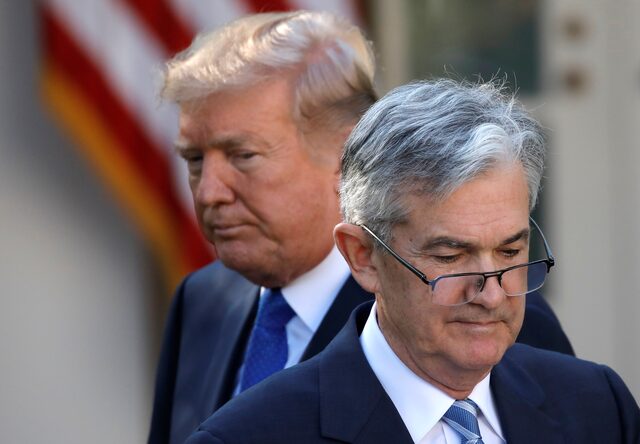
Since his return to office in January, President Donald Trump has called on Federal Reserve Chairman Jay Powell to cut interest rates which Powell and the Fed’s Board of Governors have refused to do.  In typical child-like behavior when he doesn’t get his way, Trump has hurled insults at Powell calling him a “stupid person,” “too late Powell,” and a “numbskull.” 

Trump’s juvenile attacks, although misplaced, have been quite humorous and a welcome change in tone to the respect, reverence, and almost deification that previous Presidents, Congressmen, and the financial press heap on Federal Reserve Chairmen.

Unfortunately, as with all his policies, Trump’s megalomania is on display.  After the Fed’s June meeting when it once again decided to leave rates unchanged and indicated that there might be only one rate cut in 2025, Trump again slammed Powell and suggested that “Maybe I should go to the Fed.  Am I allowed to appoint myself to the Fed.?” *

While Trump’s ridiculing the head of one of the sacred cows of America’s ruling establishment is welcomed, his crazed notion of putting himself, and presumably future presidents, in charge of monetary policy does not offer any viable alternative to the debt crisis that is staring the nation in the face with the U.S. in the hole in excess of now some $37 trillion. 

Although Trump’s blasting of Powell has provided some comic relief from the dire economic conditions which confront the U.S., in reality both the president and the Fed Chair are wrong over interest rate policy although, in this case, Powell is less wrong.  Like most of Trump’s kooky ideas – taking over Greenland, making Canada the 51st state – not only is the slashing of interest rates counterproductive, but the idea of giving the executive branch of government control of monetary policy would turn the nation into a complete dictatorship.

Powell, too, has been mistaken in his policy of holding rates steady. Interest rates, in fact, are too low and need to be higher.  At current levels, rates are too “accommodative” as price inflation remains above the Fed’s 2% target.  Of course, in reality prices are rising at a much briskier pace than official government estimates. 

Hiking rates would encourage savings and discourage consumption both of which would put downward pressure on consumer prices.  If Trump wants to achieve his goal of a reindustrialized America, there needs to be an increase in savings. Production of goods takes place over time and without savings to fund the construction of factories, the purchase of machines and equipment, and the payment of wages, there can be no economic growth.

Trump wrongly believes that lower rates will spur economic growth.  Sustained prosperity can only take place through savings and investment not money creation via credit expansion which the president is a fan of.    

More fundamentally, both Trump and Powell are wrong: interest rates should not be set by governments or monetary authorities, but be determined by market forces – the aggregate decision making of individuals on how much to save or how much to consume their income.  Concomitant with non-state involvement with the setting of interest rates, a return to a metallic monetary standard would prevent price inflation which would make saving more attractive.

Another reason why Trump wants lower rates is that servicing the mammoth U.S. debt would be somewhat more palatable. His “big, beautiful bill,” working its way through the Senate, will need to be financed.  Lower rates would reduce the government’s borrowing costs.  This irresponsible argument was also made by former Federal Reserve Chair and later Treasury Secretary Janet Yellen.   

Since Donald Trump has no ideological core that shapes his world vision, his outlook and policies are more often than not based on what affects him personally or who strokes his ego or lines his pockets.  The proper monetary policy for the nation is not to cut interest rates, but to raise them and reduce the national debt through spending cuts.  While there would certainly be short-term pain from such a policy, eventually matters would turn around and economic activity would be placed on a sound footing.

Ultimately, if sound money is ever to return to America and the Western world, its control must be taken away from central banks and the influence of mercurial politicians.  The creation of money, its distribution, authenticity, and safe keeping should be left up to a decentralized non-governmental arrangement. 

*Tyler Durden, “Trump Slams ‘Stupid’ Powell: ‘I Think He Hates Me.  I Call Him Every Name in the Book to Try and Get Him to Cut,’” Zero Hedge, 18 June 2025. https://www.zerohedge.com/markets/trump-slams-stupid-powell-i-think-he-hates-me-i-call-him-every-name-book-try-and-get-him

Antonius Aquinas@AntoniusAquinas

Big Spending Continues Under Trump

While DOGE (the Department of Government Efficiency) has made almost daily headlines pointing out fraud and waste in government, the real battle over federal spending is beginning to take place.  From what has been proposed, it looks like it will be business as usual in Washington.

Last week, the full House of Representatives passed the House Budget Committee’s plan (budget resolution) which specifies cuts in both taxes and spending over the next decade.  The key phrase here is “over the next decade.”

In a Feb. 13, 2025 Tax Foundation article titled “House Budget Resolution Aims to Balance Tax Cut and Spending Reduction Goals,” William McBride, explains that:

The resolution caps the deficit increase resulting from

                   tax cuts at $4.5 trillion over the next decade and requires

                   a minimum of $1.2 trillion in spending cuts.  Additionally,

                   it sets as a goal to reduce mandatory spending by $2 trillion

                   over the next decade, and, if not accomplished, the cap on

                   tax cuts would be reduced commensurately. *

The resolution calls for certain committees to implement the cuts:

  • Energy and Commerce Committee ($880 billion)
  • Education and Workforce Committee ($330 billion)
  • Agriculture Committee ($230 billion)

Programs that more than likely face budget reductions include: Medicaid, student loan relief, and the Supplemental Nutrition Program. 

Despite Defense Secretary Pete Hegseth’s call for an 8% yearly cut in defense spending over the next five years, the current House resolution would increase defense spending by $100 billion. There is an additional increase of $230 billion for border control and “deportation plans to be executed” according to Brett Samuels of the political website The Hill, in an article he penned titled “Trump Backs House GOP Reconciliation Bill Over Senate Version.”  ** 

Like Trump and most of his administration, Hegseth has sent conflicting signals on defense spending.  While in Germany, the defense secretary said: “I think the US needs to spend more than the Biden administration was willing to, who historically under-invested in the capabilities of our military.”

Hegseth bombastically added that he wants “the biggest most badass military on the planet,” as quoted by Dave DeCamp of news and commentary website Antiwar.com in a Feb 2025 analysis. *** So much for an America first foreign policy. 

The House’s estimate for spending and tax cuts are based on a real rate of growth of 2.6%.  This optimistic forecast, of course, does not account for any downturn in the economy, war, or continued uptick in price inflation.  Any of these, or some exogeneous shock to the economy would lower gross domestic product and tax revenues and jeopardize any long-term projected tax or spending cuts.

In the end, the budget resolution will increase spending, which Trump vowed to curb, as Rep. Thomas Massie (KY), who courageously voted against, succinctly summarized:

If the Republican plan passes under the rosiest

                                                assumptions, which aren’t even true, we’re gonna

                                                add $328 billion to the deficit this year, we’re gonna

                                                add $295 billion to the deficit the year after that, and

                                                $242 billion to the deficit after that. . . . ****

Trump, who enthusiastically supports the budget resolution, fails to realize that without deep and significant spending cuts, the cost of living will continue to escalate.  The president blamed the Biden Administration’s policies for the run-up in prices, when, in fact, it was Trump who began the present inflation cycle with the passage of the CARES Act in 2020, expanding the budget an unimaginable $2.2 trillion.

Without spending cuts, the burgeoning federal deficit ($2 trillion) and the interest on the national debt ($1 trillion) will need to be continually financed through borrowing.  The borrowing by the federal government is “paid for” through money printing (the real definition of inflation) by the Federal Reserve which buys U.S. debt with money “created out of thin air” which in essence is debt monetization.  The new money puts pressure on prices as it filters through the economy increasing the cost of living. 

While cuts in spending and reducing the amount of dollars in circulation will lower the cost of living, it will not come without severe economic pain.  The fall in prices will pop the bubble that stocks and other financial assets have been in which will result in widespread unemployment and business failures.  This is necessary to cleanse the malinvestment caused by the money printing and credit expansion and is necessary if America is to be put on a sound financial footing.

Of course, no politician wants to be blamed for such misery and even though Trump will not be up for re-election, he still does not want to be holding the bag when the economy implodes.  Yet, if such a scenario happens, the president should bear much of the blame for his policies ignited the present problem.

If President Trump truly wants to make America great again, cutting government spending must be undertaken no matter how painful. 

It appears, however, that he will join the long list of chief executives who have spent the nation into a horrific debt spiral which will inevitably end in economic ruin.

*William McBride, “House Budget Resolution Aims to Balance Tax Cut and Spending Reduction Goals,” Tax Foundation, 13 February 2025.  https://taxfoundation.org/blog/house-budget-resolution-tax-cuts-spending/

**Brett Samuels, “Trump backs House GOP reconciliation bill over Senate version,” The Hill, 19 February 2025.   https://thehill.com/homenews/administration/5152871-trump-endorses-house-gop-strategy/

***Dave DeCamp, “Pentagon Says Hegseth’s Order Will Redirect Spending, Not Make Actual Cuts,” Antiwar.com, 20 February 2025.

****Tyler Durden, “House Republicans Advance Trump Agenda as Final Vote Looms Tonight.” Zero Hedge, 25 February 2025,  https://www.zerohedge.com/political/house-republicans-advance-trump-agenda-final-vote-looms-tonight

Antonius Aquinas@AntoniusAquinas

Trump’s Grandiose Political Centralization Scheme Not America-First in Spirit

Colorful houses of the coastal town of Ilulissat in western Greenland.

Although Donald Trump is now in office, his statements since the election indicated he has forgotten his pledge to follow an “America first” foreign policy. This is what he promised during the recent presidential contest and what he pledged in the 2016 campaign, but failed to deliver during his first term.  While domestic issues are what a president is mostly concerned with, the most important decisions surround foreign affairs, since they often involve war.

Since his lopsided victory over the hapless Kamala Harris, Trump has made few references about reigning in the murderous U.S. Empire, but instead has talked about buying or invading Greenland, seizing the Panama Canal, and making Canada an American state.  After the resignation of Prime Minister Justin Trudeau, Trump said that “many people in Canada love being the 51st state,” according to The New York Times, Jan. 7.*

If Joe Biden or Kamala Harris said such things, the MAGA crowd would be up in arms and accuse them of moving the country in the direction of the New World Order.

Whether Trump follows through with such fanciful plans, it shows that he does not understand what lies at the heart of the social and economic problems that America and the Western world face.  Trump’s ideas would create greater political centralization, as an American-Canadian or American-Canadian-Mexican-Greenland union would create a gigantic North American state.

For anyone concerned with individual liberty, prosperity, and the No. 1 social issue that confronts the U.S. – illegal immigration – a North American superstate would be a nightmare. Gone would be the vital ability of “dissenters” to “vote with their feet” and move to less burdensome political jurisdictions.

In the United States, one can see this taking place on a daily basis as Americans move from high-tax and high regulatory states to those less onerous.  Of course, citizens cannot escape the federal government’s dictates unless one decides to expatriate. Students of the nation’s history know the often-overlooked Anti-federalists made this argument in their opposition to the Constitution which has, over time, proven to be quite prescient.

The idea that more political entities lead to greater freedom has been proven by history.  The best example of this is pre-modern Europe which was made up of a host of kingdoms, duchies, and free states with no dominant central government that could tax without impunity.  It is well accepted by historians that Europe’s rise in its standard of living was the result of its political decentralization that resulted in low levels of taxation.

A multitude of nation states allows for “competition,” where if one government becomes too tyrannical, people have an opportunity to flee to another land.  In recent U.S. history, a number of draft-aged men fled to Canada instead of being sent off to Vietnam to fight in what they considered an immoral war.  A colossal North American state would have ended such an option.

Although not explicitly discussed by Trump, a North American Union would more than likely mean the creation of a new monetary unit as was done with the euro when the European Union was formed.  Despite the warnings of some economists, price inflation in Europe escalated for countries like Germany once they relinquished their monetary autonomy. 

Currently, national currencies “float” against one another in terms of exchange rates. If one central bank inflates its currency too much, its money will lose purchasing power to less inflationary nations.  While not nearly as good as a gold standard, there is a sort of a “check and balance” on central bank monetary debasement with floating exchange rates.

A single North American monetary unit would not face the kind of limit that now exists, where the Canadian dollar, Mexican peso and U.S. dollar vie against each other.  A North American currency would be another ominous step to a one-world currency – a dream of New World Order proponents. 

While Trump’s disappointing talk about political centralization looks like a betrayal of the principles of America first principles, there may be a glimmer of hope.  In a recent Truth Social post, Trump reposted a video of Prof. Jeffery Sachs, a longtime critic of American foreign policy, criticizing Israeli Prime Minister Benjamin Netanyahu’s genocidal actions in Gaza and throughout the Middle East calling him a “deep, dark SOB.”

Since the video has been posted, Netanyahu has canceled his plans to attend Trump’s inauguration, the implication being the Israeli leader was offended by the comment.

Only time will tell if Trump will abandon his promised America-first policies or pursue a drive to a New World Order.

*David E. Sanger and Michael D. Shear, “Trump Floats Using Force to Take Greenland and the Panama Canal,”  The New York Times, 7 January 2025. 

Antonius Aquinas@antoniusaquinas

https://antoniusaquinas.com

Trump’s Inflation

Former President Donald Trump attends a rally in support of Arizona GOP candidates, Prescott, Ariz., on July 22, 2022. (Mario Tama/Getty Images)

Once again, former president Donald Trump criticized the Biden Administration for the record consumer price increases that Americans are now paying.  His remarks followed up on his July 4th speech in Wyoming where he lamented about the state of the nation: “I know it’s not looking good for our Country right now, with a major War raging out of control in Europe, the Highest Inflation in memory, the worst 6 month Stock Market in History, the highest energy prices ever.”* 

In his most recent campaign rally for GOP hopeful Kari Lake, Trump lambasted President Biden for creating the “worst inflation in 47 years”** and for his “war on American energy” which Trump believes has contributed to the record hike in fuel prices.

The former president boasted that had he been re-elected “none of these terrible events would have happened.”  He reassured his audience “not to worry” and that “we will make America great again.” 

As with all of his post-presidential rallies, Trump’s criticism of the Biden regime comes with touting his own accomplishments as chief executive.  Most of these claims are so outrageous they damage or totally negate his critique of Biden’s policies and make Trump sound like a fool.

Take, for instance, his rally in Arizona for Kari Lake, where he had the audacity to say that under his watch the country “had the greatest economy in the history of the world with no inflation.” [!]  Such nonsense needs no comment.

Like his boasts about the economy, the former president deftly left out his Administration’s role in the drastic rise in prices which Americans are currently suffering from. 

First, however, the meaning of “inflation” should be explained.

Inflation, properly defined, as it was understood until the present era, meant an expansion of the money supply.  “Deflation,” its opposite is a decrease in the money supply.  The rise or fall in prices – usually a rise in producer and consumer prices – is a consequence of the expansion or contraction of the money supply.  Once understood, the rampant rise in prices in America and throughout the world has been the result of the increase in the money supply not only by the Federal Reserve, but all central banks.

Another important tenet of monetary theory long since forgotten has been the notion of a “lagging indicator.”  Between the expansion of the money supply – inflation – and the resultant increase in prices, there is often a lag which could take months or years to appear. 

The increase in consumer and producer prices is due to the dramatic explosion of money and credit which took place during the Trump Administration not only in response to the scamdemic, but in the years leading up to it.  In fact, the plandemic was a convenient excuse to inject massive liquidity into a system that began to hemorrhage in September, 2019.  In the early months of 2020, the markets began to implode before the unnecessary lockdowns as the air began to come out of the financial bubble.  This has been ignored by the financial press and Trump himself.

Prior to the covid hysteria, Trump had repeatedly lobbied for “cheap” money, calling for a renewal of quantitative easing, reduction in interest rates, and he even spoke about “negative” rates.  The former president threatened to fire Jerome Powell, whom he had picked to head the Federal Reserve, for not reducing interest rates far enough.  Trump complained that President Obama benefited from the Fed’s accommodative monetary policy and wanted similar treatment so as to keep the financial bubble going.

Trump’s fiscal policy was also highly inflationary as he ran record deficits long before covid.  His tax cuts and failure to cut government spending led to greater government borrowing which the Fed was forced to monetize.  Trump was on pace, well before the 2020 lockdowns, to spend more money in four years than Obama spent in his two terms.  By 2019, the deficit had grown to $1 trillion dollars, up $205 billion, 26 percent from 2018.***  Again, all before covid had begun.   

It was the Trump Administration’s wrongheaded response to the corona virus which is largely responsible for the rising prices of today.  If the lockdowns were necessary (which a growing number of officials now admit they were not), the proper policy would have been to reduce the money supply (and government spending in general) since the lockdowns reduced production meaning less goods and employment.  The massive increase in the Fed’s balance sheet from $4 trillion to some $9 trillion meant more money “chasing fewer goods” causing the prices of the available goods to increase – some dramatically.

What was needed was a reduction in consumer spending since there was less goods being produced with the lockdowns.  Less demand would have offset the reduction in supply and would have kept prices from spiraling.

Instead, Trump – as did his successor – following the doctrines of Lord Keynes, attempted to maintain aggregate demand at pre-covid levels and sent out stimulus checks even to those still employed.  While the money given out to American workers pales in comparison to the massive transfer of wealth to politically-favorite corporations, big business, and the expansion of the government itself, the propping up of aggregate demand led to supply chain shortages.   

Trump is not alone in his ignorance of economics.  His handlers, economic advisors, and the vast majority of his loyal supporters do not understand what took place under his administration.  The current financial mess can be laid at his – and the Federal Reserve’s – feet.  To be fair, his predecessor, Barrack Obama, is also liable.    

The “inflation,” and now recession, which the country is suffering through cannot be fully attributed to the Biden Administration although it too has added to the crisis with more profligate spending. 

The remedy for the current mess is not the re-election of a very flawed former president who does not understand the problem at hand and throughout his term was constantly outfoxed by the Swap which he was elected to drain.  The solution is a return to sound money, the abolition of central banking, and the allowance for the necessary cleansing of the financial bubble. Until a presidential contender speaks in these terms, America’s financial woes will continue.

*https://www.zerohedge.com/political/heres-what-trump-says-inflation-would-be-if-he-were-still-president

**https://www.zerohedge.com/political/trump-blasts-biden-over-soaring-prices-says-true-inflation-rate-much-much-higher-91

***https://www.washingtonpost.com/business/2019/10/25/us-deficit-hit-billion-marking-nearly-percent-increase-during-trump-era/

Antonius Aquinas@AntoniusAquinas

https://antoniusaquinas.com

America’s Trade Deficit: An Enormous Concern

Another milestone (or more accurately millstone) was recently passed by the U.S. economy as the January trade deficit surged to an all-time record high of $107.6 billion, up some $26 billion from December’s $80.7 billion imbalance.*

Like the gigantic federal budget deficit, the trade imbalance is no longer talked about by the financial press.  There has been little criticism of President Biden on either matter nor are Administration officials questioned about how things can be reversed.  In fact, some commentators bizarrely contend that trade deficits show how robust an economy actually is!     

The trade deficit was supposed to be alleviated by former President Trump who vowed throughout the 2016 campaign that he would rectify the situation and repeatedly ridiculed U.S. trade negotiators for their lack of financial acumen.  He touted that his “friendship” with world leaders, most notably Chinese President Xi Jinping, would result in favorable trade deals for the country. 

Trade hawks got on board with Trump’s economic nationalism believing that he would not only fix imbalances, but create an American industrial renaissance.  Optimism ran high after his unexpected win in 2016. 

As president, after a couple of contentious years of on-again, off-again negotiations a first phase of an agreement with China was signed in early 2018.  During the negotiations, he boasted:

When a country (USA) is losing many billions of dollars

on trade with virtually every country it does business with,

trade wars are good and easy to win.**

In actuality, nothing significant was agreed upon with China despite the Trump Administration bragging that it was the first phase of a more comprehensive deal to come.  Despite all of the hoopla, the trade imbalance continued to grow and no deal was ever finalized. 

Besides the initial agreement with China, the next biggest trade policy act was the scrapping of NAFTA and its replacement with a new treaty, “The U.S.-Mexico-Canada Agreement” (USMCA).  The new agreement was little different than the original treaty.

Thus, by the time he left office in 2020, the U.S.’s trade gap ($68.2 billion) was greater than during his predecessor, Barrack Obama’s term, who Trump lambasted for his ruinous trade policy.***

Trump wisely spoke little about trade during his unsuccessful 2020 re-election bid and, surprisingly, his opponents, despite the president’s miserable failure, steered clear of the issue.  Of course, the Democrats were limited in what they could do with an obvious feeble, senile, and vile candidate at the top of their ticket.

Like the Democrats, Trump’s trade-hawk cheerleaders have remained reticent about the escalating trade numbers and like the former president they too, are now discredited when it comes to trade.  If America could not overcome its trade gap with an economic nationalist as president for four years, then there must be a problem with their thinking.      

The reason why Trump failed – as will Biden – is that he, his negotiators, and the trade hawks who supported him are ignorant of basic economics. The burgeoning trade deficits are not the result of bad trade deals or that of ineffective tariff policies, but are the result of a deteriorating U.S. economy which is no longer one of production, but of consumption and debt.  A growing economy creates trade surpluses not deficits; it produces more than it consume.

Because of decades of anti-capitalistic economic legislation – confiscatory taxation, regulatory burdens, inflationary monetary policy, “crowding out” budget deficits, unemployment subsidies, minimum wage laws, and an overemphasis by the Establishment on higher education – the U.S. is no longer an industrial power and not a conducive environment for economic growth.    

Because it possesses the world’s reserve currency, the U.S. has been able to offset its trade imbalances by importing goods in exchange for dollars.  Even with this advantage, however, trade deficits have continued to grow.  It appears that even its status as the possessor of the world’s reserve currency may be coming to an end as the dollar’s preeminence will fall with the surge in price inflation.  This will have a devastating effect not only for the domestic economy but its foreign trade as well as the country will not be able to export dollars for goods in the future. 

The burgeoning trade deficit is a far more accurate indicator of the health of an economy than GDP, unemployment figures, or the government’s “official” rate of price inflation.  All these statistics are so manipulated that they do not come close to showing what is actually happening in the real world.  The trade deficit is a more reflective gauge of an economy’s productive capacity.    

That Trump posted the largest trade deficit in history also explodes his claim that under his watch, the U.S. had the greatest economy ever!  How he calculated and supported such nonsense (which was not challenged by the financial press) is hard to maintain with trade deficits in the stratosphere.

When America’s economy was at its zenith, it was a creditor nation with trade surpluses and producing goods which were sold the world over.  It had a high savings rate, a low inflationary environment, little public debt, and respect for private property, particularly the right for entrepreneurs to hire and fire whom they pleased.  All socio-economic groups prospered from the free market and free trade, not just the 1%. 

The trade deficit can be turned around, but not through bureaucratic state orchestrated deals which favor big business and multi-national corporations at the expense of American consumers.  The proper trade policy is no policy at all, except the freeing of the economy from government intervention.     

*https://www.reuters.com/business/us-goods-trade-deficit-hits-record-high-january-2022-02-28/

**https://www.reuters.com/article/us-usa-trade-trump/trump-tweets-trade-wars-are-good-and-easy-to-win-idUSKCN1GE1E9

***https://www.cnbc.com/2021/03/05/us-trade-deficit-january-2021.html

Antonius Aquinas@AntoniusAquinas

https://antoniusaquinas.com


The January 6th “Insurrection” and the Epiphany

One year ago a haphazard and foolish attempt was made by supporters of former President Donald Trump to disrupt a joint session of Congress which had assembled to formalize the victory of then president-elect Joseph Biden.  Some Congressional offices were vandalized while Congress had to halt proceedings as representatives were evacuated and the Capitol building was put under a lockdown.

A number of the participants in the ransacking were arrested and even those who did not take an active part have been imprisoned and remain there to this day.  Some of the right-wing groups, such as Proud Boys and Oath Keepers, have been fined and face further legal persecution.

The ease that protesters were able to gain access to the Capitol building, the lack of police response, and the number of agent provocateurs among the Trump supporters makes it hard not to believe that the entire affair was a sting operation. Trump played right into the scheme by calling for the rally on December 18, four days after the Electoral College had voted, “Big protest in D.C. on January 6th.  Be there, will be wild.”  The build-up and encouragement by Trump and others gave U.S. intelligence agencies plenty of time to orchestrate a false flag.

What has been forgotten since the calling of the “Save America” rally by Trump and the government’s response to the ‘insurrection” has been that January 6th is an important date in human history.  January 6th is the feast day of the Epiphany, the date that it was revealed to the gentile nations that the Messias had been born.  “Epiphany” in Greek signifies “appearance” or “manifestation.”

The Magi – guided by the Star of Bethlehem – were led to Bethlehem to adore the Savior, bearing with them precious gifts.  In fact, Epiphany has been traditionally a higher class of feast than the Nativity. 

That Trump and his supporters most of whom consider themselves Christians decided to make their futile protests on the Epiphany instead of celebrating the day for its importance demonstrates why the world is in its present deplorable condition.

Until those who seek to halt the neo-leftist assault on what is left of Western culture which began in earnest with the election of President Trump in 2016 get their priorities straight, they will have little success against the forces that seek to destroy them. 

Antonius Aquinas@AntoniusAquinas

https://antoniusaquinas.com

Memo to The Donald: Cut Tariffs NOT Rates

trump tariff

So far, President Trump’s economic response to a potential coronavirus outbreak and a further stock market sell off has been expected – calls for more interest rate cuts and an additional round of monetary stimulus.  For the stock market, economy, and the virus itself, neither measure will have their desired effect and, in fact, may exacerbate things.

Further rate cuts and more money printing will not alleviate the situation since it has been the Federal Reserve’s recent “repo operations” which has pushed the market to its unsustainable highs.  For President Trump’s re-election hopes, the current “correction” better be short lived since he has repeatedly boasted about the stock market and has tied its success with the supposed health of the economy.  He will pay a political price if the market continues to tank and brings the economy down with it.

While President Trump and economic nationalists have bashed China for its trade practices, they are now going to see first hand how dependent the US and the West are on Chinese exports, as supply chains are disrupted over the coronavirus.

A Bloomberg article describes China’s weakest factory activity ever recorded:

The manufacturing purchasing managers’ index plunged to 35.7 in

February form 50 the previous month, according to data received by the

National bureau Statistics on Saturday, much lower than the median

estimate of economists.  Both were well below 50, which denotes

contraction.*

The expected reduction of Chinese goods will mean higher US domestic prices, however, the increase in prices can be offset somewhat not by rate cuts, but by tariff reductions, or, better still, elimination of duties on imports.  Increasing the money supply or cutting interest rates, which is what Trump, the market, and 95% of economists favor, will only mean higher prices for dwindling imports as greater amounts of money will chase fewer goods.

In the President’s comments on the coronavirus and the stock market plunge, he has repeatedly cited other nations’ (Japan, Germany) – lower interest rates as a policy that the Fed should pursue.  Apparently, the President is not aware that recent data out of Japan has shown that the economy shrank at an annualized rate of 6.3% for the fourth quarter of 2019 while the German economy only grew at 0.6% last year.**  Low rates have not helped either economy or anywhere else where they have been foolishly tried.

What President Trump, world policy makers, and central bankers do not understand, whether deliberately or from willful ignorance, is that the artificial suppression of interest rates and money printing does not lead to economic growth. Instead, prosperity can only come about by the arduous process of saving (abstention from consumption), which provides the means for capital formation, which leads to production.  Employment, wage growth, and income are also ultimately tied to savings.  For the creation of wealth, there is no way around this elementary economic principle – one that few profession economists comprehend.

For saving and investment to have their most efficacious impact and for individuals to engage in such sacrificial behavior, a sound monetary order must be in place.  Unfortunately, ever since the US went off the gold standard internationally in 1971, its monetary system has grown increasingly unstable.

If the Trump Administration would eliminate, or at least reduce significantly, tariffs, it would more than likely induce China to do the same.  The benefits of lower import prices for the millions of out of work Chinese due to the coronavirus shut downs would be a tremendous help and would also boost America’s export industries.  Such action would show to those who elected him that Donald Trump was not a typical politician, but one who thought outside the box.

While it did not cause the Great Depression, the Smoot-Hawley Tariff of 1930 contributed to its severity.  If the recent sell-off is indeed the beginning of the long anticipated bust, following a supposed decade long expansion, then policy makers should do all in their power to alleviate the coming suffering.  The reduction of tariffs not only on Chinese goods, but those the world over would be a step in the right direction.

Let us hope that someone will convince Donald Trump that tariff reduction and not rate cuts will help Americans better deal with the troublesome and potentially economic and socially devastating coronavirus.

*China Posts Weakest Factory Activity on Record,” Bloomberg News, 29 February 2020.  https://www.bloomberg.com/news/articles/2020-02-29/china-feb-manufacturing-pmi-at-35-7-est-45-0

**Megumi Fujikawa, “Japan’s Economy Shrinks Faster Than Expected.”  Market Watch.  16 February 2020.  https://www.marketwatch.com/story/japans-economy-shrinks-faster-than-expected-2020-02-16;  “German Economy Stagnates as Eurozone Growth Hits Seven-Year-Low,”  The Guardian,  14 February 2020, https://www.theguardian.com/business/live/2020/feb/14/german-economy-stagnates-growth-eurozone-gdp-business-live

Antonius Aquinas@AntoniusAquinas

https://antoniusaquinas.com