Category Archives: libertarianism

Taxes vs. Tariffs: Which is Fairer?

In the final days of his presidential run, Donald Trump floated the idea of eliminating the income tax and replacing it with tariffs as the means to fund federal spending.  He cited the era of U.S. history when the country had no income tax:

When we were a smart country, in the 1890s . .

this is when the country was relatively the

richest it ever was.  It had all tariffs.  It didn’t

have an income tax.*

While Trump was correct about the prosperity at the time, it is wrong to suggest that tariffs were the reason.  While there was no income tax, there was little if any burdensome regulation or government subsidy, and, most importantly, the nation was on a gold standard, which kept increasing the purchasing power of wages, all of which raised living standards to unprecedented heights.

On the surface, the idea of replacing the income tax with tariffs seems equitable. This is why many conservatives, populists, and libertarians have supported the idea. 

Under the present political order, the United States is a constitutional republic that is based on the social contract theory.  Government is established, in part, to protect the persons and property from external threats and internal unrest.  All citizens, in theory at least, are protected by the state.  It follows, therefore, that they are obliged to contribute to their defense.

Tariffs, on the other hand, are borne directly by two groups: consumers who buy imported goods, and businesses who sell imported goods and are impacted by a loss of income. 

Consumers pay the tax levied on foreign goods.  Therefore, those consumers who buy more expensive goods, such as a Mercedes Benz, pay a higher percentage of tax than those who buy trinkets such as Christmas tree ornaments and plastic cutlery from China.

Businesses, too, suffer from tariffs.  While it is often said that the tax is “passed on to consumers,” companies will see a reduction in income, since tariffs raise the price of goods.  Higher prices will cause a fall in demand, resulting in loss revenue.  Moreover, businesses who deal in foreign products have to bear the bureaucratic cost of complying with the government’s ever-changing trade policies while serving as tax collector for the state. 

While the income tax under social contract theory is more “equitable” than tariffs, one of its most egregious features cannot be justified.  Under current law, American citizens that are living abroad or have relocated permanently are still subjected to the income tax.  However, expats are no longer being defended by the U.S. government.  Renouncing citizenship (which is quite costly) is the only way to avoid being taxed.

Why should Americans, who are no longer being defended by their government, still be required to pay for it?  This would be a clear violation of the “social contract” that citizens have supposedly agreed to. 

There are other dangers that have come with government financing through tariffs, or, as some have called for, a national sales tax. Originally, when the income tax was proposed, it was to replace tariffs.  Tariffs, like all sales taxes, burden the poor and middle class disproportionately.  The income tax, which at first only affected the affluent, was accepted by the public since tariffs were to be eliminated.  Unfortunately, the tariffs remained after the two world wars and the income tax was levied on almost everyone. 

A similar situation could occur with the expansion of tariffs or the implementation of a national sales tax.  Governments rarely relinquish their taxing power.  

What is being ignored in the talk about tariffs and the income tax are the exploding government deficits.  Fiddling with what source of revenue the government collects is not addressing an impending financial crisis that could bring down the entire U.S. economy.

Of course, runaway debts and deficits are inherent in democratic republics as politicians are not personally responsible for the debt, unlike a monarch or king.  This is another flaw in the social contract theory. 

Before policy makers change the nation’s tax system, they should carefully consider the ramifications and seek to find the most equitable solution that will not burden only part of the citizenry. Cutting runaway federal spending is a first step.       

*https://www.cnn.com/2024/10/26/politics/trump-income-taxes-tariffs/index.html

What Tucker Carlson and the Pro-Life Movement Miss about Abortion

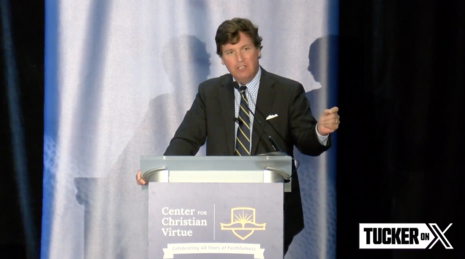
In a recent talk to the Center for Christian Virtue, Tucker Carlson railed against abortion asserting that it is “no benefit to society” and “it erode[s] its very foundation.”*  The former Fox News anchor called the battle over infanticide not a “political debate,” but a “spiritual battle.”**  The speech comes as the issue of abortion has heated up in the Republican presidential campaign.

Carlson is certainly correct in his assessment that the fight over abortion is a spiritual struggle, but he, like most of the pro-life movement, does not understand the larger tragedy of abortion.  The failure of the pro-life movement to stress this fundamental aspect, and to see abortion in the light of eternity, is one of the reasons why the evil is still a legalized part of the so-called civilized world.

While the killing of the unborn is a crime, a greater injustice of that heinous offense is committed.  Most Christians, including presumably Tucker Carlson (who was brought up Episcopalian) and the Center for Christian Virtue, would agree that one must be baptized to have a chance at salvation.  Abortion denies that opportunity.  Unbaptized infants neither go to heaven or hell, but to the “limbo of the children” where they do not suffer the pains of hell, but neither can they receive the beatific vision.

Abortion is not only the killing of the unborn, which is heinous in its own right, but it denies one from entering heaven.  If this aspect had been emphasized from the start, it may have mobilized even greater public and judicial support to outlaw the abominable practice.

Tucker Carlson’s Christian priorities are also skewed as he states:

The point of life is to have children and to watch

them have grandchildren.  Nothing will bring you

joy like that will.  Nothing comes close.  Would

trade your job for your children?  Would you trade                                                

anything for your children?  Of course not.***

The point of life is to save one’s soul and, as the Divine Savior taught, this is done by loving God with “thy whole heart, and with thy whole soul, and with thy whole mind” and loving “thy neighbor as thyself.”

Christ is very clear about those who put either parents or children above Him:

He that loveth father or mother more than

me, is not worthy of me; and he that loveth

son or daughter more than me, is not worthy                                                

of me.  [Matthew 10: 37]

Of course, children are precious gifts from God who add enjoyment and fulfillment to one’s life for those who can have them.  Children, however, are sinners and are in need of nurturing and instruction in how to live a moral life.  Sadly, despite the efforts and best intentions of parents, some children turn out badly. 

The fact that abortion is now a part of the political discourse demonstrates just how far the natural authority figures and institutions of society have failed in fulfilling their roles as moral guideposts.  Yet, this was bound to happen with the increased power of the state in all aspects of society, usurping the role that the family (and its extension – uncles, aunts, grandparents), churches, ministers, arbitrators, employers, philanthropists and scholars once held.  Where at one time ethical matters were discussed and decided outside of the state apparatus, now nearly every personal decision is subjected to government interference which has become the supreme arbitrator of what is moral and what is not.

That society’s non-governmental authority elements have little clout is also a factor in why most young people do not have much of a moral compass in how to conduct their lives and are susceptible to support the most debauched aspects of society. 

The left has long recognized this and has used the state to push through their agenda on all sorts of social and economic issues.  Using the levers of the state, a small, determined minority can impose its will on an unorganized majority.  This is another argument as to why pro-lifers should be for radical political de-centralization and the restoration of natural authority in society.    

Ultimately, the eradication of legalized abortion will not come via politics.  Instead of political wrangling, what should be made clear to the pro-abortion crowd is the real eternal consequences of their actions where the Divine Judge, who is not subject to legislative interference or some perverted, phony “right to choose” nonsense, will deliver perfect justice.

*https://www.zerohedge.com/political/watch-tucker-carlson-spits-fire-anti-abortion-speech

**https://www.breitbart.com/politics/2023/09/26/tucker-carlson-abortion-not-political-debate-spiritual-battle/

***Ibid.

Antonius Aquinas@AntoniusAquinas

https://antoniusaquinas.com

“Don’t Buy Government Bonds”

As another farcical “debt-ceiling raising” saga unfolds, conducted by the two indistinguishable political parties hell-bent on driving America into economic ruin, it would be instructive to look at how some earlier conservative/libertarian thinkers viewed public debt.  Unlike the present generation – with the notable exception of Ron Paul – these intellectuals asked fundamental questions about such matters as debt, taxation, central banking, and foreign policy.

One of the leading lights of what was known as the “Old Right” of the 1950’s, which opposed the Cold-War globalism of the likes of William Buckley and domestically sought to overturn the New Deal, was Frank Chodorov (1887-1966).  In his books and essays, Chodorov challenged the pillars which social democracy rested and sought to return America to small government, free trade, and “isolationism.” 

In one of his provocative essays, Chodorov pervasively argued that those who purchase public debt are complicit in the enhancement of state power.  Unlike many present-day economists who only see the baneful economic effects of profligate government borrowing, he makes a moral case against debt financing.*

He points out that public borrowing burdens future generations for the benefit of the present.  Despite reasons often given for the necessity of borrowing – war, natural disaster, infrastructure, etc., – Chodorov contends that the practice of shifting the cost to later generations, whatever the reason, is unjust:

This is exactly what you do when you
cooperate with the State’s borrowing
program. You are loading on your children
and your children’s children an obligation to
pay for something they had no voice in, and
for which they may not care at all. Your
‘investment for posterity’ may earn you
nothing but the curses of posterity.

Chodorov understood, as most commentators do not today, that a gold-backed currency restrained State largesse: “When money was redeemable in gold, the inherent profligacy of government was somewhat retrained; for, if the citizen lost faith in his money, or his bond, he could demand gold in exchange, and since the government did not have enough gold on hand to meet the demand, it had to curtail its spending proclivity accordingly.”

It was Franklin Delano Roosevelt’s despicable and criminal act of taking the U.S. off the gold standard domestically that led to the expansion of the public debt as Chodorov describes: “. . . Mr. Roosevelt removed this shackle and thus opened the flood gates.  The only limit to the inclination of every politician to spend money, in order to acquire power, is the refusal of the public to lend its money to the government. . . . the government can then resort to printing of money, to make money out of nothing. . . .” 

Not realized at the time, but the ability of the American government to expand its revenue base fit nicely into FDR’s later nefarious foreign policy objectives. 

Chodorov’s viewpoint on public debt can also easily be applied to FDR’s decision to eradicate the gold standard through which the U.S. currency could be redeemed for precious metals.  FDR’s act, however, was a “violation of contract” with American citizens since the U.S. government defaulted on its obligations.

In Orwellian fashion, the verbiage used with most government operations is often misused to legitimize State functions.  “Investment” is one such term that has been corrupted in relations to spending and debt.

In promoting their spending schemes, politicians will often use the term investment, “investment in education,” “investment in infrastructure,” etc.  This is deliberate, since it tries to equate government spending with a vital component of the market process.

In a market economy, investment means the lending of savings, which is used to expand and/or start an enterprise.  In return, the lender receives a stock or a bond.  If the business is successful, the lender’s investment will receive a return – dividends from a stock or interest from a bond.  Business investment is, therefore, a necessary aspect of capitalism which results in economic growth and increased living standards.

As Chodorov incisively points out, however, government investment is the antithesis of what takes place in the marketplace:  

The State, however, does not put your money into production.  The State spends it – that is all the State is capable of doing – and your savings disappear.  The interest you get comes out of the tax fund, to which you contribute your share, and your share is increased by the cost of servicing your bond.

Chodorov’s solution to deficit financing was not to buy government bonds.  While this would certainly be a step in the right direction, a more radical approach is needed since the problem has now become so immense. 

Simply put: there should be a prohibition on government borrowing of any kind.  State revenues should only come through tax receipts and fees paid by those in the present.  This would completely eliminate the “moral hazard” of debt financing and drastically reduce the size and scope of government over society.

For those who seek to put an end to the current debt-ceiling charade and rectify the immoral practice of burdening future generations by the irresponsibility of the present, the works of Frank Chodorov are essential.

* “Don’t Buy Government Bonds,” The Mises Institute, 13 January 2011. https://cdn.mises.org/Out%20of%20Step_4.pdf

Antonius Aquinas@AntoniusAquinas

https://antoniusaquinas.com

The Convention of States Project: A Bad Idea

Similar to Patrick Buchanan’s campaigns, Newt Gingrich’s “Contract with America,” the Tea Party, and to some extent Donald Trump’s presidency, the Convention of States Project* will not solve the crises that America faces.  It will, undoubtedly, like most of the previous reform and populist movements be sabotaged by the ruling class if it ever gets close to accomplishing its goals.

The Project’s rhetoric is “old-style” conservative/populist-speak which seeks to “[propose] amendments that impose fiscal restraint on the federal government, limit the power and jurisdiction of the federal government, and limit the terms of office for its officials and for members of Congress.”** Some of the proposed amendments include:

  • Congressional term limits
  • Requiring a two-thirds vote of the House and Senate to increase the public debt
  • Restoring the Commerce Clause to its original intent and scope
  • Repeal of the 16th Amendment, which gave us the income tax
  • Giving states, by a three-fifths vote, the power to negate any federal law, regulation or executive order giving Congress an easy means of overriding regulation

So far, 19 state legislatures have called for a constitutional convention, 34 states are needed for a convention to be called and, for an amendment to be passed, it must be approved by three quarters of state legislatures. 

The state legislatures who have signed on have realized that the federal government has become omnipotent and the individual states are now merely appendages to Washington.  “The states,” said South Carolina state representative Bill Taylor, “have sort of lost their voice, and all we can do now is beg from the cheap seats and say, ‘Hey, don’t do that.’”***

After the totalitarian and draconian efforts of the U.S. government and those around the world the past two years in response to the “pandemic,” Mr. Taylor’s sentiment is, to say the least, an understatement!

The fundamental problem with efforts such as the Convention of States Project is that they do not understand the nature of the crises that both America and most of the world face.  For America, its current malaise can be traced shortly after its independence with the adoption of the Constitution itself. 

While it has long been touted as a great document of freedom and liberty, it is anything but.  The “founding fathers” knowingly created a powerful central government and decreased the sovereignty of the individual state governments which had existed under the Articles of Confederation. 

In the words of Murry Rothbard, the Constitution was a coup that, for the most part, was the antithesis of the spirit and drive of the American Revolution which was a movement against political centralization and empire:

It was a bloodless coup d’etat against an unresisting

Confederation Congress. . . . .  The Federalists, by use

of propaganda, chicanery, fraud, malapportionment of

delegates, blackmail threats of secession and even

coercive laws, had managed to sustain enough delegates

to defy the wishes of the majority of the American people

and create a new Constitution.****

Worse than the power grab was the establishment of an omnipotent state as Rothbard incisively continues:

The drive [for ratification] was managed by a

corps of brilliant members and representatives

of the financial and landed oligarchy.  These

wealthy merchants and large landowners were

joined by the urban artisans of the large cities in

their drive to create a strong overriding central

government – a supreme government with its

own absolute power to tax, regulate commerce,

and raise armies.*****

410jXD-zO+L


The celebrated “separation of powers,” and “checks and balances” within the federal system and even the Bill of Rights, so often lauded by conservative and populist commentators, have proven from the very start to be ineffectual in stopping the expansion of state power. 

The Constitution itself declares that it is the ultimate authority as Article VI states:

This Constitution and the laws of the United States which

shall be made in pursuance thereof, and all treaties made,

or which shall be made, under the authority of the United States,

shall be the supreme law of the land. . . . [Italics mine.]

The massive and now unresolvable social, economic and political troubles both in the U.S. and around the world stems from a concentration of political power that is inherent in the nature of constitutional government.  This power is augmented and sustained by a system of central banking which provides the nation state with seemingly unlimited financial power to implement its various social engineering schemes, conduct continuous warfare, and has the ability to crush any opposition to its hegemony. 

The solution, which is all too obvious, but not attainable in the current ideological atmosphere dominated by statist thinking, is political decentralization.

The smaller political alignments under decentralization would probably coalesce around peoples with similar economic, social and religious affiliations and status and those with similar ethnic and racial backgrounds.  Such a system would be truly diverse and undoubtedly lower social tensions which derive from the central state’s forced integration polices. 

Once political decentralization became a reality, the natural and mutually beneficial relationships and interactions between peoples would emerge.  The immense advantage of free trade – the widening of the division of labor and specialization – would be the norm between societies since smaller countries could not afford to restrict trade since doing so would lead to autarky and the resultant fall in standards of living to primitive levels. 

Likewise, a universal monetary standard, most likely based on gold and silver, would arise among differing communities since a multitude of currencies would lead to monetary chaos and render economic calculation an impossibility.  Since no central state could impose its currency, the only honest and sound money – gold/silver – would be quickly adopted by all.

The mass invasion of the U.S. taking place under the negligence and encouragement of the Biden Administration could also be thwarted through political decentralization.  Areas where the lives and property of people are threatened by invaders have more of an incentive to effectively deal with unwanted groups than bureaucrats living often times thousands of miles away. 

Each jurisdiction would make its own policies on who or how many it wanted in its territory.  Moreover, each community could expel undesirables without interference from those who are not property owners or members of such communities.

While those behind the Convention of States Project and the state legislatures which have called for a constitutional convention may be well meaning, they will ultimately fail.  Such efforts are a wrongheaded approach to address the myriad of problems that plague the U.S. and, for that matter, the entire world.

Instead of attempts to amend the Constitution or though the electoral process by finding the “right candidate,” the very viable and historically proven alternative of de-centralization through secession is the only pathway to ultimate success.  Until the break-up of the nation state is accomplished, America and the world’s future will be considerably bleak.

*https://conventionofstates.com/

**https://starkrealities.substack.com/p/activists-more-than-halfway-to-forcing

***Ibid

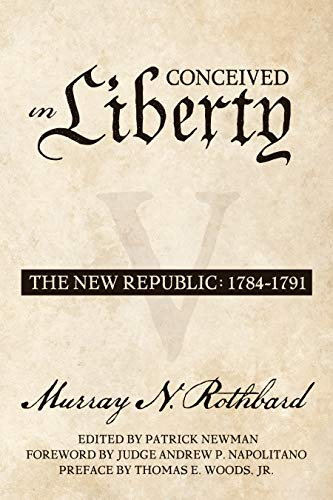
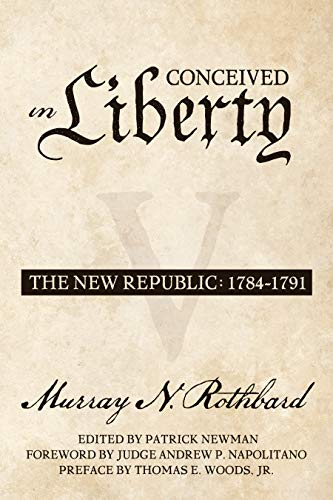
**** Murray N. Rothbard, Conceived in Liberty. Vol. 5, The New Republic, 1784-1791, ed., Patrick Newman.  Auburn, AL.: Mises Institute, 2019, p. 306.

*****Ibid.

Antonius Aquinas@AntoniusAquinas

https://antoniusaquinas.com