Category Archives: Jerome Powell

Treasury Secretary Janet Yellen Apologizes for Out-of-Control Debt

Outgoing Treasury Secretary Janet Yellen has apologized (sort of) for the Biden administration’s failure to reign in the U.S. financial house and presiding over an increase in trillions of dollars in debt for the nation. According to Tyler Durden, writing for Zero Hedge, Yellen said at a Wall Street Journal organized event in December:

I am concerned about fiscal sustainability and I am sorry that we haven’t made progress . . . . [T]he deficit needs to be brought down especially now that we’re in an environment of higher interest rates.*

A little too late – don’t you think, Janet? 

Yellen was Federal Reserve chairman from February 2014 to February 2018 and, before that, served as vice chairman under Ben Bernanke.  She was replaced by President Donald Trump with Jerome Powell. 

Yellen, as do all Fed officials, reiterated the point that the central bank remains “independent” to pursue its mandate of full employment and price stability.

This is nonsense like most of what she has said over the course of her long and disastrous career.  Instead of independence, her move from Fed chair to Treasury secretary is a striking demonstration of just how political the Fed and the nation’s entire monetary and financial system truly is. 

Nevertheless, she continued to espouse the hypocrisy:

I see from my own experience is that countries perform better – they have not only inflation performance – but real performance in terms of job creation and growth is also stronger when a central bank is left to use its best judgement without political influence.

Under Yellen as Fed chair (the direct subordinate to Ben Bernanke), and as Treasury secretary, it has been estimated that the U.S. debt skyrocketed to the unfathomable amount of $15 trillion.  Yet, it is only when she is about to depart her post that Yellen is lamenting the Biden administration’s efforts to reign in the debt. In fact, there were none.

Besides the debt, the interest on it under Yellen’s watch stands at $1.2 trillion yearly, which is now the second-largest federal expenditure only topped by Social Security.  In her mea culpa, Yellen ignored this ticking timebomb.

One of the non-sensical reasons that Yellen often gave to justify massive U.S. borrowing was that interest rates over the past decade had been historically low.  She argued that the federal government should take advantage – and did – of the low-interest rate environment. 

Economic nincompoops like Yellen apparently didn’t understand that interest rates were low because the Fed was artificially suppressing them through currency debasement.

Recklessly borrowing for this reason would be similar to a drunk refusing to sober up because liquor prices had fallen to all-time lows.  Yet, this is what a secretary of the U.S. Treasury espouses for monetary policy.  Worse, few in the financial press or Congress, where Fed officials routinely testify, are ever questioned about such a dangerous idea. 

Most sensible people, if given the chance, would ask: “What would happen to the debt and interest on the debt if rates would go up?”  The United States may soon see this unpleasant reality come to fruition. 

Sadly, Yellen’s replacement, Scott Bessent, who was a business associate of George Soros, is an “easy money” advocate, as is Trump, who continually badgered Fed Chairman Powell during his first term for not cutting interest rates. 

It will be interesting to see what actions the new Treasury secretary will take if the long-anticipated debt crisis arrives.  More likely than not, the second Trump administration will follow the monetary policies of the disgraced Janet Yellen. 

*Tyler Durden, “Janet Yellen ‘Sorry After Presiding Over $15 Trillion Increase in US Debt.”  13 December 2024 https://www.zerohedge.com/markets/janet-yellen-sorry-after-presiding-over-15-trillion-increase-us-debt

Antonius Aquinas@antoniusaquinas
https://antoniusaquinas.com

What the Rising Gold Price Signals

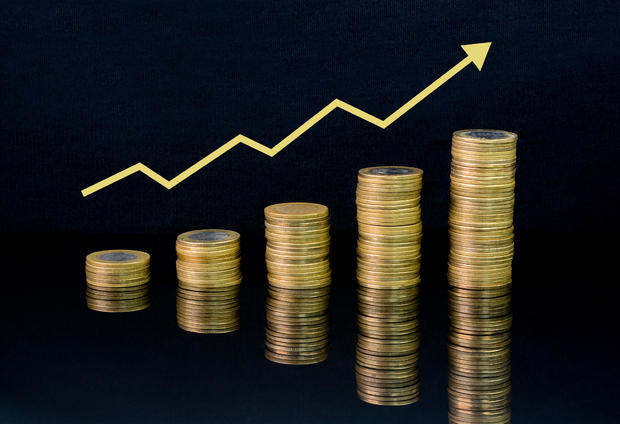
The recent run-up in the gold price has not garnered the attention among the mainstream financial media outlets as it should.  Gold has, in part, been overshadowed by the rise in the price of bitcoin and other cryptocurrencies. 

Naturally, the financial press, which is really an arm of the government and its central bank, wants to ignore, as much as possible, references to gold as protection against the continuing increase in the price level which itself has been deliberately understated by monetary officials.  The media and government understand that precious metals are the ultimate security against runaway inflation and economic collapse.

While the increase in the gold price has reached nominal highs, it and the price of silver have not passed their all-time 1980 highs in real terms.  Adjusted for inflation, gold would have to rise to about $3590 an ounce while silver would have to surpass $50 an ounce.  Both are poised to exceed these watermarks in the not-too-distant future.

Precious metals will continue to escalate unless the Federal Reserve radically changes its interest rate policy to combat inflation as former Fed Chairman Paul Volcker once did.  Volcker raised interest rates to double-digit levels which caused gold prices to fall.  While Volcker could get away with such actions (because, at the time, the U.S. was still a creditor nation), current Chair Jerome Powell cannot because of the enormity of public and private debt.  Double-digit interest rates would collapse the economy and plunge millions of Americans into bankruptcy.

The rising price of gold is anticipating some of the promised policy actions of the Fed.  Since the end of last year, the central bank has indicated that it would be cutting interest rates.  In addition, Powell is considering ending the Fed’s “Quantitative Tightening” (QT) program.  Both are highly inflationary. 

While commentators have focused on gold’s spectacular price rise, there is an underlying issue that is also taking place.  The record setting gold price is signaling that the present fiat monetary order, which is based on the dollar as the world’s reserve currency, is coming to a financially unpleasant end. 

Ever since 1971, when the Nixon Administration closed the “gold window,” refusing to redeem gold for dollars held by foreign central banks, the world has been on a “dollar standard” where bank reserves are held in Greenbacks.  If the Fed continues to print dollars to sustain government spending at this rate, the dollar will continue to lose purchasing power and foreigners will no longer want to hold them.  Foreign central banks will then turn to gold.  In fact, central banks are already increasing their positions in gold which has been a catalyst that has fueled the latest rally.

Not surprisingly, the Fed has not purchased much gold (or is not admitting publicly that it has) since it would be a bad look for the issuer of the world’s reserve currency to be abandoning its own currency for gold.

Besides the severe financial implications if the dollar is dethroned, there will be dramatic geopolitical repercussions from the loss of its hegemony.  Just like the British pound was replaced as the dominant world currency after England insanely exhausted itself in fighting WWII and ending its empire, America will face a similar future when the dollar becomes just another money.  Many will see it as a “blessing” if and when the U.S. Empire comes to an end.

While it would appear logical and morally sound to replace the present crumbling monetary order with one based on gold and silver, a far worse paradigm than even the present one is, no doubt, being planned.  The new system will be one of central bank digital currency (CBDC) which would give governments and bankers the power to monitor and control all aspects of economic and social life. 

Some states have passed legislation to counter CBDC, such as Florida in 2023 under Governor Ron DeSantis who said: “The Biden administration’s efforts to inject a Centralized Bank Digital Currency is about surveillance and control.  Today’s announcement will protect Florida consumers and businesses from the reckless adoption of a ‘centralized digital dollar’ which will stifle and promote government-sanctioned surveillance. . . .”*

While the press and policy makers have ignored the surge in precious metal prices, it should be a warning to everyone that difficult economic times are still yet to come with the potential of a new draconian monetary order to be installed on the horizon.  Observant individuals should heed gold’s signals and take appropriate measures to safeguard their futures.

*https://www.flgov.com/2023/03/20/governor-ron-desantis-announces-legislation-to-protect-floridians-from-a-federally-controlled-central-bank-digital-currency-and-surveillance-state/

Antonius Aquinas@AntoniusAquinas

https://antoniusaquinas.com

Trump’s Inflation

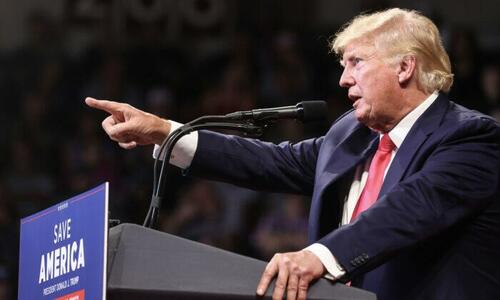
Former President Donald Trump attends a rally in support of Arizona GOP candidates, Prescott, Ariz., on July 22, 2022. (Mario Tama/Getty Images)

Once again, former president Donald Trump criticized the Biden Administration for the record consumer price increases that Americans are now paying.  His remarks followed up on his July 4th speech in Wyoming where he lamented about the state of the nation: “I know it’s not looking good for our Country right now, with a major War raging out of control in Europe, the Highest Inflation in memory, the worst 6 month Stock Market in History, the highest energy prices ever.”* 

In his most recent campaign rally for GOP hopeful Kari Lake, Trump lambasted President Biden for creating the “worst inflation in 47 years”** and for his “war on American energy” which Trump believes has contributed to the record hike in fuel prices.

The former president boasted that had he been re-elected “none of these terrible events would have happened.”  He reassured his audience “not to worry” and that “we will make America great again.” 

As with all of his post-presidential rallies, Trump’s criticism of the Biden regime comes with touting his own accomplishments as chief executive.  Most of these claims are so outrageous they damage or totally negate his critique of Biden’s policies and make Trump sound like a fool.

Take, for instance, his rally in Arizona for Kari Lake, where he had the audacity to say that under his watch the country “had the greatest economy in the history of the world with no inflation.” [!]  Such nonsense needs no comment.

Like his boasts about the economy, the former president deftly left out his Administration’s role in the drastic rise in prices which Americans are currently suffering from. 

First, however, the meaning of “inflation” should be explained.

Inflation, properly defined, as it was understood until the present era, meant an expansion of the money supply.  “Deflation,” its opposite is a decrease in the money supply.  The rise or fall in prices – usually a rise in producer and consumer prices – is a consequence of the expansion or contraction of the money supply.  Once understood, the rampant rise in prices in America and throughout the world has been the result of the increase in the money supply not only by the Federal Reserve, but all central banks.

Another important tenet of monetary theory long since forgotten has been the notion of a “lagging indicator.”  Between the expansion of the money supply – inflation – and the resultant increase in prices, there is often a lag which could take months or years to appear. 

The increase in consumer and producer prices is due to the dramatic explosion of money and credit which took place during the Trump Administration not only in response to the scamdemic, but in the years leading up to it.  In fact, the plandemic was a convenient excuse to inject massive liquidity into a system that began to hemorrhage in September, 2019.  In the early months of 2020, the markets began to implode before the unnecessary lockdowns as the air began to come out of the financial bubble.  This has been ignored by the financial press and Trump himself.

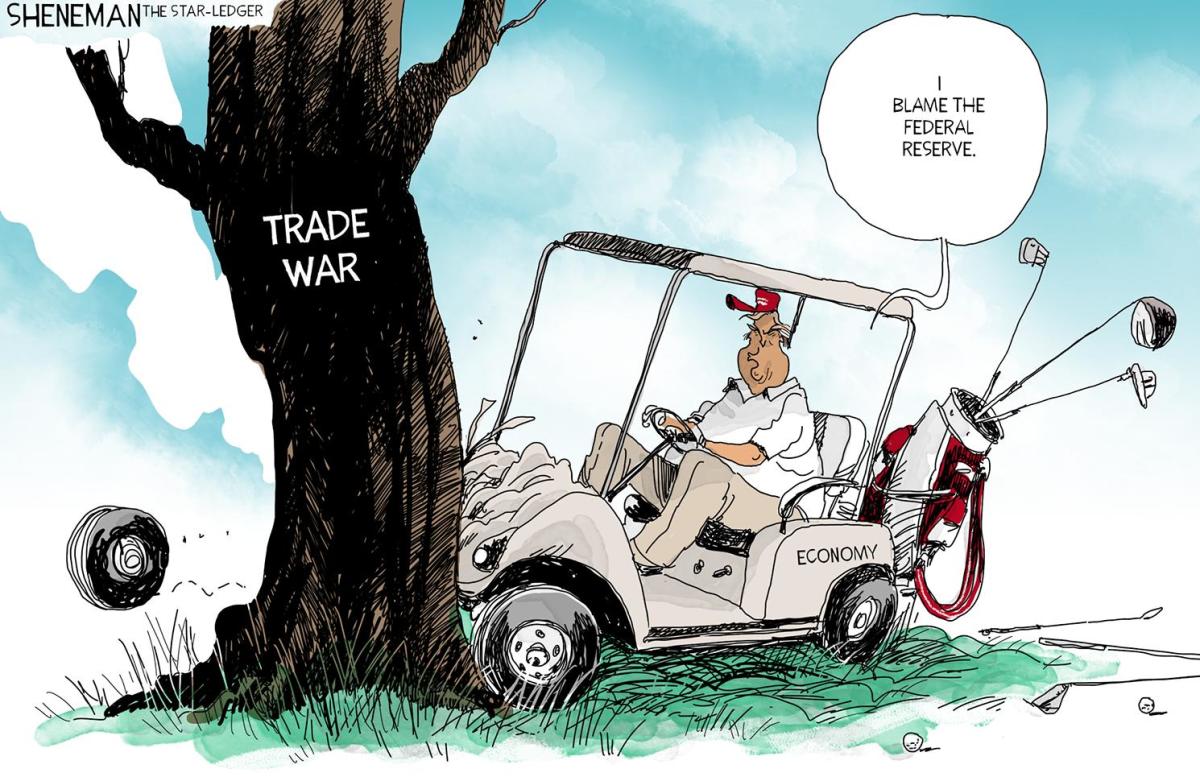
Prior to the covid hysteria, Trump had repeatedly lobbied for “cheap” money, calling for a renewal of quantitative easing, reduction in interest rates, and he even spoke about “negative” rates.  The former president threatened to fire Jerome Powell, whom he had picked to head the Federal Reserve, for not reducing interest rates far enough.  Trump complained that President Obama benefited from the Fed’s accommodative monetary policy and wanted similar treatment so as to keep the financial bubble going.

Trump’s fiscal policy was also highly inflationary as he ran record deficits long before covid.  His tax cuts and failure to cut government spending led to greater government borrowing which the Fed was forced to monetize.  Trump was on pace, well before the 2020 lockdowns, to spend more money in four years than Obama spent in his two terms.  By 2019, the deficit had grown to $1 trillion dollars, up $205 billion, 26 percent from 2018.***  Again, all before covid had begun.   

It was the Trump Administration’s wrongheaded response to the corona virus which is largely responsible for the rising prices of today.  If the lockdowns were necessary (which a growing number of officials now admit they were not), the proper policy would have been to reduce the money supply (and government spending in general) since the lockdowns reduced production meaning less goods and employment.  The massive increase in the Fed’s balance sheet from $4 trillion to some $9 trillion meant more money “chasing fewer goods” causing the prices of the available goods to increase – some dramatically.

What was needed was a reduction in consumer spending since there was less goods being produced with the lockdowns.  Less demand would have offset the reduction in supply and would have kept prices from spiraling.

Instead, Trump – as did his successor – following the doctrines of Lord Keynes, attempted to maintain aggregate demand at pre-covid levels and sent out stimulus checks even to those still employed.  While the money given out to American workers pales in comparison to the massive transfer of wealth to politically-favorite corporations, big business, and the expansion of the government itself, the propping up of aggregate demand led to supply chain shortages.   

Trump is not alone in his ignorance of economics.  His handlers, economic advisors, and the vast majority of his loyal supporters do not understand what took place under his administration.  The current financial mess can be laid at his – and the Federal Reserve’s – feet.  To be fair, his predecessor, Barrack Obama, is also liable.    

The “inflation,” and now recession, which the country is suffering through cannot be fully attributed to the Biden Administration although it too has added to the crisis with more profligate spending. 

The remedy for the current mess is not the re-election of a very flawed former president who does not understand the problem at hand and throughout his term was constantly outfoxed by the Swap which he was elected to drain.  The solution is a return to sound money, the abolition of central banking, and the allowance for the necessary cleansing of the financial bubble. Until a presidential contender speaks in these terms, America’s financial woes will continue.

*https://www.zerohedge.com/political/heres-what-trump-says-inflation-would-be-if-he-were-still-president

**https://www.zerohedge.com/political/trump-blasts-biden-over-soaring-prices-says-true-inflation-rate-much-much-higher-91

***https://www.washingtonpost.com/business/2019/10/25/us-deficit-hit-billion-marking-nearly-percent-increase-during-trump-era/

Antonius Aquinas@AntoniusAquinas

https://antoniusaquinas.com

Memo to The Donald: Cut Tariffs NOT Rates

trump tariff

So far, President Trump’s economic response to a potential coronavirus outbreak and a further stock market sell off has been expected – calls for more interest rate cuts and an additional round of monetary stimulus.  For the stock market, economy, and the virus itself, neither measure will have their desired effect and, in fact, may exacerbate things.

Further rate cuts and more money printing will not alleviate the situation since it has been the Federal Reserve’s recent “repo operations” which has pushed the market to its unsustainable highs.  For President Trump’s re-election hopes, the current “correction” better be short lived since he has repeatedly boasted about the stock market and has tied its success with the supposed health of the economy.  He will pay a political price if the market continues to tank and brings the economy down with it.

While President Trump and economic nationalists have bashed China for its trade practices, they are now going to see first hand how dependent the US and the West are on Chinese exports, as supply chains are disrupted over the coronavirus.

A Bloomberg article describes China’s weakest factory activity ever recorded:

The manufacturing purchasing managers’ index plunged to 35.7 in

February form 50 the previous month, according to data received by the

National bureau Statistics on Saturday, much lower than the median

estimate of economists.  Both were well below 50, which denotes

contraction.*

The expected reduction of Chinese goods will mean higher US domestic prices, however, the increase in prices can be offset somewhat not by rate cuts, but by tariff reductions, or, better still, elimination of duties on imports.  Increasing the money supply or cutting interest rates, which is what Trump, the market, and 95% of economists favor, will only mean higher prices for dwindling imports as greater amounts of money will chase fewer goods.

In the President’s comments on the coronavirus and the stock market plunge, he has repeatedly cited other nations’ (Japan, Germany) – lower interest rates as a policy that the Fed should pursue.  Apparently, the President is not aware that recent data out of Japan has shown that the economy shrank at an annualized rate of 6.3% for the fourth quarter of 2019 while the German economy only grew at 0.6% last year.**  Low rates have not helped either economy or anywhere else where they have been foolishly tried.

What President Trump, world policy makers, and central bankers do not understand, whether deliberately or from willful ignorance, is that the artificial suppression of interest rates and money printing does not lead to economic growth. Instead, prosperity can only come about by the arduous process of saving (abstention from consumption), which provides the means for capital formation, which leads to production.  Employment, wage growth, and income are also ultimately tied to savings.  For the creation of wealth, there is no way around this elementary economic principle – one that few profession economists comprehend.

For saving and investment to have their most efficacious impact and for individuals to engage in such sacrificial behavior, a sound monetary order must be in place.  Unfortunately, ever since the US went off the gold standard internationally in 1971, its monetary system has grown increasingly unstable.

If the Trump Administration would eliminate, or at least reduce significantly, tariffs, it would more than likely induce China to do the same.  The benefits of lower import prices for the millions of out of work Chinese due to the coronavirus shut downs would be a tremendous help and would also boost America’s export industries.  Such action would show to those who elected him that Donald Trump was not a typical politician, but one who thought outside the box.

While it did not cause the Great Depression, the Smoot-Hawley Tariff of 1930 contributed to its severity.  If the recent sell-off is indeed the beginning of the long anticipated bust, following a supposed decade long expansion, then policy makers should do all in their power to alleviate the coming suffering.  The reduction of tariffs not only on Chinese goods, but those the world over would be a step in the right direction.

Let us hope that someone will convince Donald Trump that tariff reduction and not rate cuts will help Americans better deal with the troublesome and potentially economic and socially devastating coronavirus.

*China Posts Weakest Factory Activity on Record,” Bloomberg News, 29 February 2020.  https://www.bloomberg.com/news/articles/2020-02-29/china-feb-manufacturing-pmi-at-35-7-est-45-0

**Megumi Fujikawa, “Japan’s Economy Shrinks Faster Than Expected.”  Market Watch.  16 February 2020.  https://www.marketwatch.com/story/japans-economy-shrinks-faster-than-expected-2020-02-16;  “German Economy Stagnates as Eurozone Growth Hits Seven-Year-Low,”  The Guardian,  14 February 2020, https://www.theguardian.com/business/live/2020/feb/14/german-economy-stagnates-growth-eurozone-gdp-business-live

Antonius Aquinas@AntoniusAquinas

https://antoniusaquinas.com

The Fed’s “Inflation Target” is Impoverishing American Workers

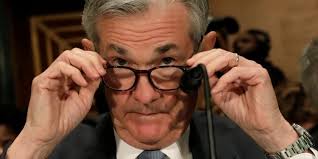
Powell   Fed Chair Jerome Powell apparently doesn’t see the pernicious effects of inflation
At one time, the Federal Reserve’s sole mandate was to maintain stable prices and to “fight inflation.”  To the Fed, the financial press, and most everyone else “inflation” means rising prices instead of its original and true definition as an increase in the money supply.  Rising prices are a consequence – a very painful consequence – of money printing.

Naturally, the Fed and all other central bankers prefer the definition of inflation as a rise in prices which insidiously hides the fact that they, being the issuers of currency, are the real culprit for increased prices.

Be that as it may, the common understanding of inflation as rising prices has always been seen as pernicious and destructive to an economy and living standards.  In the perverted world of modern economics, however, the idea of inflation as an intrinsic evil has been turned on its head and monetary authorities the world over now have “inflation targets” which they hope to attain.

America’s central bank is right in line with this lunacy, as it has been reported that at the Fed’s “May minutes” it wants “a temporary period of inflation modestly above 2 percent [which] would be consistent with the Committee’s symmetric inflation objective.”* Translated into understandable verbiage, the Fed wants everyone to pay at least 2% higher prices for the goods they buy.

Yes, by some crazed thinking US monetary officials believe that consumers paying higher prices is somehow good for economic activity and standards of living!  Of course, anyone with a modicum of sense can see that this is absurd and that those who espouse such policy should be laughed at and summarily locked up in an asylum!  Yet, this is now standard policy, not just with the Fed, but with the ECU and other central banks.

The baneful consequence of this economic quackery is being felt by American workers as admitted by the Labor Department.  Instead of spurring expansion, inflation is eating into and depressing wages:

For workers in ‘production and

nonsupervisory” positions, the value

of the average paycheck has actually

declined in the past year.  For those

workers, average ‘real wages’ – a

measure of pay that takes inflation

into account fell – from $22.62 in

May 2017 to $22.59 in May of 2018.*

While the decline in nominal wages is not significant, the manner in which the government now calculates inflation has been skewed to understate its impact.  Under the previous calculation, the current US inflation rate is probably closer to 5%.

Wage stagnation is not new.  Average real wages peaked more than 40 years ago and have fallen in real terms ever since.  Not surprisingly, the drop in wages in real terms began soon after the US went off the last vestiges of the gold standard in 1971.

As sound theory has long ago demonstrated, the idea of economic growth through money printing is absurd.  Increases in living standards and real wages can only come about through savings, investment, and capital accumulation.  Workers who have superior tools and equipment are obviously more productive than those that do not. Yet, capital goods have to be produced and production takes place over time.  Savings allow for the production process.

The level of wages are also closely linked to savings.  The greater savings an economy has enables entrepreneurs to bid for workers and increase wage rates.  This is how wages rise – competition for labor among businessmen pushes up wage rates.  The more savings entrepreneurs have, the higher they can bid for employees.

How and why wage rates rise and how employment is created had been understood by economists of yesteryear.  Today, however, the profession is dominated by “inflationists” and monetary cranks who believe that nearly every economic problem can be solved by the printing press.  Anyone who holds such ideas cannot be taken seriously.

While the Federal Reserve may think an inflation target will create prosperity, the reality for real wages is quite the opposite.  The laws of economic science have not been repealed.  An inflation target will lead to the impoverishment of not just workers, but lower living standards for all.

inflation target.jpg

*Jeff Stein and Andrew van Dam, “For the Biggest Group of American Workers, Wages Aren’t Just Flat.  They’re Falling.”  The Washington Post.  16 June 2018 A10.

Antonius Aquinas@AntoniusAquinas

https://antoniusaquinas.com