Author Archives: editors

School Choice: A Bad Idea

While the school choice movement has been a popular policy initiative for conservative politicians and parents who are disgusted with the failing and, in many areas, debauched public school system, a closer look at “choice” in education, which includes charter schools, vouchers, and scholarships, may not be the panacea for educational reform as many believe.

One of the latest developments in school choice involves the funding of an Oklahoma religious charter school. The state’s Supreme Court has ruled that the public funding of St. Isidore of Seville Catholic Virtual School is unconstitutional.* While privately run, charter schools are tax financed and “must abide by many of the rules that govern traditional public schools” says Laura Meckler in an article titled “Oklahoma Weighs Nation’s First Religious Charter School,” published in The Washington Post, April 3, 2024.

The “constitutionality” of the case was challenged by Oklahoma Attorney General Gentner Drummond, who cited state law that says “charter schools may not be sectarian or affiliated with a religious institution.” The attorney general contended that, if the school is allowed to exist, it would have “unlimited unintended consequences” and thus “the state of Oklahoma effectively has control over the school.”

Drummond said, “That’s the state controlling religion. That is a slope for which there is no end.”

While the Oklahoma Supreme Court has concurred with Drummond’s assessment in the St. Isidore school case, it is disturbing as to why the school’s backers, as well as other proponents of charter schools, do not see the obvious danger of government interference in religious education which necessarily comes once state monies are allocated.

In the past, religious institutions would have recognized the threat to their independence and would have no part in such an arrangement no matter how lucrative. The appeal of private schools has always been that the government has little oversight over the curricula, and that parents have a say in what their children are taught. Many private schools today, however, are little different than their public school counterparts in curriculum offered, discipline, and cultural outlook.

Besides the obvious constitutional issue of forcing taxpayers to support religious institutions, there is another moral issue which is rarely, if ever, discussed that exists not only with charter schools, but public education in general. Why should those that are single, childless couples, and those parents who send their children to private schools be forced to pay for public education? While taxpayers are protected from being coerced to contribute to religious institutions, why are the rights of those who do not use public schools not observed?

While constitutional conservatives have ignored this aspect of tax-funded schooling, there is another troubling aspect of public education. The public school has always been a vehicle for the left’s social-engineering schemes. One of the most egregious of these was Brown vs. Board of Education, which inaugurated the coercive racial integration movement.

It is little wonder why the American electorate has moved decidedly leftward. Several generations of young minds have spent their formative years exposed to some of the most radical ideas that are now presented as normal. At one time conservative commentators spoke about this, but, like nearly all of their other principles (except for their love of war), the right has abandoned this important aspect of American life.

The entire concept of school choice is confused, put forward by its proponents to somehow reform and act as an alternative to public education. Because of its nature – “one size fist all” – a bureaucracy cannot be reformed or offer diverse products or services to its customers.

If reformers want real choice, they should call for an end to public schooling and substitute in its place a decentralized system of education provision, where a wide variety of schools and institutions offer families genuine alternatives. In a market for education, parents can choose their children’s curriculum and also who instructs them.

Of course, a truly free educational system includes home schooling, which would be completely liberated from state interference.

Removing government from schooling would be a gigantic blow against the nanny state and, once again, place the responsibility for the education of youngsters with the family. The societal benefit of such a change would be incalculable.

Choice in education is another example of conservatives attempting to amend the welfare/warfare state. While it has gained in popularity and may receive in the future judicial approval, school choice will not fix public education, which will continue to be a breeding ground for the left. However, the elimination of government involvement in schooling would not only provide families with superior educational opportunities, but would remove a key component of the left’s power and control over society.

*https://apnews.com/article/public-religious-catholic-charter-school-unconstitutional-oklahoma-e4ef414605094313331a39cc645ede8a

Antonius Aquinas@AntoniusAquinas

https://antoniusaquinas.com

Economic Collapse May Be the Only Way to Prevent World War III

The tensions between the West and Russia over the Ukraine have escalated over the past few months with an almost daily occurrence of provocations and belligerent talk mostly from members of NATO.  In response, Russia sent a naval contingent to the Caribbean in a show of force.  Some of the Western provocations include:

  • Polish President Andrzej Duda’s willingness to place U.S. nuclear weapons on Polish soil;
  • German Defense Minister Boris Pistorius’ s call for reinstitution of a draft;
  • A hand-delivered check by Biden to Volodymyr Zelensky as part of the $95 billion U.S. “defense” package for Ukraine
  • A request by Zelensky for Westerners to train troops on Ukrainian soil; and
  • US and NATO okaying Ukraine to fire long-range American weapons as much as 12 miles into Russian territory

It is apparent that, until Russian President Vladimir Putin capitulates to Western demands in regard to Ukraine, NATO will continue to push the envelop.  In hindsight, analysts such as Paul Craig Roberts have, from the start, urged Putin to swiftly finish off Ukraine militarily and replace the Zelensky regime with one favorable to Russia.  A protracted struggle, Roberts warned, would give the West more time to supplement Ukraine: “The conflict dragged on, because having declared the intervention limited, the Kremlin left Kiev to continue the war, thus playing into Western hands as the West gradually widened the war.” *

Unfortunately for Russia, Paul Craig Roberts’s prognostication is now coming to fruition. 

The counter argument to a more aggressive Russia is that Putin realizes that the West is run by a pack of sociopaths who would have no qualms launching WWIII, which would include the use of nuclear weapons, or ignite a major military conflagration in the area.  The Russian president sees that the West holds a decisive military advantage over Russia even if it allied with China.  The U.S. alone spends more than the combined expenditures of the top nine militaries in the world.

The United States has thus the ability and means to operate and intervene in almost any sector of the world.  It is able to do so because it has had, for the longest time, an economy which was able to not only produce goods for the domestic market and also for its foreign adventures.  It takes wealth to be able to arm, transport, deploy, and maintain men in distant lands.

Because of America’s relatively free economy, it could produce a seemingly endless supply of military hardware for itself, but also to buy off client states and fund proxy wars.  In contrast, the Soviet Union could never export communism in any significant way after World War II because it lacked the means to do so.  Its economy was a basket case that could barely feed its citizens. 

While the U.S. may have the military capability to be the world’s policeman, its actions in the Ukraine are ultimately controlled by ideology.  And, for the longest time, U.S. foreign policy has been one of interventionism and war with the ultimate goal of the establishment of a one-world state.  Its proxy war in Ukraine is designed to cripple Russia, which stands as a roadblock to this long-desired goal.

Since it is apparent that the principles guiding U.S. foreign policy are not going to change anytime soon, the nation will continue on its bellicose course until it no longer has the means to do so.  This would mean a financial crisis, most likely in the form of a dollar collapse, which would ground the economy to a halt. 

In such a scenario, the United States would be following the course that Great Britain took after World War II, when its empire could no longer be sustained since the country insanely exhausted itself in the conduct of fighting two world wars. 

A similar, earlier historical example was the Western Roman empire, which, through currency debasement, heavy taxation and government largesse, ruined its economy and then could no longer maintain its empire.

 The ideology of Great Britain and Rome did not change, however, they simply no longer had the means to sustain and expand their empires.

Despite massive deficits, record-setting inflation, and a recent bank crisis in March, 2023, a financial crisis does not appear to be on the horizon.  Although things can change quickly, for the foreseeable future, the U.S. empire is in no danger from internal collapse.

While an economic collapse would mean misery for millions of Americans, it would be, in a sense, retribution for the nation’s murderous and costly foreign policy, which has brought, and still is bringing, untold death and destruction to millions of people.  

*Paul Craig Roberts, “Normalizing War with Russia,” PaulCraigRoberts.org, 6 June 2016, https://www.paulcraigroberts.org/2024/06/06/normalizing-war-with-russia/

U.S. Fertility Rates Collapse

The destructive demographic effects of the leftist social engineering schemes of the past century are now being felt in the latest federal data on the precipitous decline in U.S. birth rates.  A recent report from the Centers for Disease Control shows that the fertility rate among U.S. women has fallen to 1.62 births per woman in 2023, which is the lowest recorded rate since the government began keeping such statistics in the 1930s.

Buried in the media reports is the drop off in white women’s fertility rates, which fell some 3% from last year and stand less than the national average.  Asian women and white women have equal reproductive capacities.  The fertility rate is an estimate of the number of babies a woman would normally have in her lifetime.  A rate of 2.1 births per woman is needed for a generation to replace itself.

While this demographic trend has been in motion for quite some time, the explanation for the fall in reproduction by the news media and think tanks devoted to the subject have largely missed the mark.

In its coverage of the story, The Wall Street Journal’s Jennifer Calfas and Anthony DeBarros cited such factors as “women establishing fulfilling careers,” and that they have more access to contraception.*  The most fertile child-bearing group – young women – are putting off motherhood because they are uncertain about the future and are “spending more of their income on homeownership, student debt and child care.” 

The reasons that The Journal and other commentators give to explain the decline in birth rates are the consequences of what took place in America and the Western world decades ago.  Leftists had always wanted to break down and corrupt the traditional family.  A splintered and dysfunctional family structure would be less likely to act as bulwark against its agenda. 

One of the ways to accomplish this was to get women out of the household and into the labor market, as working and career women would have fewer opportunities to have children. 

The feminist movement was more than just the attainment of “equal rights” for women.  Its main objective was to lead women out of the home and away from their traditional roles as mothers and homemakers.  The record drop in birth rates demonstrates how well this plan has been accomplished. 

Besides the disruptive impact on family life and its size, working women are also an indication (and a much better one than government statistics) that living standards have fallen over the generations despite what the financial press has maintained about the economy.  Some 50 to 60 years ago most women did not work, one income could sustain a family and even larger families at that. 

Now, due to the dramatic increase in the cost of living – mostly due to the Federal Reserve’s inflationary monetary policies, D.C.’s unbridled lust of spending, and massive corporate bailouts and subsidies – real incomes have fallen.  For most couples, it takes two full-time jobs to sustain a household which today is a lot smaller than earlier generations. 

While the financial argument has merit, the most important factor has been the establishment’s relentless push to justify and make appealing the idea of working women.  This arrangement has led to countless conflicts between the sexes in and out of the workplace.

Of course, this is not to say that women should be prohibited from the labor market or do so on a part-time, informal basis.  Some, out of tragic circumstances, need to work or some may not be cut out for motherhood, but this should be the exception to the norm.

While anti-immigration voices have rightly focused on the cultural and political altering impact of mass illegal immigration, there has been less emphasis on the fundamental change of women’s role in society.  Such neglect is probably due to a reluctance to take a moral position and appear chauvinistic or misogynistic.  A healthy birth-rate model could offset the influx of unwanted immigrants. 

Recently, Elon Musk wrote that “Any nation with a birth rate below replacement will eventually cease to exist.”  When confused New World Order types like Musk recognize the seriousness of population collapse, it is time to worry.  Yet, Musk and others do not understand the essence of the problem.

Without a reordering of society to its natural state and restoring the family as a fruitful and nurturing institution for child rearing, a demographic nightmare is in store for America and the Western world.

*Jennifer Calfas & Anthony DeBarros, “Fertility Rate Falls to a Record Low Amid Social Shifts,” The Wall Street Journal, 25 April 2024, pp. A1-A2.

Antonius Aquinas@AntoniusAquinas

https://antoniusaquinas.com

Many Americans Say They Will Never Retire

A recent AARP poll provides further evidence of the deterioration of American living standards, especially for those approaching retirement age.  The study contradicts what most policy makers have believed to be a “soft landing” for the economy after two years of rampant inflation.

“More than one quarter of U.S. adults over the age of 59,” the survey found, “say they expect to never retire.”  One in four have no retirement savings while one third of “older adults” have credit card debt of more than $10,000 and 12% hold a balance of $20,000 or more.” The Headline of an April 25 Washington Times article by Fatima Hussein says it all: “More Than 25% of U.S. Adults Over 50 Expect Never to Retire.”*

Not surprisingly, the report conducted with the NORC Center for Public Affairs Research, points out that the lack of savings is due to the rising cost of living: “Everyday expenses and housing costs, including rent and mortgage payments, are the biggest reasons why people are unable to save for retirement.”

While AARP zeroed in on rising prices as the culprit for the financial pinch that potential retirees are feeling, it did not delve into who or what was the catalyst for the increase in living costs.  Neither has the financial press, which has always been a cheerleader for the Uniparty, been diligent in its duty about the ultimate source for soaring prices. 

While the trend of Americans working well into their retirement years has been going on for years, the situation has accelerated under both the Trump and Biden presidencies.  In concert with the Federal Reserve, the fiscal policies of the two administrations have been the primary factor for why many Americans cannot retire. 

Even before the start of the hyped Covid pandemic, the Trump administration, in just one term, was on pace to become the biggest spender in U.S. history.  The astronomical increase in government spending and money printing which took place in response to Covid are now being felt.

The Fed’s balance sheet before the Covid lockdowns in January of 2020 stood at $4.15 trillion. By the end of Trump’s presidency, it had nearly doubled to $7.3 trillion as the government doled out “stimulus checks” to non-working Americans and transferred billions to business favorites and cronies in an unimaginable grab of power and wealth. 

Under Biden, the balance sheet had risen to a little short of $9 trillion in mid-2022 and has come down, now standing at $7.4 trillion, according to American Action Forum.**  

Expanding the balance sheet means that the Fed issues more dollars it takes and buys assets (mostly government bonds). This is actually debt monetization.  The increase in the money supply is the classic – and true – definition of inflation.  Rising prices are not inflation, but its consequence.   

At first, the new money went into financial assets increasing their nominal values. However, because of the “lag effect,” the inflation the Fed created is now pushing up consumer prices.  The Fed has had to do this because of profligate government spending which must be sustained through borrowing, since tax revenues are not enough to meet expenditures. 

When asked in his current re-election campaign on what he would do to solve the rising cost of living, Trump said that he would “drill baby drill.”  Such a statement demonstrates again that the former president, like the current occupant of the office, does not understand the problem.

Increasing domestic oil production is certainly good in itself, which will create jobs and bring more oil to the market. But it will not address general price inflation which is a monetary phenomenon

Rising prices can be reversed if the Fed increases interest rates, or better yet, lets rates be set by the market.  Higher rates will entice people to save, which will take money out of circulation, thus putting downward pressure on prices.

Just as important, the government needs to cut spending and eliminate departments and programs which will mean less money printing by the Fed.  The likelihood of this taking place in a presidential election year is next to zero.      

Even if the government and the Fed took the proper steps and began to put the nation on a sound financial footing, it will take years for the damage that has been done to be rectified.

Sadly, the Uniparty has no intention of doing the right thing and as economic conditions worsen, the number of people who must work until they drop will continue to rise.

*Fatima Hussein, “More than 25% of U.S. adults over 50 expect never to retire.” The Washington Times, 25 April 2024, A7. **https://www.americanactionforum.org/insight/tracker-the-federal-reserves-balance-sheet/

What the Rising Gold Price Signals

The recent run-up in the gold price has not garnered the attention among the mainstream financial media outlets as it should.  Gold has, in part, been overshadowed by the rise in the price of bitcoin and other cryptocurrencies. 

Naturally, the financial press, which is really an arm of the government and its central bank, wants to ignore, as much as possible, references to gold as protection against the continuing increase in the price level which itself has been deliberately understated by monetary officials.  The media and government understand that precious metals are the ultimate security against runaway inflation and economic collapse.

While the increase in the gold price has reached nominal highs, it and the price of silver have not passed their all-time 1980 highs in real terms.  Adjusted for inflation, gold would have to rise to about $3590 an ounce while silver would have to surpass $50 an ounce.  Both are poised to exceed these watermarks in the not-too-distant future.

Precious metals will continue to escalate unless the Federal Reserve radically changes its interest rate policy to combat inflation as former Fed Chairman Paul Volcker once did.  Volcker raised interest rates to double-digit levels which caused gold prices to fall.  While Volcker could get away with such actions (because, at the time, the U.S. was still a creditor nation), current Chair Jerome Powell cannot because of the enormity of public and private debt.  Double-digit interest rates would collapse the economy and plunge millions of Americans into bankruptcy.

The rising price of gold is anticipating some of the promised policy actions of the Fed.  Since the end of last year, the central bank has indicated that it would be cutting interest rates.  In addition, Powell is considering ending the Fed’s “Quantitative Tightening” (QT) program.  Both are highly inflationary. 

While commentators have focused on gold’s spectacular price rise, there is an underlying issue that is also taking place.  The record setting gold price is signaling that the present fiat monetary order, which is based on the dollar as the world’s reserve currency, is coming to a financially unpleasant end. 

Ever since 1971, when the Nixon Administration closed the “gold window,” refusing to redeem gold for dollars held by foreign central banks, the world has been on a “dollar standard” where bank reserves are held in Greenbacks.  If the Fed continues to print dollars to sustain government spending at this rate, the dollar will continue to lose purchasing power and foreigners will no longer want to hold them.  Foreign central banks will then turn to gold.  In fact, central banks are already increasing their positions in gold which has been a catalyst that has fueled the latest rally.

Not surprisingly, the Fed has not purchased much gold (or is not admitting publicly that it has) since it would be a bad look for the issuer of the world’s reserve currency to be abandoning its own currency for gold.

Besides the severe financial implications if the dollar is dethroned, there will be dramatic geopolitical repercussions from the loss of its hegemony.  Just like the British pound was replaced as the dominant world currency after England insanely exhausted itself in fighting WWII and ending its empire, America will face a similar future when the dollar becomes just another money.  Many will see it as a “blessing” if and when the U.S. Empire comes to an end.

While it would appear logical and morally sound to replace the present crumbling monetary order with one based on gold and silver, a far worse paradigm than even the present one is, no doubt, being planned.  The new system will be one of central bank digital currency (CBDC) which would give governments and bankers the power to monitor and control all aspects of economic and social life. 

Some states have passed legislation to counter CBDC, such as Florida in 2023 under Governor Ron DeSantis who said: “The Biden administration’s efforts to inject a Centralized Bank Digital Currency is about surveillance and control.  Today’s announcement will protect Florida consumers and businesses from the reckless adoption of a ‘centralized digital dollar’ which will stifle and promote government-sanctioned surveillance. . . .”*

While the press and policy makers have ignored the surge in precious metal prices, it should be a warning to everyone that difficult economic times are still yet to come with the potential of a new draconian monetary order to be installed on the horizon.  Observant individuals should heed gold’s signals and take appropriate measures to safeguard their futures.

*https://www.flgov.com/2023/03/20/governor-ron-desantis-announces-legislation-to-protect-floridians-from-a-federally-controlled-central-bank-digital-currency-and-surveillance-state/

Antonius Aquinas@AntoniusAquinas

https://antoniusaquinas.com

The U.S. Is Spending $1 Trillion Every 100 Days On The Deficit

While it made some headlines in the financial press, neither policy makers nor the two presumptive presidential nominees have paid much attention to the fact that the U.S. is adding a mind-boggling $1 trillion to the national debt every 100 days.  This amounts to around $3.6 trillion annually. 

As law makers remain willfully ignorant of the financial elephant in the room, it is most likely that the only way that the debt will be addressed is through a monetary crisis which will involve the status of the dollar as the world’s reserve currency.  Such a scenario would then force authorities to take action.

As if there needed to be more evidence of how impervious Congress and the Biden Administration are to the burgeoning debt spiral, the House and Senate passed two stop-gap funding packages to avoid a government shut down on March 22, 2024.  One Senator called it “a pork fest of epic proportions.”*

Despite the ominous prognostications of a dollar collapse by financial doomsayers, the Greenback has remained the best of all competing currencies.  Yet, this time could be different, since interest rates – which have been artificially suppressed by the Federal Reserve (Fed) – have risen, making servicing of the national debt more expensive as Moody’s Investors Service noted: “In the context of higher interest rates, without effective fiscal policy measures to reduce government spending or increase revenues Moody’s expects that the US’ fiscal deficits will remain very large, significantly weakening debt affordability.”** 

While “King Dollar” has continued its financial hegemony, the running of a staggering national debt – which now stands at over $34 trillion – has had baneful repercussions for the average American.  The funding of the debt has led to a resurgence in 1970s-style stagflation with a decline in productive job growth such as manufacturing and near double-digit price inflation.  This, of course, has had a deleterious effect on the middle and lower classes’ standards of living since rising prices disproportionately effect these groups harder than the more affluent.

Of course, the simplest approach (although politically unpalatable) to the problem would be to dramatically cut government spending by eliminating agencies and programs.  With the Uniparty in charge, however, there is virtually no chance of budget cuts, especially in an election year.  Whatever happened to the “deficit hawks” and those calling for a balance budget amendment to the Constitution?

The funding of the debt is the primary factor for the rise in consumer and producer prices.  Since federal spending is beyond what the government receives in revenues, it must borrow through the issuance of debt/bonds to make up for the shortfall. 

The principal buyer of government debt has been the Fed, which pays for the bonds by the creation of money, “out of thin air.”  The printing of money (now done through the stroke of a computer key) bids up prices in the market.  Federal Reserve officials have innocuously called this scam “Quantitative Easing” (QE), which is in realty a monetization of the debt. 

Since the Fed has begun hiking interest rates, it has been doing “Quantitative Tightening” (QT) where it ostensibly has not been buying U.S. debt, but selling it.  This would lead to a contraction of the money supply and a fall in prices. The central bank has not been aggressive enough in its tightening nor has it raised interest rates enough to have any real effect on soaring prices. 

It is highly doubtful that the U.S. will escape the fate of other republics who have pursued reckless fiscal and monetary policies.  It is almost a mathematical certainty that the nation will default on its debt by either hyperinflating the currency or discounting bonds with massive haircuts to their premiums. 

The most likely path is hyperinflation; then the dollar will once again fulfill Voltaire’s dictum that all “paper money eventually returns to its intrinsic value – zero.”  While there will be massive social misery from a dollar collapse, the one bright spot from its demise is that it will mean an end of the murderous U.S. Empire.

*Tyler Durden, “’A Pork Fest of Epic Proportions:’ Congress Passes Spending Package to Avert Shutdown.” Zero Hedge 8 March 2024.  https://www.zerohedge.com/markets/pork-fest-epic-proportions-congress-passes-spending-package-avert-shutdown

**Quoted in Michelle Fox, “The U.S. national debt is rising by $1 trillion about every 100 days,” cnbc.com   https://www.cnbc.com/2024/03/01/the-us-national-debt-is-rising-by-1-trillion-about-every-100-days.html   Updated, 4 March 2024.

Antonius Aquinas@AntoniusAquinas

https://antoniusaquinas.com

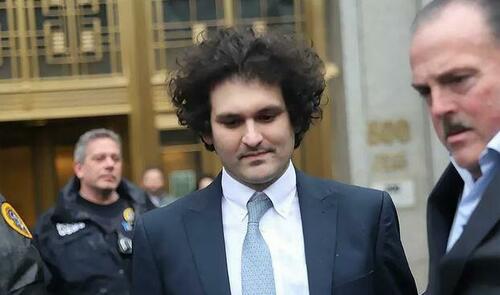
The Hypocrisy of the Sam Bankman-Fried Conviction

Sam Bankman-Fried (SBF), the founder of FTX and Alameda Research hedge fund has been found guilty on all seven counts related to financial fraud and money laundering in a lower Manhattan court room.  The trial took a lot less time than expected as did the jury’s deliberation of the case which speaks to the overwhelming evidence against the onetime financial guru of entertainers, crypto enthusiasts, and politicians.  SBF could face up to 100 years behind bars.

Gary Gensler, chairman of the Securities and Exchange Commission, said that “Sam Bankman-Fried built a house of cards on a foundation of deception while telling investors that it was one of the safest buildings in crypto.”*  Manhattan U.S. Attorney Damian Williams concurred, calling Bankman-Fried’s actions “one of the biggest financial frauds in American history.”**

SBF’s conviction is particularly fitting since he had marketed himself as a new-style capitalist who was more interested in philanthropy and giving away his wealth, instead of enriching himself.  That so many were taken in by this charlatan, especially a number of supposedly savvy investors, demonstrates again that greed remains a significant part of the human condition. 

While SBF will hopefully receive his just rewards for his wrongdoings, there is another fraud that has been taking place in the financial world for quite some time which dwarfs exponentially the scam of the one-time “crypto-king.” Unlike SBF, however, this entity continues to exist and faces no prosecution, but instead is often praised for its operations.

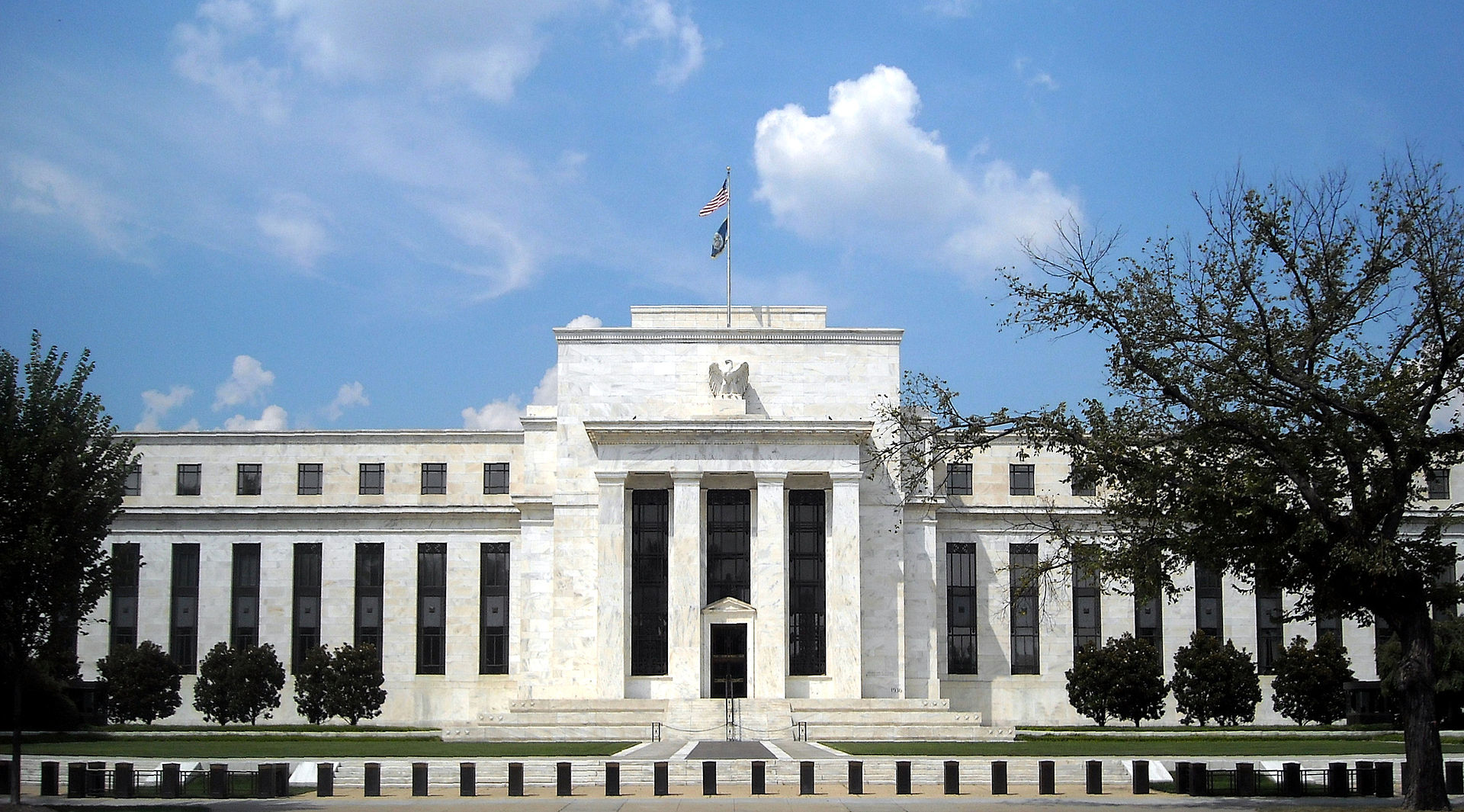
The institution, of course, is the Federal Reserve and, for that matter, all central banks.  Central banks do what FTX did but on a colossal scale.  While SBF’s crimes were limited to those who foolishly invested with him, the Fed’s customers are all those who hold dollars and have little option to not use them unless they want to revert to barter and become desperately poor.  Like what SBF did to his investors, the Fed has defrauded (although surreptitiously) its “customers” by robbing them of their purchasing power through monetary debasement.  The loss of purchasing power by the public has been redistributed to the Fed, the political class, and financial elites. 

The Federal Reserve

While Fed officials, the government, academia, and the sycophantic financial press may try and obfuscate the matter, the fact remains that the Federal Reserve has the ability to create money out of thin air and without limit.  It is counterfeiting writ large.  No criminal, be it SBF, Bernie Madoff, or the Mafia could ever dream of such a scenario! 

The Fed’s creation of money through credit expansion is certainly more subtler than the swindling which SBF engaged in or what took place in earlier times from “coin clipping,” but the criminality of the action is the same.  Under Western jurisprudence, however, central banking is now enshrined in law as a legitimate part of financial life.

As SBF wrapped himself in an aura of a benevolent and charitable new-age businessman, the Fed hides behind its criminality by presenting itself as a necessary and indispensable factor for the nation’s economic well-being.  Without the Fed and its dual mandate of “price stability” and full employment, the economy would collapse. 

Yet, this is a ruse.  Before the advent of central banking, economic life went about quite nicely.  It was only when central banks appeared that the dreaded boom and bust cycle became more frequent and severe.  Moreover, in the pre-central bank era, the world was on a metallic monetary standard which protected peoples’ purchasing power.

The Fed was created by the major U.S. banks and top politicos at the time to allow banks to counterfeit without facing the consequences of their actions.  Stable prices and low unemployment are secondary functions of the Fed and mostly spoken about for public relations.  Protection of the system, especially the solvency of the Big Banks and now funding the national government through debt monetization, remains the prime responsibility of the Fed. 

This, of course, is not to exonerate SBF.  Why is it though that the laws which convicted the rogue crypto financier are not applied to America’s central bank?  When sovereigns of the past debased the money supply most acknowledged its immorality and pointed out who benefited.  In this supposed enlightened age where “equal justice before the law” is a ruling mandate of the legal system, its application apparently does not apply to the monetary authorities of the world.

Capitalism, at its core, is a moral argument where respect for property rights, the freedom to exchange, honest money, and the liberty to become an entrepreneur are the foundations which the system rests.  Those who legitimately satisfy consumer tastes and demand are rightly rewarded.  Naturally, in doing so, entrepreneurs enrich themselves but they do so by providing for the needs of their customers and in the process create jobs and incomes for those they employ, all of which is done on a voluntary basis. 

Central banking is the essential instrument of “crony capitalism” which is the antithesis of free enterprise.  Crony capitalism is a new version of mercantilism which was condemned by the likes of Adam Smith and was one of the factors why the American Revolution was fought.  It has since come back with a vengeance.

Besides the immorality of central banking, the Fed’s manipulation of the money supply has deleterious effects on economic life. Inflation hurts the poor and the working class disproportionately while the Fed’s control of interest rates and credit is the reason for the dreaded business cycle.

The present age has prided itself in its efforts to attain justice in regard to race relations, the environment, economic equality, and now gender recognition.  Yet, the immorality of central banking remains and while Sam Bankman-Fried may be incarcerated, social justice warriors (as well as conservatives) willfully ignore the counterfeiting elephant in the room.  Until central banking is outlawed, a truly just social order is an impossibility.

*https://www.zerohedge.com/political/sam-bankman-fried-found

**https://nymag.com/intelligencer/2022/12/sam-bankman-fried-has-been-arrested.html

Antonius Aquinas@AntoniusAquinas

https://antoniusaquinas.com

What Tucker Carlson and the Pro-Life Movement Miss about Abortion

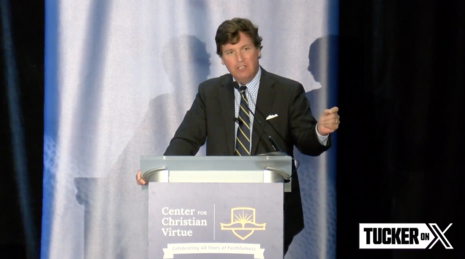
In a recent talk to the Center for Christian Virtue, Tucker Carlson railed against abortion asserting that it is “no benefit to society” and “it erode[s] its very foundation.”*  The former Fox News anchor called the battle over infanticide not a “political debate,” but a “spiritual battle.”**  The speech comes as the issue of abortion has heated up in the Republican presidential campaign.

Carlson is certainly correct in his assessment that the fight over abortion is a spiritual struggle, but he, like most of the pro-life movement, does not understand the larger tragedy of abortion.  The failure of the pro-life movement to stress this fundamental aspect, and to see abortion in the light of eternity, is one of the reasons why the evil is still a legalized part of the so-called civilized world.

While the killing of the unborn is a crime, a greater injustice of that heinous offense is committed.  Most Christians, including presumably Tucker Carlson (who was brought up Episcopalian) and the Center for Christian Virtue, would agree that one must be baptized to have a chance at salvation.  Abortion denies that opportunity.  Unbaptized infants neither go to heaven or hell, but to the “limbo of the children” where they do not suffer the pains of hell, but neither can they receive the beatific vision.

Abortion is not only the killing of the unborn, which is heinous in its own right, but it denies one from entering heaven.  If this aspect had been emphasized from the start, it may have mobilized even greater public and judicial support to outlaw the abominable practice.

Tucker Carlson’s Christian priorities are also skewed as he states:

The point of life is to have children and to watch

them have grandchildren.  Nothing will bring you

joy like that will.  Nothing comes close.  Would

trade your job for your children?  Would you trade                                                

anything for your children?  Of course not.***

The point of life is to save one’s soul and, as the Divine Savior taught, this is done by loving God with “thy whole heart, and with thy whole soul, and with thy whole mind” and loving “thy neighbor as thyself.”

Christ is very clear about those who put either parents or children above Him:

He that loveth father or mother more than

me, is not worthy of me; and he that loveth

son or daughter more than me, is not worthy                                                

of me.  [Matthew 10: 37]

Of course, children are precious gifts from God who add enjoyment and fulfillment to one’s life for those who can have them.  Children, however, are sinners and are in need of nurturing and instruction in how to live a moral life.  Sadly, despite the efforts and best intentions of parents, some children turn out badly. 

The fact that abortion is now a part of the political discourse demonstrates just how far the natural authority figures and institutions of society have failed in fulfilling their roles as moral guideposts.  Yet, this was bound to happen with the increased power of the state in all aspects of society, usurping the role that the family (and its extension – uncles, aunts, grandparents), churches, ministers, arbitrators, employers, philanthropists and scholars once held.  Where at one time ethical matters were discussed and decided outside of the state apparatus, now nearly every personal decision is subjected to government interference which has become the supreme arbitrator of what is moral and what is not.

That society’s non-governmental authority elements have little clout is also a factor in why most young people do not have much of a moral compass in how to conduct their lives and are susceptible to support the most debauched aspects of society. 

The left has long recognized this and has used the state to push through their agenda on all sorts of social and economic issues.  Using the levers of the state, a small, determined minority can impose its will on an unorganized majority.  This is another argument as to why pro-lifers should be for radical political de-centralization and the restoration of natural authority in society.    

Ultimately, the eradication of legalized abortion will not come via politics.  Instead of political wrangling, what should be made clear to the pro-abortion crowd is the real eternal consequences of their actions where the Divine Judge, who is not subject to legislative interference or some perverted, phony “right to choose” nonsense, will deliver perfect justice.

*https://www.zerohedge.com/political/watch-tucker-carlson-spits-fire-anti-abortion-speech

**https://www.breitbart.com/politics/2023/09/26/tucker-carlson-abortion-not-political-debate-spiritual-battle/

***Ibid.

Antonius Aquinas@AntoniusAquinas

https://antoniusaquinas.com

President Trump’s Role in the Ukraine War

With his usual braggadocio, former President Donald Trump has promised that if returned to the White House he would end the Ukraine conflict within hours and claims, as many of his supporters do, that the war would never have taken place had he been in office.  Like most of his campaign promises during his 2016 presidential run – drain the swamp, pull troops out of Afghanistan, build a wall – very few were accomplished, despite the fact that the former president had a Republican House and Senate at the start of his first term.

Listening to Trump’s often incoherent statements on the Ukrainian imbroglio shows that the ex-chief executive has learned little from his four years in the Oval Office.  While talk of ending wars in a few hours may garner popular support, translating them into actual results is a far different and, to say the least, difficult matter, as Trump should now realize after his fruitless years as president.

Trump had a chance to de-escalate tensions in the Ukraine that had been building especially after the Western-inspired coup of February, 2014 which replaced the democratically-elected government of Viktor Yanukovych.  Yet, the former president did nothing to remedy the situation and, in fact, worsened matters by providing military hardware to the Ukraine, which the Obama Administration had denied.

Demonstrating a lack of understanding of the region’s geo-political realities, Trump decided to provide the Ukraine with military equipment.  In December, 2017 the U.S. shipped, among other weaponry, Javelin anti-tank missile systems, with the first sale completed in March of the following year to the sum of $47 million.  Reportedly, the former president was convinced by his advisors that the military aid would be “good for U.S. business.” 

If one considers the military industrial complex a vibrant part of the U.S. economy and not a parasitical drain that redistributes scarce resources away from the production of useful consumer goods into the creation of destabilizing and murderous weapons of war, then – “yes” – military spending is good for business.  For those, like Trump, who support such an idea are apparently unfamiliar with Brigadier General Smedley D. Butler who rightly called “defense spending” a racket:

I spent 33 years in the Marines, most of my time being a high-class muscle man for big business, for Wall Street and the bankers.  In short, I was a racketeer for Capitalism.*

After the provocative action of supplying the Ukraine with military hardware, the Trump Administration inflamed relations further by pulling out of the Intermediate-Range Nuclear Forces Treaty (INF) which was agreed to by President Ronald Reagan and Soviet leader Mikhail Gorbachev in 1987. The landmark treaty banned missiles with range between 500 and 5,500 km (310-3,400 miles).**

The U.S. accused Russia of non-compliance to the terms of the treaty, a charge that the Russians and many military analysts denied.  This, of course, led to a greater level of distrust between the two nations and went against candidate Trump’s aims of lessening tensions between the two powers.

Trump, as with the pro-war Western media, is ignorant of the historical context that played into Vladimir Putin’s decision to invade the Ukraine.  It is a well-established fact that the U.S. and Western powers gave assurances to Russia as far back as when the Berlin Wall came down that NATO would not expand eastward.  That promise has been repeatedly broken as NATO now includes 31 nations with Sweden set to come on board in 2024.***

Making matters worse, the Biden Administration, the war mongers in Congress, and the U.S.’s NATO lapdogs have escalated matters with tremendous financial and military assistance, which has done little to stop the Russians, but has resulted in the needless slaughter of thousands and the wholesale destruction of Ukrainian territory.  The introduction of cluster bombs into the fray and the promise of F-16 fighter-jets capable of carrying nuclear war heads has heightened the possibility of a general conflagration. 

 None of the declared Republican presidential contenders have critiqued the former president’s reckless Ukrainian policy.  Some of the candidates (Chris Christie, Nikki Haley) have instead insanely called for greater support of the Zelensky regime!    

The American involvement in the Ukrainian War has nothing to do with its national security, but with the interests of the U.S. Empire.  The tragedy of the Trump Presidency is that things were supposed to be different.  Instead of non-intervention, the Administration armed Ukraine, stationed troops in Syria, assassinated an Iranian general on a Middle East peace mission, and committed a host of other head scratching acts which went against candidate Trump’s pledge of an “America First” foreign policy that propelled him to victory in 2016.

To think that things will be different in a second go-around is clearly delusional, as the former president is now campaigning with never-ending war proponent Senator Lindsey Graham.   

*See War is a Racket, Port Townsend, WA.: Feral House, 2003; 1935.

**“INF Nuclear Treaty: US Pulls Out of Cold War-Era Pact With Russia,” BBC, 2 August 2019.   https://www.bbc.com/news/world-us-canada-49198565

***Patrick Wintour, The Guardian, 22 January 2022 ttps://www.theguardian.com/world/2022/jan/12/russias-belief-in-nato-betrayal-and-why-it-matters-today

Antonius Aquinas@AntoniusAquinas

https://antoniusaquinas.com

“Don’t Buy Government Bonds”

As another farcical “debt-ceiling raising” saga unfolds, conducted by the two indistinguishable political parties hell-bent on driving America into economic ruin, it would be instructive to look at how some earlier conservative/libertarian thinkers viewed public debt.  Unlike the present generation – with the notable exception of Ron Paul – these intellectuals asked fundamental questions about such matters as debt, taxation, central banking, and foreign policy.

One of the leading lights of what was known as the “Old Right” of the 1950’s, which opposed the Cold-War globalism of the likes of William Buckley and domestically sought to overturn the New Deal, was Frank Chodorov (1887-1966).  In his books and essays, Chodorov challenged the pillars which social democracy rested and sought to return America to small government, free trade, and “isolationism.” 

In one of his provocative essays, Chodorov pervasively argued that those who purchase public debt are complicit in the enhancement of state power.  Unlike many present-day economists who only see the baneful economic effects of profligate government borrowing, he makes a moral case against debt financing.*

He points out that public borrowing burdens future generations for the benefit of the present.  Despite reasons often given for the necessity of borrowing – war, natural disaster, infrastructure, etc., – Chodorov contends that the practice of shifting the cost to later generations, whatever the reason, is unjust:

This is exactly what you do when you
cooperate with the State’s borrowing
program. You are loading on your children
and your children’s children an obligation to
pay for something they had no voice in, and
for which they may not care at all. Your
‘investment for posterity’ may earn you
nothing but the curses of posterity.

Chodorov understood, as most commentators do not today, that a gold-backed currency restrained State largesse: “When money was redeemable in gold, the inherent profligacy of government was somewhat retrained; for, if the citizen lost faith in his money, or his bond, he could demand gold in exchange, and since the government did not have enough gold on hand to meet the demand, it had to curtail its spending proclivity accordingly.”

It was Franklin Delano Roosevelt’s despicable and criminal act of taking the U.S. off the gold standard domestically that led to the expansion of the public debt as Chodorov describes: “. . . Mr. Roosevelt removed this shackle and thus opened the flood gates.  The only limit to the inclination of every politician to spend money, in order to acquire power, is the refusal of the public to lend its money to the government. . . . the government can then resort to printing of money, to make money out of nothing. . . .” 

Not realized at the time, but the ability of the American government to expand its revenue base fit nicely into FDR’s later nefarious foreign policy objectives. 

Chodorov’s viewpoint on public debt can also easily be applied to FDR’s decision to eradicate the gold standard through which the U.S. currency could be redeemed for precious metals.  FDR’s act, however, was a “violation of contract” with American citizens since the U.S. government defaulted on its obligations.

In Orwellian fashion, the verbiage used with most government operations is often misused to legitimize State functions.  “Investment” is one such term that has been corrupted in relations to spending and debt.

In promoting their spending schemes, politicians will often use the term investment, “investment in education,” “investment in infrastructure,” etc.  This is deliberate, since it tries to equate government spending with a vital component of the market process.

In a market economy, investment means the lending of savings, which is used to expand and/or start an enterprise.  In return, the lender receives a stock or a bond.  If the business is successful, the lender’s investment will receive a return – dividends from a stock or interest from a bond.  Business investment is, therefore, a necessary aspect of capitalism which results in economic growth and increased living standards.

As Chodorov incisively points out, however, government investment is the antithesis of what takes place in the marketplace:  

The State, however, does not put your money into production.  The State spends it – that is all the State is capable of doing – and your savings disappear.  The interest you get comes out of the tax fund, to which you contribute your share, and your share is increased by the cost of servicing your bond.

Chodorov’s solution to deficit financing was not to buy government bonds.  While this would certainly be a step in the right direction, a more radical approach is needed since the problem has now become so immense. 

Simply put: there should be a prohibition on government borrowing of any kind.  State revenues should only come through tax receipts and fees paid by those in the present.  This would completely eliminate the “moral hazard” of debt financing and drastically reduce the size and scope of government over society.

For those who seek to put an end to the current debt-ceiling charade and rectify the immoral practice of burdening future generations by the irresponsibility of the present, the works of Frank Chodorov are essential.

* “Don’t Buy Government Bonds,” The Mises Institute, 13 January 2011. https://cdn.mises.org/Out%20of%20Step_4.pdf

Antonius Aquinas@AntoniusAquinas

https://antoniusaquinas.com