
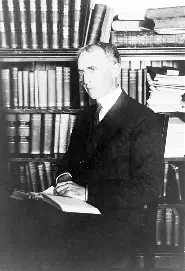
CHARLES AUSTIN BEARD, 1874-1948
Charles Beard was born in Knightstown, Indiana on November 27, 1874 in the heart of the state’s corn belt. By the close of his life in 1948, Beard was considered the foremost American historian of the first half of the 20th century, and his works and life still receive discussion to this day. [1]
Beard is mostly remembered for his iconoclastic study, An Economic Interpretation of the Constitution of the United States. In addition, and sometimes with his wife, he wrote a series of books on American and European history and was awarded a number of prestigious academic honors and appointments, including a position on the editorial board of the Political Science Quarterly and president of the American Historical Association in 1933, where he delivered his famous address, “Written History as an Act of Faith.”
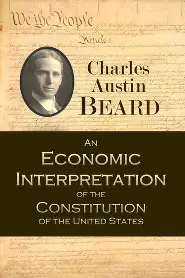
The importance of his book on the Constitution is recognized to this day, as it was one of the first studies to demonstrate that there was more to the making of the document than the founding fathers’ attempt to “form a more perfect union.” Beard contended that the system of government that they created was also highly favorable to their financial interests.
An Economic Interpretation of the Constitution remains relevant today for it opened the door to later critiques of the Constitution and the republic that it established, which is now burdened by trillions of dollars in debt and has become a worldwide empire interfering in the lives of countless people. Despite the founders’ failure to produce a long-lasting, limited federated system of government, the Constitution is still beloved and treated as Holy Writ by most conservatives and, surprisingly, many libertarians.
Beard’s view on the Constitution raised quite an uproar among his colleagues and the political class at the time. How could anyone not see the altruistic motives of the document’s framers, who sought to do what was only best for the American people?
Beard’s interpretation of the Constitution eventually gained grudging acceptance among the historical establishment. However, his opposition and exposition of the bellicose foreign policy of the Franklin Roosevelt administration prior to World War II has been mostly ignored. Yet, his books and articles on foreign policy, which have proven over time to be highly prescient, should, like An Economic Interpretation of the Constitution, receive equal if not more attention, given the chaotic state of the world due mostly to the actions of the United States.
THE MAKING OF A REVISIONIST
Beard fell in line with most of academia, and was an ardent supporter of American intervention in World War I. It would not be until the early years of the 1920s that Beard changed his view. This shift set him on a course to become a prominent voice of non-interventionist American foreign policy in the years to come.
Although he eventually adopted the Revisionist position on World War I, it was surprising that he was not skeptical from the outset of U.S. participation in it, and did not see that it was more than just “making the world safe for democracy.” His book on the Constitution showed that the protection of the financial interests of the framers played an overlooked role in the political system they created. If the Entente Powers lost, or if there was an unfavorable settlement, it was widely believed at the time that American financial interests, which had invested heavily in the Allied cause, would suffer tremendous losses.
While Beard came over to the anti-interventionist camp, like many of his fellow Revisionists, he did not see the decisive role that ideology played in Woodrow Wilson’s fateful decision. It was the president’s contempt of Austria-Hungary – at the time one of the last vestiges of Christendom and aristocratic governance, in general, versus the democratic nation-state which America embodied – that drove Wilson to intervene, despite no existential threat to America’s national security.
The eminent anti-egalitarian social critic Erik Ritter von Kuehnelt-Leddihn describes this crucial aspect of America’s 28th president:
Austria was far more wicked than Germany. It existed in
contradiction of the Mazzinian principle of the national state, it
had inherited many traditions as well as symbols from the Holy
Roman Empire . . . its dynasty had once ruled over Spain . . .
it had led the Counter-Reformation, headed the Holy Alliance,
fought against the Risorgimento, suppressed the Magyar
rebellion under Kossuth . . . and morally supported the
monarchial experiment in Mexico.
Kuehnelt-Leddihn continues:
Hapsburg – the very name evoked memories of Roman
Catholicism, of the Armada, the Inquisition, Metternich,
Lafayette jailed at Olmütz, and Silvio Pellico in Brünn’s
Spielberg fortress. [2]
“Such a state,” Kuehnelt-Leddihn asserts, “had to be shattered, such a dynasty had to disappear.” [3]
Despite his pro-war views and before he became a Revisionist, Beard was outspoken in defense of the free speech rights of those who opposed U.S. participation in the war. For this unpopular stance, the historian was criticized in the press and even at Columbia University, where he taught. To his outrage, Beard was required to explain his views to a hostile Columbia board of trustees.
The acrimony between the school and Beard escalated when, in 1917, after the United States had entered the war, Columbia fired two anti-war professors, James McKeen Cattell and Henry Wadsworth Longfellow Dana. [4]
Despite America’s participation in the war – which Beard pushed for – he, nevertheless, defended Cattell and Dana. He realized the hypocrisy in “fighting to safeguard democracy and America’s cherished liberties,” yet one of the nation’s leading universities was persecuting two of its members for expressing their right of free speech. Still, Beard did not change his position on the war, although he may have begun to have doubts.
The dismissal of Cattell and Dana was the final straw for Beard. He resigned his position in protest, ending his contentious tenure at Columbia, never again to return to academia. The incident showed that the nation’s leading educational establishments had long been propagandists for the U.S. government with the sycophancy only accelerating as the years have passed.
The affair reveals the type of person that Beard was, and which he would show over the course of his life. Despite the attacks by the press, academia, and politicians, the historian displayed great courage in sticking to his convictions. Very few of his stature have stood up for their principles as Beard did, especially if one looks at the recent “Covid-19 epidemic,” where hardly any of those who knew better tried to stop the insanity that was taking place.
One of the first works that set Beard on his Revisionist path was the extremely influential series of articles by Sidney B. Fay that appeared in the American Historical Review in 1920. It eventually became part of his book Origins of the World War (1928). Fay was one of the first to look at the diplomatic documents of Austria, Germany and Russia (which the Bolsheviks happily supplied) that provided a much-needed balance to the one-sided Allied account of how hostilities began.
They showed that the Allies were just as culpable for the war’s outbreak as the Central Powers. Such a revelation undermined the “war guilt” clause of the Versailles Treaty which placed the blame for the conflict’s outbreak solely on Germany.
In his must-read biography of Beard, Richard Drake wrote of the impact of Fay’s work on the historian’s thinking:
Fay’s articles successfully challenged the conventional picture
of France, England and Russia as purehearted innocents fiendishly
set upon by the congenitally sinister Germans, as the Treaty of
Versailles, with excessive compression about the conduct of the
victors, presented matters in the clause assigning full and eternal
blame to the defeated foe. [5]
The enormously influential British author John Maynard Keynes, whose economic theories continue to be followed by policy makers to this day, wrote a truthful account of the Versailles Treaty entitled The Economic Consequences of the Peace (1919). Keynes understood the grave injustice of the settlement which he compared to what Rome did to Carthage after the Punic Wars. The economist predicted that Germany would be turned into an economic basket case, and that another war would most likely be to reverse the humiliation of the treaty.
Beard believed that The Economic Consequences of the Peace was “the definitive analysis of the postwar settlement,” and “that the war had been about the furtherance of militarism and imperialism, not their extinction.” [6]
By 1922, Beard had almost come full circle to a Revisionist viewpoint on the war. In a speech given at Amherst College, the historian dismissed the Allied propaganda of German militarism and its autocracy as a cause for the war and instead pointed to the devastating archival evidence that showed that all the belligerents had driven “Europe into the abyss.” The war was “motivated by the same lust for strategic and economic advantage, with no scruples at all regarding the means to attain them.” [7]
In his speech, America, too, was blamed for its own form of imperialism and war profiteering. While Beard did not allude to it, later research would show that, even before its official declaration of war, the Wilson administration was deeply involved behind the scenes prolonging the conflict when a settlement could have been reached with the pre-war political landscape salvaged. The president’s promise to the Allies that he would get the country into the war after his 1916 re-election not only meant more slaughter and destruction, but the end of the old political order – a goal Wilson wanted to see through. [8]
BEARD AND BARNES
By the time Harry Elmer Barnes’s The Genesis of the World War was published in 1926, Beard was firmly in the Revisionist camp. Like Beard, Barnes had supported U.S. intervention and Wilson’s decisions throughout the conflict. Later, he, too, had become convinced of the president’s duplicity and the Allied guilt in igniting the conflagration after reading the first wave of Revisionist scholars. This included Keynes, Fay, Raymond Beazley, Edmund Dene Morel, and Max Montgelas. [9]
Barnes was quite forward in his denunciation of Wilson, calling his pledge to keep the United States out of the war a deliberate lie. He also noted the hypocrisy of one of the president’s reasons for entering the conflict: “The German submarine warfare was a legitimate retaliation against the British violations of international law . . . against which Mr. Wilson refused to protest with adequate persistence and firmness.” [10]
Beard and Barnes would grow closer in the following decade, as both saw the actions of the FDR administration leading the country into another conflagration. Barnes did not take any classes from Beard during his studies at Columbia, where he earned his Ph.D. in 1918. It is likely, however, that Beard was “the highly competent critic who prefers not to be mentioned by name” whom Barnes referred to in his acknowledgements to the Genesis of the World War. [11] Beard was a keen observer of the developments in Yugoslavia and had written The Balkan Pivot in 1929.
Both great scholars were in agreement on why America became involved in the struggle, the role of the Allies in starting the conflagration, and the draconian Treaty of Versailles that they, along with a number of others, believed would lead to another war. “Beard shared unreservedly Barnes’s Revisionist views” writes Richard Drake, “of the war’s origins and America’s involvement in it. Thereafter, they would reinforce each other’s arguments about these two subjects.” [12] Both saw that:
America’s intervention had absolutely nothing to do with the
president’s assurance about how the country would be
making the world safe for democracy and everything to with safeguarding
the investments of American bankers and financiers in the Allied cause. [13]
While financial considerations were certainly a cause, it was the former Princeton political science professor’s fanatical desire to transform what was left of the Christian hierarchical social order of the Old World to his liking that brought America into the war.
While An Economic Interpretation of the Constitution would remain his most notable achievement among academia and the reading public at large, it was World War I that had the most profound impact on Beard’s life as he saw it as “the greatest calamity ever to befall Western civilization.” He would “spend the rest of his life trying to identify the tragic flaw that had caused Europe’s downfall, and to understand the American side of the horrific story.” [14]
BEARD AND WORLD WAR II
Prior to his two masterful studies on FDR’s foreign policy– American Foreign Policy in the Making, 1932-1940 (1940) and President Roosevelt and the Coming of the War, 1941 (1948) [15] – Beard spent most of his later scholarly years aimed at keeping the United States from making the same mistake as it did in 1917. His theoretical endeavors such as A Foreign Policy for America and advocacy of “continentalism,” were outlining a theoretical program of neutrality.
In Giddy Minds and Foreign Quarrels, published, ironically, in September 1939 with the start of what would become WWII, Beard sketches the history of U.S. foreign policy from the time of George Washington to Theordore Roosevelt. The nation decidedly remained neutral, at least in regard to overseas affairs. Of course, the U.S. government had no qualms about making war on its own citizens when the South valiantly attempted to secede from the Union, or the many incursions that it made in Latin America with its relentless drive to remove Spain’s political presence from the Western Hemisphere.
Beard describes this period of what he called that “’wonderful’ century of ‘peace, religion, and international good faith’:”
[T]he Government of the United States kept aloof from the
aggressions, wars, and quarrels of Europe. It proposed no
world conferences for correcting the wicked, settling conflicts,
and curing unrest in the four corners of the earth. From time to
time, it is true, groups of American people held meetings in
favor of one country or party or another, but even they did not
try to force their Government to play the role of universal
preceptor and manufacturer of rules for settling everybody and
everything under threats of armed intervention. [16]
In one of the few acknowledgements by the historian that ideas have a transformative effect on history, [17] Beard contends that the end of an America First foreign policy came in the 1890s led by the ideology held and eventually spread by four individuals: Alfred Thayer Mahan, Theodore Roosevelt, Henry Cabot Lodge, and Albert J. Beveridge. “These [four] were,” in Beard’s eyes, “the chief manufactures of the new doctrine correctly characterized as ‘imperialism for America,’ and all of them were primarily phrase-makers. . . .” [18]
Whether Beard realized it or not, it was ideology which also made the “wonderful century” that he so esteemed. The dominant idea that shaped the era was anti-statism with its components of laissez-faire, trade and commerce with all, non-interventionist foreign policy, and a monetary system based on hard money. The American Revolution and later the War for Southern Independence were decentralization movements which sought to break away from larger political entities – the British Empire and the U.S. federal government.
In the American Revolution, the ideas of Locke, Jefferson, the Englishmen John Trenchard and Thomas Gordon’s Cato Letters, among others, inspired the colonists. [19] American Southerners voiced the same arguments as their forefathers did in their valiant effort to secede from the North.
Unfortunately, a conservative backlash quickly ensued, and the decentralized anti-statist mentality that drove the American Revolution was replaced by the adoption of the Constitution which created a powerful central government and destroyed much of the autonomy that the individual states enjoyed under the Articles of Confederation. Beard saw as much in his own analysis of what took place in Philadelphia in 1789.
In Giddy Minds and Foreign Quarrels and throughout his works in the 1930s, Beard chronicled each bellicose foreign policy step that the Roosevelt Administration took making it inevitable that war would not be avoided: massive armament spending, the provocative 1937 “quarantine speech,” the institution of a peacetime draft, the freezing of Japanese assets, the undeclared war on German ships and submarines, etc. All of this led to an unmistakable conclusion as Beard incisively states in Giddy Minds and Foreign Quarrels:
President Roosevelt’s foreign policy is clear
as daylight. He proposes to collaborate actively
with Great Britain and France in their everlasting
wrangle with Germany, Italy and Japan. He wants
to wring from Congress the power to throw the
whole weight of the United States on the side of
Great Britain and France in negotiations, and in
war if they manage to bungle the game. That
using measures short of war would, it is highly
probable, lead the United States into full war
must be evident to all who take thought about such tactics. [20]
Beard, of course, did not just stop with a critique of FDR’s reckless foreign policy activities, but proposed a sensible and proven alternative that would ensure peace and prosperity for Americans, which is still applicable to this very day:
It is the doctrine formulated by George Washington . . .
and followed . . . [by] the United States until near the
end of the nineteenth century, when the frenzy for
foreign adventurism burst upon the country. This
doctrine is simple. . . . We should promote commerce,
but force ‘nothing.’ We should steer clear of hates and
loves. We should maintain correct and formal relations
with all established governments without respect to
their forms or their religions. . . . [21]
While many modern-day conservatives and neocons talk incessantly about their admiration for the nation’s founding fathers and the system of government they set up, almost all never speak of the founders’ views on foreign policy, despite the historical evidence of its overall beneficial effects, as Beard notes:
This policy was stated positively in the early days of our
Republic. It was clear. It was definite. It gave the powers
of the earth something they could understand and count
upon in adjusting their policies and conflicts. It was not
only stated. It was acted upon with a high degree of
consistency until the great frenzy overtook us. [22]
While the vast majority of Americans at the time saw the U.S. involvement in World War I as an aberration and agreed with Beard and his fellow “isolationists” about keeping the nation neutral, the cunning Roosevelt was doing everything in his power to provoke an attack. Pearl Harbor shattered forever Beard and the country’s hopes of an America dedicated to commerce and peaceful co-existence.
CONCLUSION
Why should Charles Beard be remembered today?
While Beard’s debunking of the still lauded U.S. Constitution is important for those who consider the document severely flawed and the basis for the nation’s current political, economic, and social woes, more important are his works on foreign policy, as America is now, more than ever, engaged in conflicts the world over. The cost of maintaining U.S. hegemony is bankruptcy at home and the distinct possibility of igniting WWIII.
Like his friend Harry Elmer Barnes, Beard had hoped to bring “history in accord with the facts” which is why his life should be studied and become a model for those who hope to bring sanity to American foreign affairs.
ENDNOTES
[1] In 2013, there were a number of academic conferences dedicated to the centenary publication of Beard’s An Economic Interpretation of the Constitution of the United States.
[2] Quoted in Hans-Hermann Hoppe, Democracy The God That Failed: The Economics and Politics of Monarchy, Democracy, and Natural Order, New Brunswick (U.S.A.): Transaction Publishers, 2001, p. x.
[3] Ibid.
[4] Richard Drake, Charles Austin Beard: The Return of the Master Historian of American Imperialism, Ithaca: Cornell University Press, 2018, pp. 36-37.
[5] Drake, Charles Austin Beard, p. 53.
[6] Ibid., p. 55.
[7] Ibid.
[8] For the extension of the war, see Jim MacGregor & Gerry Docherty, Prolonging the Agony: How the Anglo-American Establishment Deliberately Extended WWI by Three-and-a-Half Years, Walterville, OR.: Trine Day LLC., 2018.
[9] Drake, Charles Austin Beard, p. 64.
[10] Quoted in Drake, Charles Austin Beard, p. 65.
[11] Ibid., p. 64.
[12] Ibid., p. 65.
[13] Ibid.
[14] Ibid., p. 67.
[15] See the reviews of both books in The Barnes Review, March/April, 2020 and July/August, 2018.
[16] See, Charles A. Beard, Giddy Minds and Foreign Quarrels: An Estimate of American Foreign Policy, New York: The Macmillan Company, 1939, p. 12.
[17] Drake, Charles Austin Beard, p. 76.
[18] Beard, Giddy Minds and Foreign Quarrels, p. 16.
[19] See, Bernard Bailyn, The Ideological Origins of the American Revolution, Cambridge, Massachusetts: The Belknap Press of Harvard University Press, 1967.
[20] Beard, Giddy Minds and Foreign Quarrels, p. 57.
[21] Ibid., pp. 65-66.
[22] Ibid., pp. 66-67.
Antonius Aquinas@antoniusaquinas
https://substack.com/@antoniusaquinas


